For sawmills, pallet shops, flooring manufacturers, and firewood producers, moisture is money. Green lumber can sit in a yard for a year or more waiting to air dry, tying up inventory, yard space, and working capital the entire time. A lumber kiln compresses that timeline from months to days and turns rough green stock into a premium, stable, sellable product on your schedule. The challenge is that a commercial kiln is a serious capital investment, often running from tens of thousands of dollars for a compact dehumidification unit to well over half a million for a high-capacity conventional or vacuum system. That is exactly where lumber kiln financing comes in: it lets you put the equipment to work now, generate revenue from kiln-dried inventory immediately, and spread the cost over predictable monthly payments that match the cash the machine produces.
This guide covers everything a business owner needs to know about financing a lumber kiln, from the types of kilns you can finance and what they cost, to qualification requirements, loan structures, real-world scenarios, and the exact steps to get funded. Whether you run a small specialty sawmill looking at your first dry kiln or an established operation adding capacity, you will find the numbers and the process laid out plainly below.
In This Article
- What Is Lumber Kiln Financing?
- How Does Lumber Kiln Financing Work?
- Types of Lumber Kilns You Can Finance
- How Much Does a Lumber Kiln Cost?
- Benefits of Financing a Lumber Kiln
- Who Is Lumber Kiln Financing Best For?
- Lumber Kiln Financing vs. Other Funding Options
- Real-World Scenarios
- How Crestmont Capital Helps
- Frequently Asked Questions
- Next Steps
What Is Lumber Kiln Financing?
Lumber kiln financing is a form of equipment financing designed to help wood products businesses acquire dry kilns without paying the full purchase price upfront. A lender provides the capital to buy the kiln, and you repay the amount over a fixed term, typically 24 to 84 months, with the kiln itself serving as collateral for the loan. Because the equipment secures the transaction, approval standards are often more flexible than they would be for an unsecured loan, and rates are generally lower than unsecured alternatives.
The category covers every major kiln type used in the wood industry: conventional steam kilns, dehumidification kilns, vacuum kilns, solar-assisted kilns, and heat-treatment kilns used for ISPM 15 export compliance on pallets and wood packaging. It also extends to the related equipment that makes a kiln operation functional, including kiln carts and track systems, moisture meters and computerized controls, boilers, fans, baffles, and in many cases the insulated chamber or building itself when it is purchased as part of an equipment package.
For most borrowers, lumber kiln financing takes one of two forms. The first is an equipment loan, where you own the kiln from day one and the lender holds a lien on it until the final payment. The second is an equipment lease, where the financing company owns the equipment and you pay for its use, usually with an option to purchase it at the end of the term for a nominal amount or fair market value. Both structures convert a large capital outlay into a manageable operating expense, and both are widely used by sawmills and wood manufacturers of every size.
What makes this financing category distinct is the asset itself. A lumber kiln is not a discretionary purchase. It is a production asset that directly increases the value of every board that passes through it. Kiln-dried lumber commands a meaningful price premium over green or air-dried stock, often adding hundreds of dollars per thousand board feet, and it opens doors to customers such as flooring mills, cabinet shops, and exporters who will not accept material that has not been dried to a verified moisture content. Lenders understand this revenue logic, which is why well-prepared kiln financing applications tend to move quickly.
How Does Lumber Kiln Financing Work?
The mechanics of financing a lumber kiln follow the same broad pattern as other equipment financing, with a few industry-specific wrinkles. Understanding the sequence before you start will save you time and help you avoid the mistakes that slow applications down.
Step 1: Define the equipment package. Before any lender can evaluate your request, you need a specific machine or package in mind. That means choosing a kiln type, capacity (usually expressed in board feet per charge), and manufacturer, then getting a formal written quote from the vendor. The quote should itemize the kiln, controls, carts, and any installation or building work included in the price.
Step 2: Submit a financing application. With the quote in hand, you complete an application that covers your business basics: time in business, annual revenue, ownership structure, and credit history. For most equipment financing under a few hundred thousand dollars, the application itself is short, and many lenders can work from a one-page application plus a few months of business bank statements.
Step 3: Credit review and approval. The lender evaluates your credit profile, cash flow, and the collateral value of the kiln. Because the equipment secures the loan, lenders focus heavily on whether your business generates enough cash to cover the payment, and on the resale market for the kiln if they ever had to recover it. Established kiln manufacturers with strong resale markets make this step easier.
Step 4: Documentation and funding. Once approved, you sign the financing agreement, the lender pays the equipment vendor directly, and the kiln is delivered and commissioned. Your payment schedule begins on the agreed date, usually 30 days after funding. Many borrowers time the funding so the first payment lands after the kiln is already producing dried inventory.
Step 5: Own the asset. On a loan structure, the lien is released when the final payment clears, and you own the kiln outright. On a lease, you exercise your purchase option or return the equipment depending on the terms you selected at signing.
The whole process, from application to funded deal, frequently closes in days rather than weeks for qualified borrowers. The single biggest cause of delay is an incomplete vendor quote, so getting the equipment package nailed down first is the highest-leverage thing you can do to speed up funding.
Types of Lumber Kilns You Can Finance
Not all kilns dry lumber the same way, and the right choice depends on your species mix, production volume, energy costs, and end customers. The good news is that lenders finance the full range of commercial drying equipment. Here are the main categories you will encounter when building your equipment package.
Conventional Steam Kilns
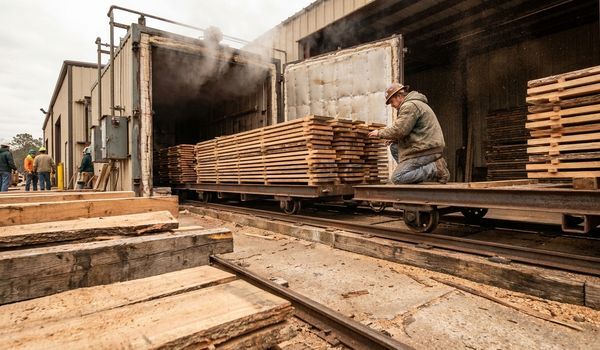
The conventional steam kiln is the workhorse of the commercial lumber industry. These systems use steam-heated coils and powerful fans to move hot air through stickered lumber stacks inside an insulated chamber, with precise control over temperature and humidity throughout the drying schedule. They handle large charges, often 20,000 to 100,000 board feet or more, and dry most species in days to a couple of weeks.
Typical price range (new): A small commercial conventional kiln starts around $50,000 to $100,000, while large, high-capacity installations with boilers, controls, and multiple chambers regularly run $250,000 to $1,000,000 or more.
Dehumidification Kilns
Dehumidification kilns use a refrigeration system, similar in principle to an air conditioner running in reverse, to pull moisture out of the chamber air instead of venting it. They are the most popular choice for small and mid-size operations because they cost less to buy, require no boiler, run on standard electrical service, and are gentler on wood, which reduces drying defects on valuable hardwoods.
Typical price range (new): Compact units for a few thousand board feet per charge start around $10,000 to $30,000, and larger commercial dehumidification systems commonly run $40,000 to $150,000 depending on chamber size and controls.
Vacuum Kilns
Vacuum kilns dry lumber under reduced atmospheric pressure, which drops the boiling point of water and pulls moisture out of the wood dramatically faster than conventional methods. Thick slabs, difficult species, and high-value hardwoods that might take weeks in a conventional kiln can dry in days. The trade-off is capacity and cost: vacuum kilns hold smaller charges and carry premium price tags, but for specialty operations drying high-margin material, the speed pays for itself.
Typical price range (new): Expect to invest $100,000 to $400,000 or more for a commercial vacuum kiln, with the largest continuous vacuum systems exceeding that range.
Solar Kilns
Solar kilns use greenhouse-style collectors to heat the chamber with sunlight, supplemented by fans to circulate air. They are the lowest-cost entry point into kiln drying and have minimal operating expense, but they are slower, weather-dependent, and offer less precise control than powered systems. For small sawmills and woodworking operations drying modest volumes, a well-built solar kiln is a practical first step before graduating to a dehumidification unit.
Typical price range: Purpose-built commercial solar kilns generally run $5,000 to $30,000 depending on capacity, putting them within reach of even the smallest operations.
Heat-Treatment and Firewood Kilns
Heat-treatment kilns serve a regulatory rather than purely drying function: they raise the core temperature of wood packaging material to a certified threshold, typically 56 degrees Celsius for at least 30 minutes, to kill pests and satisfy ISPM 15 international shipping requirements. Pallet manufacturers and exporters need certified heat-treatment capability to sell into export supply chains. Firewood producers use similar kiln systems to dry firewood to sale-ready moisture levels in days and to meet state heat-treatment rules designed to stop the spread of invasive insects.
Typical price range (new): Heat-treatment systems for pallet operations commonly run $30,000 to $150,000, with automated, high-throughput systems priced above that.
Industry Insight: Drying defects are the silent profit killer in lumber operations. A poorly matched kiln or an aggressive schedule can cause checking, warping, and case hardening that downgrade or destroy an entire charge. When you spec your kiln, match the technology to your species and thickness mix first, then size capacity to your monthly volume. Financing makes it practical to buy the right kiln instead of settling for the cheapest one.
Ready to Add Kiln-Drying Capacity?
Put a commercial lumber kiln to work for your business without draining your cash reserves. Our simple application takes just minutes.
Get a Financing QuoteHow Much Does a Lumber Kiln Cost?
Lumber kiln pricing varies widely based on drying technology, charge capacity, level of automation, and whether you buy new or used. The table below summarizes typical ranges for the main categories so you can anchor your budget before requesting vendor quotes.
| Kiln Type | Typical Capacity | New Price Range |
|---|---|---|
| Solar kiln | 1,000 to 5,000 board feet | $5,000 to $30,000 |
| Dehumidification kiln | 2,500 to 30,000 board feet | $10,000 to $150,000 |
| Heat-treatment kiln (ISPM 15) | Pallet loads per cycle | $30,000 to $150,000 |
| Conventional steam kiln | 20,000 to 100,000+ board feet | $50,000 to $1,000,000+ |
| Vacuum kiln | 1,000 to 10,000 board feet | $100,000 to $400,000+ |
Beyond the kiln itself, budget for the supporting equipment and site work that make the system operational. Kiln carts and track, computerized moisture control systems, and forklift capacity to move charges in and out all add to the package. Site preparation, concrete pads, electrical service upgrades, and the chamber building can add 20 to 40 percent to the equipment price on a new installation. Many borrowers fold these soft costs into the same financing package, which is one reason it pays to plan the full project before you apply rather than financing the kiln and paying cash for everything around it.
Used kilns are another way to control cost. Quality dehumidification and conventional kilns hold their value well because the core technology is durable, and a maintained used unit can deliver most of the capability of a new one at 40 to 60 percent of the price. Used equipment financing is widely available for kilns, although lenders typically want details on the machine's age, condition, and the seller, and terms may be slightly shorter than for new equipment.
Benefits of Financing a Lumber Kiln
Paying cash for a kiln is an option if your balance sheet can absorb it, but most growing wood businesses choose financing for reasons that go beyond simply not having the money. Here is what the structure actually buys you.
- Immediate production capability. The kiln starts generating value the day it is commissioned. Every charge of kiln-dried lumber you sell at a premium contributes to covering the payment, so the asset effectively helps pay for itself from month one.
- Preserved working capital. Buying logs, paying crews, and carrying inventory through the drying cycle all require cash. Financing keeps your reserves available for operations instead of locking them inside a capital asset.
- Fixed, predictable payments. Equipment financing locks in a level monthly payment for the full term, which makes budgeting straightforward and protects you from the kind of rate volatility that hits variable-rate credit lines.
- Faster drying cycle, faster inventory turns. Air drying can take a year per inch of thickness. A kiln delivers the same result in days or weeks, which means your inventory investment turns over many more times per year and your yard holds product instead of waiting.
- Access to better customers. Flooring mills, cabinet and furniture makers, exporters, and big-box suppliers typically require kiln-dried material at a verified moisture content. The kiln is your ticket into those higher-margin relationships.
- Potential tax advantages. Depending on how your purchase is structured, financed equipment may qualify for depreciation benefits that improve the after-tax economics of the deal. Your accountant can confirm how current rules apply to your situation.
- Collateral-based approval. Because the kiln secures the financing, businesses that might struggle to qualify for a large unsecured loan can often get approved on the strength of the equipment and their cash flow.
Lumber Kilns: By the Numbers
6-12%
Target moisture content for kiln-dried lumber sold for interior use.
12x
How much faster kiln drying can be versus air drying one-inch hardwood.
24-84
Typical range of lumber kiln financing term lengths in months.
56°C
Core temperature required for ISPM 15 heat-treatment certification.
Who Is Lumber Kiln Financing Best For?
Kiln financing makes sense for a wide range of wood products businesses, but it is an especially strong fit for operations where drying capacity is the bottleneck between raw material and a higher-value sale. You are a strong candidate if any of the following describe your business.
Sawmills selling green lumber. If you are producing green boards and selling them at commodity prices, a kiln lets you capture the drying premium yourself instead of handing that margin to whoever dries your lumber down the chain. This is the single most common kiln financing scenario, and the revenue math is usually straightforward to show a lender.
Flooring, millwork, and cabinet manufacturers. Operations that buy kiln-dried lumber at retail or wholesale prices often save substantially by drying their own stock in-house. Financing a kiln converts an ongoing materials premium into a fixed monthly payment that eventually ends, while the savings continue.
Pallet and wood packaging manufacturers. If your customers export, you need ISPM 15 heat-treatment capability or you are locked out of the contract. Financing a certified heat-treatment kiln turns a regulatory barrier into a competitive advantage, since many smaller competitors cannot offer stamped export-compliant packaging.
Firewood producers. Kiln-dried firewood sells at a significant premium, lights easily, and meets the heat-treatment rules many states impose on firewood moved across county or state lines. A firewood kiln financed on monthly payments lets a producer scale into the premium retail and bundled firewood market quickly.
Specialty and custom operations. Cooperages, instrument makers, slab and live-edge specialists, and woodworkers drying thick or difficult stock benefit from vacuum or dehumidification kilns that protect high-value material. When a single ruined slab can cost thousands of dollars, the precision of the right kiln is worth financing.
Your Kiln Should Pay for Itself
Structure your financing so the drying premium covers the monthly payment. Get a decision fast and put the equipment to work this season.
Start Your ApplicationLumber Kiln Financing vs. Other Funding Options
Equipment financing is not the only way to pay for a kiln, and it is worth understanding how the alternatives compare before you commit. The table below lays out the main funding routes business owners consider for a kiln purchase.
| Funding Option | Strengths | Trade-Offs |
|---|---|---|
| Equipment loan | You own the kiln; fixed payments; equipment is the collateral; fast approval | Lien on the equipment until payoff; may require a down payment |
| Equipment lease | Lower upfront cost; flexible end-of-term options; easy upgrades | You do not own the kiln during the term; total cost can exceed a loan |
| SBA loan | Long terms and competitive rates for qualified borrowers | Slow process with heavy documentation; strict eligibility rules |
| Business line of credit | Flexible draws; reusable capital | Variable rates; ties up credit capacity meant for operating needs |
| Paying cash | No interest cost; no lien; simplest transaction | Drains working capital; slows other growth investments; no payment flexibility |
For most buyers, the decision comes down to cash flow timing. A kiln generates returns over 15 to 25 years of service life, so paying for it over 3 to 7 years with financing aligns the cost with the revenue far better than a single upfront payment. SBA loans deserve a look if you have strong credit and time to spare, since the rates can be attractive, but the weeks-long process often conflicts with vendor quote expirations and seasonal production windows. Lines of credit are best reserved for inventory and operating swings rather than long-life capital equipment.
Key Takeaway: Match the funding tool to the asset's life. Long-life production equipment like a kiln belongs on term financing, not on a revolving credit line or a pile of cash you will need for next quarter's log purchases.
Real-World Scenarios: How Businesses Use Lumber Kiln Financing
Numbers on a page are useful, but it helps to see how the financing decision plays out in practice. These scenarios reflect the most common situations we see from wood products businesses adding kiln capacity.
Scenario 1: The Regional Sawmill Capturing the Drying Premium
A hardwood sawmill in the Southeast was producing roughly 80,000 board feet of green oak and poplar per month and selling it green at commodity prices. A customer survey showed steady demand for kiln-dried stock at a premium of $300 to $450 per thousand board feet. The owners financed a $180,000 conventional kiln package, including carts and computerized controls, over 60 months. The drying premium on just a third of their monthly volume more than covered the payment, and within the first year they added two flooring customers who required certified kiln-dried material.
Scenario 2: The Pallet Manufacturer Unlocking Export Contracts
A Midwest pallet shop was losing bids on export accounts because it could not supply ISPM 15 stamped pallets. Rather than outsourcing heat treatment and surrendering the margin, the company financed a $95,000 heat-treatment kiln. The ability to certify in-house won back two export contracts within six months, and the stamp itself became a selling point that justified a per-pallet price increase across their entire export book.
Scenario 3: The Custom Slab Studio Drying High-Value Stock
A live-edge slab studio was buying pre-dried walnut and maple slabs at retail prices, and still losing occasional pieces to hidden moisture problems that showed up after final finishing. The owner financed a $120,000 vacuum kiln, which dries thick slabs in days instead of the months a conventional kiln would need. Bringing drying in-house cut materials cost by roughly 40 percent and, more importantly, gave the studio verified moisture readings on every slab before it entered production.
Scenario 4: The Firewood Producer Meeting State Heat-Treatment Rules
A firewood producer selling into campgrounds and retail bundles saw orders stall when neighboring states tightened rules on moving untreated firewood to slow the spread of invasive pests. The business financed a $60,000 firewood kiln that dries and heat-treats simultaneously. Certified kiln-dried firewood now commands a retail premium, ships legally across state lines, and turns inventory in days rather than the seasons air drying required.
Scenario 5: The Cabinet Shop Insulating Itself from Supply Shocks
A commercial cabinet shop watched lumber prices whipsaw during a volatile stretch in the wood products market, widely covered by business outlets like Reuters and CNBC, and decided to reduce its exposure to purchased kiln-dried stock. The shop financed a $45,000 dehumidification kiln and now buys green lumber at a discount, drying it in-house to its own specifications. Materials cost dropped, lead times shortened, and the fixed kiln payment replaced a volatile line item with a predictable one.
How Crestmont Capital Helps with Lumber Kiln Financing
Crestmont Capital has funded equipment purchases for wood products businesses across the country, from single-kiln sawmill upgrades to full production-line packages. As the #1 rated business lender in the United States, we built our process around the realities of equipment buyers: vendor quotes expire, production seasons are short, and a slow answer is often the same as a no.
Our equipment financing programs cover the full range of kiln types discussed in this guide, with terms from 24 to 84 months and structures for both new and used equipment. Businesses that prefer an ownership-alternative structure can explore equipment leasing, and shops adding a kiln alongside saws, planers, or handling equipment often bundle everything into a single package through our woodworking equipment financing program.
The application takes minutes, not weeks. Most decisions come back within hours for qualified applicants, and funding can follow in as little as one to two business days once documents are signed. If you are still comparing kiln options, our team can also tell you what payment structures fit a given equipment price before you commit to a vendor quote, so you can negotiate with real numbers in hand.
For related reading, see our guides to sawmill equipment financing and logging equipment financing, which cover the upstream machinery that feeds a kiln operation.
Get Your Lumber Kiln Financed Fast
Join thousands of business owners who trust Crestmont Capital for equipment financing. Quick decisions, competitive rates, and funding in as little as 24 hours.
Apply Now - Get Funded FastFrequently Asked Questions
What is lumber kiln financing? +
Lumber kiln financing is a type of equipment financing that lets wood products businesses purchase dry kilns and related equipment without paying the full price upfront. A lender funds the purchase, and you repay it in fixed monthly installments over a set term, typically 24 to 84 months, with the kiln itself serving as collateral.
How much does a lumber kiln cost? +
Costs range from about $5,000 for a small commercial solar kiln to more than $1,000,000 for a large, automated conventional steam kiln system. Most small to mid-size operations invest between $30,000 and $200,000 for a dehumidification or modest conventional kiln, including controls and handling equipment.
What credit score do I need to finance a lumber kiln? +
Most lenders look for a personal credit score of 600 or higher, with the best rates and terms reserved for scores above 680. Because the kiln secures the financing, borrowers with lower scores can still qualify, especially with strong business cash flow, time in business, and a reasonable down payment.
Can I finance a used lumber kiln? +
Yes. Used equipment financing is widely available for kilns, and a well-maintained used dehumidification or conventional kiln can cost 40 to 60 percent less than new. Lenders will typically ask for the machine's age, condition, hours, and seller details, and terms may be slightly shorter than for new equipment.
How long are lumber kiln financing terms? +
Terms generally run from 24 to 84 months depending on the equipment cost, age, and your business profile. Shorter terms mean higher payments but less total interest, while longer terms lower the monthly cost and are common for larger kiln systems with long service lives.
What is the difference between a conventional kiln and a dehumidification kiln? +
A conventional kiln heats the chamber with steam or direct heat and vents moist air, drying large charges quickly. A dehumidification kiln uses a refrigeration system to condense moisture out of the recirculated air, which costs less to install, needs no boiler, and is gentler on valuable hardwoods, though it typically dries more slowly.
Do I need a down payment to finance a lumber kiln? +
Many qualified borrowers can finance 100 percent of the equipment cost with no down payment. However, putting 10 to 20 percent down can improve your approval odds, lower your rate, and reduce the monthly payment, particularly for newer businesses or larger ticket amounts.
Can a new sawmill or startup qualify for lumber kiln financing? +
Startups can qualify, though options are more limited than for established businesses. Lenders typically want to see industry experience, a solid business plan, strong personal credit, and often a larger down payment. Some equipment financing programs are designed specifically for newer operations.
Is it better to lease or buy a lumber kiln? +
Buying with an equipment loan builds equity and usually costs less over the full term, making it the better choice for a kiln you plan to run for 15 years or more. Leasing lowers upfront cost and simplifies upgrades, which can suit operations testing kiln drying for the first time or those that prefer off-balance-sheet financing.
How long does it take to get approved for lumber kiln financing? +
For most equipment financing, approval takes anywhere from a few hours to two business days once the lender has your application and vendor quote. Funding typically follows within one to three business days after you sign documents, so the entire process often completes in under a week.
Can I finance kiln installation and building costs too? +
In many cases, yes. Lenders frequently allow soft costs such as delivery, installation, controls, wiring, and even the chamber building to be rolled into the equipment financing package, as long as they are itemized on the vendor quote. This keeps the entire project on one predictable payment.
What is kiln-dried lumber worth compared to air-dried lumber? +
Kiln-dried lumber typically sells at a premium of several hundred dollars per thousand board feet over green or air-dried stock, because it is stable, verified to a target moisture content, and acceptable to flooring, cabinet, and export buyers. The exact premium varies by species, grade, and regional market conditions.
Do I need a heat-treatment kiln for ISPM 15 export compliance? +
If you manufacture pallets, crates, or other wood packaging for export, you need certified heat-treatment capability to stamp your products as ISPM 15 compliant. You can either operate your own certified kiln or outsource treatment to a certified facility, though outsourcing adds per-unit cost and limits scheduling flexibility.
Can I finance a solar kiln? +
Yes. Commercial solar kilns are financeable like other drying equipment, and their low purchase price makes payments very manageable. Many small operations start with a financed solar or small dehumidification kiln to build a kiln-dried customer base before upgrading to larger equipment.
What documents do I need to apply for lumber kiln financing? +
Most applications require a completed one-page application, a vendor quote or purchase agreement for the kiln, and three to six months of business bank statements. Larger loan amounts may also call for tax returns, financial statements, or a brief description of how the kiln fits your production plans.
Next Steps
You now have a complete picture of how lumber kiln financing works, what kilns cost, and how businesses like yours are using financing to add drying capacity without draining cash. Here is how to move from research to a funded kiln.
Define Your Drying Requirements
Pin down your species mix, average thickness, and monthly board-foot volume. These three numbers determine the kiln type and capacity you need, and they drive every other decision in the process.
Request Vendor Quotes
Get formal written quotes from two or three kiln manufacturers. Make sure each quote itemizes the kiln, controls, carts, installation, and any building work so your financing package can cover the complete project.
Apply for Financing
Submit a short application with your quote and recent bank statements. Most qualified applicants receive a decision within hours, so have your documents ready before you start.
Schedule Delivery and Commissioning
Coordinate delivery, installation, and a test charge with your vendor. Time the financing funding date so your first payment lands after the kiln is producing dried, sellable inventory.
Conclusion
A lumber kiln is one of the few equipment purchases that directly changes your position in the market. It converts a slow, weather-dependent, capital-tying air-drying process into a controlled production step measured in days, and it upgrades every board you sell into a premium product that better customers actually want to buy. The businesses that thrive in the wood products industry are the ones that capture more of the value chain, and drying capacity is usually the highest-leverage step a sawmill, pallet shop, or manufacturer can add.
Lumber kiln financing makes that step accessible without forcing you to empty your operating account or wait years to save the purchase price. With terms from 24 to 84 months, collateral-based approvals that work for a wide range of credit profiles, and funding timelines measured in days, there is rarely a good reason to delay a kiln that the numbers already justify. The drying premium is real, the demand for kiln-dried material keeps growing, and the right financing structure lets the equipment pay for itself while you keep your cash working everywhere else in the business.
When you are ready to run the numbers on your own kiln project, the Crestmont Capital team is ready to help you structure a payment that fits your cash flow and get you an answer fast. Apply online in minutes and take the first step toward owning your drying capacity.
Disclaimer: The information provided in this article is for general educational purposes only and is not financial, legal, or tax advice. Funding terms, qualifications, and product availability may vary and are subject to change without notice. Crestmont Capital does not guarantee approval, rates, or specific outcomes. For personalized information about your business funding options, contact our team directly.

Allan Garfinkle
Allan Garfinkle is the Chief Revenue Officer at Crestmont Capital, where he has spent more than a decade leading revenue strategy, business development, and operational growth. With 28 years of experience building and advising startups and small businesses, Allan has helped more than 10,000 business owners navigate financing decisions, growth opportunities, and changing economic conditions. He earned a Bachelor of Science in Economics and an MBA with a concentration in Finance from Northeastern University, as well as a Juris Doctor from New England Law, where his studies focused on contracts and business law. His writing draws on extensive practical experience in small-business lending, equipment financing, business credit, and commercial finance.