The gummy industry is experiencing one of the strongest growth runs in the entire food and supplement sector, and manufacturers are racing to add capacity. Whether you produce classic gummy bears for the confectionery market or functional vitamin gummies for the booming nutraceutical space, production starts with the right equipment. Gummy manufacturing machine financing gives business owners a practical way to acquire depositors, cookers, drying systems, and packaging lines without draining the cash reserves their operations depend on.
The numbers behind this market are hard to ignore. The broader gummy market, spanning candy and functional products, has been valued at roughly $39 billion globally and continues to expand at a compound annual growth rate near 9 percent. Gummy vitamins and supplements alone represent a segment estimated between $8 billion and $13 billion, with growth rates projected to stay in the double digits through the next decade. For business owners, that demand translates into a simple question: how do you fund the machinery that turns pectin, gelatin, sugar, and active ingredients into revenue?
This guide answers that question in full. You will learn what gummy manufacturing machine financing is, which equipment qualifies, what machines actually cost, who qualifies for funding, and how to compare loans, leases, and credit lines. You will also see real-world scenarios from businesses like yours and get clear next steps for applying. If you are ready to scale gummy production, this is the playbook.
In This Article
- What Is Gummy Manufacturing Machine Financing?
- The Gummy Market Opportunity
- Key Benefits of Financing Gummy Production Equipment
- How Gummy Manufacturing Machine Financing Works
- Types of Gummy Manufacturing Equipment You Can Finance
- How Much Do Gummy Manufacturing Machines Cost?
- Who Qualifies for Gummy Equipment Financing?
- Comparing Your Financing Options
- How Crestmont Capital Helps Gummy Manufacturers
- Real-World Scenarios
- The Application Process
- FAQ
- How to Get Started
What Is Gummy Manufacturing Machine Financing?
Gummy manufacturing machine financing is a form of equipment financing designed for businesses that produce gummy candy, gummy vitamins, and other deposited confectionery or supplement products. Instead of paying the full purchase price of production machinery upfront, a business spreads the cost over fixed monthly payments, typically across terms of 24 to 84 months. The equipment itself usually serves as collateral, which keeps the structure accessible even for companies that do not want to pledge other assets.
The category covers far more than a single machine. A complete gummy production line includes cooking and mixing vessels, depositing machines that shape each piece, drying and curing systems that set texture, coating and finishing equipment, and packaging machinery that counts, fills, seals, and labels the finished product. Financing can fund one machine or an entire line, and many lenders allow soft costs like shipping, installation, and operator training to be rolled into the same agreement.
For most owners, the appeal is straightforward. Gummy production equipment is expensive, demand is growing fast, and cash tied up in machinery is cash that cannot buy ingredients, fund payroll, or support marketing. Financing converts a large capital expense into a predictable operating cost that the equipment itself helps repay through increased output.
The Gummy Market Opportunity
Timing matters in manufacturing, and the gummy category is in a rare position where both sides of the market, candy and supplements, are expanding at the same time. On the confectionery side, non-chocolate candy has been the fastest-growing segment in the United States, with sales of roughly $22.5 billion and growth of nearly 70 percent since 2019. Gummies sit at the center of that surge, driven by sour varieties, novelty shapes, and better-for-you reformulations.
On the supplement side, the shift is even more dramatic. Industry coverage from outlets like CNBC's retail desk and Forbes business reporting has tracked the rise of gummy vitamins from a children's niche into the dominant delivery format for adult supplements. Adults now account for an estimated 60 to 65 percent of gummy supplement consumption. Consumers prefer gummies because they eliminate pill fatigue, taste better, and fit daily routines more naturally than capsules or tablets.
Key Stat: The global gummy market has been valued at roughly $39.2 billion and is expanding at a compound annual growth rate near 8.7 percent, with functional and nutraceutical gummies growing even faster than traditional candy. Manufacturers with available production capacity are positioned to capture that demand.
Manufacturing data reinforces the trend. The U.S. Census Bureau's Annual Survey of Manufactures tracks non-chocolate confectionery as a distinct manufacturing category, and the sector supports thousands of production jobs across the country. For a business owner with formulation ideas, retail relationships, or contract manufacturing clients, the bottleneck is rarely demand. The bottleneck is machine capacity, and that is exactly what financing solves.
Key Benefits of Financing Gummy Production Equipment
Paying cash for a six-figure production line might feel clean, but it often starves a growing business of liquidity at the worst possible moment. Financing gummy manufacturing equipment delivers several structural advantages:
- Preserve working capital. Keep cash available for ingredients, packaging materials, payroll, and the marketing spend that actually sells your product.
- Predictable monthly payments. Fixed payments make budgeting simple and let you map equipment cost directly against the revenue each line generates.
- The equipment secures itself. Because the machinery serves as collateral, approvals are often faster and require fewer additional guarantees than unsecured borrowing.
- Scale on your timeline. Add a second depositor or a full drying tunnel when orders justify it, not years later when you have saved enough cash.
- Bundle soft costs. Many agreements allow delivery, installation, rigging, and operator training to be financed alongside the machine.
- Upgrade flexibility. Lease structures in particular let you refresh technology as depositing speeds, sanitation standards, and automation improve.
For businesses selling into the supplement channel, speed matters even more. Retail buyers and brand partners expect reliable supply, and a funded production line lets you commit to volume contracts with confidence instead of turning down purchase orders you cannot fill.
Ready to Scale Your Gummy Production?
Get fast, flexible equipment financing from the #1 business lender in the U.S. No obligation, apply in minutes.
Apply Now →How Gummy Manufacturing Machine Financing Works
The mechanics of equipment financing are simpler than most owners expect. The process follows a predictable sequence from quote to funded machine:
Step 1: Identify the Equipment
Start with a quote or invoice from your equipment vendor. Lenders fund specific machines at specific prices, so a formal quote for a depositor, mogul line, or complete production system is the foundation of the application. Both new and used equipment qualify, and private-party purchases can often be funded with an inspection.
Step 2: Submit a Short Application
A typical application asks for basic business information, time in business, annual revenue, and ownership details. For smaller ticket sizes, many lenders approve based on the application plus a soft credit review, without deep financial documentation. Larger transactions, usually above $250,000 to $500,000, may call for tax returns, bank statements, or financial statements.
Step 3: Credit Review and Approval
Underwriters evaluate business credit, personal credit of the owners, time in business, cash flow, and the equipment itself. Because the machine is the collateral, approvals frequently come through within 24 to 72 hours for well-qualified applicants, even on six-figure transactions.
Step 4: Documents, Funding, and Delivery
Once approved, you sign finance documents and the lender pays the vendor directly. The vendor ships and installs the machine, you confirm delivery, and your payment schedule begins. From application to funded equipment, many deals close inside one to two weeks.
Term lengths usually run 24 to 84 months depending on the equipment type, age, and amount financed. Longer terms lower the monthly payment, while shorter terms reduce total interest cost. The right choice depends on how quickly the machine pays for itself through added production revenue.
Types of Gummy Manufacturing Equipment You Can Finance
Gummy production is a multi-stage process, and every stage has dedicated machinery. Financing applies to each category below, whether you are buying a single unit or building a complete line. Many of these assets also overlap with broader confectionery production, which our candy making equipment financing guide covers in more detail. Crestmont Capital funds the full spectrum through its food equipment financing programs.
Cooking and Mixing Systems
Every gummy begins as a slurry of sweeteners, gelling agents, water, flavors, colors, and active ingredients. Jacketed cooking kettles, vacuum cookers, and high-shear mixing tanks bring the mixture to precise temperatures and solids content. Supplement producers often add dedicated dosing and blending systems for vitamins, minerals, and botanicals, since accuracy here determines label claim compliance.
Depositing Machines
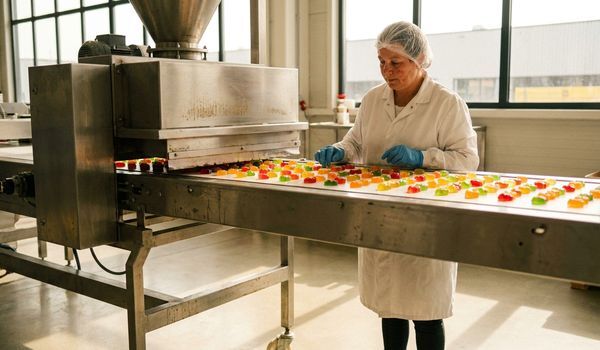
The depositor is the heart of the operation. It portions the cooked slurry into molds at high speed with tight weight control. Two families dominate the industry. Starch mogul systems deposit into impressions pressed into trays of food-grade starch, a flexible approach that handles a wide range of recipes and shapes. Starchless depositors form gummies in reusable metal or silicone molds, delivering faster cycles, easier cleaning, and lower labor costs for high-volume or nutraceutical production. Tabletop depositors serve pilot runs and small brands, while servo-driven industrial depositors produce tens of thousands of pieces per hour.
Drying and Curing Systems
Fresh gummies leave the depositor with too much moisture for shelf stability. Drying tunnels, climate-controlled drying rooms, and tray handling systems bring water activity down to target levels over hours or days. This stage is frequently underestimated in capacity planning: a fast depositor paired with insufficient drying space creates a bottleneck that caps the entire line.
Coating and Finishing Equipment
Finishing gives gummies their final texture and appearance. Sanding drums apply sugar or sour coatings, polishing pans add shine, and oiling systems apply a light glaze that prevents sticking and extends shelf life. Supplement gummies often receive specialized coatings for stability or taste masking.
Packaging Lines
Once cured, product moves to counting machines, bottle fillers, pouch form-fill-seal systems, cappers, induction sealers, labelers, and checkweighers. Packaging automation is one of the highest-return investments in the category because it replaces repetitive manual labor and directly supports retail compliance requirements.
Quality and Safety Systems
Metal detectors, X-ray inspection units, and batch coding systems protect consumers and satisfy retailer and regulatory audits. These machines are fully financeable and are often required before major retail or contract manufacturing accounts will approve a facility.
How Much Do Gummy Manufacturing Machines Cost?
Equipment pricing varies widely based on capacity, automation level, and whether the machine is new or used. The table below shows realistic ranges that owners encounter when budgeting a gummy production line:
| Equipment | Typical Price Range (New) | Notes |
|---|---|---|
| Tabletop gummy depositor | $10,000 to $35,000 | Pilot batches, R&D, small brands |
| Cooking kettles and mixing tanks | $15,000 to $150,000 | Size and jacketing drive price |
| Semi-automatic depositing line | $50,000 to $250,000 | Entry-level commercial production |
| Starch mogul system | $250,000 to $1,500,000+ | Tray handling and starch conditioning included |
| Starchless depositing line | $300,000 to $2,000,000+ | High-speed servo systems, nutraceutical grade |
| Drying tunnels and curing rooms | $75,000 to $500,000 | Capacity must match depositor output |
| Coating and polishing systems | $20,000 to $200,000 | Sanding drums, pans, oiling systems |
| Packaging and labeling lines | $50,000 to $400,000 | Counting, filling, sealing, coding |
A complete entry-level commercial line typically lands between $150,000 and $400,000, while a fully automated industrial line can exceed $2 million. These are exactly the ticket sizes where financing delivers the most value, because few growing businesses should tie up that much cash in a single purchase.
Pro Tip: Used gummy equipment can cut capital costs by 30 to 60 percent, and well-maintained depositors and kettles often have decades of service life left. Crestmont Capital offers used equipment financing with the same fast approvals as new machine purchases, so a refurbished line from a reputable dealer can be a smart first step into production.
By the Numbers
The Gummy Market: Key Statistics for Manufacturers
$39.2B
Estimated global gummy market value across candy and functional products
8.7%
Compound annual growth rate of the global gummy market
65%
Approximate adult share of gummy vitamin and supplement consumption
$22.5B
U.S. non-chocolate candy sales, the fastest-growing confectionery segment
Who Qualifies for Gummy Equipment Financing?
Equipment financing is one of the most accessible forms of business funding because the machine itself anchors the deal. That said, lenders still evaluate a consistent set of factors, and knowing them in advance helps you position an application for fast approval.
Time in Business
Two or more years of operating history unlocks the broadest range of programs and the best rates. Younger businesses are not excluded, though. Companies with six months to two years of history routinely qualify, and startups can be approved when owners bring strong personal credit, industry experience, meaningful down payments, or signed customer contracts to the table.
Credit Profile
Personal credit scores of 650 and above generally access the most competitive terms, but approvals happen across a wide spectrum. Scores in the 600s are commonly approved at adjusted rates or with additional down payment, and some programs work with challenged credit when cash flow and equipment value support the deal. Business credit history, when it exists, strengthens the file further.
Revenue and Cash Flow
Lenders want to see that monthly equipment payments fit comfortably inside existing cash flow, or that signed orders and contracts make the new capacity immediately productive. Bank statements from the most recent three to six months usually tell this story for mid-sized transactions.
The Equipment Itself
Machine type, age, condition, and resale value all influence structure. A new servo-driven depositor from a major manufacturer supports longer terms and higher advance rates than an aging custom-built line, simply because the collateral holds value better.
Who This Financing Is Best For
Gummy manufacturing machine financing fits a wide range of businesses: nutraceutical brands launching their first in-house line, established confectioners adding capacity, contract manufacturers and co-packers expanding services, supplement companies bringing production in-house from a co-packer, and distributors verticalizing into manufacturing. If your business sells or plans to sell gummy products at commercial scale, this funding category was built for you.
Comparing Your Financing Options
Four structures account for nearly all gummy equipment funding. Each has a distinct profile, and the right choice depends on ownership goals, cash position, and how fast the technology in your segment evolves.
| Feature | Equipment Loan | Equipment Lease | Business Line of Credit | SBA Loan |
|---|---|---|---|---|
| Ownership | You own from day one | Lessor owns until buyout | You own (cash purchase) | You own from day one |
| Typical down payment | 0 to 20% | First and last payment | None, draw as needed | 10 to 20% |
| Term length | 24 to 84 months | 24 to 72 months | Revolving | Up to 10 years for equipment |
| Approval speed | 24 to 72 hours | 24 to 72 hours | Days to a week | Weeks to months |
| Best for | Long-term ownership, building equity in the machine | Lowest upfront cost, easy technology upgrades | Smaller machines, attachments, ingredient inventory | Lowest rates when timeline allows |
Equipment loans suit owners who plan to run a machine for a decade or more and want to own it outright at the end of the term. Leases shine when depositing technology, sanitation design, or automation is improving quickly and you want the option to refresh equipment every few years without a resale process. A business line of credit works well for smaller assets, spare parts, and the ingredient purchases that scale alongside new capacity. SBA loan programs offer attractive rates for qualified borrowers who can accommodate a longer approval timeline.
Many growing manufacturers combine structures: an equipment loan for the core production line, a lease on packaging automation that will be upgraded as retail requirements change, and a credit line covering ingredients and seasonal inventory. A funding specialist can model these combinations against your cash flow before you commit.
How Crestmont Capital Helps Gummy Manufacturers
Crestmont Capital is rated the #1 business lender in the United States, and equipment financing for food and confectionery producers is a core specialty. The team funds gummy manufacturers at every stage, from first-line startups to multi-line industrial plants, and structures deals around how production businesses actually operate.
What that looks like in practice: applications take minutes, approvals routinely arrive within 24 to 48 hours, and funding amounts cover everything from a $25,000 tabletop depositor to multi-million-dollar complete lines. New and used machines both qualify, soft costs like installation and training can be included, and terms are matched to the useful life of the equipment rather than a one-size template.
Owners who want to explore the full range of structures can review Crestmont Capital's equipment financing programs, and the manufacturing equipment financing guide on our blog walks through how production businesses of all types fund capacity expansion. When you are ready, a dedicated advisor will help you compare loan, lease, and credit structures side by side so the machine you buy fits both your production goals and your balance sheet.
Get the Equipment Your Gummy Business Needs
Fast approvals, flexible terms, and funding built for manufacturers. Apply in minutes with no obligation.
Apply Now →Real-World Scenarios: Gummy Equipment Financing in Action
Financing structures make the most sense in context. These scenarios reflect the situations funding specialists see every week in the gummy and confectionery space.
Scenario 1: The Supplement Brand Launching Its First Line
A direct-to-consumer wellness brand has been selling melatonin and vitamin C gummies through a contract manufacturer for two years. Margins are thin, minimum order quantities keep rising, and lead times stretch to twelve weeks. The owners decide to bring production in-house with a tabletop depositor, two cooking kettles, a small drying room buildout, and a semi-automatic bottling line, a package totaling roughly $220,000. An equipment loan with a 10 percent down payment and a 60-month term puts the monthly payment well below what they were paying their co-packer in margin, and the line pays for itself in under two years through improved unit economics.
Scenario 2: The Established Confectioner Adding Starchless Capacity
A third-generation candy company runs two starch mogul lines for its classic gummy bear and sour worm products. A national retailer offers a private-label contract, but the volumes demand faster cycles and quicker changeovers than the moguls can deliver. The company finances a $1.2 million starchless depositing line with a structured lease, keeping ownership of the legacy moguls while adding high-speed capacity. The retail contract covers the lease payment with room to spare, and the company keeps its legacy products running without interruption.
Scenario 3: The Contract Manufacturer Solving a Drying Bottleneck
A co-packer lands two new nutraceutical clients but realizes its depositor already outruns its drying capacity. Product backs up, trays stack in hallways, and quality suffers. Rather than a full line expansion, the company finances a $180,000 continuous drying tunnel sized to match the depositor's output. The single machine unlocks the full speed of equipment the company already owned, and the new clients' recurring orders service the debt from the first month.
Scenario 4: The Family Confectioner Replacing an Aging Mogul
A regional candy maker's thirty-year-old mogul is breaking down monthly, and replacement parts are getting scarce. A refurbished mogul from a reputable dealer costs $350,000, roughly half the price of new. Used equipment financing covers the full purchase with a 72-month term, and the predictable payment replaces the unpredictable repair bills that were eating the maintenance budget. The refurbished line comes with a dealer warranty, and production downtime drops to near zero.
Scenario 5: The Co-Packer Automating Packaging
A growing co-packer wins a club store account, but the contract requires retail-compliant bottle counts, induction seals, and lot coding that the company's manual packing station cannot deliver. A $150,000 packaging line financed over 60 months automates counting, filling, sealing, and labeling. Labor costs per unit drop by more than half, the club account launches on schedule, and the same line now supports three other retail clients.
Compliance Note: Whether you produce candy or supplements, your facility will need to meet FDA food facility registration requirements, and supplement producers must follow current Good Manufacturing Practices for dietary supplements. Retail buyers increasingly audit for both. Financing can cover the stainless steel, washdown-capable, and inspection equipment these standards demand, so build compliance into your equipment plan from day one rather than retrofitting later.
The Application Process: What to Expect
Applying for gummy manufacturing machine financing is deliberately streamlined. Here is the sequence most owners experience with Crestmont Capital:
1. Gather the Basics
Have your equipment quote or invoice ready, along with basic business information: legal name, time in business, annual revenue, and ownership details. For transactions above roughly $250,000, pull recent bank statements and the most recent tax return as well.
2. Submit the Application
The online application takes only a few minutes. There is no obligation, and submitting does not lock you into any structure or term.
3. Review Your Options
A funding advisor reviews your file and presents structures matched to your equipment and cash flow: loan versus lease, term lengths, down payment levels, and monthly payment options. This is the moment to ask about bundling shipping, installation, and training into the financed amount.
4. Sign and Fund
Once you select a structure, documents are issued electronically, the lender pays your vendor, and the machine ships. Most deals move from application to funded equipment inside one to two weeks, and straightforward approvals can close even faster.
Frequently Asked Questions
What is gummy manufacturing machine financing? +
It is equipment financing designed for businesses that produce gummy candy and gummy supplements. A lender funds the purchase of production machinery, and you repay over fixed monthly installments, typically across 24 to 84 months, while the equipment itself serves as collateral.
How much does a gummy manufacturing machine cost? +
Tabletop depositors start around $10,000 to $35,000, semi-automatic lines run $50,000 to $250,000, and fully automated starchless or mogul systems range from $300,000 to over $2 million. Complete entry-level commercial lines typically total $150,000 to $400,000.
Can I finance used gummy manufacturing equipment? +
Yes. Used and refurbished machines from dealers or private sellers are routinely financed, often with an inspection for older or private-party equipment. Used machinery can cut capital costs by 30 to 60 percent while delivering years of reliable production.
What credit score do I need to qualify? +
Scores of 650 and above generally access the most competitive terms, but approvals happen across a wide range. Because the equipment secures the financing, lenders can work with scores in the 600s and sometimes lower, often with adjusted rates or additional down payment.
How long does approval take? +
Well-qualified applicants frequently receive decisions within 24 to 72 hours, and funding typically follows within days of signed documents. From application to machine delivery, most transactions close inside one to two weeks.
What is the difference between an equipment loan and an equipment lease? +
With a loan, you own the machine from day one and build equity with each payment. With a lease, the financing company owns the equipment during the term, and you choose to buy it out, upgrade, or return it at the end. Leases usually require less upfront cash and suit fast-evolving technology.
Can startups qualify for gummy machine financing? +
Yes, though the bar is higher. Startups strengthen their applications with strong personal credit, relevant industry experience, meaningful down payments of 10 to 30 percent, and signed customer or retail contracts that demonstrate immediate demand for the new capacity.
What documents do I need to apply? +
At minimum, an equipment quote or invoice and basic business information. Larger transactions, generally above $250,000 to $500,000, typically add three to six months of business bank statements and recent tax returns. Application-only approvals are common for smaller ticket sizes.
Can I finance nutraceutical or supplement gummy lines? +
Absolutely. Starchless depositing systems, precision dosing equipment, and GMP-compliant production lines for vitamin and supplement gummies are among the most commonly financed assets in this category, reflecting how quickly the functional gummy segment is growing.
How much can I borrow for gummy equipment? +
Financing amounts range from around $10,000 for a single tabletop depositor to $5 million or more for complete automated lines. The approved amount depends on your business profile, cash flow, and the value of the equipment being financed.
What are typical rates and terms? +
Terms usually run 24 to 84 months. Rates vary with credit strength, time in business, down payment, and equipment type, with the strongest profiles earning the lowest costs. Fixed payments make the total cost of financing transparent from the start.
Can shipping, installation, and training be financed too? +
In most cases, yes. Soft costs including freight, rigging, installation, and operator training can be bundled into the financed amount, typically up to a set percentage of the equipment cost. Ask your funding advisor to structure these in from the start.
What happens at the end of an equipment lease? +
End-of-term options depend on the lease type. A $1 buyout lease transfers ownership to you for a dollar, while a fair market value lease lets you purchase the machine at its then-current value, return it, or upgrade to newer equipment. Your advisor will match the structure to your long-term plans.
Is a down payment required? +
Not always. Well-qualified businesses often secure 100 percent financing with no down payment, while newer businesses or challenged credit profiles may be asked for 10 to 30 percent down. Leases typically require only the first and last monthly payments upfront.
How do I get started with Crestmont Capital? +
Complete the short online application with your equipment quote and basic business details. A funding advisor will review your options, often within 24 to 48 hours, and walk you through structures until you find the fit that matches your production goals and cash flow.
Launch or Expand Your Gummy Line
Join the manufacturers who fund their growth with the #1 business lender in the U.S. Apply in minutes.
Apply Now →How to Get Started
Complete our quick application at offers.crestmontcapital.com/apply-now, it takes just a few minutes.
A Crestmont Capital advisor will review your equipment quote, production goals, and cash flow, then match you with the right financing structure.
Your vendor gets paid, your machines ship, and your gummy line starts producing, often within days of approval.
Conclusion
The gummy category offers manufacturers something rare: a market growing on two fronts at once, with confectionery buyers and supplement consumers both demanding more product every year. Capturing that demand takes capacity, and capacity takes machines. Gummy manufacturing machine financing removes the capital barrier between where your business is and where the market is going, converting six and seven-figure equipment costs into manageable monthly payments that the machinery itself helps generate.
Whether you are launching a first supplement line, adding starchless speed to an established candy operation, or solving a drying bottleneck that is costing you contracts, the right financing structure makes the equipment decision easier. Crestmont Capital funds gummy manufacturers at every scale with fast approvals, flexible terms, and advisors who understand production businesses. Apply today, and put your growth on the line, the production line.
Disclaimer: The information provided in this article is for general educational purposes only and is not financial, legal, or tax advice. Funding terms, qualifications, and product availability may vary and are subject to change without notice. Crestmont Capital does not guarantee approval, rates, or specific outcomes. For personalized information about your business funding options, contact our team directly.

Allan Garfinkle
Allan Garfinkle is the Chief Revenue Officer at Crestmont Capital, where he has spent more than a decade leading revenue strategy, business development, and operational growth. With 28 years of experience building and advising startups and small businesses, Allan has helped more than 10,000 business owners navigate financing decisions, growth opportunities, and changing economic conditions. He earned a Bachelor of Science in Economics and an MBA with a concentration in Finance from Northeastern University, as well as a Juris Doctor from New England Law, where his studies focused on contracts and business law. His writing draws on extensive practical experience in small-business lending, equipment financing, business credit, and commercial finance.