
 (800) 949-0401
Padel Court Construction Financing: The Complete Guide for Business Owners
Explore padel court construction financing options, from SBA loans to equipment leasing, for U.S. facility owners.
Padel court construction financing is becoming one of the fastest-growing niches in commercial real estate and equipment lending, as entrepreneurs, real estate developers, and existing racquet sports operators race to capture demand from one of the fastest-growing sports in the country. Whether you are building a single outdoor court behind an existing fitness club or developing a dedicated multi-court padel facility from the ground up, understanding your financing options can mean the difference between breaking ground this year and waiting on the sidelines while competitors get there first.
In This Article
- What Is Padel Court Construction Financing?
- The Padel Boom: Why Now Is the Time to Build
- Key Benefits of Financing Your Padel Court Build
- How Padel Court Construction Financing Works
- Types of Financing for Padel Court Construction
- Financing Options Compared
- Who Padel Court Financing Is Best For
- How Crestmont Capital Helps
- Real-World Scenarios
- FAQ
- Next Steps
- Conclusion
What Is Padel Court Construction Financing?
Padel court construction financing refers to the business funding used to cover the design, permitting, site work, structural build-out, and equipping of a padel facility. Depending on the scope of your project, this can include land acquisition, foundation and drainage work, structural steel and glass enclosures for regulation-height walls, playing surfaces, artificial turf infill, lighting, netting, scoring systems, and clubhouse or reception space.
Because padel courts combine elements of commercial construction and specialized sports equipment, most owners end up using a blend of financing products rather than a single loan. A developer purchasing raw land and constructing an indoor facility has very different financing needs than an existing tennis or fitness club owner adding two outdoor courts to an underused parking lot.
The primary keyword for facility owners searching for funding is padel court construction financing, and it typically overlaps with related searches like padel court cost, padel court builder, and commercial construction loans.
Unlike financing a single piece of equipment for an existing business, padel court construction financing often requires coordinating multiple funding sources at once. A developer might need a construction loan for the building shell, a separate equipment package for the court systems, and a working capital cushion to cover the months between breaking ground and reaching a stable membership base. Understanding how these pieces fit together before you start shopping for financing can save significant time and prevent gaps in your funding plan.
The Padel Boom: Why Now Is the Time to Build
Padel has gone from a niche curiosity to one of the fastest-expanding racquet sports in the United States in just a few years. The number of padel courts nationwide grew from fewer than 20 in 2019 to over 650 courts across 31 states by early 2025, and the total surpassed 700 courts across more than 230 operating clubs by the end of 2025. Florida alone accounts for roughly 41 percent of all U.S. courts, with Texas, California, and New York rounding out the leading states.
This kind of rapid facility expansion mirrors patterns seen in other fast-growing recreation categories tracked under the fitness and recreational sports centers industry classification maintained by the U.S. Census Bureau, which includes racquet sports facilities alongside gyms, health clubs, and skating rinks. As padel-specific data matures, it is increasingly being folded into broader industry analysis of recreational sports facility growth.
Key Stat: The number of padel courts in the United States grew from fewer than 20 in 2019 to more than 700 across over 230 clubs by the end of 2025, with more than half of all existing courts built since January 2024 alone.
This growth has attracted attention well beyond the sport itself. Investment funds focused exclusively on padel facilities have launched in markets like Miami, and professional leagues have secured significant outside funding, signaling that lenders and investors increasingly view padel as a durable, scalable business model rather than a passing trend. For a business owner considering construction now, that momentum can translate into strong early-mover advantages in underserved markets.
Part of what makes padel attractive from a business standpoint is its space efficiency compared to other racquet sports. A padel court occupies a smaller footprint than a tennis court while supporting doubles play, which means operators can fit more courts on a given piece of land and generate more court-hours of revenue per square foot. Combined with premium pricing on membership and court rentals, this efficiency is a major reason lenders are increasingly comfortable underwriting padel construction projects even though the category is still relatively new in the U.S. market.
According to Forbes, the sport's appeal to luxury resorts, private clubs, and real estate developers is accelerating construction activity well beyond dedicated padel clubs alone, with hospitality groups adding courts as premium amenities. Separately, Forbes also reported on a $10 million funding round for a professional U.S. padel league, underscoring how quickly outside capital is flowing into the sport at every level, from grassroots facility construction to professional competition.
Ready to Build Your Padel Facility?
Get fast, flexible construction and equipment financing from the #1 business lender in the U.S. No obligation, apply in minutes.
Apply Now →Key Benefits of Financing Your Padel Court Build
- Preserve working capital. Financing construction and equipment costs keeps your cash reserves available for staffing, marketing, and the inevitable surprises that come with any build-out.
- Match payments to revenue. Structured loan terms let you spread the cost of a court over years rather than paying the full construction bill up front, aligning payments with membership and court-rental revenue as it ramps up.
- Move faster than cash-only competitors. In a rapidly growing market, the ability to finance construction can let you secure a location and open before other operators in your area.
- Access specialized equipment financing. Court surfaces, glass panel systems, and lighting can often be financed separately from real estate, sometimes with faster approval timelines.
- Build credit history for future expansion. Successfully financing and repaying a first court or facility can make it easier to secure funding for additional locations down the road.
How Padel Court Construction Financing Works
The financing process for a padel facility generally follows the same structure as other commercial construction and equipment financing projects, with a few sport-specific wrinkles related to specialized materials and the relative newness of the category in the U.S. market.
Quick Guide
How Padel Court Construction Financing Works, At a Glance
Determine number of courts, indoor vs. outdoor, land or lease, and total estimated budget.
Match your project to SBA, commercial real estate, or equipment financing based on what you are funding.
Provide a business plan, contractor bids, site plans, and financial statements to the lender.
Once approved, funds are disbursed on a construction schedule so your build can proceed on time.
Lenders evaluating a padel construction request will typically want to understand not just the construction budget, but also your plan for generating revenue once the courts are open, including projected membership pricing, court rental rates, and anticipated utilization. Because padel is newer to many U.S. lenders than tennis or fitness centers, presenting solid comparable data from established markets can strengthen your application.
It also helps to separate your financing request into clear line items rather than presenting a single lump-sum figure. Lenders generally respond well to a budget broken out by category, such as land or lease costs, site work and permitting, structural construction, court surfaces and enclosures, lighting and technology, and a contingency reserve for unexpected costs. This level of detail signals that you have done thorough due diligence on the project and reduces the perceived risk of cost overruns derailing construction partway through.
Timing matters as well. Because padel courts, especially outdoor installations, can often be completed faster than a full commercial building project, some owners choose to phase their financing, securing a smaller loan or equipment package for an initial one or two courts before expanding. This phased approach can reduce risk for both the borrower and the lender, and it gives you real operating data to support financing for a larger expansion later.
Types of Financing for Padel Court Construction
SBA 504 Loans
The SBA loan program includes the 504 structure, which is specifically designed for fixed assets like land, buildings, and ground-up construction. A 504 loan typically involves a conventional lender covering up to 50 percent of project costs, a Certified Development Company covering up to 40 percent, and the borrower contributing a minimum down payment, often around 10 percent. Repayment terms of 10, 20, or 25 years with fixed rates make this an attractive option for a purpose-built padel facility. According to the U.S. Small Business Administration, 504 loans can finance up to 90 percent of total project costs, which can meaningfully reduce the amount of cash a borrower needs to bring to the table for a construction project of this size.
SBA 7(a) Loans
SBA 7(a) loans offer more flexibility than the 504 program, allowing funds to be used for a combination of construction, equipment, and working capital in a single loan. This can be useful for owners who want to bundle court construction with opening-phase expenses like staffing, marketing, and initial inventory for a pro shop or cafe.
Commercial Real Estate Financing
Commercial real estate financing can fund the purchase of land or an existing building to convert into a padel facility, particularly for operators who prefer a conventional loan structure outside the SBA process or who need to move on a time-sensitive property acquisition.
Equipment Financing for Court Surfaces and Enclosures
Equipment financing can cover the specialized components of a padel court separately from the underlying real estate, including glass or acrylic wall panels, galvanized steel framing, artificial turf and infill systems, LED lighting packages, and scoring or booking technology. This approach can be faster to approve than a full construction loan and may not require the same collateral position.
Business Lines of Credit and Working Capital
A business line of credit can help bridge cash flow gaps during construction delays, cover unexpected change orders, or fund initial operating expenses before membership revenue ramps up. Because a line of credit is revolving, you only pay interest on what you actually draw.
Commercial Financing for Larger, Multi-Court Developments
For larger projects, such as a multi-court complex combined with a clubhouse, restaurant, or pro shop, commercial financing solutions outside the SBA umbrella may offer more flexibility on loan size and structure. This can be especially useful for experienced developers who already have a strong banking relationship or who need a financing timeline that moves faster than typical SBA underwriting allows.
Financing Options Compared
Every padel facility project is different, so the right financing mix depends on whether you already own real estate, whether you are building indoors or outdoors, and how much of your budget is going toward the building shell versus the court equipment itself. The table below summarizes how the main options stack up.
| Financing Type | Best For | Typical Term | Down Payment |
|---|---|---|---|
| SBA 504 Loan | Ground-up construction, land, and buildings | 10, 20, or 25 years | As low as 10% |
| SBA 7(a) Loan | Construction plus working capital in one loan | Up to 25 years | 10% to 15% |
| Commercial Real Estate Loan | Purchasing land or an existing building to convert | 5 to 25 years | 15% to 25% |
| Equipment Financing | Court surfaces, glass enclosures, lighting, netting | 2 to 7 years | $0 to 10% |
| Business Line of Credit | Bridging cash flow gaps during and after build-out | Revolving | None |
Who Padel Court Financing Is Best For
Padel court construction financing tends to make the most sense for a few distinct types of business owners:
- Existing racquet sports or fitness club operators looking to add padel courts to an existing property to diversify revenue and attract new members.
- Real estate developers and investors building dedicated multi-court padel clubs as a standalone business or as an amenity within a larger mixed-use development.
- Hospitality operators, including hotels and resorts, adding padel courts as a premium guest amenity to differentiate their property.
- Entrepreneurs entering the sport industry for the first time who see an underserved local market and want to move quickly to establish a presence before competitors arrive.
How Crestmont Capital Helps
Crestmont Capital works with business owners across the country to structure financing for construction projects like padel facilities, matching each project to the right combination of funding tools rather than forcing every borrower into a single loan type.
Depending on your project, that might mean pairing an SBA loan for the real estate and shell construction with equipment financing for the court surfaces and enclosures, or arranging a construction company business loan structure if you are also managing the general contracting side of the project. A business line of credit can then be layered in to smooth out cash flow while your facility ramps up to full membership.
If you are exploring adjacent racquet sports financing needs, our guides on pickleball club business loans and tennis court equipment financing cover similar financing structures that may apply to a multi-sport racquet facility.
Our team works with borrowers at every stage of the process, from early budgeting conversations through final funding and disbursement. Because we work with a range of lending partners and structures rather than a single product, we can help you compare an SBA loan against a conventional commercial loan or equipment financing package side by side, so you understand the true cost and timeline of each option before committing.
Turn Your Padel Court Plans Into Reality
Crestmont Capital helps facility owners secure the right funding structure for construction, equipment, and working capital.
Get Started Today →Real-World Scenarios
Scenario 1: Adding Courts to an Existing Tennis Club
A tennis club owner with an underused back parking area decides to convert the space into two outdoor padel courts to attract younger members and generate new court-rental revenue. She uses equipment financing to cover the glass enclosure system, turf, and lighting, keeping the project separate from her existing real estate and preserving cash for a marketing push around the new courts.
Scenario 2: Ground-Up Indoor Padel Club
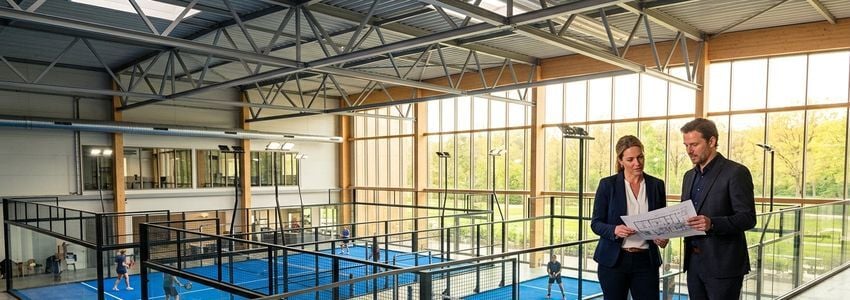
A group of investors purchases a vacant warehouse to convert into a six-court indoor padel facility with a full clubhouse, pro shop, and cafe. They use an SBA 504 loan to finance the building purchase and structural renovation, combined with a separate equipment financing package for the court systems and interior fit-out.
Scenario 3: Resort Amenity Expansion
A boutique hotel adds two outdoor padel courts as a guest amenity to compete with nearby resorts already offering the sport. Because the courts are relatively low-cost outdoor installations, the hotel uses a business line of credit to fund the project quickly without disrupting a longer-term renovation loan already in place for the property.
Pro Tip: Many operators finance the real estate and shell construction separately from the court surfaces, glass enclosures, and technology package. Splitting the financing this way can shorten approval timelines and let you move faster on the parts of the project with the longest lead times.
Scenario 4: First-Time Operator Entering a New Market
An entrepreneur with a background in fitness club management identifies a mid-sized city with strong local interest in padel but no dedicated facility. He combines a smaller SBA 7(a) loan for construction and initial working capital with a personal down payment, using membership pre-sales during construction to strengthen his case with the lender.
Frequently Asked Questions
Don't Let Financing Slow Your Groundbreaking
Apply today and find out what padel court construction financing options you qualify for.
Apply Now →Next Steps
Get contractor bids and a clear picture of total costs before approaching lenders.
Business and personal financial statements, tax returns, and a revenue projection.
Discuss which combination of SBA, commercial, and equipment financing fits your project.
Once approved, funds are typically disbursed on a construction draw schedule.
Conclusion
Padel court construction financing has moved from a niche question to a mainstream financing conversation as the sport's U.S. footprint expands rapidly across every region of the country. Whether you are adding a pair of courts to an existing property, developing a ground-up indoor club, or bringing padel to an underserved market for the first time, the right combination of SBA, commercial real estate, and equipment financing can help you move from blueprint to grand opening without draining your cash reserves. With the market still in its early growth phase, business owners who secure financing and break ground now are positioned to capture demand ahead of the competition.
Ready to explore financing for your padel facility? Contact our team or apply now to get started.
Disclaimer: The information provided in this article is for general educational purposes only and is not financial, legal, or tax advice. Funding terms, qualifications, and product availability may vary and are subject to change without notice. Crestmont Capital does not guarantee approval, rates, or specific outcomes. For personalized information about your business funding options, contact our team directly.








