
 (800) 949-0401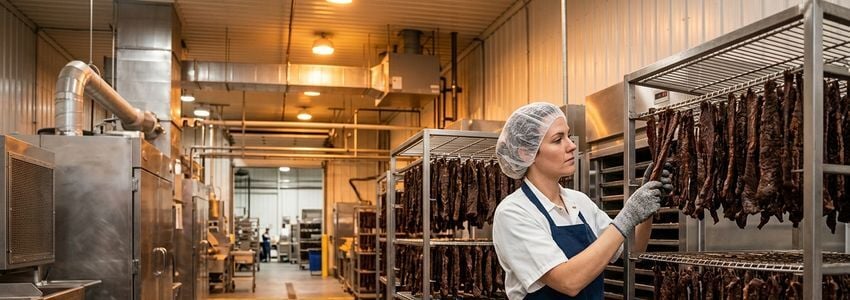
Jerky Production Equipment Financing: The Complete Guide for Jerky and Snack Food Makers
Jerky production equipment financing gives meat snack producers a way to acquire commercial dehydrators, smokehouses, slicers, mixers, vacuum sealers, and packaging lines without draining cash reserves. Whether you are scaling a small-batch jerky operation into a regional brand or opening your first USDA-inspected processing facility, the right financing structure can be the difference between waiting years to grow and expanding on your own timeline.
The jerky segment of the U.S. meat snacks market is projected to reach roughly $6.14 billion in 2026, with continued annual growth as protein-focused snacking keeps gaining ground with consumers. That demand is real, but capturing it requires production capacity, and commercial-grade jerky equipment is expensive. This guide breaks down exactly how jerky production equipment financing works, what it costs, which machines qualify, and how to structure a deal that fits a growing snack food business.
In This Article
What Is Jerky Production Equipment Financing?
Jerky production equipment financing is a business funding tool that lets meat snack producers purchase or lease the specialized equipment needed to make jerky, meat sticks, and other dehydrated protein snacks, then pay for it over time instead of in one lump sum. Rather than tying up working capital in a single large purchase, a business spreads the cost of a dehydrator, smoker, slicer, mixer, or packaging line across monthly payments that align with the revenue the equipment helps generate.
This type of financing typically comes in two forms: an equipment loan, where the business owns the equipment from day one and the lender places a lien on the asset as collateral, or an equipment lease, where the business pays to use the equipment and may have an option to purchase it at the end of the term. Both structures are widely used across the food manufacturing industry, and jerky producers use them for everything from a single commercial dehydrator to a full production line.
Jerky production is unusually equipment-intensive compared to many food businesses. A commercial-grade dehydration or smoking process, precise temperature and humidity control for food safety, and consistent throughput all require purpose-built machines that cost significantly more than consumer-grade equipment. Financing exists specifically to make that capital expense manageable for growing producers.
Key Stat: The U.S. jerky market is projected to reach approximately $6.14 billion in 2026 and is expected to grow at a compound annual rate near 6.8% through 2034, driven by consumer demand for high-protein, shelf-stable snacks.
Key Benefits of Financing Jerky Production Equipment
- Preserve working capital. Keep cash available for ingredients, packaging inventory, and marketing instead of locking it into machinery.
- Match payments to revenue. Monthly payments can be structured to align with sales cycles and cash flow, particularly useful for producers with seasonal demand spikes around holidays and outdoor/hunting seasons.
- Access newer, more efficient equipment. Financing makes it possible to acquire commercial-grade dehydrators and smokers with better yield, more consistent moisture control, and higher throughput than older or secondhand units.
- Potential tax advantages. Depending on the financing structure, businesses may be able to deduct lease payments as an operating expense or depreciate owned equipment. A tax professional should always be consulted on specifics.
- Scale production without waiting years to save up. A producer with strong retail or wholesale demand can add capacity now rather than turning away orders while saving cash.
- Approval speed. Equipment financing is often faster to approve than a traditional bank term loan because the equipment itself serves as collateral, reducing the lender's risk.
Ready to Scale Your Jerky Production?
Get fast, flexible equipment financing from the #1 business lender in the U.S. No obligation, apply in minutes.
Apply Now →How Jerky Production Equipment Financing Works
The process is more straightforward than most first-time applicants expect, especially compared to applying for a conventional bank loan. Here is the typical path from application to running equipment on your production floor:
Quick Guide
How Jerky Production Equipment Financing Works, At a Glance
Choose the dehydrator, smoker, slicer, mixer, or packaging line and get a vendor quote or invoice.
Basic business details, time in business, and revenue information, usually with minimal paperwork.
Approval decisions can often come back within one to two business days, with terms outlining rate, term length, and monthly payment.
The lender pays the vendor directly, and the equipment ships to your facility for installation.
Terms for jerky production equipment financing typically range from 24 to 84 months depending on the equipment type and useful life. A commercial dehydrator or smokehouse, which has a long service life if properly maintained, will often qualify for a longer term than a piece of packaging equipment with a shorter expected lifespan. Down payments range from zero to 20 percent depending on the applicant's credit profile, time in business, and the lender's underwriting approach. Newer businesses or those with limited credit history may see a slightly higher down payment requirement or a modestly higher rate to offset lender risk.
Most lenders that specialize in equipment financing, including equipment financing providers like Crestmont Capital, base their underwriting more heavily on business cash flow and the value of the equipment than on personal credit alone. That makes this financing path more accessible than a traditional bank loan for many food producers, particularly those who are asset-rich in equipment value but have not yet built years of banking relationships.
Types of Jerky Production Equipment You Can Finance
Jerky and meat snack producers typically finance one piece of equipment at a time as they scale, or bundle several machines into a single financing package for a full line upgrade. Common equipment categories include:
- Commercial dehydrators. Industrial dehydration units with programmable temperature and airflow controls, sized from small batch units to walk-in dehydration rooms for high-volume producers.
- Smokehouses and smoking ovens. Combination smoke-and-cook chambers used for traditional smoked jerky, often requiring precise humidity and temperature control for food safety compliance.
- Meat slicers. Commercial slicers for producing uniform-thickness strips, critical for consistent drying times and finished product texture.
- Mixers and marinating equipment. Tumblers and vacuum marinators that inject or massage seasoning and cure into meat before drying.
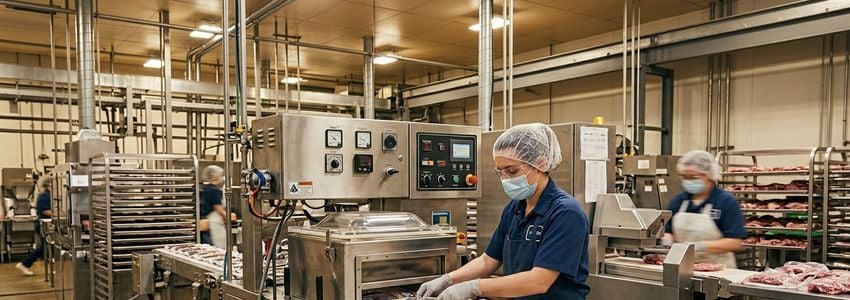
- Vacuum sealers and packaging lines. Vacuum sealing and modified atmosphere packaging (MAP) equipment that extends shelf life and meets retail packaging standards.
- Metal detection and quality control equipment. Metal detectors and check-weighers required for retail distribution and many co-packing agreements.
- Walk-in coolers and freezers. Cold storage for raw materials and finished product, often financed alongside production equipment during a facility buildout.
- Labeling and coding equipment. Date coding, lot tracking, and label application machines needed for regulatory traceability.
- Conveyor and material handling systems. Automated conveyors that move product between drying, packaging, and quality control stations, reducing labor costs on high-volume lines.
Producers should also consider financing supporting infrastructure alongside the core production equipment. Backup generators to protect a batch mid-cycle during a power outage, water filtration systems for wash-down compliance, and HVAC upgrades to manage humidity in a drying room are all examples of equipment that keep a facility running reliably and can typically be rolled into the same financing package as the primary machines.
Both new and used equipment can typically be financed, which matters for producers looking to acquire well-maintained secondhand dehydrators or smokehouses from equipment resellers or businesses upgrading their lines. Financing new equipment often comes with better warranty coverage, while financing used equipment can lower the total cost of a buildout for a business watching every dollar during a growth phase.
Many producers finance equipment in phases rather than all at once. A common approach is to finance the dehydration or smoking equipment first, since it represents the largest capital outlay and the biggest constraint on throughput, then add a second financing package for packaging and quality control equipment once volume justifies the upgrade. This phased approach keeps monthly payments proportional to revenue at each stage of growth rather than front-loading years of payments before the business has scaled into the capacity.
Facility infrastructure tied directly to production, such as ventilation systems for smokehouses, drainage upgrades for wash-down areas, and electrical upgrades to support higher-draw equipment, can sometimes be bundled into an equipment financing package as well. Lenders that understand food manufacturing will often structure financing around the full production line rather than a single machine, which simplifies the paperwork and gives the business one predictable monthly payment instead of several.
By the Numbers
Equipment Financing and the Meat Snack Industry
$6.14B
Projected 2026 U.S. jerky market size
6.8%
Projected annual growth rate through 2034
82%
U.S. businesses that use financing to acquire equipment
33M+
Small businesses operating in the U.S. today
Who Jerky Production Equipment Financing Is Best For
This type of financing serves a wide range of producers at different stages of growth:
- Small-batch producers moving into commercial production. Businesses outgrowing home-kitchen or shared commercial kitchen dehydrators and moving into a dedicated processing facility.
- Existing jerky brands scaling wholesale distribution. Producers who have landed retail shelf space or a distribution deal and need higher throughput to meet order volume.
- Meat processors and butchers adding a jerky line. Businesses already processing meat that want to add value-added products like jerky and meat sticks to diversify revenue.
- Co-packers serving multiple jerky brands. Contract manufacturers financing equipment to serve several client brands under one production facility.
- Hunters and outdoor-focused specialty producers. Regional and seasonal producers who need equipment that can handle demand surges around hunting season.
Businesses with at least six months of operating history and consistent revenue tend to see the most favorable terms, though startups with a strong business plan, purchase orders, or existing retail commitments can often still qualify, sometimes with a larger down payment or a co-signer.
Geography and facility type also factor into how a producer approaches equipment financing. A producer operating out of a shared commercial kitchen has different equipment needs than one building a dedicated USDA-inspected facility from the ground up. Shared-kitchen producers often start by financing portable, smaller-footprint equipment that can be moved or shared across production runs, while dedicated-facility operators typically finance larger, fixed installations like walk-in dehydration rooms and permanent smokehouse structures designed to run continuously.
Financing vs. Buying Outright: Which Makes Sense?
Some jerky producers have enough cash reserves to purchase equipment outright, and for a smaller purchase like a single slicer, that may make sense. But for larger investments like a commercial dehydrator, smokehouse, or full packaging line, financing usually wins on both flexibility and opportunity cost.
| Factor | Financing | Buying Outright |
|---|---|---|
| Upfront cash needed | Low to none | Full purchase price |
| Impact on working capital | Minimal | Significant |
| Speed to acquire equipment | Fast, often days | Delayed until cash is saved |
| Flexibility to upgrade later | Higher, especially with leasing | Lower, capital already committed |
| Total cost over time | Includes interest or lease markup | Lower if cash is truly idle otherwise |
For most growing producers, the deciding factor is opportunity cost. Cash tied up in a dehydrator cannot be used to buy inventory, fund a marketing push, or cover payroll during a slow month. Financing keeps that capital available for the parts of the business that generate revenue faster than a piece of equipment appreciates in value.
There is also a risk-management angle worth considering. Jerky and meat snack production involves food safety compliance costs that can shift over time, from ingredient sourcing changes to updated packaging regulations. A business that has not committed all of its cash to equipment has more flexibility to absorb an unexpected compliance cost or ingredient price spike without a cash flow crisis. Financing effectively acts as a buffer that keeps the balance sheet more resilient during a period when the business is also investing in growth.
Some producers also weigh the resale value of jerky-specific equipment before deciding whether to finance or buy outright. Commercial dehydrators and smokehouses hold value reasonably well when properly maintained, which supports favorable financing terms since the equipment retains meaningful collateral value over the life of the loan or lease. This is one reason lenders that specialize in food production equipment are often able to offer more competitive terms than general-purpose small business lenders unfamiliar with the resale market for this type of machinery.
How Crestmont Capital Helps Jerky Producers
Crestmont Capital works with food manufacturers, including meat snack and jerky producers, to structure equipment financing and equipment leasing that fits the realities of a food production business, including seasonal cash flow and the need to move quickly when a wholesale opportunity appears.
For producers who need working capital in addition to equipment, such as covering ingredient costs, packaging inventory, or payroll during a growth phase, Crestmont also offers unsecured working capital loans and a business line of credit that can be used alongside equipment financing to fund a full expansion. Businesses that qualify for government-backed terms may also explore SBA loans for larger facility buildouts.
Every application is reviewed with an understanding of the food manufacturing business, not just a generic credit score. Producers with an established meat processing operation looking to add jerky as a new product line, such as those covered in Crestmont's guide to meat processing equipment financing or the butcher shop equipment financing guide, will find a similar underwriting approach applies to jerky-specific machinery.
Crestmont also works with producers who need to finance a full facility buildout rather than a single machine. In those cases, equipment financing for the dehydrators, smokers, and packaging line can be paired with commercial financing for leasehold improvements, giving a growing producer one point of contact for the full scope of a new or expanded facility instead of juggling multiple lenders.
Get Pre-Qualified in Minutes
Tell us about your equipment needs and get a fast, no-obligation financing decision from Crestmont Capital.
Check Your Options →Real-World Scenarios
Scenario 1: The small-batch producer scaling to retail. A jerky maker selling at farmers markets lands a regional grocery chain listing that requires 500 pounds of product per week, far beyond what a home dehydrator can produce. Financing a commercial dehydration room and a vacuum sealing line lets the business meet the order without depleting the cash needed for the first several inventory cycles.
Scenario 2: The butcher shop diversifying revenue. An established butcher shop with steady foot traffic wants to add a house-brand jerky line to sell in-store and online. Financing a slicer, marinator, and smokehouse allows the shop to launch the new product line without touching the working capital needed for its core meat counter operations.
Scenario 3: The co-packer adding capacity. A contract meat snack manufacturer serving three regional jerky brands is turning away new client business because its current dehydration capacity is maxed out. Financing a second walk-in dehydration room lets it take on two new brand contracts, generating revenue that covers the new equipment payment within the first several months.
Scenario 4: The seasonal specialty producer. A producer focused on hunting-season demand needs to double capacity ahead of a predictable fall sales spike. A short-term equipment lease on an additional smoker lets the business meet seasonal demand without committing to a long-term loan for equipment that runs at full capacity only part of the year.
Scenario 5: The direct-to-consumer brand expanding online. A jerky brand that built its customer base through e-commerce and subscription boxes sees online orders outpace its current dehydration capacity during a viral social media moment. Financing a second dehydrator and an automated vacuum sealing line allows the brand to fulfill the surge in orders without backlogging shipments or damaging customer trust built up over months of marketing investment.
Pro Tip: Get a written equipment quote before applying. Lenders can move faster and often provide more accurate terms when they know the exact make, model, and price of the dehydrator, smoker, or packaging line being financed.
Frequently Asked Questions
Turn Demand Into Production Capacity
Apply today and find out how quickly you could have new equipment on your production floor.
Apply Now →Next Steps
Identify dehydrators, smokers, slicers, or packaging equipment and get a vendor quote.
Apply online with basic business and revenue details.
Compare rate, term, and monthly payment against your production and cash flow plan.
Once approved, equipment is purchased and delivered so you can start producing at scale.
Conclusion
Jerky production equipment financing gives jerky and meat snack producers a practical path to acquiring the dehydrators, smokehouses, slicers, and packaging equipment needed to meet growing consumer demand for protein-rich snacks. With the U.S. jerky market projected to keep growing through the next decade, producers who can add capacity without draining cash reserves are better positioned to take on new retail listings, wholesale contracts, and seasonal demand spikes. Whether the need is a single commercial dehydrator or a full production line, structuring the right financing can turn equipment from a bottleneck into a growth engine.
Disclaimer: The information provided in this article is for general educational purposes only and is not financial, legal, or tax advice. Funding terms, qualifications, and product availability may vary and are subject to change without notice. Crestmont Capital does not guarantee approval, rates, or specific outcomes. For personalized information about your business funding options, contact our team directly.








