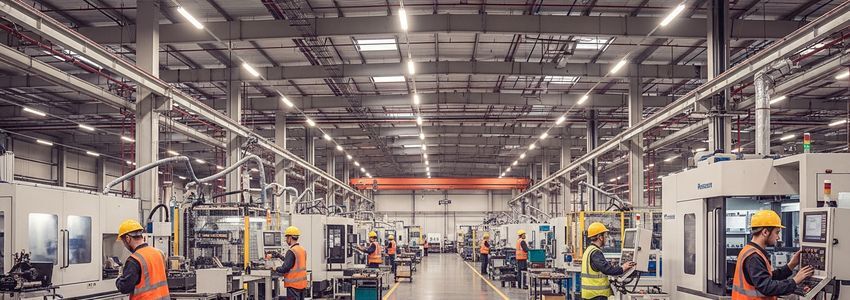
Manufacturing equipment financing gives businesses the capital they need to purchase, upgrade, and replace production machinery without tying up operating cash. Whether you run a metal fabrication shop, a food processing plant, a plastics factory, or a custom packaging operation, the right equipment loan can directly translate into higher throughput, lower per-unit costs, and a stronger competitive position.
Yet despite the clear need, many manufacturers stall on equipment decisions because the upfront cost is simply too high. A single CNC machining center can run $100,000 to $500,000. An industrial robotic welding system may cost $75,000 to $250,000. Financing solves that barrier by spreading the cost over the equipment's useful life - keeping cash reserves intact while production capacity grows.
This guide covers everything manufacturers need to know about equipment loans: how they work, what they cost, who qualifies, and how to use financing strategically to increase output.
In This Article
- What Is Manufacturing Equipment Financing?
- How Equipment Loans Work
- Types of Manufacturing Equipment Financing
- Key Benefits for Manufacturers
- Qualification Requirements
- Rates, Terms, and Loan Amounts
- Types of Manufacturing Equipment You Can Finance
- How Crestmont Capital Helps Manufacturers
- Real-World Scenarios
- Frequently Asked Questions
- How to Get Started
What Is Manufacturing Equipment Financing?
Manufacturing equipment financing is a specialized form of business lending designed to help companies purchase or upgrade the machinery and tools needed for production operations. The loan is typically secured by the equipment itself, which means the asset serves as collateral - often resulting in lower rates and more flexible terms compared to unsecured business loans.
This type of financing is distinct from a general working capital loan. The funds are earmarked for equipment acquisition, and the repayment structure is usually tied to the asset's useful life. When a manufacturer finances a piece of equipment, they own it from day one. Unlike leasing, there is no buyout clause at the end, and the business builds equity in the asset with every payment.
According to the U.S. Census Bureau, manufacturing contributes over $2.3 trillion annually to U.S. GDP, and capital investment in machinery and equipment is one of the sector's most consistent growth drivers. Access to affordable equipment financing directly enables manufacturers to keep pace with demand, adopt new technology, and compete on cost.
Key Fact: The Equipment Leasing and Finance Association (ELFA) reports that U.S. businesses finance approximately $1.16 trillion in equipment annually. Manufacturing is consistently one of the top three sectors driving that investment.
How Equipment Loans Work
The mechanics of a manufacturing equipment loan are straightforward. A business identifies the equipment it needs - either from a manufacturer, dealer, or distributor - and applies for financing. The lender evaluates the business's creditworthiness, the equipment's value, and the loan structure. Upon approval, the lender funds the purchase and the business begins making fixed monthly payments.
Because the equipment itself serves as collateral, lenders can often approve loans with less documentation and at faster speeds than traditional term loans. The collateral reduces the lender's risk, which typically translates into better rates for the borrower.
Here is the standard process from application to funded:
Quick Guide
How Manufacturing Equipment Financing Works - At a Glance
Determine the machinery, tools, or production assets required. Get a vendor quote or invoice.
Submit an application with basic financial documents. Crestmont Capital can often pre-approve within 24-48 hours.
The lender reviews credit, revenue, and equipment value. Asset-backed loans are typically approved faster than unsecured loans.
Funds are released directly to the vendor or to you. Equipment is purchased, delivered, and put into service.
Fixed monthly payments over the agreed loan term. No balloon payments, no surprises. Equipment is fully yours upon payoff.
Types of Manufacturing Equipment Financing
Not all manufacturing businesses have the same needs, and not all financing structures work the same way. Here are the most common options available to manufacturers:
Equipment Term Loans
The most common structure for equipment acquisition. The lender provides a lump sum that covers the full purchase price (minus any down payment), and the business repays over a fixed term with regular monthly installments. The equipment serves as collateral. At the end of the term, the business owns the asset outright.
Best for: High-value equipment with a long useful life (CNC machines, presses, robotic systems, heavy manufacturing equipment).
Equipment Leasing
Instead of purchasing, the business rents the equipment from a leasing company for a fixed period. Monthly payments are typically lower than loan payments, but the business does not own the equipment at the end of the term. Most leases offer an option to buy at fair market value or for $1 at end of term (depending on lease type).
Best for: Equipment that becomes obsolete quickly (software-driven machines, inspection equipment, lab tools) where upgrading regularly is more valuable than ownership.
For a detailed comparison of loans vs. leasing, see our guide to equipment leasing options and how they differ from traditional equipment loans.
SBA Loans for Equipment
The Small Business Administration's 7(a) and 504 loan programs can both be used for equipment purchases. SBA-backed loans offer some of the lowest interest rates available and longer repayment terms - up to 10 years for equipment. The tradeoff is a longer approval process and stricter documentation requirements.
Learn more about eligibility and terms in our complete SBA loans guide.
Business Line of Credit
A revolving credit facility that can be used for equipment purchases, parts, maintenance, or operational needs. Rather than a single lump sum, you draw what you need and repay as you go. Rates are typically higher than dedicated equipment loans, but the flexibility can be valuable for manufacturers with variable equipment needs.
Working Capital Loans for Equipment
When a manufacturer needs both equipment and cash for operations (payroll, inventory, supplies), a small business loan or working capital product can cover both. Useful when a single financing event needs to address multiple growth requirements simultaneously.
Ready to Finance Your Manufacturing Equipment?
Crestmont Capital offers fast, flexible equipment financing for manufacturers of all sizes. Get pre-approved in 24-48 hours - no long waits, no red tape.
Apply Now ->Key Benefits of Equipment Financing for Manufacturers
Manufacturing equipment financing is not just a way to afford something you cannot buy outright. Used strategically, it is a growth tool that allows businesses to scale faster, operate more efficiently, and preserve financial flexibility.
Preserve Working Capital
Writing a $300,000 check for a piece of equipment drains cash reserves that could fund payroll, materials, marketing, or an unexpected expense. Equipment financing converts that large capital outlay into manageable monthly payments, keeping cash available for day-to-day operations.
Increase Production Capacity Without Delay
Waiting to save up for equipment means months or years of operating below full potential. Financing allows manufacturers to act now, put the equipment to work immediately, and generate the revenue needed to pay for the investment.
Fixed, Predictable Payments
Equipment loans typically carry fixed interest rates and fixed monthly payments. This predictability makes budgeting and cash flow planning far easier than variable-rate credit products.
Asset Ownership from Day One
Unlike leasing, equipment loans give you ownership of the asset immediately. The equipment appears on your balance sheet as an asset. You can use it as collateral for future financing, depreciate it for accounting purposes, and sell it if needed.
Faster Approval Than Traditional Bank Loans
Because equipment loans are asset-secured, they carry lower risk for lenders. This translates into faster underwriting and approval timelines. Alternative lenders like Crestmont Capital can fund equipment purchases in as little as 2-5 business days, vs. 30-90 days at a traditional bank.
Competitive Technology Advantage
Modern manufacturing is increasingly driven by automation, robotics, and precision machinery. Financing allows manufacturers to adopt current-generation technology without a large upfront cash commitment - closing the gap with larger, better-capitalized competitors.
Industry Insight: According to CNBC reporting on U.S. manufacturing investment trends, businesses that regularly finance equipment upgrades report 15-30% higher output per worker compared to those that defer capital investment due to budget constraints. The ROI on modern equipment typically exceeds its financing cost within 18-24 months for well-run manufacturing operations.
Qualification Requirements for Manufacturing Equipment Loans
Qualification requirements vary by lender and loan type, but here are the typical benchmarks manufacturers need to meet:
Credit Score
Most equipment lenders look for a minimum personal credit score of 600-650 for standard approval. Scores above 680 typically qualify for the best rates. Manufacturers with lower scores may still qualify through lenders that prioritize business cash flow and equipment value over personal credit - or through bad credit equipment financing programs designed for businesses in rebuilding mode.
Time in Business
Most lenders require 1-2 years in business. Some alternative lenders will work with businesses as young as 6 months with demonstrated revenue. Startups with strong business plans and collateral may qualify for startup-specific equipment programs.
Annual Revenue
Minimum revenue requirements typically start around $100,000-$150,000 annually, though requirements vary based on loan size. For larger equipment purchases ($500,000+), lenders may require $500,000 or more in annual revenue.
Down Payment
Many equipment loans require a down payment of 10-20% of the equipment cost, though some programs offer 0% down for qualified borrowers. A larger down payment can improve your rate and reduce monthly payments.
Equipment Type and Age
Lenders prefer equipment that holds its value and is easily resold if needed. New equipment from reputable manufacturers is the easiest to finance. Used equipment can be financed but may require a larger down payment or carry a higher rate. Equipment older than 10-15 years may not qualify for standard programs.
Documentation Typically Required
- Business bank statements (3-6 months)
- Business tax returns (1-2 years)
- Vendor quote or invoice for the equipment
- Business license and formation documents
- Profit and loss statement (for larger loans)
- Personal financial statement (for larger loans or SBA programs)
Rates, Terms, and Loan Amounts for Manufacturing Equipment Financing
Interest rates and terms for manufacturing equipment loans vary based on credit profile, loan size, equipment type, and lender. Here is a practical overview of what manufacturers can expect:
| Factor | Bank / SBA Loan | Alternative Lender (e.g., Crestmont) |
|---|---|---|
| Interest Rate | 5% - 12% | 6% - 25% |
| Loan Term | 5 - 10 years | 1 - 7 years |
| Loan Amount | $50K - $5M+ | $10K - $5M+ |
| Time to Fund | 30 - 90 days | 2 - 7 business days |
| Credit Requirement | 680+ preferred | 600+ (case by case) |
| Collateral | Equipment + personal guarantee | Equipment (personal guarantee may vary) |
For most manufacturers, the choice between bank financing and alternative lending comes down to speed and qualification. Banks offer the lowest rates but take weeks or months to fund. Alternative lenders like Crestmont Capital approve and fund in days, which matters when a production window, a vendor deal, or a growth opportunity has a deadline.
By the Numbers
Manufacturing Equipment Financing - Key Statistics
$1.16T
Equipment financed annually by U.S. businesses (ELFA)
80%
Of U.S. businesses use some form of financing for equipment
2-5 Days
Typical funding time with Crestmont Capital
$2.3T
Manufacturing's annual contribution to U.S. GDP
Types of Manufacturing Equipment You Can Finance
Manufacturing equipment financing covers virtually any piece of production machinery or industrial tool. Here are some of the most commonly financed equipment categories:
CNC Machinery and Precision Equipment
CNC mills, lathes, routers, and machining centers are among the most frequently financed items in manufacturing. These machines can cost anywhere from $30,000 to over $500,000, and their direct impact on production precision and throughput makes them a strong candidate for equipment financing. Our CNC machine financing guide covers this category in depth.
Robotics and Automation Systems
Industrial robots, robotic welding cells, pick-and-place systems, and automated assembly lines represent significant capital investments. Financing allows manufacturers to adopt automation incrementally without a single large capital event.
Metal Fabrication Equipment
Press brakes, laser cutters, plasma cutters, waterjet cutters, welding systems, and metal forming equipment all qualify for equipment financing. These assets tend to hold their value well, which supports favorable loan terms.
Injection Molding and Plastics Equipment
Injection molding machines, blow molding systems, extruders, and tooling equipment are routinely financed through equipment loans. Given the high cost of industrial-grade molding machinery, financing is often the only practical path to acquisition.
Packaging and Material Handling Equipment
Conveyor systems, palletizers, stretch wrappers, case sealers, labelers, and automated packaging lines can be financed as a package or individually. As e-commerce drives higher packaging throughput requirements, financing enables manufacturers to keep pace.
Food Processing and Agricultural Equipment
Industrial mixers, filling machines, slicers, pasteurizers, freeze dryers, and processing lines for food manufacturers are commonly financed. Food-grade manufacturing equipment often requires specialized financing knowledge, which alternative lenders experienced in manufacturing can provide.
Printing and Converting Equipment
Commercial printing presses, digital printers, die cutters, laminators, and converting equipment qualify for equipment financing. These assets often carry strong residual values, which supports financing approval.
HVAC, Electrical, and Infrastructure Equipment
Industrial HVAC systems, compressors, generators, electrical switchgear, and facility infrastructure upgrades can be financed through equipment loans or commercial renovation financing. These investments may not directly produce output but are essential to keeping manufacturing operations running efficiently.
How Crestmont Capital Helps Manufacturers Secure Equipment Financing
Crestmont Capital is a direct business lender rated #1 in the U.S., with deep experience funding manufacturers across industries. We understand that production timelines are real - when you need equipment, you cannot wait 60 days for a bank committee decision.
Our equipment financing program is built for speed and flexibility. We work with manufacturers at every stage - from well-established factories seeking to modernize to growing shops adding their second or third machine. Here is what sets our manufacturing equipment loans apart:
- Fast approvals: Most decisions in 24-48 hours. Funding in 2-5 business days.
- Flexible qualification: We evaluate the full picture - revenue, cash flow, and equipment value - not just credit score alone.
- Loans from $10,000 to $5M+: Whether you need a single $50,000 CNC lathe or a $2M automated production line, we can structure a solution.
- Fixed rates and terms: No variable rates, no balloon payments. Know exactly what you owe each month from day one.
- Industry expertise: We have funded equipment for metal fabricators, plastics manufacturers, food processors, printers, and more.
For manufacturers with past credit challenges, our bad credit equipment financing program provides an alternative path to approval. We also offer equipment leasing for businesses that prefer lower monthly payments or want to preserve ownership flexibility.
If you need a broader understanding of how equipment financing works across different business contexts, our in-depth Equipment Financing 101 guide is a great starting point. And for manufacturers managing receivables alongside equipment needs, our manufacturing factoring guide covers a complementary financing tool worth knowing.
Get Manufacturing Equipment Financing Today
Crestmont Capital has helped manufacturers across the U.S. acquire the equipment they need to grow. Apply in minutes - no obligation required.
Apply Now ->Real-World Scenarios: How Manufacturers Use Equipment Financing
Scenario 1: Metal Fabricator Adds Laser Cutting Capacity
A 15-employee metal fabrication shop in Ohio had been outsourcing laser cutting work to a third-party vendor, spending roughly $12,000 per month on cut parts. The owner identified a fiber laser cutter for $185,000 that would bring the work in-house. After securing equipment financing through Crestmont Capital with a 60-month term, the monthly payment came to approximately $3,800 - a fraction of the outsourcing cost. Within 4 months, the equipment had paid for its own monthly cost through savings alone. Within 18 months, the shop had expanded its customer base with new cutting capabilities.
Scenario 2: Plastic Injection Molder Upgrades Aging Machines
A plastics manufacturer in Michigan was operating three injection molding machines, two of which were over 20 years old and requiring frequent repair. Downtime was costing the business an estimated $8,000 per incident. The owner financed two new machines totaling $420,000 through a structured equipment loan with a 7-year term. The new machines reduced unplanned downtime by over 80%, improved cycle times, and allowed the business to take on new contracts requiring tighter tolerances that the old machines could not meet.
Scenario 3: Food Manufacturer Scales for Retail Contract
A specialty food manufacturer in California received a purchase order from a major retail chain requiring 10x their current production volume. To fulfill the contract, they needed a commercial filling line and additional packaging equipment - approximately $275,000 total. Traditional bank financing was taking too long to process. Crestmont Capital approved and funded the equipment loan in 4 days, allowing the manufacturer to accept the contract, onboard the equipment, and ship the first order on time.
Scenario 4: Print Shop Modernizes with Digital Press
A commercial printing company in Texas had been losing digital printing work to competitors with newer equipment. A high-volume digital press cost $95,000 - more than available cash. Equipment financing spread the cost over 48 months with fixed payments of approximately $2,300/month. The new press won back three accounts within 90 days of installation, each billing $3,000-$5,000 per month.
Scenario 5: Startup Manufacturer Launches with Financed Equipment
A first-generation manufacturing startup specializing in custom aluminum components needed $150,000 in equipment to begin operations. With 8 months in business and a strong customer LOI in hand, they qualified for equipment financing through Crestmont's program for newer businesses. The founder had solid personal credit and the equipment itself - a CNC milling center and associated tooling - provided strong collateral. The business launched, fulfilled its first contracts, and has since financed an additional $200,000 in equipment upgrades.
Scenario 6: Packaging Company Automates for E-Commerce Volume
A contract packaging company serving e-commerce brands was running out of capacity. Manual packaging lines could not keep pace with client order volumes during peak periods. Financing a $310,000 automated case-packing and stretch-wrapping line reduced labor costs by 40% during peak weeks while doubling throughput. The ROI on the equipment was achieved in under 14 months.
Frequently Asked Questions
What is the difference between an equipment loan and equipment leasing?
With an equipment loan, you own the machinery from day one and build equity as you repay. At the end of the term, the equipment is yours with no further obligation. With leasing, you rent the equipment for a fixed period. Monthly payments are often lower, but you do not own the asset unless you exercise a buyout option. Equipment loans are generally better for long-life machinery you plan to keep. Leasing can make sense for equipment that becomes obsolete quickly.
How much can I borrow for manufacturing equipment?
Loan amounts for manufacturing equipment financing typically range from $10,000 to $5 million or more, depending on the lender and the borrower's qualifications. The maximum amount is usually tied to the equipment's value, the business's revenue, and the borrower's creditworthiness. Crestmont Capital can structure equipment loans for both small individual machines and large multi-machine production line investments.
What credit score do I need to qualify for equipment financing?
Most equipment lenders require a minimum personal credit score of 600-650 for standard approval. Scores of 680 or higher typically qualify for the best rates and terms. However, credit score is not the only factor - lenders also consider business revenue, cash flow, time in business, and the value of the equipment being financed. Manufacturers with lower credit scores may still qualify through bad credit equipment financing programs that weight revenue and collateral more heavily.
How long does it take to get approved and funded?
Approval timelines depend heavily on the lender. Traditional banks and SBA programs typically take 30-90 days. Alternative lenders like Crestmont Capital can provide approval decisions in 24-48 hours and fund in as little as 2-5 business days after final approval. For time-sensitive equipment needs - a vendor deal with a deadline, a new contract with a startup date - the speed of alternative lending can be the difference between landing an opportunity and missing it.
Can I finance used manufacturing equipment?
Yes, used manufacturing equipment can typically be financed, though the terms may differ from new equipment financing. Lenders will generally require an appraisal or dealer quote to establish fair market value. Equipment older than 10-15 years may have limited financing options. Newer used equipment - machines that are 2-7 years old with documented service history - typically qualifies without issue.
What is a typical interest rate for manufacturing equipment financing?
Interest rates for equipment loans typically range from 5% to 25% annually, depending on the lender type, loan amount, credit profile, and term length. Bank and SBA loans generally offer the lowest rates (5-12%), while alternative lenders carry slightly higher rates (8-25%) in exchange for faster funding and more flexible qualification.
Do I need to put money down for an equipment loan?
Down payment requirements vary by lender and borrower profile. Many equipment loans require 10-20% of the equipment's purchase price as a down payment. However, some programs offer 0% down financing for qualified borrowers, particularly for new equipment with strong collateral value.
Can a startup manufacturing business qualify for equipment financing?
Startup manufacturing businesses can qualify for equipment financing, though the options are more limited than for established businesses. Lenders will typically look at the owner's personal credit score, any revenue generated so far, the value of the equipment being purchased (which serves as collateral), and whether the business has contracts or purchase orders in place. Some alternative lenders offer startup equipment financing for businesses as young as 6 months with strong credit and documented revenue.
What happens if the equipment breaks down during the loan term?
The loan obligation remains regardless of the equipment's operational status. Loan payments are required whether the equipment is running or down for repairs. For this reason, many manufacturers carry equipment insurance and may include service/maintenance contracts as part of their financing package.
What documents do I need to apply for equipment financing?
For most equipment loan applications, you will need: 3-6 months of business bank statements, 1-2 years of business tax returns, a vendor quote or invoice for the equipment, basic business formation documents (license, EIN, Articles of Incorporation), and a profit and loss statement for larger loan amounts.
Can I finance multiple pieces of equipment at once?
Yes. Many manufacturers finance multiple equipment items under a single loan or use a master financing agreement that covers an entire production line or equipment package. Bundling multiple items into one loan simplifies administration, may reduce total fees, and allows you to structure a single payment that covers the entire equipment investment. Crestmont Capital can structure equipment financing packages for multiple machines, tooling, installation, and software as a single facility.
Is equipment financing better than using cash reserves?
For most manufacturers, financing equipment is more strategically sound than depleting cash reserves - even when cash is available. Cash reserves provide a buffer for unexpected costs, payroll gaps, slow payment cycles, and new opportunities. Financing spreads the equipment cost over time and preserves liquidity.
How does equipment financing affect my business credit?
Equipment loans reported to business credit bureaus (Dun and Bradstreet, Experian Business, Equifax Business) can help build your business credit profile. Consistent on-time payments strengthen your business credit score over time, which makes future financing easier to secure at better rates.
What is the maximum loan term for manufacturing equipment financing?
Loan terms for equipment financing typically range from 1 to 10 years. Equipment loans from alternative lenders usually cap at 5-7 years. SBA 504 loans offer up to 10-year terms for equipment. The term is generally structured to align with the equipment's expected useful life.
Does Crestmont Capital offer equipment financing for all manufacturing industries?
Yes. Crestmont Capital funds equipment for manufacturers across a wide range of industries, including metal fabrication, plastics and composites, food and beverage processing, printing and packaging, electronics assembly, woodworking, textile manufacturing, and more. Contact our team to discuss your specific manufacturing equipment needs and get a preliminary assessment.
How to Get Started
Complete our quick application at offers.crestmontcapital.com/apply-now - takes just a few minutes and does not affect your credit score to apply.
A Crestmont Capital advisor with manufacturing industry experience will review your equipment needs and match you with the best financing structure for your business.
Most manufacturing equipment loans are approved within 24-48 hours and funded in 2-5 business days. Your equipment gets ordered and production output starts climbing.
Conclusion
Manufacturing equipment financing is one of the most direct levers a business owner has for increasing output without risking the operating cash that keeps the business running. Whether you are replacing aging machinery that limits your throughput, adopting automation to reduce labor costs, or purchasing new production equipment to fulfill a major contract, financing lets you act now rather than waiting for savings to accumulate.
The key is choosing the right financing structure for your specific situation. Equipment term loans offer ownership and predictability. Leasing offers lower payments and flexibility. SBA loans offer the best rates but require patience. Alternative lenders like Crestmont Capital offer speed and accessibility when timelines are tight and qualifications are less than perfect.
If manufacturing equipment financing is on your radar, the best next step is simple: apply, get a real number, and evaluate whether the economics work. Most well-run manufacturers find that the revenue generated by new equipment more than covers the monthly payment - often within the first year. Crestmont Capital is here to make that calculation as straightforward as possible.
Disclaimer: The information provided in this article is for general educational purposes only and is not financial, legal, or tax advice. Funding terms, qualifications, and product availability may vary and are subject to change without notice. Crestmont Capital does not guarantee approval, rates, or specific outcomes. For personalized information about your business funding options, contact our team directly.