

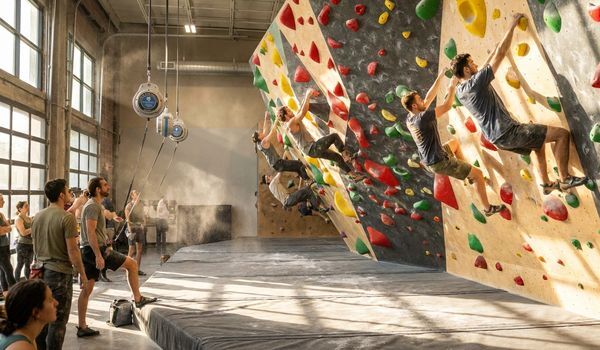
Indoor climbing has moved from a niche hobby to a mainstream fitness category, and the numbers behind the industry tell a remarkable growth story. Whether you own a climbing gym, are thinking about opening one, or invest in the fitness and recreation sector, understanding the latest climbing gym statistics is essential for making smart decisions. This guide breaks down the market size, participation data, revenue benchmarks, and growth trends shaping the indoor climbing industry in 2026, along with what those numbers mean for business owners looking to start, expand, or finance a climbing facility.
In This Article
- The State of the Climbing Gym Industry in 2026
- Climbing Gym Market Size and Growth
- Participation Statistics and Demographics
- Revenue and Membership Economics
- What It Costs to Open a Climbing Gym
- Industry Segments: Bouldering, Rope, and Hybrid Gyms
- Key Trends Shaping the Industry
- Challenges Facing Climbing Gym Owners
- How Crestmont Capital Helps Climbing Gym Owners
- Real-World Scenarios
- Financing Options Compared
- Industry Outlook Through 2030
- Frequently Asked Questions
- How to Get Started
The State of the Climbing Gym Industry in 2026
The indoor climbing industry enters 2026 in one of the strongest positions in its history. Industry trackers estimate that more than 640 commercial climbing gyms now operate in the United States, up from roughly 400 a decade ago, and new facilities continue to open at a steady pace of 20 to 30 locations per year. Canada adds another 100-plus facilities to the North American total, and the global count of commercial climbing walls is estimated in the thousands.
Several structural forces drive this growth. Climbing's debut as an Olympic sport at the Tokyo Games introduced the discipline to a massive global audience, and its return at the Paris 2024 Games reinforced that exposure. Fitness consumers increasingly favor experience-based, community-oriented workouts over traditional big-box gyms, and climbing sits squarely at the intersection of exercise, social connection, and skill progression. Meanwhile, developers of mixed-use retail and entertainment centers actively recruit climbing gyms as anchor tenants because they draw repeat visits from a loyal, high-retention customer base.
For business owners, the practical takeaway is that indoor climbing has matured into a legitimate, financeable business category. Lenders, landlords, and investors who once viewed climbing gyms as exotic specialty businesses now treat them alongside boutique fitness studios and family entertainment centers. That shift matters when it comes time to secure funding, negotiate a lease, or value an existing facility for sale.
Key Stat: The United States is home to more than 640 commercial climbing gyms, and industry publications tracking new openings report that roughly 9 out of 10 new facilities that open each year remain in business five years later, a survival rate well above the small business average reported by the U.S. Small Business Administration.
Climbing Gym Market Size and Growth
Measuring the exact size of the climbing gym market requires combining data from industry associations, market research firms, and government economic surveys, because no single agency tracks the category in isolation. The consensus view among industry analysts puts the global indoor climbing market at approximately $3.5 billion to $4 billion in annual revenue as of 2025, with North America accounting for roughly one third of that total. The U.S. indoor climbing segment alone is estimated to generate between $1.2 billion and $1.5 billion per year when memberships, day passes, instruction, retail, events, and food and beverage sales are combined.
Growth rates are where the category stands out. While the broader health club industry has grown at a low single-digit annual pace over the past decade, the indoor climbing segment has consistently posted annual growth in the 6 to 10 percent range, depending on the year and the specific metric measured. Some years have seen double-digit expansion in facility count. Market research projections published in 2025 generally forecast a compound annual growth rate between 7 and 9 percent for the global indoor climbing market through 2030.
Several measurable indicators support that forecast:
- Facility count growth: North American gym counts have grown at roughly 5 to 7 percent annually over the past five years, with no sign of a slowdown in new openings.
- Membership expansion: Established gyms report membership growth even after the initial post-opening surge, indicating the customer base is deepening rather than churning.
- Capital investment: Wall manufacturers, hold producers, and auto belay suppliers all report record order books, a reliable leading indicator of facility construction and expansion.
- Institutional interest: Private equity groups and regional fitness operators have begun acquiring successful independent gyms and forming multi-location platforms, a pattern that typically signals a maturing, consolidating market.
By the Numbers
Climbing Gym Industry - Key Statistics for 2026
640+
Commercial climbing gyms operating in the United States
$3.5B+
Estimated global indoor climbing market revenue
7-9%
Projected annual market growth rate through 2030
4.4M
Estimated Americans who participate in indoor climbing
Climbing Participation Statistics and Demographics
Participation data explains why the industry keeps growing. Industry surveys and participation studies estimate that between 4 and 5 million Americans take part in indoor climbing each year, with a core group of roughly 1.5 to 2 million climbing regularly, defined as at least once per month. The participant base has grown substantially over the past decade, and gyms consistently report that first-time visitor counts remain strong.
The demographic profile of the typical indoor climber is a major part of the industry's appeal to investors and landlords:
- Age: The core climbing demographic skews young, with the largest share of participants between 18 and 34 years old. However, youth programming has expanded rapidly, and children ages 6 to 17 now represent one of the fastest-growing participant segments. Adult climbers over 40 are also a growing cohort as the generation that started climbing in the 1990s and 2000s continues to participate.
- Gender: Indoor climbing has one of the most balanced gender splits in the fitness industry. Survey data consistently shows women representing 40 to 45 percent of indoor climbing participants, compared with roughly 30 percent in traditional outdoor climbing disciplines.
- Income and education: Indoor climbers skew affluent and highly educated. Industry surveys regularly find that a majority of regular climbers hold college degrees, and median household incomes among members sit well above national averages. This profile supports premium membership pricing and strong retail spending.
- Retention: Climbing gyms report membership retention rates that exceed traditional health clubs, with monthly churn frequently cited in the 3 to 5 percent range compared with 5 to 8 percent at conventional gyms.
Gender balance matters more than it might appear. Fitness categories with broad gender appeal tend to support higher household penetration, larger birthday party and group event businesses, and more durable membership bases. Climbing's nearly even split is a structural advantage that few fitness concepts can match.
Ready to Launch or Expand Your Climbing Gym?
Get fast, flexible financing from the #1 business lender in the U.S. No obligation. Apply in minutes.
Apply Now →Climbing Gym Revenue and Membership Economics
Climbing gym revenue varies widely by market, facility size, and business model, but industry surveys and operator disclosures provide useful benchmarks. A small bouldering-focused facility in a mid-size market might generate $400,000 to $800,000 in annual revenue, while a large full-service gym in a major metro can exceed $3 million to $5 million. The median independent gym in North America is generally estimated to produce between $1 million and $1.5 million in annual revenue once it reaches maturity.
Revenue mix is one of the most important statistics for prospective owners to understand:
- Memberships: Recurring monthly and annual memberships typically account for 45 to 60 percent of total revenue at established gyms. Average membership pricing ranges from $70 to $110 per month depending on market and facility type, with premium urban gyms at the high end.
- Day passes and punch cards: Drop-in visits usually represent 15 to 25 percent of revenue. Day pass pricing averages $20 to $30, and many gyms report that a meaningful share of day pass users eventually convert to members.
- Instruction and programming: Classes, youth programs, camps, team training, and private coaching contribute 10 to 20 percent of revenue at gyms with developed programming. Youth programs in particular have become a growth engine, with many gyms reporting waitlists for after-school and competitive team programs.
- Events and birthday parties: Group events, corporate outings, and birthday parties add 5 to 10 percent of revenue and serve as a low-cost customer acquisition channel.
- Retail, rentals, and food: Gear shops, equipment rentals, and cafe sales round out the mix, typically contributing 5 to 15 percent of total revenue. Shoe and chalk rentals alone can be surprisingly profitable because the underlying equipment amortizes quickly.
On the profitability side, mature climbing gyms commonly report EBITDA margins between 20 and 35 percent, which compares favorably with most fitness concepts. The reasons are structural: memberships provide predictable recurring revenue, staffing needs are lean relative to member counts, and the climbing wall itself, while expensive to build, has a long useful life of 15 to 25 years with periodic route maintenance. The tradeoff is a high upfront capital requirement, which is exactly where financing strategy becomes critical.
Pro Tip: Lenders evaluate climbing gyms on the strength of their recurring membership revenue. If you are preparing to finance a new facility or an expansion, build your pro forma around conservative membership ramp assumptions and document the pre-sale membership commitments you collect before opening day. A strong pre-sale list materially improves financing terms.
What It Costs to Open a Climbing Gym
Startup cost is the statistic prospective owners ask about most, and the honest answer is that it depends heavily on format and market. Based on industry publications and operator reports, typical ranges for 2026 look like this:
- Small bouldering gym (8,000 to 12,000 square feet): $500,000 to $1.5 million all-in, including build-out, walls, holds, flooring, and working capital.
- Mid-size full-service gym (15,000 to 25,000 square feet): $1.5 million to $3.5 million.
- Large flagship facility (30,000-plus square feet): $3 million to $7 million or more, particularly in high-cost urban markets.
The climbing walls themselves are usually the single largest line item. Commercial wall construction costs commonly run $40 to $60 per square foot of climbing surface installed, and a mid-size gym might carry 8,000 to 12,000 square feet of climbable surface. Add in holds and volumes (a new gym typically spends $30,000 to $80,000 on its initial hold inventory), padded flooring, auto belays, HVAC upgrades for tall open spaces, and front-of-house build-out, and the capital stack grows quickly.
Working capital deserves special mention. New gyms rarely reach break-even membership counts on day one. Most operators plan for 12 to 18 months of membership ramp, which means the financing package needs to cover not just construction but also the cash burn during the ramp period. Undercapitalization is one of the most commonly cited reasons promising gym concepts struggle in their first two years, which is why experienced operators build a working capital cushion into their initial raise rather than trying to stretch the build budget.
The U.S. Census Bureau's Economic Census tracks the broader fitness and recreational sports center category, and its historical data confirms that the segment has added establishments and revenue faster than the overall economy for more than a decade. Climbing gyms represent one of the fastest-growing niches within that category.
Industry Segments: Bouldering, Rope, and Hybrid Gyms
One of the most important structural statistics in the industry is the shift toward bouldering-only facilities. Bouldering, which is climbing on shorter walls without ropes over padded flooring, requires less ceiling height, no rope infrastructure, and smaller footprints than traditional rope climbing. That translates directly into lower startup costs and access to a much wider range of real estate.
The data tells the story clearly:
- Bouldering-only gyms have accounted for a majority of new gym openings in North America in recent years, and industry trackers report that the segment's share of new builds continues to climb.
- Full-service rope and bouldering facilities still dominate total industry revenue because of their larger size and broader programming, but their share of new openings has declined steadily.
- Hybrid concepts that combine climbing with fitness training, yoga, coworking, and food and beverage are emerging as a distinct segment, particularly in dense urban markets where maximizing revenue per square foot is essential.
For entrepreneurs, the segment data has a practical implication: bouldering-first concepts lower the barrier to entry, while full-service facilities offer more revenue streams and stronger competitive moats once established. Many successful operators start with a bouldering gym, prove the market, and then expand into a larger full-service facility once membership demand is demonstrated. That phased approach also aligns well with staged financing, where each expansion is funded against the cash flow history of the existing operation.
Key Trends Shaping the Industry
Beyond the headline growth numbers, several measurable trends are shaping where the industry heads next:
Youth programming is becoming a primary revenue driver. Gyms consistently report that youth teams, camps, and after-school programs are among their fastest-growing and most profitable programs. Parents treat climbing as a structured athletic activity comparable to gymnastics or martial arts, and youth participants often convert parents into members as well.
Competitive climbing keeps raising the sport's profile. Olympic inclusion, plus the growth of national and collegiate competition circuits, drives a steady stream of media coverage and first-time gym visits after every major event. Gyms report predictable membership inquiry spikes around televised competitions.
Technology is changing gym operations. Membership management software, app-based check-ins, digital waivers, and route-setting apps have reduced administrative overhead. On the climbing side, adjustable training boards and app-connected systems like standardized spray walls let gyms offer fresh challenges between full route resets.
Markets are maturing in waves. Major metros like Denver, Boulder, Seattle, and Salt Lake City approached saturation years ago, and growth there is now largely replacement and expansion. The current wave of openings is concentrated in mid-size metros and suburbs of large cities that have never had a dedicated climbing facility, which is where most of the remaining whitespace sits.
Route setting has professionalized. Gyms now treat route quality as a core product feature, employing full-time setting teams and refreshing sections of wall on weekly or monthly cycles. Industry surveys show members cite route quality and variety as top retention factors, which has pushed setting labor and hold budgets up as a share of operating expenses.
Challenges Facing Climbing Gym Owners
An honest look at industry statistics also requires acknowledging the headwinds:
Rising construction and labor costs. Wall construction, insurance, and wages have all increased meaningfully since 2020, pushing total project budgets up 20 to 30 percent compared with pre-pandemic norms for comparable facilities.
Insurance complexity. Climbing gyms operate in a specialized insurance market. Premiums are manageable for operators with clean safety records, but coverage requires working with carriers who understand the sport, and lapses in safety protocols can be costly.
Competitive density in proven markets. In cities with multiple established gyms, new entrants face a real fight for members. The statistics favor markets with no existing facility or with clear unmet demand, which is why site selection and market analysis matter more than almost any other decision.
Seasonality. Many gyms report summer softness as members move outdoors, which makes cash flow planning and access to flexible working capital important during the first few years of operation.
None of these challenges changes the fundamental picture: demand growth continues to outpace supply in most markets, and well-capitalized, well-run facilities are thriving. The owners who struggle are disproportionately those who undercapitalized at launch or chose saturated submarkets.
How Crestmont Capital Helps Climbing Gym Owners
Climbing gyms require significant upfront capital, and the strongest financing strategies match the funding product to the specific use. That is where Crestmont Capital comes in. As the #1 rated business lender in the United States, Crestmont works with gym owners at every stage, from first-time founders building a bouldering gym to established operators expanding to a second or third location.
For the walls, flooring, holds, and auto belays that make up the core of the build, equipment financing lets owners spread the cost of revenue-producing assets over their useful life while preserving cash for operations. For owners who qualify, SBA loans can fund real estate purchases, ground-up construction, and large expansions at attractive terms. And for the working capital that carries a gym through its membership ramp or covers a seasonal soft patch, a business line of credit provides flexible, draw-as-needed funding.
Crestmont has written extensively about the climbing gym business. Our complete guide to rock climbing gym business loans walks through funding options for new and existing facilities, and our guide to indoor climbing gym financing covers qualification requirements and application strategy in detail. For owners evaluating wall and hold purchases specifically, our article on climbing gym equipment financing breaks down what lenders look for.
Build the Gym Your Community Is Waiting For
Crestmont Capital funds climbing gym builds, expansions, and equipment purchases. Apply in minutes and talk to a specialist who understands your industry.
Apply Now →Real-World Scenarios
Statistics become useful when they inform actual decisions. Here are three scenarios that show how the data above plays out in practice:
Scenario 1: The bouldering-first founder. A former routesetter in a mid-size Texas metro identifies a suburb of 200,000 people with no climbing facility within a 45-minute drive. She secures a 10,000-square-foot second-generation retail space, raises $850,000 through a combination of investor capital and equipment financing, and opens with 400 pre-sold memberships. Because bouldering gyms skip rope infrastructure, her build cost per square foot stays low, and she reaches break-even membership within nine months.
Scenario 2: The expansion-minded operator. The owner of a profitable eight-year-old full-service gym in the Pacific Northwest sees demand data showing his market can support a second location. Rather than diluting cash reserves, he finances the new build with an SBA 504 structure for the real estate and an equipment facility for the walls and holds, keeping his original gym's cash flow untouched. The second location opens with 1,200 members transferring or adding memberships in the first quarter.
Scenario 3: The acquisition buyer. A fitness entrepreneur acquires a 15-year-old gym with 1,800 members, aging walls, and dated programming. The purchase price reflects the existing cash flow, and a working capital line funds a reskin of high-traffic walls, new hold inventory, and a revamped youth program. Within 18 months, membership grows 25 percent, driven almost entirely by youth programming and refreshed routes, the two highest-leverage investments the industry data points to.
Financing Options for Climbing Gyms Compared
Different funding needs call for different products. This comparison summarizes how the main options stack up for a typical climbing gym project:
| Financing Type | Best Use | Typical Term | Key Advantage |
|---|---|---|---|
| Equipment Financing | Walls, holds, flooring, auto belays, training boards | 3 to 7 years | Asset-backed, fast approval, preserves cash |
| SBA 7(a) Loan | Acquisition, expansion, larger build-outs | Up to 10 years (25 for real estate) | Long terms, lower monthly payments |
| SBA 504 Loan | Purchasing real estate or ground-up construction | 10 to 25 years | Fixed rates on major fixed assets |
| Business Line of Credit | Working capital, seasonal gaps, hold purchases, marketing pushes | Revolving | Draw only what you need, pay interest on what you use |
| Term Loan | Defined one-time projects like a second location | 2 to 10 years | Predictable payments, lump-sum funding |
Most successful climbing gym projects combine two or more of these products. A typical structure pairs equipment financing for the wall package with an SBA or term loan for the build-out and a line of credit for ramp-period working capital. Spreading the capital stack across purpose-built products usually produces better blended terms than forcing everything into a single facility.
Industry Outlook Through 2030
Pulling the statistics together, the climbing gym industry's trajectory through 2030 looks strongly positive. Market research projections consistently place the global indoor climbing market on a path toward $6 billion or more in annual revenue by the end of the decade, with North America continuing to grow facility count at a mid-single-digit annual pace. Participation forecasts are similarly encouraging: as the generation introduced to climbing through youth programs over the past ten years ages into adult memberships, the industry gains a structural tailwind that few fitness categories enjoy.
Several factors will shape how that growth distributes geographically. Mid-size metros and suburbs with no existing facility remain the clearest opportunity, and the bouldering-only format makes those markets accessible at lower capital requirements than ever before. Consolidation is likely to accelerate as multi-location platforms acquire successful independents, which creates exit opportunities for founders and acquisition entry points for new operators. Coverage of the business of fitness in outlets like Reuters and CNBC increasingly treats boutique fitness and experiential recreation as a durable category rather than a fad, which reflects the underlying data.
The bottom line from the 2026 data: the climbing gym industry is past its speculative phase. Demand statistics, retention data, revenue benchmarks, and survival rates all support well-planned new facilities and expansions. The differentiator is no longer whether the market exists. It is whether the operator has the capitalization, site selection, and programming discipline to capture it.
Frequently Asked Questions
How many climbing gyms are there in the United States? +
Industry trackers estimate that more than 640 commercial climbing gyms operate in the United States as of 2026, up from roughly 400 a decade ago. New facilities continue to open at a pace of 20 to 30 per year, and the total grows steadily as existing operators expand to second and third locations.
How big is the climbing gym industry? +
Industry analysts estimate the global indoor climbing market at approximately $3.5 billion to $4 billion in annual revenue, with North America representing roughly one third of the total. The U.S. segment alone is estimated at $1.2 billion to $1.5 billion per year across memberships, day passes, programming, retail, and events.
How fast is the climbing gym industry growing? +
The indoor climbing segment has grown at roughly 6 to 10 percent annually over the past decade, well ahead of the broader health club industry. Market research projections generally forecast a compound annual growth rate between 7 and 9 percent for the global market through 2030.
How many people go indoor climbing in the US? +
Participation studies estimate that between 4 and 5 million Americans take part in indoor climbing each year, with a core group of roughly 1.5 to 2 million climbing at least once per month. Youth participants represent one of the fastest-growing segments of the customer base.
How much does it cost to open a climbing gym? +
A small bouldering gym typically requires $500,000 to $1.5 million all-in, a mid-size full-service facility runs $1.5 million to $3.5 million, and large flagship locations can exceed $7 million in high-cost markets. The climbing walls are usually the largest single expense, commonly running $40 to $60 per square foot of climbing surface installed.
How much revenue does an average climbing gym make? +
The median established independent gym in North America is generally estimated to produce between $1 million and $1.5 million in annual revenue. Small bouldering facilities in mid-size markets often generate $400,000 to $800,000, while large urban gyms can exceed $3 million to $5 million per year.
What is the average climbing gym membership price? +
Average membership pricing ranges from $70 to $110 per month depending on market and facility type, with premium urban gyms at the high end of that range. Day passes typically run $20 to $30, and many gyms report that a meaningful share of day pass visitors eventually convert to members.
What percentage of climbing gym revenue comes from memberships? +
Recurring memberships typically account for 45 to 60 percent of total revenue at established gyms. Day passes and punch cards add 15 to 25 percent, instruction and youth programming contribute 10 to 20 percent, and events, retail, and rentals make up most of the remainder.
Are bouldering gyms more popular than rope climbing gyms? +
Bouldering-only facilities have accounted for a majority of new gym openings in North America in recent years because they need less ceiling height, no rope infrastructure, and smaller footprints. Full-service rope and bouldering gyms still generate the majority of industry revenue due to their larger size and broader programming.
What demographics climb most often? +
The core climbing demographic is 18 to 34 years old, but children ages 6 to 17 are the fastest-growing segment thanks to youth programs and competitive teams. Indoor climbing also has one of the most balanced gender splits in fitness, with women representing roughly 40 to 45 percent of participants, and the member base skews college-educated and higher-income.
How did the Olympics affect climbing gym growth? +
Climbing's debut at the Tokyo Games introduced the sport to a global mainstream audience, and its return at the Paris 2024 Games reinforced that exposure. Gyms consistently report membership inquiry spikes around televised competitions, and Olympic legitimacy has helped climbing shed its niche reputation with landlords, lenders, and local governments.
What are the biggest expenses for climbing gym owners? +
On the startup side, wall construction, holds, padded flooring, and HVAC dominate the budget. Ongoing operating expenses are led by payroll (including route setters), rent, insurance, and recurring hold and route refresh costs. Experienced operators also budget working capital for the 12 to 18 month membership ramp most new gyms experience.
Is the climbing gym market saturated? +
Saturation is local, not national. Climbing hubs like Denver, Boulder, and Seattle are mature markets where growth comes from replacement and expansion, but most mid-size metros and suburbs in the U.S. still have no dedicated climbing facility. Industry data shows new gym survival rates well above small business averages, which suggests demand continues to outpace supply in most markets.
What is the outlook for the climbing gym industry through 2030? +
Market research projections place the global indoor climbing market on a path toward $6 billion or more in annual revenue by 2030, with annual growth in the 7 to 9 percent range. Youth program graduates aging into adult memberships provide a structural demand tailwind, and consolidation is expected to create both acquisition opportunities and exits for independent owners.
How can I finance a climbing gym? +
Most climbing gym projects combine equipment financing for walls, holds, and flooring with an SBA or term loan for the build-out and a business line of credit for working capital. Crestmont Capital specializes in funding climbing gyms and other fitness businesses, and a specialist can help you structure the right capital stack for your project.
Turn These Industry Trends Into Your Opportunity
Join the gym owners who funded their builds and expansions with Crestmont Capital. Fast decisions, flexible terms, no obligation.
Apply Now →How to Get Started
Complete our quick application at offers.crestmontcapital.com/apply-now, which takes just a few minutes.
A Crestmont Capital advisor will review your climbing gym project and match you with the right financing option for your build, expansion, or equipment purchase.
Receive your funds and put them to work on walls, holds, build-out, or working capital, often within days of approval.
Conclusion
The climbing gym statistics for 2026 describe an industry that has earned its place in the mainstream fitness landscape. More than 640 U.S. facilities, a global market approaching $4 billion, participation measured in the millions, annual growth projected at 7 to 9 percent through 2030, and survival rates that beat small business averages all point in the same direction: well-run climbing gyms are durable, financeable businesses with room to grow in most American markets.
The opportunity belongs to operators who respect the numbers. That means choosing markets with unmet demand, building a realistic capital stack that covers both construction and the membership ramp, investing in the youth programming and route quality that drive retention, and working with a lender who understands the industry. If you are ready to act on what the climbing gym statistics are telling you, Crestmont Capital is ready to help you fund it.
Disclaimer: The information provided in this article is for general educational purposes only and is not financial, legal, or tax advice. Funding terms, qualifications, and product availability may vary and are subject to change without notice. Crestmont Capital does not guarantee approval, rates, or specific outcomes. For personalized information about your business funding options, contact our team directly.

About the author and reviewer
Allan GarfinkleMBA (Finance), JD
Chief Revenue Officer, Crestmont Capital
Allan Garfinkle is the Chief Revenue Officer at Crestmont Capital, where he has spent more than a decade leading revenue strategy, business development, and operational growth. With 28 years of experience building and advising startups and small businesses, Allan has helped more than 10,000 business owners navigate financing decisions, growth opportunities, and changing economic conditions. He earned a Bachelor of Science in Economics and an MBA with a concentration in Finance from Northeastern University, as well as a Juris Doctor from New England Law, where his studies focused on contracts and business law. His writing draws on extensive practical experience in small-business lending, equipment financing, business credit, and commercial finance.