
The welding trade sits at the center of American manufacturing, construction, energy, and infrastructure work, and the latest welding shop statistics tell a consistent story: demand for skilled welding services is strong, the supply of welders is tight, and shop owners who run efficient operations have real room to grow. Whether you already own a welding shop, are thinking about opening one, or simply want to understand where the industry is heading, this guide breaks down the numbers that matter most in 2026, from market size and workforce data to startup costs, shop rates, profitability, and the trends shaping the trade this year.
In This Article
- What Is a Welding Shop?
- Welding Industry Market Overview
- Key Welding Shop Statistics for 2026
- Welding Shop Startup and Operating Costs
- Types of Welding Shops
- Who Benefits Most from Welding Shop Services?
- Welding Shop vs. Mobile Welding Business
- Starting or Growing a Welding Shop Business
- How Crestmont Capital Helps Welding Shops
- Real-World Scenarios
- Frequently Asked Questions
- How to Get Started
What Is a Welding Shop?
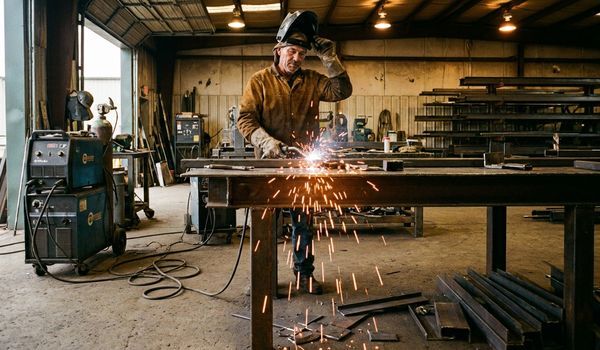
A welding shop is a commercial operation that joins, repairs, and fabricates metal components for paying customers. Work ranges from quick repairs on gates, trailers, and equipment to full custom fabrication of structural steel, railings, tanks, frames, and production parts. Most shops combine several processes under one roof, typically MIG, TIG, and stick welding, along with cutting, grinding, fitting, and finishing work.
What separates a welding shop from a solo welder is infrastructure: a physical bay or building, industrial power service, welding machines, cutting equipment, material handling gear, and usually a small team of welders and fitters. Shops take on larger, higher-value contracts than a one-person mobile operation because they can control quality, handle bigger assemblies, and run repeat production work for manufacturers and contractors.
Welding shops serve a wide customer base: construction contractors, manufacturers, farmers and ranchers, trucking and fleet operators, oil and gas companies, municipalities, and homeowners. That diversity is one of the trade's biggest economic strengths, because weakness in one customer segment is often offset by strength in another.
Welding Industry Market Overview
Welding is not a niche trade. The American Welding Society has long estimated that more than half of all products manufactured in the United States involve welding at some stage of production, which makes the trade a load-bearing part of the entire manufacturing economy. Cars, bridges, pipelines, ships, farm equipment, buildings, and appliances all depend on welded joints.
Industry analysts place the United States welding services market in the range of $5 billion to $6 billion in annual revenue, with the broader global welding market, including equipment, consumables, and automation, estimated above $20 billion and growing at a steady mid-single-digit pace. Domestic demand is being pushed by several forces at once: federal infrastructure spending on bridges, roads, and energy projects, reshoring of manufacturing, data center construction, and ongoing maintenance needs across aging industrial facilities.
The supply side is the constraint. The U.S. Bureau of Labor Statistics reports roughly 454,000 welders, cutters, solderers, and brazers working in the country, with median annual pay just under $49,000 and top earners in specialized fields well above that. The BLS projects tens of thousands of openings per year through the decade, driven mostly by retirements and workers leaving the trade rather than layoffs.
Key Stat: The American Welding Society projects that the United States will need more than 320,000 new welding professionals by 2029 to fill open jobs and replace retiring workers. For shop owners, that shortage translates directly into pricing power and a steady flow of work.
For shop owners, the market overview boils down to a simple equation: strong, diversified demand plus a constrained supply of skilled labor equals favorable conditions for well-run shops. Customers are competing for capacity, lead times have stretched, and shops with modern equipment and efficient workflows can be selective about the work they accept.
Need Equipment for Your Welding Shop?
From welders and plasma tables to compressors and cranes, Crestmont Capital finances the tools that keep shops producing. Apply in minutes.
Apply Now →Key Welding Shop Statistics for 2026
The numbers below capture the state of the welding shop business in 2026. They are drawn from federal labor data, industry associations, and market research, and together they give owners and prospective owners a realistic benchmark for planning.
Workforce and wages. The U.S. Bureau of Labor Statistics counts approximately 454,000 welders, cutters, solderers, and brazers in the national workforce. Median annual pay sits just under $49,000, while specialized welders in pipe, underwater, aerospace, and nuclear work routinely earn $70,000 to $100,000 or more. The BLS projects around 45,000 welding job openings per year on average through the early 2030s, one of the steadiest demand signals in the skilled trades.
The shortage. The American Welding Society estimates the country will need more than 320,000 additional welding professionals by 2029. The average welder is in their mid-50s, and a large share of the current workforce will retire over the next decade. Shops consistently report that finding qualified welders, not finding work, is their number one growth constraint.
Business landscape. Census Bureau business data shows tens of thousands of welding, brazing, and metal fabrication establishments operating across the United States, most of them small businesses with fewer than 20 employees. The trade remains highly fragmented, which means local reputation, turnaround time, and reliability still win contracts over scale.
Rates and revenue. Welding shops commonly charge $50 to $150 per hour for in-shop work depending on region and specialization, with mobile and emergency field work commanding $75 to $200 per hour. A well-utilized two-to-five-person shop can generate $500,000 to $1.5 million in annual revenue, and owner income for established shops typically falls between $60,000 and $150,000 or higher for specialized operations.
Profitability. Well-run welding shops commonly target net margins in the 15 percent to 25 percent range, with higher margins on specialty and rush work and thinner margins on commodity fabrication. Consumables, shielding gas, and material costs are the main variable expenses, while labor utilization is the single biggest driver of profit.
By the Numbers
Welding Shop Industry - Key Statistics for 2026
454,000
Welders, cutters, solderers, and brazers employed in the U.S. (Bureau of Labor Statistics)
320,000+
New welding professionals the American Welding Society projects the U.S. will need by 2029
$50 - $150
Typical hourly shop rate, with mobile and emergency field work running higher
50%+
Share of U.S. manufactured products that involve welding at some stage (American Welding Society)
Welding Shop Startup and Operating Costs
Startup costs vary widely depending on whether you open a full fabrication shop or start lean with mobile capability and grow into a building. Here is how the numbers generally break down in 2026.
Lean startup (mobile-first): A welder starting with a truck, a quality engine-driven welder, basic tools, insurance, and business licensing can get operational for $10,000 to $60,000. Many successful shop owners started exactly this way, building a customer base and cash reserves before signing a lease on a bay.
Full shop buildout: A brick-and-mortar welding shop typically requires $50,000 to $150,000 or more before the first invoice goes out. That covers lease deposits and buildout (including three-phase power service, which alone can run $5,000 to $25,000 depending on the building), welding machines for each process, a plasma or oxy-fuel cutting table, an air compressor, grinders and hand tools, material storage racks, a forklift or overhead crane for heavier work, ventilation and fume extraction, safety equipment, and initial inventory of steel and consumables.
Ongoing monthly costs: Rent or mortgage on an industrial bay typically runs $2,000 to $8,000 per month depending on market and size. Add utilities (welding shops are heavy power users), shielding gas and consumables, insurance, payroll, equipment payments, and marketing. A realistic monthly overhead for a small shop lands between $8,000 and $25,000 before owner pay.
Pro Tip: Equipment is usually the largest single startup line item, and it is also the easiest to finance. Financing welders, cutting tables, and material handling equipment preserves your cash for payroll, gas, and materials during the slow first year, when most new shops fail from undercapitalization rather than lack of work.
The capital planning mistake new owners make most often is spending their entire budget on equipment and leaving nothing for operating expenses. A safer structure is financing the major equipment over three to five years and keeping cash available for at least six months of overhead. That buffer is what carries a new shop through the gap between landing customers and actually collecting payment on 30-to-60-day commercial terms.
Types of Welding Shops
Welding businesses cluster into a few common models, each with different economics, equipment needs, and growth paths.
General Repair and Custom Fabrication Shops
The most common model: a local shop handling walk-in repairs, custom railings and gates, trailer work, farm equipment repair, and small fabrication contracts. Revenue is diverse and steady, margins are healthy on repair work, and growth comes from reputation and repeat customers. These shops typically run two to ten employees.
Mobile Welding Operations
Mobile welders bring the shop to the customer with a truck-mounted rig. Startup costs are the lowest in the trade, hourly rates are the highest (often $75 to $200 per hour for field and emergency work), and there is no rent. The tradeoff is limited capacity, weather exposure, and dependence on the owner-operator. Many mobile operators eventually open a fixed shop once their customer base outgrows one truck.
Specialty and Certified Welding Shops
Shops that hold certifications such as AWS structural welding credentials, ASME pressure vessel stamps, or aerospace and defense qualifications can charge premium rates and win work that general shops cannot touch. The barrier to entry is real: certification testing, documented procedures, and quality systems cost time and money. The payoff is defensible margins and long-term contracts with industrial customers.
Production and Manufacturing Welding
These shops run repeat production work: welding assemblies, frames, and components for manufacturers under contract. Margins per part are thinner than custom work, but volume and predictability make up for it. Production shops invest heavily in fixtures, jigs, robotic welding cells, and process efficiency, and they scale by adding shifts and automation rather than headcount alone.
Heavy Industrial and Field Welding
Field operations serve pipelines, refineries, power plants, mining, and large construction sites. Revenue per job is the highest in the trade, but so are equipment costs, insurance requirements, and the need for certified welders willing to travel. These businesses often combine a home shop for fabrication with field crews for installation.
Who Benefits Most from Welding Shop Services?
Welding shop customers span nearly every sector of the physical economy. Understanding who buys welding services, and why, helps explain the demand statistics above.
Construction contractors rely on shops for structural steel, stairs, railings, embeds, and on-site welding support. With infrastructure funding flowing into bridges, roads, and public works, this segment has been one of the strongest sources of shop work in 2026.
Manufacturers outsource welding for assemblies, frames, tanks, and production overflow. Reshoring trends have increased domestic fabrication demand, and many manufacturers prefer local shops that can turn parts quickly over distant suppliers with long lead times.
Agriculture and ranching customers need constant repair work on equipment, fencing, and structures. Farming regions support some of the busiest small-town welding shops in the country.
Transportation and fleet operators keep shops busy with trailer repairs, truck frames, and equipment modification. Energy companies in oil, gas, wind, and solar need certified welding for pipelines, tanks, and structural work. Homeowners and small businesses round out the mix with gates, railings, furniture, and repair work that fills schedule gaps between larger contracts.
Welding Shop vs. Mobile Welding Business
The most common strategic question in the trade is whether to invest in a fixed shop or run mobile. The numbers compare like this:
| Factor | Fixed Welding Shop | Mobile Welding Business |
|---|---|---|
| Typical startup cost | $50,000 - $150,000+ | $10,000 - $60,000 |
| Typical hourly rate | $50 - $150 | $75 - $200 |
| Monthly overhead | $8,000 - $25,000 | $1,500 - $5,000 |
| Revenue potential | $500,000 - $1.5M+ with a crew | $100,000 - $300,000 solo |
| Scalability | High: add welders, shifts, automation | Limited without hiring or opening a shop |
| Best for | Owners building a long-term, sellable business | Welders testing the market with low risk |
Many of the strongest welding businesses use both: a mobile rig for field and emergency work at premium rates, feeding customers back to a shop that handles fabrication and repeat contracts. If you are weighing the leap from mobile to a fixed shop, the statistics favor making the move once your mobile schedule is consistently booked four to six weeks out, because that backlog is evidence of demand that a shop can capture at scale.
Starting or Growing a Welding Shop Business
The path from welder to welding shop owner is well worn, and the data points to a few practices that separate the shops that thrive from the ones that stall.
Get certified where it counts. AWS structural certifications and ASME stamps unlock work that uncertified competitors cannot bid. The testing costs are modest compared to the contracts they open up, and certification is one of the highest-return investments a shop can make.
Invest in throughput, not just capacity. The shops with the best margins are rarely the ones with the most welders. They are the ones whose workflow keeps arc time high: material staged before jobs start, fixtures that cut fit-up time, a plasma table that eliminates hours of hand cutting, and clear job scheduling. Every hour of non-arc time is unbillable overhead.
Price for the real cost of labor. With the welder shortage pushing wages up, shops that underprice work to win bids end up busy and broke. Know your fully loaded cost per shop hour, including overhead, consumables, and non-billable time, and price above it. In a shortage market, customers pay for reliability.
Build commercial accounts. Walk-in repair work keeps the lights on, but recurring contracts with manufacturers, contractors, and municipalities build enterprise value. The U.S. Small Business Administration's business guide offers solid frameworks for planning this kind of growth, and its market research resources can help you size local demand before you expand.
Watch the national data. The Census Bureau's Annual Survey of Manufactures tracks the manufacturing activity that drives welding demand, and it is a useful leading indicator when you are deciding whether to add capacity.
How Crestmont Capital Helps Welding Shops
The statistics above describe an industry full of opportunity, but capturing that opportunity takes capital. Welders, cutting tables, compressors, cranes, ventilation systems, trucks, and working capital all cost money before the revenue arrives. That is where Crestmont Capital comes in.
Crestmont Capital is the #1 rated business lender in the United States, and welding and fabrication businesses are among the trades we fund most often. Through our welding equipment financing programs, shop owners can finance welders, plasma tables, and shop machinery with fixed monthly payments that match the revenue the equipment produces. For shops adding fabrication capability, our fabrication equipment financing covers everything from press brakes to CNC cutting systems.
For broader needs, our equipment financing programs cover nearly any machinery a shop needs, and a business line of credit gives you flexible working capital for materials, payroll, and the gap between invoicing and collecting on commercial accounts.
If you are researching the lending side of the trade, our guides on welding shop business loans and welding equipment financing walk through qualification requirements, terms, and how to structure funding for each stage of growth. Approvals are fast, documentation is simple, and our advisors understand the equipment and the economics of the welding trade.
Ready to Scale Your Welding Business?
Get fast, flexible financing from the #1 business lender in the U.S. No obligation - apply in minutes.
Apply Now →Real-World Scenarios
Statistics become useful when they map to real decisions. Here are five common situations welding business owners face, and how the numbers apply.
Scenario 1: The Mobile Welder Opening a First Shop
A mobile welder in Texas has run a truck rig for three years, billing $95 per hour and booked six weeks out. The data says the backlog justifies a fixed shop. A $90,000 buildout, financed largely through equipment financing, adds a bay, a second welder, and a plasma table. Within a year, shop revenue passes what the mobile rig ever produced, because the shop can run two jobs at once and take fabrication work a truck cannot handle.
Scenario 2: The Fabrication Shop Adding a CNC Plasma Table
A four-person shop spends $45,000 on a CNC plasma cutting table after tracking how many hours hand cutting consumed. Cutting time on repeat jobs drops by more than half, fit-up quality improves, and the shop takes on production contracts it previously had to decline. The equipment payment is covered by a single new contract, and everything beyond it is margin.
Scenario 3: The Repair Shop Landing a Municipal Contract
A general repair shop wins a recurring contract to maintain a city's fleet of trucks and equipment. The catch: the city pays net-60, and the shop must cover materials and payroll for two months before the first check arrives. A business line of credit bridges the gap, and the contract becomes the shop's most stable revenue line.
Scenario 4: The Owner Chasing Certified Work
A shop owner invests in AWS structural certification and ASME procedure development, roughly $15,000 in testing, documentation, and training. Within eighteen months the shop is bidding pressure and structural work at rates 40 percent above its old repair pricing, with multi-year industrial contracts replacing one-off walk-in jobs.
Scenario 5: The Emergency Equipment Replacement
A shop's primary engine-driven welder fails mid-contract during its busiest season. Rather than losing the job, the owner uses fast equipment financing to replace the machine within days. The financed payment is trivial next to the penalty and reputational cost of blowing the contract deadline.
Frequently Asked Questions
How many welding shops are there in the United States? +
Census Bureau business data shows tens of thousands of welding, brazing, and metal fabrication establishments operating across the country. The vast majority are small businesses with fewer than 20 employees, and the trade remains highly fragmented, so local reputation and turnaround time still win work over scale.
How big is the welding industry in 2026? +
Industry analysts estimate the U.S. welding services market at roughly $5 billion to $6 billion in annual revenue, while the broader global welding market, including equipment, consumables, and automation, is estimated above $20 billion and growing at a steady mid-single-digit annual pace.
How severe is the welder shortage? +
The American Welding Society projects the United States will need more than 320,000 new welding professionals by 2029, and the average welder is in their mid-50s. For shop owners, the shortage means strong pricing power and steady demand, but it also makes recruiting and retaining skilled welders the top operational challenge.
How much does it cost to start a welding shop? +
A lean mobile-first startup typically runs $10,000 to $60,000, while a full brick-and-mortar shop with multiple welding stations, cutting equipment, and material handling gear usually requires $50,000 to $150,000 or more. Equipment financing is the most common way owners cover the major machinery costs without draining operating cash.
How much do welding shop owners make? +
Established shop owners commonly earn $60,000 to $150,000 per year, with specialized shops in certified structural, pressure vessel, or industrial work often exceeding that range. Owner income tracks utilization: shops that keep welders billing a high share of hours earn substantially more than shops with idle capacity.
What is the average welder salary in 2026? +
The U.S. Bureau of Labor Statistics reports median annual pay for welders, cutters, solderers, and brazers just under $49,000. Specialized welders in pipe, underwater, aerospace, and nuclear work routinely earn $70,000 to $100,000 or more, and shop foremen and lead welders in tight labor markets command premium wages.
What services do welding shops typically offer? +
Most shops combine MIG, TIG, and stick welding with cutting, grinding, fitting, and finishing. Common work includes equipment and trailer repair, custom railings and gates, structural steel, tanks and frames, and production fabrication. Certified shops add pressure vessel, structural, and code work at premium rates.
What equipment does a welding shop need? +
Core equipment includes MIG, TIG, and stick welding machines, a plasma or oxy-fuel cutting table, an industrial air compressor, grinders and hand tools, material racks, and a forklift or overhead crane for heavier work. A full outfit typically runs $50,000 to $100,000 or more, which is why most shops finance the major pieces rather than paying cash.
Is a welding shop a profitable business? +
Yes, when run with discipline. Well-managed shops commonly target net margins of 15 to 25 percent, with higher margins on specialty and rush work. The biggest profitability drivers are labor utilization, accurate job costing, and pricing that reflects the true loaded cost of a shop hour. In the current shortage market, reliable shops rarely lack for work.
What certifications do welding shops need? +
There is no universal license to open a welding shop, but AWS welder certifications are the baseline credential customers expect. Structural work requires AWS D1.1 certification, pressure vessel and piping work requires ASME code qualifications, and aerospace and defense work has its own standards. Certifications cost time and testing fees but unlock far higher-rate contracts.
How do welding shops find customers? +
Most shop work comes from repeat commercial customers: contractors, manufacturers, farmers, fleet operators, and municipalities. New shops build their base through local networking, fast turnaround on repair work, and a strong Google Business profile for local searches. Long-term growth comes from converting one-off repairs into recurring accounts.
What are the biggest welding industry trends for 2026? +
The dominant trends are the skilled labor shortage, growing adoption of CNC cutting and robotic welding cells in production shops, rising demand from infrastructure and energy projects, and reshoring-driven manufacturing work. Shops that invest in automation to multiply the output of scarce skilled welders are pulling ahead of shops competing on labor alone.
Can you finance welding equipment for a new shop? +
Yes. Equipment financing is the standard way new shops acquire welders, cutting tables, compressors, and material handling equipment without exhausting startup cash. Terms typically run three to five years with fixed monthly payments, and approval is based more on the equipment value and your revenue picture than on perfect credit.
How much working capital does a welding shop need? +
A practical target is three to six months of overhead, which for a small shop usually means $25,000 to $100,000 in accessible capital. Commercial customers commonly pay on net-30 to net-60 terms, so the gap between buying materials and collecting payment is where most shops feel the squeeze. A business line of credit is the most flexible tool for covering that cycle.
How long does it take to open a welding shop? +
A mobile operation can be running within weeks. A fixed shop typically takes three to six months from signing a lease to full operation, with most of that time going to electrical buildout, ventilation, equipment delivery and setup, insurance, and any certification testing. Owners who line up financing and equipment orders before signing the lease compress that timeline significantly.
Put These Numbers to Work
The welding market rewards shops that invest ahead of demand. See what your business qualifies for today.
Apply Now →How to Get Started
Complete our quick application at offers.crestmontcapital.com/apply-now - it takes just a few minutes.
A Crestmont Capital advisor will review your needs and match you with the right financing option for your shop.
Receive your funds and put them to work, often within days of approval.
Conclusion
The welding shop statistics for 2026 describe a trade with durable demand, constrained labor supply, and real pricing power for owners who run efficient operations. Roughly 454,000 welders are at work in the United States, the American Welding Society projects a need for more than 320,000 additional welding professionals by 2029, and more than half of all manufactured products involve welding. Customers across construction, manufacturing, agriculture, energy, and transportation are competing for shop capacity.
For owners and prospective owners, the opportunity is clear, but it requires investment: equipment, certifications, space, and working capital to bridge commercial payment terms. The shops that thrive are the ones that invest ahead of demand rather than scrambling to catch up to it. If you are ready to start or grow your welding business, contact Crestmont Capital or apply online to see what your shop qualifies for today.
Disclaimer: The information provided in this article is for general educational purposes only and is not financial, legal, or tax advice. Funding terms, qualifications, and product availability may vary and are subject to change without notice. Crestmont Capital does not guarantee approval, rates, or specific outcomes. For personalized information about your business funding options, contact our team directly.

About the author and reviewer
Allan GarfinkleMBA (Finance), JD
Chief Revenue Officer, Crestmont Capital
Allan Garfinkle is the Chief Revenue Officer at Crestmont Capital, where he has spent more than a decade leading revenue strategy, business development, and operational growth. With 28 years of experience building and advising startups and small businesses, Allan has helped more than 10,000 business owners navigate financing decisions, growth opportunities, and changing economic conditions. He earned a Bachelor of Science in Economics and an MBA with a concentration in Finance from Northeastern University, as well as a Juris Doctor from New England Law, where his studies focused on contracts and business law. His writing draws on extensive practical experience in small-business lending, equipment financing, business credit, and commercial finance.