
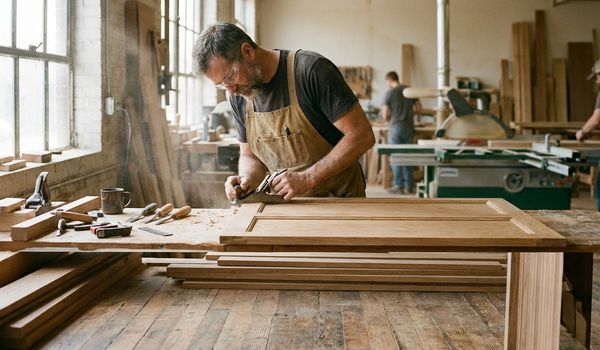
Cabinet shop statistics tell the story of one of the most resilient trades in American manufacturing. From custom residential kitchens to commercial casework for offices, schools, and healthcare facilities, cabinet shops sit at the intersection of construction, design, and skilled craftsmanship. In 2026, the shops that understand their numbers (revenue benchmarks, equipment costs, approval rates, and market demand) are the ones winning larger contracts and scaling with confidence.
This report compiles the most current cabinet shop statistics available, including industry size, revenue and profitability data, equipment investment trends, and financing patterns. Whether you own a two-person custom shop or manage a production facility with a full CNC line, these figures will help you benchmark your operation and plan your next stage of growth.
In This Article
- The Cabinet Shop Industry at a Glance
- Key Cabinet Shop Statistics for 2026
- Revenue and Profitability Statistics
- Equipment and Technology Investment Statistics
- How Cabinet Shops Use Financing
- The Most-Financed Equipment in Cabinet Shops
- Financing Approval Rates, Terms, and Costs
- Financing Options Compared
- What These Statistics Mean for Shop Owners
- Real-World Financing Scenarios
- How Crestmont Capital Helps Cabinet Shops
- FAQ
- How to Get Started
The Cabinet Shop Industry at a Glance
The U.S. cabinet and countertop manufacturing industry generates an estimated $11 billion to $13 billion in annual revenue, with the broader custom woodworking and architectural millwork segment adding several billion more. The industry is made up predominantly of small businesses: the vast majority of cabinet shops employ fewer than 20 people, and a large share operate with fewer than five.
According to the U.S. Census Bureau's County Business Patterns data, wood kitchen cabinet and countertop manufacturing (NAICS 337110) and custom architectural woodwork and millwork (NAICS 337212) together account for well over 10,000 business establishments across the country. These shops range from garage-based custom builders to automated production facilities shipping hundreds of cabinets per week.
Demand in 2026 is being driven by three forces: a residential remodeling market that continues to run near record levels, steady commercial construction in hospitality, healthcare, and office buildouts, and a persistent shortage of skilled labor that is pushing shops toward automation. The SBA Office of Advocacy counts nearly 35 million small businesses in the U.S., and construction-adjacent trades like cabinetmaking consistently rank among the most common small business categories in manufacturing.
Key Stat: The U.S. kitchen cabinet market alone is estimated at more than $11 billion annually, and industry analysts project continued low-single-digit growth through the end of the decade as remodeling activity stays elevated.
Housing market coverage from outlets like CNBC Real Estate continues to highlight the same underlying trend: homeowners are staying in place longer and renovating rather than moving, which keeps kitchen and bath remodels (the single largest demand driver for cabinet shops) at historically strong levels.
Ready to Grow Your Cabinet Shop?
Get fast, flexible financing from the #1 business lender in the U.S. No obligation - apply in minutes.
Apply Now →Key Cabinet Shop Statistics for 2026
Before diving into the details, here are the headline numbers every cabinet shop owner should know going into 2026:
- Industry size: The U.S. kitchen cabinet and vanity manufacturing market is valued at roughly $11 billion to $13 billion per year, with custom architectural millwork adding billions more.
- Number of shops: More than 10,000 cabinet manufacturing and custom millwork establishments operate across the United States, and the majority have fewer than 20 employees.
- Employment: The broader wood product and furniture manufacturing sector employs well over 350,000 workers, with cabinetmakers and bench carpenters representing one of the largest skilled trade occupations in the industry.
- Average project value: A full custom kitchen cabinet package typically runs $15,000 to $40,000, while commercial casework contracts regularly exceed $100,000 per project.
- Equipment investment: A production-level CNC router costs $30,000 to $120,000 or more, and a fully equipped modern shop often carries $250,000 to $750,000 in machinery.
- Financing usage: Equipment financing is the most common form of capital access in the trade, with the majority of machinery purchases over $25,000 involving some form of financing or leasing.
- Growth outlook: Analysts project low-single-digit annual growth for cabinet demand through 2028, with remodeling outpacing new construction as the primary driver.
These cabinet industry statistics reflect a mature but evolving trade. Shops that invest in automation and efficient workflows are capturing a growing share of the market, while shops that delay capital investment are finding it harder to compete on lead times and price.
Cabinet Shop Revenue and Profitability Statistics
Revenue varies enormously by shop size and specialization, but industry benchmarks provide useful guideposts. A solo custom cabinet maker typically generates $80,000 to $150,000 in annual revenue. A small shop with two to five employees commonly falls in the $250,000 to $750,000 range. Mid-size production shops with 10 to 20 employees often report $1 million to $3 million, and large regional manufacturers exceed $5 million.
Profitability follows a similarly wide band. Gross margins on custom cabinetry typically run 40% to 55%, while net profit margins after labor, materials, overhead, and debt service usually land between 8% and 18% for well-run shops. The shops at the top of that range share a few traits: accurate estimating systems, tight material waste control, and machinery that reduces labor hours per cabinet.
Material costs remain the single largest variable expense, typically consuming 25% to 35% of revenue. Plywood, hardwood lumber, hardware, and finishing supplies all saw price volatility earlier in the decade, and shops that lock in pricing with volume purchasing or early material buys (often funded with working capital) protect their margins more effectively.
Labor is the second major cost center. With skilled cabinetmakers in short supply, wages have risen steadily, and many shops report that finding qualified help is their number one constraint on growth. This labor pressure is a direct driver of the automation trend covered in the next section.
Pro Tip: Shops that track job-level profitability (not just overall monthly numbers) consistently outperform on margin. Knowing which job types actually make money lets you price, staff, and invest with precision.
Equipment and Technology Investment Statistics
Capital equipment is where the cabinet trade is changing fastest. A generation ago, a well-equipped shop meant a table saw, a planer, and hand tools. Today, the competitive baseline includes CNC machinery, and the investment numbers are substantial:
- CNC routers: $30,000 to $120,000 or more depending on bed size, tool changers, and vacuum systems. Nested-based manufacturing cells at the high end can exceed $200,000 with material handling.
- Edgebanders: $15,000 to $80,000, with contour and high-speed production banders at the top of the range.
- Panel saws and beam saws: $10,000 to $60,000 depending on size and automation.
- Wide belt sanders: $20,000 to $60,000 for production-grade machines.
- Finishing equipment: Spray booths, drying racks, and dust collection systems typically add $20,000 to $70,000 combined.
- Software: Cabinet design and manufacturing software (Cabinet Vision, Mozaik, Microvellum, and similar) runs $5,000 to $30,000 or more upfront, plus ongoing licensing.
Industry surveys consistently show that shops investing in CNC automation reduce labor hours per cabinet by 40% to 60% and cut material waste by 15% to 25% through optimized nesting. That is why cabinet shop equipment spending has become one of the largest line items in the trade, and why equipment financing has become the standard acquisition method rather than an exception.
How Cabinet Shops Use Financing
Financing is woven into nearly every stage of a cabinet shop's growth. Based on application patterns across the trade, here is how shop owners most commonly put capital to work:
Equipment acquisition is the dominant use. CNC routers, edgebanders, panel saws, sanders, and dust collection systems are exactly the kind of hard-asset purchases that equipment financing was designed for, and lenders can fund them quickly because the machinery itself secures the transaction.
Working capital covers the gap between paying for materials and labor and collecting on completed jobs. Cabinet shops typically front 30% to 50% of a project's cost in materials and shop time before the final invoice is paid, which makes working capital loans a common tool for smoothing cash flow across multiple concurrent jobs.
Expansion and facility costs rank third: moving to a larger building, adding a showroom, building out a finishing room, or adding a second CNC cell. These projects often combine a term loan for buildout costs with equipment financing for the machinery itself.
Materials and inventory purchases round out the list. Shops that win a large commercial contract or a multi-home builder package often need to buy $30,000 to $100,000 or more in sheet goods and hardwood before the first draw payment arrives. Short-term financing bridges that gap and keeps production moving.
By the Numbers
Cabinet Shop Industry - Key Statistics for 2026
$11B+
Estimated U.S. kitchen cabinet market size
10,000+
Cabinet manufacturing and millwork establishments nationwide
$30K-$120K
Typical cost range for a production CNC router
40-60%
Labor hours saved per cabinet with CNC automation
The Most-Financed Equipment in Cabinet Shops
Looking across financed purchases in the trade, a clear ranking emerges. These are the machines cabinet shop owners finance most often, roughly in order of frequency:
1. CNC routers and nested-based manufacturing cells. The single most financed category by dollar volume. Shops moving from manual or semi-manual production to CNC see the fastest payback, which is why lenders view these machines favorably.
2. Edgebanders. The natural second purchase after a CNC router. A shop cutting panels on a CNC needs banding capacity to match, and mid-range banders in the $25,000 to $50,000 range are the most common financing ticket.
3. Panel saws and beam saws. Shops that do not go full CNC often finance a vertical panel saw or sliding table saw as their first major upgrade.
4. Dust collection and air filtration systems. Increasingly financed as standalone purchases because of tighter shop air quality expectations and insurance requirements.
5. Finishing equipment. Spray booths, flatline finishers, and curing systems are high-ticket items that shops almost always finance rather than purchase outright.
6. Delivery vehicles and forklifts. Box trucks, trailers, and material handling equipment round out the list, typically financed alongside a larger equipment package.
For a deeper look at funding options specific to machinery purchases, our guide on cabinet making shop equipment financing walks through terms, qualification standards, and lender comparisons in detail.
Financing Approval Rates, Terms, and Costs
Cabinet shop financing statistics on the approval side are more favorable than many owners expect. Because the trade involves hard assets with strong resale markets, equipment financing approval rates for established shops are among the highest of any small business category. Alternative lenders approve the majority of complete applications from shops with at least one year of operating history, and approvals frequently come through within 24 to 48 hours.
Typical terms in 2026 look like this: equipment financing runs 24 to 72 months with fixed payments, working capital products run 6 to 24 months, and larger expansion loans can extend to 10 years or more when real estate or heavy buildout is involved. Rates depend on time in business, credit profile, and revenue, but shops with two or more years of history and consistent deposits generally qualify for far better pricing than they expect.
Credit standards are also more flexible than the bank stereotype suggests. While traditional banks typically want scores above 680 and two to three years of tax returns, alternative lenders regularly work with scores in the 600 to 650 range, and equipment-secured deals can stretch lower because the machinery collateralizes the transaction. Bank statement-based underwriting means many shops qualify on revenue alone without extensive documentation.
One underappreciated statistic: the speed difference between bank and alternative lending. An SBA or bank loan for equipment can take 30 to 90 days from application to funding. Alternative equipment financing routinely funds in two to five business days, which matters when a machine goes down mid-contract or a time-sensitive deal on used equipment appears.
Cabinet Shop Financing Options Compared
Cabinet shops have more funding options in 2026 than at any point in the trade's history. Here is how the main categories compare on the dimensions that matter most to shop owners:
| Feature | Equipment Financing | Working Capital Loan | Business Line of Credit | SBA Loan |
|---|---|---|---|---|
| Best for | CNC routers, saws, banders, vehicles | Materials, payroll, cash flow gaps | Recurring expenses and flexible draws | Large expansions, real estate |
| Typical amounts | $10,000 - $500,000+ | $10,000 - $250,000 | $25,000 - $500,000 | $50,000 - $5 million |
| Funding speed | 2 - 5 business days | 1 - 3 business days | 2 - 7 business days | 30 - 90 days |
| Term length | 24 - 72 months | 6 - 24 months | Revolving | 7 - 25 years |
| Documentation | Light: application, bank statements, quote | Light: application and bank statements | Moderate | Heavy: tax returns, financials, projections |
| Credit flexibility | High (equipment secures the deal) | Moderate to high | Moderate | Low (strictest standards) |
Most growing shops end up using a combination: equipment financing for machinery, a business line of credit for ongoing flexibility, and term-based working capital for large material buys or expansion projects. The right mix depends on where your shop is in its growth cycle and how much monthly payment capacity your cash flow supports.
What These Statistics Mean for Cabinet Shop Owners
Numbers without context are trivia. Here is what the 2026 data actually signals for shop owners making decisions this year:
Automation is no longer optional at the production level. With labor scarce and wages rising, the shops gaining share are the ones where a three-person crew with a CNC cell out-produces a six-person manual shop. The 40% to 60% labor savings per cabinet is the statistic driving more equipment financing applications than any other.
Remodeling demand is the reliable baseline. Even when new construction slows, kitchen and bath remodeling keeps cabinet demand steady. Shops with a diversified mix of residential custom work, builder relationships, and light commercial casework weather cycles far better than single-channel shops.
Cash flow discipline separates survivors from statistics. The failure rate in small manufacturing is not driven by lack of work but by cash flow mismanagement: materials purchased before deposits, payroll met before invoice collection, equipment payments sized for best-case revenue. Financing used strategically (matching payment schedules to actual cash conversion cycles) is a stabilizer, not a risk.
Speed to quote and deliver wins work. General contractors and homeowners increasingly award jobs to shops that can commit to reliable lead times. Shops with financed capacity (the second CNC, the faster bander, the dedicated finishing line) win bids on schedule certainty as often as on price.
Real-World Cabinet Shop Financing Scenarios
To make the statistics concrete, here are five scenarios drawn from common patterns across the trade:
Scenario 1: The first CNC router. A three-person custom shop in Tennessee doing $420,000 a year was turning away work because of six-week lead times. They financed a $78,000 CNC router with an auto tool changer over 60 months. Within four months, lead times dropped to two and a half weeks, monthly output rose 45%, and the machine payment was covered by margin on just two additional kitchens per month.
Scenario 2: The commercial contract bridge. A mid-size shop in Ohio won a $280,000 casework package for a medical office buildout. The contract required $95,000 in materials before the first draw. A short-term working capital facility covered the material buy, the shop delivered on schedule, and the facility was repaid from the second progress payment with the relationship leading to three more contracts from the same GC.
Scenario 3: The edgebander bottleneck. A production shop in Texas added a CNC router two years ago but kept banding edges by hand with a small portable unit. Financed a $42,000 automatic edgebander over 48 months. Finishing throughput finally matched cutting capacity, eliminating a two-shift backlog and cutting overtime labor by a third.
Scenario 4: The fleet and install expansion. A cabinet shop in Arizona expanded from shop-only production into full installation services, financing two box trucks and a trailer over 60 months. Installation revenue now represents 30% of their business at higher margins than fabrication alone.
Scenario 5: The finishing room buildout. A growing shop in the Carolinas was outsourcing finishing at $18 to $22 per door, eroding margin on every job. They financed a spray booth, drying system, and buildout for $85,000 combined. In-house finishing dropped their per-door cost under $9 and cut a week off delivery times, paying back the investment inside 18 months.
How Crestmont Capital Helps Cabinet Shops
Crestmont Capital works with cabinet shops and custom woodworking businesses across the country, and the funding patterns in this report mirror what we see in our own portfolio. As the #1-rated business lender in the U.S., we structure financing around how cabinet shops actually operate: project-based revenue, material-heavy cost cycles, and equipment-driven growth.
Our equipment financing programs cover everything from a first CNC router to a full production cell, with fast approvals and terms matched to the useful life of the machinery. For shops managing the gap between material purchases and project payments, our working capital loans and business lines of credit keep production moving without straining cash reserves.
If you are weighing your options, our existing guide on cabinet business loans covers the full landscape of loan types for cabinet shop owners, and the application takes just a few minutes to complete. Most shops receive a decision within 24 hours and funding within days, not months.
Get the Equipment Your Shop Needs
Fast approvals, flexible terms, and funding in days. See what your cabinet shop qualifies for today.
Apply Now →Frequently Asked Questions
How big is the cabinet shop industry in the United States? +
The U.S. kitchen cabinet and vanity manufacturing market is estimated at roughly $11 billion to $13 billion annually, with custom architectural woodwork and millwork adding several billion more. The industry includes more than 10,000 establishments, the large majority of them small businesses with fewer than 20 employees.
How many cabinet shops operate in the U.S.? +
U.S. Census Bureau County Business Patterns data shows well over 10,000 establishments across wood kitchen cabinet and countertop manufacturing and custom architectural woodwork. That count covers employer establishments; including solo non-employer shops, the true number of operating cabinet businesses is significantly higher.
What is the average revenue for a cabinet shop? +
Revenue ranges widely by size. Solo custom shops typically generate $80,000 to $150,000 annually, small shops with two to five employees often run $250,000 to $750,000, mid-size production shops reach $1 million to $3 million, and large regional manufacturers exceed $5 million per year.
What profit margins do cabinet shops typically earn? +
Gross margins on custom cabinetry typically run 40% to 55%. Net profit margins after labor, materials, and overhead usually land between 8% and 18% for well-managed shops, with the strongest performers using job-level cost tracking and automated production to protect margin.
How much does it cost to start a cabinet shop? +
A modest startup with used equipment can launch for $50,000 to $100,000, while a properly equipped new shop with a CNC router, edgebander, dust collection, and finishing capability typically requires $250,000 to $750,000 in equipment and facility investment. Most owners finance the machinery rather than paying cash.
What equipment do cabinet shops finance most often? +
CNC routers top the list by dollar volume, followed by edgebanders, panel saws, wide belt sanders, dust collection systems, spray booths and finishing equipment, and delivery vehicles. Software packages for cabinet design and nesting are also commonly financed.
How much does a CNC router cost for a cabinet shop? +
Entry-level production CNC routers start around $30,000, mid-range machines with automatic tool changers run $60,000 to $120,000, and full nested-based manufacturing cells with material handling can exceed $200,000. Most shops finance these purchases over 48 to 72 months.
What credit score do you need for cabinet shop equipment financing? +
Traditional banks typically look for scores of 680 or higher. Alternative equipment lenders regularly approve scores in the 600 to 650 range, and because the equipment itself secures the transaction, approvals are possible with lower scores when revenue and time in business are solid.
How fast can a cabinet shop get approved for financing? +
Alternative lenders typically issue decisions within 24 to 48 hours and fund within two to five business days. Bank and SBA loans offer lower rates but take 30 to 90 days from application to funding, which is why most machinery purchases use faster equipment financing.
Can a new cabinet shop get financing with no business history? +
Yes, though options narrow. Startups generally need stronger personal credit, a meaningful down payment of 10% to 20%, and sometimes additional collateral. Equipment financing is usually the most accessible product for new shops because the machinery collateralizes the deal.
Is leasing or buying better for cabinet shop equipment? +
Buying through equipment financing builds equity and usually costs less over the machine's life, making it the better choice for core production machinery you will run for a decade or more. Leasing can make sense for rapidly evolving technology or when preserving cash and credit lines matters more than ownership.
How does seasonal demand affect cabinet shop cash flow? +
Most shops see demand peaks in spring and fall when remodeling activity rises, with slower stretches in mid-winter. Owners smooth the cycle with lines of credit for materials and payroll, deposits structured to front-load cash, and equipment payments sized to remain comfortable in slow months.
What is driving cabinet industry growth in 2026? +
Three forces: a residential remodeling market running near record levels as homeowners renovate rather than move, steady commercial construction in healthcare, hospitality, and office space, and labor scarcity pushing investment toward automated production capacity.
Can cabinet shops use financing for materials and inventory? +
Yes. Working capital loans and business lines of credit are routinely used for plywood, hardwood, hardware, and finishing supply purchases, especially when a shop fronts $30,000 to $100,000 or more in materials before a large contract's first progress payment arrives.
How do I apply for cabinet shop financing with Crestmont Capital? +
Complete the short online application at offers.crestmontcapital.com/apply-now. Most shops receive a decision within 24 hours. You will typically need three to six months of business bank statements and a quote or invoice for any equipment being financed.
Join Thousands of Funded Businesses
Crestmont Capital has funded businesses in every industry across the U.S. Your cabinet shop could be next.
Apply Now →How to Get Started
Complete our quick application at offers.crestmontcapital.com/apply-now - takes just a few minutes.
A Crestmont Capital advisor will review your needs and match you with the right financing option for your shop.
Receive your funds and put them to work - often within days of approval.
The Bottom Line on Cabinet Shop Statistics in 2026
The cabinet shop statistics for 2026 describe a trade that is stable, growing modestly, and rewarding the shops that invest in capacity. An $11 billion-plus core market, more than 10,000 establishments, and sustained remodeling demand create a reliable foundation. At the same time, labor scarcity and rising customer expectations around lead times mean that the gap between automated shops and manual shops keeps widening.
For owners, the playbook the data supports is straightforward: track your numbers at the job level, keep cash flow matched to your project cycle, and use financing strategically to add the capacity that wins work. The shops growing fastest in 2026 are not necessarily the largest; they are the ones that made timely, well-structured investments in equipment and working capital.
Whether you are buying your first CNC router, bridging a major commercial contract, or building out a finishing room, Crestmont Capital can help you move quickly. The application takes minutes, decisions typically come within 24 hours, and funding arrives in days. Put the numbers in this report to work for your shop.
Disclaimer: The information provided in this article is for general educational purposes only and is not financial, legal, or tax advice. Funding terms, qualifications, and product availability may vary and are subject to change without notice. Crestmont Capital does not guarantee approval, rates, or specific outcomes. For personalized information about your business funding options, contact our team directly.

About the author and reviewer
Allan GarfinkleMBA (Finance), JD
Chief Revenue Officer, Crestmont Capital
Allan Garfinkle is the Chief Revenue Officer at Crestmont Capital, where he has spent more than a decade leading revenue strategy, business development, and operational growth. With 28 years of experience building and advising startups and small businesses, Allan has helped more than 10,000 business owners navigate financing decisions, growth opportunities, and changing economic conditions. He earned a Bachelor of Science in Economics and an MBA with a concentration in Finance from Northeastern University, as well as a Juris Doctor from New England Law, where his studies focused on contracts and business law. His writing draws on extensive practical experience in small-business lending, equipment financing, business credit, and commercial finance.