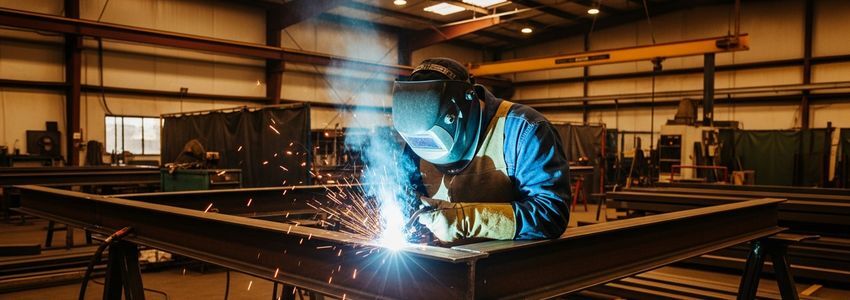
Running a welding shop takes more than skill with a torch -- it takes capital for equipment, materials, payroll, and growth. Whether you are expanding your shop floor, buying a new MIG welder, or bridging a slow season, welding shop business loans give you the financial runway to keep operations moving. This complete guide walks you through every financing option available to welding contractors and small fabrication businesses in 2026.
In This Article
- What Are Welding Shop Business Loans?
- Key Benefits of Financing for Welding Businesses
- How Welding Shop Loans Work
- Types of Loans Available to Welding Shops
- Who Qualifies for Welding Business Financing?
- How Crestmont Capital Helps Welding Contractors
- Real-World Funding Scenarios
- Welding Industry Statistics and Key Numbers
- Frequently Asked Questions
- How to Get Started
- Conclusion
What Are Welding Shop Business Loans?
Welding shop business loans are financing products designed specifically to fund the operational and growth needs of welding contractors, fabrication shops, and metalworking businesses. These loans cover a wide range of expenses -- from purchasing plasma cutters and welding robots to covering material costs, hiring certified welders, or moving into a larger facility.
Unlike general consumer loans, business loans for welding shops are evaluated on the financial health of your business -- revenue, time in operation, and creditworthiness -- rather than purely on personal credit alone. This makes them accessible to many shop owners who have strong business performance even if their personal credit history is not spotless.
Welding businesses are capital-intensive. A single industrial welding machine can run $5,000 to $100,000 or more depending on the type (MIG, TIG, plasma, robotic). Add in raw materials like steel, aluminum, and specialty alloys, plus the cost of certified welders, safety equipment, and shop overhead, and you quickly see why access to fast, flexible capital is critical in this trade.
Key Fact: The U.S. welding industry employs over 400,000 workers and generates more than $17 billion in annual revenue, with strong demand across construction, oil and gas, manufacturing, and aerospace sectors. (Source: U.S. Bureau of Labor Statistics)
Whether you run a one-person mobile welding operation or a multi-bay fabrication shop with a full crew, the right loan product can bridge cash flow gaps, fund equipment upgrades, or fuel rapid expansion when a big contract comes in.
Key Benefits of Financing for Welding Businesses
Access to business financing unlocks real competitive advantages for welding shops. Here is why savvy shop owners use loans strategically rather than waiting to save up capital:
- Upgrade Equipment Without Draining Cash: Modern welding equipment -- automated TIG welders, CNC plasma cutters, robotic welding cells -- dramatically improves throughput and quality. Financing lets you acquire the best tools without depleting your reserves.
- Win Larger Contracts: Many big industrial or government contracts require a minimum equipment inventory, certified capacity, or bonding. A business loan helps you get qualified faster so you can bid on higher-value work.
- Manage Seasonal Cash Flow: Welding shops tied to construction or oil and gas can experience sharp seasonal cycles. A business line of credit smooths out the gaps between big project payments.
- Hire and Train Certified Welders: AWS-certified welders command premium wages. Financing helps cover payroll during ramp-up periods when new hires are being onboarded to new contracts.
- Expand Your Shop Floor: Growth often means moving to a bigger space. A long-term business loan can fund a build-out or a new facility lease deposit.
- Buy Materials in Bulk: Steel, aluminum, and specialty metals fluctuate in price. Purchasing materials in bulk during price dips can save significant money -- and a working capital loan makes that possible.
- Build Business Credit: Responsibly using business financing builds your shop's credit profile, enabling access to larger credit lines and better rates in the future.
Ready to Grow Your Business?
Get fast, flexible financing from Crestmont Capital. No obligation -- apply in minutes.
Apply Now ->How Welding Shop Loans Work
The process of securing a business loan for a welding shop is more straightforward than many owners assume. Here is the typical flow:
1. Application: You submit a short application detailing your business -- monthly revenue, time in business, and intended use of funds. Most alternative lenders require minimal paperwork upfront compared to traditional banks.
2. Review and Approval: The lender evaluates your business bank statements (typically 3 to 6 months), credit score, and overall financial health. Some lenders can approve applications in as little as 24 hours.
3. Offer: You receive a loan offer detailing the amount, term, rate, and repayment structure. For welding shops, loan amounts typically range from $10,000 to $500,000+ depending on revenue and needs.
4. Funding: Once you accept the offer, funds are deposited directly into your business bank account -- sometimes the same day or next business day.
5. Repayment: Depending on the product, repayment may be daily, weekly, or monthly. Some products are tied to a percentage of your credit card sales (merchant cash advance) while others are fixed-payment term loans.
One important distinction: welding shop loans from alternative lenders like Crestmont Capital are far faster than traditional SBA loans, which can take 60 to 90 days. If you need capital quickly -- for materials on a rush job, a piece of equipment at auction, or to make payroll -- working with a direct lender is often the right call. You can learn more about the difference between these options at SBA.gov.
Types of Loans Available to Welding Shops
Welding businesses have access to a variety of financing products. The right choice depends on your purpose, timeline, and financial profile:
1. Small Business Term Loans
A lump-sum loan repaid over a fixed term (6 months to 5 years). Ideal for one-time capital needs like purchasing equipment, expanding a facility, or covering a large material purchase. Interest rates vary from around 8% to 30%+ depending on credit profile. Visit our small business loans page for details.
2. Equipment Financing
Specifically designed to purchase welding machines, plasma cutters, welding robots, lifts, or other physical assets. The equipment itself serves as collateral, which often means lower rates and higher approval odds. Loan terms typically match the useful life of the equipment -- 2 to 7 years. See our equipment financing options.
3. Business Line of Credit
A revolving credit facility that lets you draw funds as needed, up to a set limit. Pay interest only on what you draw. Perfect for welding shops managing fluctuating cash flow between project completions and material purchases.
4. Short-Term Business Loans
Repaid over 3 to 18 months, these loans are fast to obtain and useful for bridging cash flow gaps or funding urgent needs. Higher rates than long-term loans, but the speed and flexibility often justify it. Learn more about short-term business loans.
5. Merchant Cash Advance (MCA)
An advance on future sales repaid via a percentage of daily credit card or bank deposits. No fixed monthly payment -- the repayment scales with revenue. Useful for shops with high credit card volume but variable monthly income.
6. SBA Loans
Government-backed loans through the Small Business Administration offer low rates and long terms (up to 25 years for real estate). The 7(a) and 504 programs are the most common for welding shops buying equipment or real estate. The tradeoff is a lengthy application process. View our SBA loan resources to learn more.
7. Invoice Financing
If your welding shop does B2B work and invoices clients Net-30 or Net-60, invoice financing lets you get paid upfront -- typically 80% to 90% of the invoice value -- instead of waiting weeks. This is powerful for shops with slow-paying commercial clients.
Key Fact: According to Forbes, equipment financing is one of the fastest-growing segments of small business lending, with the Equipment Leasing and Finance Association reporting over $1 trillion in annual equipment and software financing across the U.S. economy.
Who Qualifies for Welding Business Financing?
Qualification requirements vary by lender and product, but here are the typical benchmarks for most alternative lending products:
- Time in Business: Most lenders require at least 6 months to 1 year of operating history. SBA and bank loans typically want 2+ years.
- Monthly Revenue: A common minimum is $10,000 to $15,000 in gross monthly revenue. Higher revenue opens access to larger loan amounts.
- Credit Score: Many alternative lenders approve welding shops with credit scores as low as 550 to 600. SBA loans and bank loans typically require 680+. If your credit is challenged, explore bad credit business loans.
- Business Bank Statements: Lenders want to see your cash flow history -- typically 3 to 6 months of bank statements.
- Industry Classification: Most welding and fabrication businesses are classified under NAICS codes 332810 (Fabricated Metal Products) or 811310 (Commercial and Industrial Machinery Repair), both of which are eligible for most small business financing products.
If you are a newer shop or have credit challenges, there are still options. No-credit-check products and revenue-based financing options are available for shops with strong bank deposits even without a stellar credit history. See business loans with no credit check for details.
How Crestmont Capital Helps Welding Contractors
Crestmont Capital is one of the top-rated direct business lenders in the United States, specializing in fast, flexible funding for small and mid-size businesses -- including welding shops and fabrication contractors. Here is what sets Crestmont apart:
- Same-Day and Next-Day Funding: When you have a time-sensitive material purchase or payroll deadline, Crestmont can often fund within hours of approval. See our same-day business loans.
- Loan Amounts from $5,000 to $2 Million: Whether you need a small bridge or a major equipment purchase, Crestmont has the right product.
- Flexible Repayment Terms: Daily, weekly, or monthly options to match your cash flow cycle.
- Simple Application: No mountains of paperwork. The online application takes minutes, and a funding advisor will reach out quickly.
- Bad Credit Options: Crestmont works with welding shop owners across the credit spectrum -- prime, near-prime, and challenged credit welcome.
- Industry Expertise: Crestmont understands the cash flow patterns of trade contractors. They speak your language and structure loans to fit how welding businesses actually operate.
Ready to Grow Your Business?
Get fast, flexible financing from Crestmont Capital. No obligation -- apply in minutes.
Apply Now ->Real-World Funding Scenarios for Welding Shops
Here are six realistic examples of how welding shop owners use business loans to solve real challenges and grow their businesses:
Scenario 1: Buying a Robotic Welding Cell
A structural fabrication shop in Ohio wins a contract to produce 500 custom steel assemblies per month for an automotive supplier. Their current manual welding setup cannot handle the volume. The owner applies for a $120,000 equipment loan to purchase a robotic MIG welding cell. Within 60 days of funding, the shop triples production capacity and lands a 2-year supply agreement -- turning the loan into a multi-year revenue driver.
Scenario 2: Bridging Slow Winter Months
A mobile welding contractor in Montana does most of his revenue from April through October supporting ranch equipment, pipeline, and oilfield repairs. The winter months create a cash crunch. He uses a $35,000 short-term loan to cover shop rent, truck payments, and equipment maintenance through February and March, then repays it as soon as spring contracts kick back in.
Scenario 3: Materials Purchasing on a Big Contract
A custom metal fabrication shop wins a $280,000 contract to produce decorative structural steel for a commercial building project. The customer pays Net-60, but materials must be purchased upfront. The shop secures a $75,000 line of credit to buy steel and supplies at the start, then pays it down when the contract milestone payments arrive.
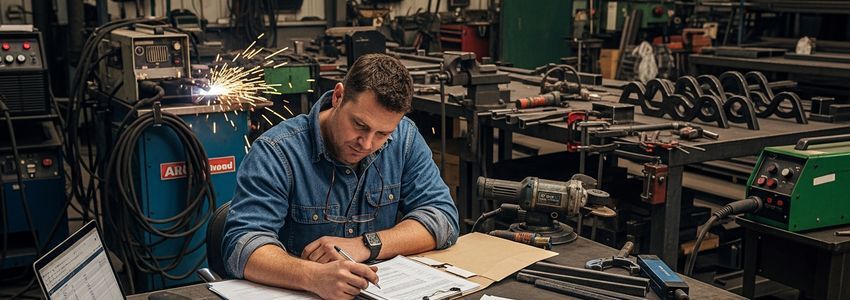
Scenario 4: Expanding from a Home Shop to a Commercial Facility
A self-employed welder has been running out of his garage for 3 years and is turning away jobs because he lacks space and equipment. He applies for a $50,000 term loan to lease a 3,000-square-foot commercial bay, purchase a new plasma table, and hire his first employee. Within 12 months, revenue doubles and he is positioned for further growth.
Scenario 5: Surviving a Customer Default
A small welding shop completes $40,000 worth of custom structural work for a contractor who goes out of business before paying. The shop owner uses a $30,000 merchant cash advance to keep the lights on, pay his two employees, and fulfill smaller jobs while pursuing legal remedies for the unpaid invoice. The advance buys critical time without requiring collateral.
Scenario 6: Certifications and Training
A pipe welding contractor wants to expand into higher-margin nuclear and pressure vessel work, but needs to get AWS D1.1 and ASME certifications for himself and two employees. Certification training and testing runs $8,000 to $15,000. He uses a small working capital loan to fund training, then wins contracts at 2x his previous rates within six months of getting certified.
Welding Industry Statistics and Key Numbers
By the Numbers
Welding Shop Business Loans -- Key Statistics
400K+
Welding workers employed in the U.S. (BLS, 2025)
$17B+
Annual U.S. welding industry revenue
3.4%
Projected annual growth in welding jobs through 2033 (BLS)
$62K
Median annual wage for welders in the U.S. (BLS, 2024)
The welding industry is robust and growing. According to the U.S. Bureau of Labor Statistics, demand for welders, cutters, solderers, and brazers is expected to grow steadily through the early 2030s, driven by infrastructure investment, manufacturing reshoring, and energy sector expansion. The American Welding Society (AWS) projects a shortage of 360,000 skilled welders by 2027 -- meaning those already in the industry are positioned for strong demand and pricing power.
For shop owners, this environment creates tremendous opportunity -- but capitalizing on it requires capital. According to CNBC, 44% of small business owners say access to capital is their biggest barrier to growth. Welding shops that secure the right financing now will be positioned to capture a larger share of this growing market.
The Small Business Administration reports that the manufacturing and fabrication sector -- which includes welding shops -- receives billions in business loan volume annually. Lenders view welding businesses as strong borrowers because the demand for welding services is consistent across multiple industries including construction, oil and gas, automotive, aerospace, defense, and agriculture. More information on business lending programs is available at SBA.gov.
Key Fact: The AWS projects a shortage of 360,000 skilled welders by 2027, creating significant pricing power and demand for established welding shops. Shops with the capital to hire and equip additional welders now stand to benefit most from this labor gap.
Frequently Asked Questions
What types of loans are best for welding shops?
The best loan type depends on your specific need. Equipment financing is ideal for purchasing welding machines and tools. A business line of credit works best for managing cash flow. Term loans are great for larger one-time investments like facility expansion. Merchant cash advances help shops with strong daily sales but variable income.
How much can a welding shop borrow?
Loan amounts for welding businesses typically range from $5,000 to $2 million or more, depending on your revenue, credit profile, and time in business. Most alternative lenders offer $10,000 to $500,000. SBA loans can go higher for established shops with strong financials.
Can I get a welding shop loan with bad credit?
Yes. Many alternative lenders approve welding shops with credit scores in the 550-600 range, especially if you have strong monthly revenue and positive cash flow. Products like merchant cash advances and revenue-based financing focus primarily on business performance rather than personal credit scores.
How fast can a welding business get funded?
Alternative lenders can fund welding shops in as little as 24 hours after approval. Same-day funding is available for qualifying businesses. Traditional banks and SBA loans take much longer -- typically 30 to 90 days for full approval and funding.
Do I need collateral to get a welding business loan?
Not always. Many alternative lenders offer unsecured business loans for welding shops based on revenue and creditworthiness. Equipment financing uses the equipment itself as collateral. SBA loans and bank loans typically require collateral and/or a personal guarantee.
Can a new welding business get a loan?
It depends. Most alternative lenders require 6 to 12 months of operating history and business bank statements. If you are a brand-new startup with zero revenue history, your options are more limited -- SBA microloans, personal business loans, or equipment financing with a personal guarantee are common routes for startups.
What can I use a welding shop business loan for?
Common uses include purchasing welding machines and equipment, buying raw materials (steel, aluminum, alloys), covering payroll, leasing or expanding shop space, funding certification and training programs, marketing and website development, purchasing vehicles and trailers, and bridging cash flow gaps between projects.
What documents do I need to apply for a welding business loan?
For most alternative lenders, you will need: 3 to 6 months of business bank statements, a government-issued ID, basic business information (EIN, legal name, address), and sometimes a voided business check. SBA and bank loans require more documentation including tax returns, P&L statements, and sometimes a business plan.
Is equipment financing better than a term loan for buying welding machines?
Equipment financing is often better for purchasing welding equipment specifically because the equipment serves as collateral, resulting in lower rates and easier approvals. Term loans offer more flexibility in how you use funds. If you are buying a specific machine, equipment financing is usually the better economic choice.
How do interest rates compare between lenders for welding shops?
Rates vary widely. Bank loans: 6-12% APR. SBA loans: 7-11% APR. Equipment financing: 8-20% APR. Alternative term loans: 15-40%+ APR. Merchant cash advances: factor rates of 1.1x to 1.5x (equivalent to 30-100%+ APR). The best rates go to businesses with strong credit, solid revenue, and longer operating history.
Can a sole proprietor welding contractor get a business loan?
Yes. Sole proprietors can qualify for business loans. You will typically apply using your SSN or EIN, provide personal and business bank statements, and may need to sign a personal guarantee. Forming an LLC can improve your options and separate personal from business liability, but it is not always required to get funded.
What is invoice financing and how does it help welding shops?
Invoice financing (or factoring) lets you sell unpaid customer invoices to a lender for immediate cash -- typically 80-90% of the invoice value upfront. This solves the common welding shop problem of completing work but waiting 30-60 days for payment. It improves cash flow without taking on traditional debt.
Will applying for a business loan hurt my credit score?
Most pre-qualification checks use a soft credit pull, which does not affect your score. A hard pull occurs when you submit a formal application. Multiple hard pulls in a short window can temporarily reduce your score by a few points. Once you find the right lender, limit formal applications to one or two.
How do I use a business loan to grow my welding shop?
The most impactful uses of a business loan for welding growth include: purchasing equipment that directly increases your capacity and speed, hiring additional certified welders to handle more projects simultaneously, investing in certifications that open access to higher-margin contracts, and expanding your facility to accommodate larger or more complex fabrication work.
How quickly can Crestmont Capital fund my welding business?
Crestmont Capital can fund qualifying welding businesses in as little as 24 hours -- and sometimes the same business day. The application takes just minutes, and a dedicated funding advisor will reach out quickly to discuss your options and move things forward.
How to Get Started
Complete our quick application at offers.crestmontcapital.com/apply-now -- it takes just a few minutes and there is no obligation.
A Crestmont Capital funding specialist will review your application and reach out to discuss loan options, amounts, and terms that fit your welding business needs.
Once approved, funds are deposited directly into your business bank account -- often the same day or next business day. Then put that capital to work growing your shop.
Conclusion
The welding industry is thriving, and welding shop owners who have access to capital are positioned to grow faster, win bigger contracts, and build lasting businesses. Whether you need to upgrade your equipment, hire more welders, smooth out cash flow, or expand your facility, the right business loan can be the catalyst that takes your operation to the next level.
Crestmont Capital makes it easy for welding contractors and fabrication shops to access the financing they need -- quickly, transparently, and with options designed for trade businesses. From small working capital advances to larger equipment loans, there is a product that fits your situation. Do not let lack of capital hold your shop back when funding is just a few clicks away. Visit our fast business loans page to see just how quickly you can get funded.
Ready to Grow Your Business?
Get fast, flexible financing from Crestmont Capital. No obligation -- apply in minutes.
Apply Now ->Disclaimer: The information provided in this article is for general educational purposes only and is not financial, legal, or tax advice. Funding terms, qualifications, and product availability may vary and are subject to change without notice. Crestmont Capital does not guarantee approval, rates, or specific outcomes. For personalized information about your business funding options, contact our team directly.