Water damage restoration is one of the most recession-resistant service businesses in existence. Floods, pipe bursts, appliance failures, and storm damage happen regardless of economic conditions — and property owners, insurance companies, and property managers all need immediate, professional remediation. The demand is non-discretionary and often urgent. But building and scaling a water damage restoration company requires substantial capital: specialized extraction and drying equipment, vehicles capable of carrying heavy equipment to job sites, working capital to fund emergency jobs before insurance reimbursement arrives, and the systems and certifications to work within the insurance billing process. This guide covers every financing option available to water damage restoration business owners, what lenders look for, and how to grow your restoration company with the right capital.
In This Article
- Why Restoration Businesses Need Financing
- Types of Restoration Business Loans
- Equipment Financing for Restoration Companies
- Insurance Receivables and Cash Flow
- SBA Loans for Restoration Businesses
- How to Qualify for a Restoration Business Loan
- Restoration Loan Rates, Terms, and Amounts
- Best Uses for Restoration Business Financing
- Water Damage Restoration Industry Statistics
- How to Apply and What to Prepare
- Why Restoration Companies Choose Crestmont Capital
- Frequently Asked Questions
Why Restoration Businesses Need Financing
Water damage restoration companies face a distinctive cash flow structure: they perform emergency work immediately, often before any payment commitment is confirmed, and then wait 30 to 90 days for insurance reimbursement. The gap between deploying equipment, labor, and materials to a job site and receiving payment from an insurance company is the most significant operational challenge in the restoration industry.
Beyond the insurance receivable gap, restoration businesses have specific capital needs at each stage of growth:
- Equipment — commercial water extractors, air movers, dehumidifiers, drying systems, thermal cameras, moisture meters, and containment equipment represent significant capital investment
- Vehicles — cargo vans and trucks capable of carrying heavy restoration equipment to job sites around the clock
- Working capital — funding emergency jobs before insurance payment, covering payroll and supplies between receivables
- Certifications and training — IICRC certifications required for insurance-paid restoration work have upfront costs; new technician training is ongoing
- Software and technology — Xactimate estimating software, job management platforms, and documentation systems
- Adding service lines — fire/smoke restoration, mold remediation, and biohazard cleanup expand revenue significantly but require additional equipment and certifications
- Expanding geographic reach — storm events create surge demand; having additional trucks and equipment to respond to large-scale events requires capital
Lender Perspective: Water damage restoration businesses are viewed favorably by lenders because of their recession-resistant demand, insurance-backed revenue (which is more reliable than typical commercial invoices), and tangible equipment collateral. Established restoration companies with documented insurance billing histories and certifications are strong loan candidates. For broader contractor financing context, see our Construction Business Loans: The Complete Financing Guide for Contractors and Builders.
Types of Restoration Business Loans
Small Business Term Loans
Term loans provide a lump sum repaid over a fixed period. For restoration businesses, term loans work best for significant one-time investments — purchasing a full equipment package, adding a crew and vehicle, or acquiring a competitor. Terms range from 12 to 84 months with rates from 6% to 45%+ depending on lender and profile. Online alternative lenders approve in 1 to 5 days; banks take 2 to 8 weeks at lower rates.
Equipment Financing
Equipment financing is ideal for restoration companies because the equipment — extractors, air movers, dehumidifiers, vehicles — is durable, identifiable, and retains value well. Equipment serves as collateral, making approval more accessible and rates more favorable than unsecured financing. Most restoration equipment packages can be financed over 3 to 5 years.
Business Lines of Credit
A revolving line of credit is the most useful ongoing financing tool for restoration companies to bridge the insurance receivable gap. Draw to fund new jobs, repay when insurance payment arrives, draw again for the next emergency. A $50,000 to $150,000 line of credit eliminates the capacity constraint of waiting for one job to pay before starting the next.
Invoice Financing
Invoice financing advances 80% to 90% of outstanding invoices — including insurance claims in processing — immediately. For restoration businesses with large insurance receivables on 60 to 90-day timelines, invoice financing directly eliminates the cash flow constraint. For more on invoice financing structures, see our Invoice Financing: The Complete Guide for Small Business Owners.
SBA 7(a) Loans
SBA loans offer the lowest rates for qualified businesses. Water damage restoration companies qualify as specialty trade contractors under SBA guidelines. SBA loans are most appropriate for $100,000+ investments — full equipment packages, vehicle fleets, or business acquisitions — where the 60 to 90-day approval timeline is acceptable.
Merchant Cash Advances
MCAs provide immediate capital repaid through a percentage of daily card transactions. Approval is 24 to 48 hours with minimal documentation, but effective APRs of 60% to 150%+ make MCAs significantly more expensive. Best reserved for urgent short-term needs when other options aren't available.
Ready to Grow Your Restoration Business?
Get fast, flexible financing from the #1 business lender in the U.S. No obligation — apply in minutes.
Apply Now →Equipment Financing for Restoration Companies
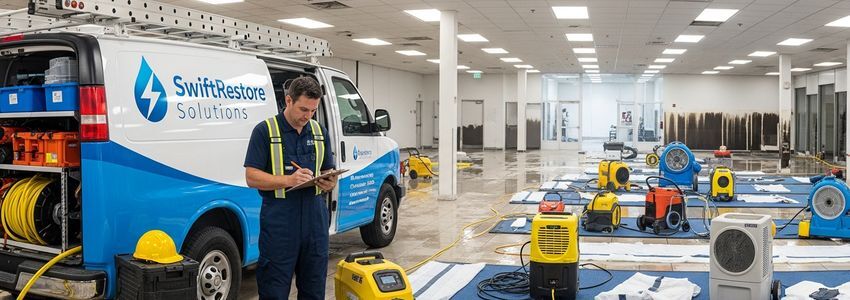
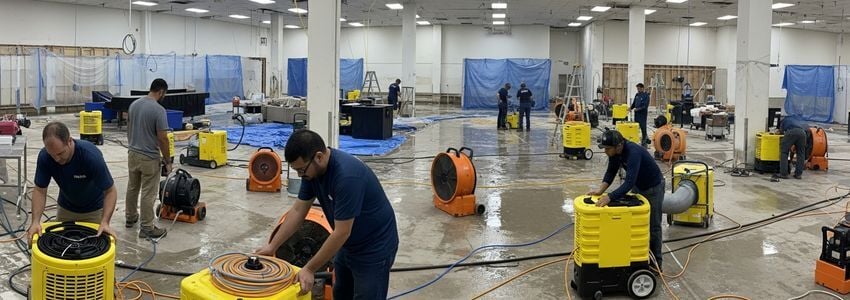
Restoration equipment is capital-intensive, technically specialized, and directly tied to job capacity. Each additional truck/equipment package enables another simultaneous job. Key equipment categories and costs:
- Commercial water extractors: $2,000–$8,000 per unit for truck-mount or portable extraction systems
- Air movers (drying fans): $150–$400 per unit; most jobs require 10–40 units simultaneously
- Commercial dehumidifiers: $1,500–$4,000 per unit for LGR (Low Grain Refrigerant) dehumidifiers
- Thermal imaging cameras: $1,500–$5,000 for moisture detection and documentation
- Moisture meters: $300–$1,500 per unit for wall and floor moisture measurement
- Air scrubbers and HEPA filtration: $800–$3,000 per unit for containment and air quality control
- Containment equipment: Poly sheeting, zipper walls, negative air pressure systems — $500–$3,000 per kit
- Cargo vans and box trucks: $35,000–$55,000 new for equipment transport vehicles
- Truck-mounted extraction systems: $20,000–$60,000 for high-capacity truck-mount units
A fully equipped single-crew restoration package (van + complete equipment set for simultaneous drying of a mid-size residential loss) commonly runs $80,000 to $150,000. Equipment financing spreads this over 3 to 5 years while the crew's revenue services the payment.
Insurance Receivables and Cash Flow
The insurance billing cycle is the defining cash flow challenge of the restoration industry. Understanding how to finance around it is essential for growing a restoration business:
The Insurance Payment Timeline
A typical restoration job follows this cash flow timeline:
- Day 0: Emergency call received; crew deploys immediately
- Day 1–5: Emergency mitigation completed; materials and labor deployed
- Day 5–30: Documentation compiled; Xactimate estimate submitted to insurance adjuster
- Day 30–60: Insurance adjuster review and approval
- Day 60–90: Payment received from insurance company or property owner
The result: you deploy $10,000 to $50,000+ in labor, equipment, and materials on Day 0, and receive payment 60 to 90 days later. A business line of credit or invoice financing eliminates this gap, enabling you to start new jobs without waiting for prior job payments.
Financing Solutions for Insurance Receivables
- Business line of credit: Draw to fund each new job; repay when insurance payment clears; draw again. The most flexible ongoing solution.
- Invoice financing: Advance 80–90% of outstanding insurance claims immediately. Particularly effective for large claims with extended review timelines.
- Working capital term loan: A lump-sum working capital injection that creates a permanent cash buffer to fund multiple simultaneous jobs without drawing on a line.
SBA Loans for Restoration Businesses
| SBA Program | Max Amount | Best Use | Min. Credit | Time to Fund |
|---|---|---|---|---|
| SBA 7(a) | $5 million | Equipment package, working capital, acquisition | 650+ | 60–90 days |
| SBA Express | $500,000 | Working capital, equipment, LOC | 650+ | 30–45 days |
| SBA Microloan | $50,000 | Startup equipment, initial working capital | 560+ | 30–60 days |
How to Qualify for a Restoration Business Loan
Credit Score Requirements
- Bank term loans: 700+
- SBA 7(a) loans: 650–680+
- Online alternative term loans: 600–650+
- Equipment and vehicle financing: 580–620+
- Business lines of credit: 600–650+
- Invoice financing: Based primarily on insurance/client creditworthiness
- MCAs: 500+
Time in Business
- Banks and SBA: 2 years preferred
- Online alternative lenders: 6 months to 1 year
- Equipment financing: 6 months (some startups with IICRC certification considered)
- Invoice financing: 3+ months with documented insurance receivables
Industry-Specific Considerations
- IICRC certifications: WRT (Water Restoration Technician), ASD (Applied Structural Drying), and other IICRC certifications are effectively required to work with insurance companies. Lenders may verify certification status.
- Insurance receivables documentation: Providing documentation of outstanding insurance claims (Xactimate estimates, adjuster correspondence, claim numbers) strengthens applications for lines of credit and invoice financing.
- Revenue seasonality: Restoration revenue can be event-driven — a regional storm or freeze can generate significant surges. Lenders appreciate context on your normal revenue baseline versus event-driven spikes.
- Contractor licensing: State contractor licenses may be required for restoration work. Verify current status before applying.
Restoration Business Loan Rates, Terms, and Amounts
| Loan Type | Typical Rate | Term | Amount Range | Speed |
|---|---|---|---|---|
| SBA 7(a) Loan | 10%–13% | Up to 10 years | $50K–$5M | 60–90 days |
| Bank Term Loan | 8%–15% | 1–7 years | $25K–$500K | 2–8 weeks |
| Online Term Loan | 15%–45% | 3 months–5 years | $5K–$500K | 1–5 days |
| Equipment / Vehicle Financing | 5%–22% | 2–6 years | $5K–$500K | 1–7 days |
| Business Line of Credit | 8%–45% | Revolving (1–3 yr facility) | $10K–$250K | 1–7 days |
| Invoice Financing | 1%–5% per month | Per invoice (60–90 day cycle) | 80–90% of invoice/claim value | 1–3 days |
| Merchant Cash Advance | Factor 1.15–1.45 (60–150%+ eff. APR) | 3–18 months | $5K–$500K | 24–48 hours |
Best Uses for Restoration Business Financing
Building a Working Capital Buffer for Insurance Receivables
The single highest-impact financing use for most restoration companies is establishing a working capital buffer — either a business line of credit or a term loan that creates cash reserves — specifically to fund jobs ahead of insurance payment. A $75,000 to $150,000 working capital facility enables a restoration company to run 3 to 5 simultaneous jobs without being constrained by receivables timing. For a company that averages $15,000 per job, this capacity increase can double or triple monthly revenue.
Purchasing an Equipment Package
Each restoration crew requires a dedicated equipment package: van, extractors, air movers, dehumidifiers, and ancillary tools. A complete package for one crew costs $80,000 to $150,000. Equipment financing over 4 to 5 years makes this affordable — a $100,000 equipment loan at 12% over 60 months is approximately $2,224/month, easily covered by the revenue from even a single mid-size job per month.
Acquiring a Restoration Company
Acquiring an established water damage restoration company with existing insurance relationships, trained technicians, IICRC certifications, and equipment is often more efficient than building from scratch. Insurance relationships are particularly valuable — preferred vendor status with major carriers (State Farm, Allstate, USAA) takes years to develop organically. SBA 7(a) acquisition loans are the primary financing vehicle for restoration company acquisitions.
Adding Service Lines
Expanding from water damage to fire/smoke restoration, mold remediation, and biohazard cleanup dramatically increases a restoration company's revenue per technician and insurance claim value. Each service line requires additional certifications (IICRC Fire & Smoke Restoration Technician, Applied Microbial Remediation Technician) and specialized equipment ($10,000–$50,000 per service line). Term loans covering equipment and training for a new service line are appropriate financing tools.
Water Damage Restoration Industry Statistics
- The U.S. water damage restoration market is estimated at approximately $12–14 billion annually, including residential and commercial mitigation, structural drying, and remediation services
- Water damage and flooding is the second most common home insurance claim in the United States, with approximately 14,000 claims filed daily according to the Insurance Information Institute
- The average residential water damage insurance claim totals approximately $11,000–$13,000, with complex structural drying cases exceeding $50,000
- Commercial water damage claims average significantly higher — $30,000–$75,000+ depending on facility size and damage severity
- Aging U.S. housing stock and increasing frequency of extreme weather events are driving above-average long-term demand growth for restoration services
- IICRC certification holders earn approximately 25–40% higher billing rates on insurance claims compared to uncertified restoration workers
- The restoration industry has an above-average business survival rate — emergency service necessity and insurance-backed revenue create more stable cash flow than most service businesses
How to Apply and What to Prepare
For Online Alternative Lenders
- 3 to 6 months of business bank statements (12 months preferred)
- Most recent business tax return
- Government-issued ID
- Basic business information (EIN, entity type, address)
For Equipment Financing
- Equipment or vehicle invoice or quote
- 3 to 6 months of bank statements
- IICRC certification documentation
- Insurance certificates
For SBA and Bank Loans
- 2 to 3 years of business and personal tax returns
- Year-to-date profit and loss statement
- Current balance sheet
- 12 months of business bank statements
- IICRC certifications and state contractor licenses
- Insurance certificates (GL, workers' comp, commercial auto)
- Summary of outstanding insurance receivables
- Personal financial statement
Application Tips for Restoration Contractors
- Document insurance relationships: Preferred vendor status with insurance carriers is a significant competitive advantage. If you have preferred vendor agreements, include them in your application.
- Explain the receivable cycle: Proactively explain to lenders how insurance billing works — that revenue arrives 60 to 90 days after work completion. This context helps underwriters evaluate cash flow patterns correctly.
- Highlight IICRC certifications: Certifications signal professionalism, insurance compliance, and revenue quality to lenders unfamiliar with the industry.
- Show 12 months of bank statements: Event-driven revenue spikes (storm seasons, freeze events) look alarming without context. Twelve months of statements show your baseline plus surge capacity.
Why Restoration Companies Choose Crestmont Capital
Crestmont Capital is the #1 rated business lender in the United States. We work with water damage restoration companies at every stage — from owner-operators seeking their first equipment package to regional restoration firms scaling multi-crew commercial operations. We understand the insurance receivable cycle, equipment-intensive capital structure, and certification requirements of the restoration industry.
- Fast approvals: Decisions in as little as 24 hours
- Working capital expertise: Lines of credit and term loans structured around insurance billing cycles
- Multiple products: Equipment loans, term loans, lines of credit, invoice financing, SBA programs
- Competitive rates: From 6% for qualified borrowers
- Transparent terms: No hidden fees
Get Your Restoration Business Loan Today
Apply in minutes. No obligation. Funding as fast as 24 hours.
Apply Now →Frequently Asked Questions
Frequently Asked Questions: Water Damage Restoration Business Loans
Disclaimer: This article is provided for general educational purposes only and does not constitute financial, legal, or tax advice. Loan rates, terms, and requirements vary by lender and are subject to change. Statistics cited reflect publicly available industry data as of the publication date and may not reflect current conditions. Consult a qualified financial advisor before making business financing decisions.