Urgent care is one of the fastest-growing segments of U.S. healthcare. By filling the gap between primary care (slow scheduling, limited hours) and emergency rooms (expensive, long waits), urgent care centers have become the preferred first stop for millions of Americans dealing with non-life-threatening illnesses and injuries. The urgent care market has grown from approximately 6,400 centers in 2013 to over 11,000 today, with continued growth projected as healthcare costs push patients toward more cost-effective settings. For entrepreneurs and physicians looking to open, expand, or acquire urgent care centers, the capital requirements are significant — medical equipment, leasehold improvements, staffing ramp-up, and working capital for insurance reimbursement cycles. This guide covers every financing option available to urgent care center owners and operators.
In This Article
- Why Urgent Care Centers Need Business Financing
- Types of Urgent Care Business Loans
- Urgent Care Center Startup and Expansion Costs
- SBA Loans for Urgent Care Centers
- How to Qualify for an Urgent Care Business Loan
- Urgent Care Loan Rates, Terms, and Amounts
- Best Uses for Urgent Care Financing
- Urgent Care Industry Statistics
- How to Apply and What to Prepare
- Why Urgent Care Operators Choose Crestmont Capital
- Frequently Asked Questions
Why Urgent Care Centers Need Business Financing
Opening or expanding an urgent care center requires substantially more capital than most service businesses. Medical equipment, leasehold improvements to meet clinical standards, staffing costs during ramp-up, and the insurance reimbursement timing gap all contribute to capital needs that range from $350,000 to $1,000,000+ for a single new center.
The most significant financing challenges for urgent care operators include:
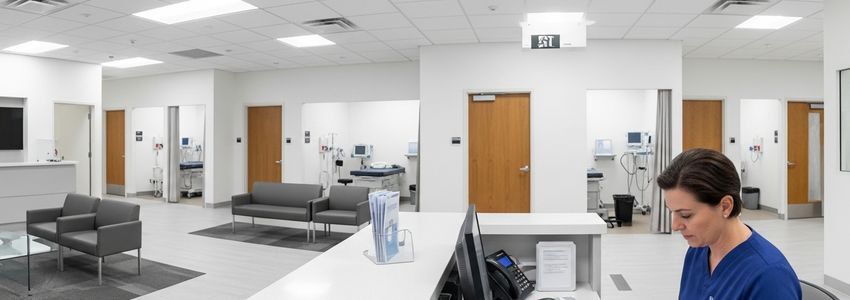
- Leasehold improvements — urgent care centers require clinical-grade buildout including examination rooms, X-ray suite (if offering imaging), lab area, procedure rooms, waiting room, and compliant restrooms ($150,000–$500,000+)
- Medical equipment — X-ray equipment, EKG machines, lab analyzers, exam tables, sterilization equipment, vital sign monitors, and treatment equipment ($100,000–$400,000)
- Information technology — EMR/EHR systems (Epic, Athena, Experity), practice management software, patient check-in systems, HIPAA infrastructure ($15,000–$50,000)
- Working capital — staffing costs during the ramp-up period before revenue reaches breakeven; insurance reimbursement lag (services billed in month 1 may be paid in month 2–3)
- Licensing and compliance — state facility licensure, CLIA (lab certification), DEA registration, Medicare/Medicaid enrollment, and accreditation costs
- Franchise fee — if operating under a franchise model (NextCare, FastMed, CityMD, etc.), franchise fees of $30,000–$75,000
- Expanding to additional locations — second and third location development, each requiring similar capital to the initial site
Healthcare Practice Financing Context: Urgent care centers share financing characteristics with other healthcare practices but at a larger scale — higher equipment costs, larger leasehold improvements, and faster revenue ramp-up potential (with the right location and marketing). For a broader view of healthcare financing, see our Medical Practice Loans: The Complete Financing Guide for Physicians and Healthcare Owners. For SBA loan details, see our SBA Loan Alternatives for Faster Funding: The Complete Guide for Business Owners.
Types of Urgent Care Business Loans
SBA 7(a) Loans
SBA 7(a) loans are the most commonly used financing vehicle for urgent care center startup and expansion. With loan amounts up to $5 million and terms up to 10 years, SBA 7(a) loans can cover the majority of a new center's capital stack at competitive rates. Urgent care centers qualify as healthcare businesses under SBA guidelines. For established centers with 2+ years of strong financial performance, SBA loans are the most cost-effective path to expansion capital.
SBA 504 Loans
For urgent care operators who plan to purchase their facility building (rather than lease), SBA 504 loans provide below-market fixed rates with only 10% down and 20–25 year terms. Owning the real estate eliminates lease renewal risk and builds equity alongside the business.
Healthcare Practice Term Loans
Banks and specialty healthcare lenders offer practice acquisition and development loans for qualified physician operators. These practice-specific products often allow higher loan-to-value ratios and more flexible underwriting for licensed physicians and healthcare operators than conventional business loans. Terms typically run 5 to 10 years at competitive rates for established healthcare professionals.
Equipment Financing
Medical equipment — X-ray machines, lab analyzers, EKG systems, and diagnostic technology — qualifies for equipment financing using the equipment as collateral. Equipment-secured financing offers lower rates and easier approval than unsecured term loans, making it the most efficient way to finance specific capital equipment needs.
Business Lines of Credit
A revolving line of credit is essential for urgent care cash flow management. Insurance claims may take 30 to 60 days to pay after service delivery — a line of credit covers payroll, supplies, and overhead during this gap. Draw as needed, repay as insurance reimbursements clear, draw again. Lines of $50,000–$250,000 are standard for urgent care operations.
Online Alternative Term Loans
For established urgent care centers needing fast capital for equipment replacement, marketing investment, or working capital — online alternative lenders fund in 1 to 5 days. Rates of 15%–45% are higher than SBA or bank loans but faster and more accessible for urgent operational needs.
Ready to Open or Expand Your Urgent Care Center?
Get fast, flexible financing from the #1 business lender in the U.S. No obligation — apply in minutes.
Apply Now →Urgent Care Center Startup and Expansion Costs
Understanding the full capital requirement before approaching lenders is essential. A typical urgent care center buildout breaks down as follows:
| Cost Category | Typical Range | Notes |
|---|---|---|
| Leasehold Improvements | $150K–$500K | Exam rooms, X-ray suite, lab, lobby, plumbing |
| X-Ray Equipment | $50K–$150K | Digital X-ray system; CT adds $300K–$800K |
| Lab Equipment | $20K–$60K | Hematology analyzer, chemistry, urinalysis, POC |
| Clinical Equipment | $30K–$80K | Exam tables, EKG, vitals monitors, treatment tables |
| IT and EMR Systems | $15K–$50K | EMR implementation, hardware, patient kiosk |
| Licensing and Compliance | $10K–$40K | State facility license, CLIA, DEA, Medicare enrollment |
| Initial Marketing | $15K–$50K | Grand opening, digital, signage, community outreach |
| Working Capital Reserve | $75K–$200K | 3–6 months operating expenses during ramp-up |
Total estimated startup capital: $365,000 to $1,130,000+ for a standard urgent care center with X-ray capability. Centers adding CT scanning or other advanced imaging can exceed $1,500,000.
SBA Loans for Urgent Care Centers
Urgent care centers qualify for all major SBA loan programs as healthcare service businesses:
| Program | Max Amount | Best Use for UC | Min. Credit | Timeline |
|---|---|---|---|---|
| SBA 7(a) | $5 million | Center buildout, equipment, acquisition, working capital | 650+ | 60–90 days |
| SBA 504 | $5.5M (CDC) | Facility purchase, real estate + major equipment | 680+ | 60–120 days |
| SBA Express | $500,000 | Expansion capital, equipment, working capital LOC | 650+ | 30–45 days |
How to Qualify for an Urgent Care Business Loan
For Established Urgent Care Centers
- Credit score: 650+ for SBA; 700+ for bank loans; 600+ for online lenders
- Annual revenue: $500,000+ (well-established centers typically generate $1–3M+ annually)
- Documentation: 2 to 3 years of business and personal tax returns, P&L, bank statements, patient volume data
- Time in operation: 2+ years for conventional financing; 1+ year for some online lenders
For New Urgent Care Center Startups
- Credit score: 680+ for SBA 7(a) startup loans
- Operator credentials: MD, DO, or NP/PA group with physician medical director qualifications
- Owner equity: 15 to 25% of total project cost from personal or partner funds
- Business plan: Detailed pro forma with market analysis, patient volume projections, and reimbursement rate assumptions
- Location analysis: Demographic study, traffic counts, competitive density, and payor mix assumptions
Urgent Care-Specific Considerations
- Physician medical director: Urgent care centers typically require a physician medical director. Lenders financing urgent care operations want to see this leadership position filled or committed.
- Payor mix analysis: Revenue reimbursement varies significantly by payor (commercial insurance versus Medicaid versus Medicare versus self-pay). A market analysis showing expected payor mix is essential for projecting realistic revenue.
- CLIA certification: In-house laboratory operations require CLIA certification. Lenders financing centers with lab capability verify that CLIA certification is in place or actively being pursued.
- Insurance credentialing: Credentialing with major commercial insurance networks takes 60 to 120 days. Working capital reserves must cover operations during this period.
Urgent Care Loan Rates, Terms, and Amounts
| Loan Type | Typical Rate | Term | Amount Range | Speed |
|---|---|---|---|---|
| SBA 7(a) Loan | 10%–13% | Up to 10 years | $150K–$5M | 60–90 days |
| Healthcare Practice Loan | 8%–15% | 5–10 years | $100K–$2M | 3–8 weeks |
| Equipment Financing | 6%–20% | 3–7 years | $20K–$500K | 1–14 days |
| Online Term Loan | 15%–45% | 3 months–5 years | $10K–$500K | 1–5 days |
| Business Line of Credit | 8%–30% | Revolving | $25K–$250K | 1–7 days |
Best Uses for Urgent Care Financing
Opening a New Urgent Care Center
The most common use of urgent care financing is funding a new center from ground up — leasehold improvements, equipment, IT systems, licensing, and working capital reserve. SBA 7(a) loans of $400,000 to $1,000,000+ cover the majority of a typical new center's capital needs, with the operator contributing 15 to 25% in equity. A well-located center reaching 30–50 patient visits per day can achieve cash-flow breakeven within 12 to 18 months.
Adding Imaging Capability
Urgent care centers that add X-ray or CT capability significantly increase revenue per visit by handling imaging in-house rather than referring to radiology centers. Digital X-ray systems ($50,000–$120,000) financed through equipment loans enable the full radiology revenue capture that transforms a basic urgent care into a comprehensive one. CT scanners ($300,000–$800,000) require SBA 7(a) or 504 financing due to their high capital cost.
Opening a Second Location
Established urgent care operators with strong first-location performance (18+ months, positive EBITDA) are prime candidates for second-location SBA 7(a) financing. Lenders evaluate first-location operational metrics — visit volume, revenue per visit, payor mix, and net operating margin — as the primary underwriting basis for expansion financing. Second locations typically require $350,000 to $850,000+ in capital.
Acquiring an Existing Urgent Care Center
Acquiring an established urgent care center — with existing patient volume, insurance panel credentials, equipment, and staff — provides immediate revenue that a de novo startup cannot match. SBA 7(a) acquisition loans cover purchase price plus working capital. Lenders evaluate the target center's patient visit volume, revenue per visit, payor mix, lease terms, and staff retention risk as key underwriting factors.
Urgent Care Industry Statistics
- The U.S. has approximately 11,000+ urgent care centers with industry revenue exceeding $38 billion annually (Urgent Care Association of America)
- The industry grew at approximately 5–7% annually for the past decade, driven by consumer preference for convenient, lower-cost alternatives to emergency rooms
- The average urgent care center sees 25 to 40+ patient visits per day at maturity, with well-located centers in high-density markets exceeding 60 visits per day
- Average urgent care revenue per visit ranges from $150 to $250 for commercial insurance, with self-pay rates varying widely by market and services provided
- Occupational health services (employer workers' comp, pre-employment physicals, drug testing) represent a high-value revenue line for urgent care centers, with commercial rates typically 25–40% higher than standard urgent care visits
- A well-run urgent care center generating 35 visits per day at $180 average revenue operates at approximately $2.3 million in annual revenue, supporting strong debt service capacity
How to Apply and What to Prepare
For New Center Startup Financing
- Detailed business plan with market analysis, patient volume projections, payor mix assumptions, and financial pro forma
- Operator credentials (MD, DO, NP, PA) and medical director documentation
- Personal financial statement and credit report
- Evidence of equity contribution (bank statements showing liquid assets)
- Signed lease or letter of intent for clinic space
- Equipment quotes and contractor construction estimates
- State facility licensing plan
For Established Center Expansion
- 2 to 3 years of business and personal tax returns
- Year-to-date profit and loss statement
- Current balance sheet
- 12 months of business bank statements
- Patient visit volume data (monthly visits, visits per day)
- Payor mix breakdown (commercial, Medicare, Medicaid, self-pay percentages)
- Current center lease agreement
- Personal financial statement
Application Tips
- Quantify patient metrics: Average daily visits, revenue per visit, and payor mix are the most compelling operating metrics for urgent care lender underwriting. Have clean monthly data ready.
- Highlight location analysis: Traffic counts, population density, household income, insurance rates, and competitive urgent care density within a 5-mile radius demonstrate market opportunity rigorously.
- Document your team credentials: Medical director credentials, NP/PA staff qualifications, and administrative leadership experience are key signals for healthcare practice lenders.
Why Urgent Care Operators Choose Crestmont Capital
Crestmont Capital is the #1 rated business lender in the United States. We work with urgent care center operators at every stage — from physicians opening their first center to multi-site operators expanding regional networks. We understand the healthcare regulatory environment, insurance reimbursement dynamics, and the significant capital requirements of urgent care center development.
- Healthcare practice financing expertise: We understand the urgent care model and capital structure
- High loan amounts: Financing up to $5 million for qualified urgent care developments
- Multiple products: SBA programs, practice loans, equipment financing, and working capital solutions
- Transparent terms: No hidden fees, complete cost disclosure before you sign
Get Your Urgent Care Business Loan Today
Apply in minutes. No obligation. We understand healthcare practice financing.
Apply Now →Frequently Asked Questions
Frequently Asked Questions: Urgent Care Business Loans
Disclaimer: This article is provided for general educational purposes only and does not constitute financial, legal, or medical practice advice. Loan rates, terms, and requirements vary by lender and are subject to change. Regulatory requirements for urgent care centers vary by state — consult a qualified healthcare attorney before structuring a new center. Revenue and financial projections are estimates based on publicly available industry data. Consult a qualified financial advisor before making business financing decisions.