
 (800) 949-0401
Truck Wash Business Loans: The Complete Financing Guide for Truck Wash Business Owners
Running a truck wash business requires significant capital investment — from high-pressure washing equipment and water reclamation systems to bay construction and staffing. Whether you're launching your first location, upgrading aging equipment, or expanding to serve more fleets, truck wash business loans provide the financial foundation to keep your operation competitive. This guide covers every financing option available to truck wash owners, how to qualify, what lenders look for, and how to get funded fast.
In This Article
- What Is a Truck Wash Business Loan?
- Types of Financing for Truck Wash Businesses
- How Truck Wash Financing Works
- What Can You Use the Funds For?
- How to Qualify
- Equipment Financing for Truck Wash Businesses
- How to Apply for a Truck Wash Business Loan
- Real-World Scenarios
- Frequently Asked Questions
- Next Steps
What Is a Truck Wash Business Loan?
A truck wash business loan is a financing product designed to help owners of commercial truck washing operations secure capital for startup costs, equipment purchases, expansions, or working capital needs. These loans come from banks, credit unions, alternative lenders, and the U.S. Small Business Administration (SBA). The commercial trucking industry relies heavily on truck wash services, making this a stable, recession-resistant business with strong demand from fleet operators, owner-operators, and logistics companies.
Truck wash facilities require considerably more capital than consumer car washes due to the size and complexity of the equipment involved. A single automatic drive-through truck wash bay can cost $150,000 to $500,000 or more to install, and touchless systems for chemical tankers can cost even more. This is why specialized financing is critical for truck wash business owners at every stage of growth.
Industry Insight: The commercial truck washing market is closely tied to freight and logistics growth. According to the American Trucking Associations, trucks move approximately 72% of all freight in the United States, supporting strong ongoing demand for truck wash services.
Types of Financing for Truck Wash Businesses
Truck wash operators have access to a wide range of financing options. The right loan type depends on your goals, credit profile, time in business, and how quickly you need funds.
Term Loans
Traditional term loans provide a lump sum of capital repaid over a fixed period with regular payments. These are ideal for major one-time expenses like building construction, large equipment purchases, or buying an existing truck wash business. Terms typically range from 1 to 10 years, with interest rates varying based on creditworthiness and lender type.
SBA Loans
The U.S. Small Business Administration guarantees loans through approved lenders, reducing lender risk and making it possible to access larger amounts at lower rates. The SBA 7(a) loan is the most popular option, offering up to $5 million with competitive interest rates. The SBA 504 loan is another excellent choice for real estate purchases and large equipment acquisitions, with long repayment terms and below-market fixed rates.
Equipment Financing
Equipment financing is one of the most common funding tools for truck wash operators. The equipment itself serves as collateral, making approval easier and rates competitive. This financing covers automatic truck wash systems, high-pressure washers, water reclamation systems, chemical injection equipment, brushes and curtains, compressors, and more. Repayment terms often match the useful life of the equipment, typically 3 to 7 years.
Business Line of Credit
A business line of credit provides revolving access to funds you draw on as needed and repay over time. This is particularly useful for managing seasonal cash flow variations, covering payroll during slower months, purchasing chemicals and supplies in bulk, or handling unexpected repairs. Lines of credit typically range from $10,000 to $500,000 depending on your revenue and creditworthiness.
Working Capital Loans
Working capital loans are short-to-medium term loans designed for day-to-day operational expenses rather than capital investments. They're ideal for bridging cash flow gaps between large fleet contracts, funding marketing campaigns, hiring additional staff, or covering insurance and licensing costs.
Merchant Cash Advance
For truck wash businesses with strong daily revenue, a merchant cash advance (MCA) provides quick capital in exchange for a percentage of future sales. While more expensive than traditional loans, MCAs offer fast approval (sometimes same-day) and flexible repayment tied to your daily cash flow. They're best used for short-term needs when speed matters more than cost.
Commercial Real Estate Loans
If you're purchasing the land and building for your truck wash facility, a commercial real estate loan provides long-term financing with competitive rates. These loans require a down payment (typically 10-30%) and offer repayment terms up to 25 years, making monthly payments manageable.
By the Numbers
Truck Wash Industry - Key Statistics
3.5M+
Commercial trucks operating in the U.S.
72%
Of U.S. freight moved by trucks annually
$500K
Average startup cost for a full-service truck wash
24 Hrs
Typical funding time with alternative lenders
Ready to Fund Your Truck Wash Business?
Get fast, flexible financing from the #1 business lender in the U.S. Apply in minutes with no obligation.
Apply Now →How Truck Wash Financing Works
The process of securing a truck wash business loan follows a straightforward path from application to funding. Understanding this process helps you prepare properly and avoid common delays.
Quick Guide
How Truck Wash Financing Works - At a Glance
Determine how much capital you need, what you'll use it for, and your ideal repayment timeline.
Select the financing product that best matches your situation - equipment loan, term loan, SBA, or line of credit.
Prepare bank statements, tax returns, financial statements, and any equipment quotes or contracts.
Submit your application. Alternative lenders can fund in 24-48 hours; SBA loans typically take 2-6 weeks.
Interest rates for truck wash business loans vary widely depending on the loan type, lender, and your creditworthiness. SBA loans typically range from 7% to 11% APR. Traditional bank loans run from 6% to 13%. Alternative/online lenders charge anywhere from 15% to 40%+ APR but offer much faster funding and more lenient qualification requirements. Equipment financing rates generally fall between 6% and 20%.
What Can You Use Truck Wash Business Loan Funds For?
Truck wash business financing can be applied to virtually any legitimate business expense. Here are the most common uses that truck wash operators finance:
Equipment Purchases and Upgrades
The most capital-intensive need for truck wash owners is equipment. Automatic drive-through systems with touch-free technology, high-pressure water systems, chemical injection and metering equipment, water reclamation and recycling systems, dryers and air blowers, undercarriage cleaning systems, and pre-soak application systems all represent significant investments that pay for themselves over time through increased throughput and reduced labor costs.
Facility Construction and Buildout
Whether you're building from the ground up or converting an existing structure, facility costs are substantial. This includes concrete bay construction designed for heavy vehicles, overhead clearance requirements for tall trailers, utility hookups for high-volume water, electricity, and drainage, environmental compliance systems, and customer waiting areas or office spaces.
Business Acquisition
Buying an existing truck wash business can be a faster path to ownership than building from scratch. Business acquisition loans cover the purchase price and often provide additional working capital for initial operations.
Working Capital and Cash Flow
Fleet contracts often pay on net 30 or net 60 terms, which creates cash flow gaps for truck wash operators. Working capital financing bridges this gap, ensuring you can meet payroll, pay suppliers, and cover operational expenses even when receivables are delayed.
Marketing and Fleet Contract Acquisition
Building relationships with large fleet operators, logistics companies, and trucking carriers requires targeted marketing, business development activities, and sometimes competitive pricing in the early stages. Financing these activities accelerates growth and customer acquisition.
Hiring and Training Staff
Skilled truck wash technicians, equipment operators, and customer service staff are critical to quality service. Payroll financing and working capital loans support hiring surges when you land new fleet contracts.
Pro Tip: Many truck wash operators use a combination of financing products - an SBA loan for real estate and major equipment, combined with a line of credit for working capital. This layered approach optimizes interest rates while maintaining operational flexibility.
How to Qualify for a Truck Wash Business Loan
Lender requirements vary considerably by loan type and institution. Here's what most lenders evaluate when reviewing truck wash business loan applications:
Credit Score Requirements
Most traditional lenders and SBA-approved banks require a personal credit score of 680 or higher. Alternative lenders may approve applicants with scores as low as 550-600, while the best rates typically require 720+. If your score needs improvement, consider addressing outstanding collections, reducing credit card utilization, and correcting any errors on your credit report before applying.
For operators with less-than-perfect credit, bad credit business loans offer viable funding paths with different underwriting criteria that emphasize revenue and cash flow over credit scores.
Time in Business
Established truck wash operations (2+ years) have the widest range of financing options. Startups and businesses under 2 years old may need to rely on SBA microloans, equipment financing (where the equipment serves as collateral), or alternative lenders that specialize in newer businesses.
Annual Revenue
Most lenders want to see annual revenue of at least $100,000 to $250,000 for term loans and lines of credit. Equipment financing is available to newer businesses with lower revenue since the equipment itself secures the loan. Some alternative lenders will work with businesses generating as little as $50,000 in annual revenue.
Debt Service Coverage Ratio (DSCR)
Lenders calculate your DSCR to ensure you can afford loan payments. A DSCR of 1.25 or higher is typically required, meaning your business generates $1.25 in operating income for every $1.00 of debt service. Strong fleet contracts and consistent revenue make truck wash businesses favorable for DSCR analysis.
Collateral
For larger loans, lenders often require collateral. Truck wash equipment, real estate, business assets, and sometimes personal assets can serve as collateral. For equipment loans specifically, the financed equipment itself typically serves as the collateral, reducing the need for additional assets.
| Loan Type | Min. Credit Score | Time in Business | Typical Amount | Funding Speed |
|---|---|---|---|---|
| SBA 7(a) Loan | 680+ | 2+ years | Up to $5M | 4-8 weeks |
| Equipment Financing | 600+ | 6+ months | $10K - $2M+ | 1-5 days |
| Term Loan (Alt.) | 550+ | 1+ year | $5K - $500K | 24-72 hours |
| Line of Credit | 620+ | 1+ year | $10K - $500K | 1-5 days |
| Bank Term Loan | 680+ | 2+ years | $50K - $2M | 2-4 weeks |
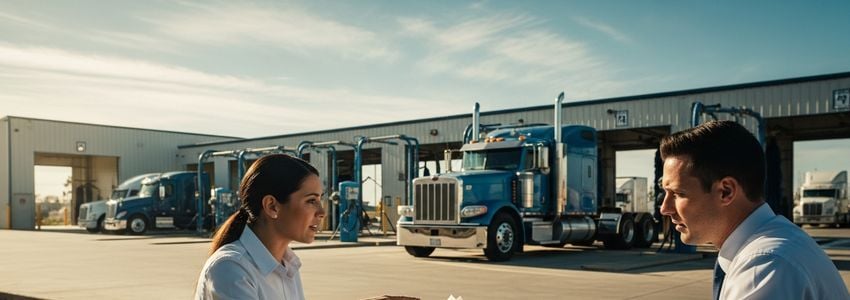
Equipment Financing for Truck Wash Businesses
Equipment is the backbone of any truck wash operation, and financing it correctly can mean the difference between strained cash flow and healthy margins. Equipment financing specifically designed for truck wash businesses covers a wide range of assets.
Types of Equipment You Can Finance
Automatic truck wash systems represent the largest investment for most operators. These range from basic rollover brush systems to sophisticated touchless systems using high-pressure water and chemical applications specifically engineered for large commercial vehicles. Full-service automated systems can wash 60+ trucks per hour, dramatically increasing revenue potential compared to manual operations.
Water reclamation and recycling systems are increasingly important both for environmental compliance and operating cost reduction. Many municipalities require water recycling for commercial vehicle wash facilities, and financing these systems through equipment loans makes compliance achievable without depleting working capital.
High-pressure washing systems, chemical injection and dispensing equipment, dryers and air knife systems, undercarriage wash systems, and payment kiosks all represent additional financed equipment categories. According to the Forbes Advisor guide to equipment financing, equipment loans typically cover 80% to 100% of the equipment cost, making them highly accessible even for businesses with limited cash reserves.
Equipment Financing vs. Equipment Leasing
When considering truck wash equipment, you'll face the choice between financing (owning the equipment at loan completion) and leasing (paying for use without eventual ownership). Equipment financing builds equity and may be preferable for long-lived assets like wash bays and water systems. Leasing provides lower monthly payments and flexibility to upgrade technology, which may suit rapidly evolving touchless wash technology.
Most truck wash operators choose equipment financing for core infrastructure (wash bays, water systems) and may lease certain ancillary equipment (payment systems, management software). Discuss both options with your financing advisor to determine the optimal structure for your specific situation.
Need Equipment Financing for Your Truck Wash?
Crestmont Capital offers fast equipment financing with competitive rates. Get a decision in hours, not weeks.
Get Equipment Financing →How to Apply for a Truck Wash Business Loan
Preparing a strong loan application increases your approval odds and helps you secure better terms. Here's what the application process typically involves for truck wash businesses.
Documents You'll Need
Lenders require different documentation depending on the loan type and amount. For most truck wash business loans, you'll need:
- Personal and business credit reports
- Last 3-12 months of business bank statements
- 2-3 years of business and personal tax returns
- Profit and loss statements (year-to-date and prior years)
- Balance sheet
- Business plan (especially for startups and SBA loans)
- Equipment quotes or purchase agreements
- Business license and registration documents
- Accounts receivable aging report (if you serve fleet accounts)
Improving Your Application
Several strategies can strengthen your truck wash loan application. Document your fleet contracts - long-term agreements with large carriers or logistics companies demonstrate revenue stability that lenders value highly. Maintain clean business and personal bank statements with consistent deposits and minimal non-sufficient funds. Keep your debt-to-income ratio manageable by not overextending credit before applying. Having 6 months or more of operating expenses in cash reserves demonstrates financial discipline.
Working with a Financing Specialist
Truck wash financing can be complex given the large equipment costs and specialized nature of the business. Working with a lender that understands the industry and has experience with similar businesses can make the process significantly smoother. Crestmont Capital works with truck wash operators across the country and understands the unique cash flow dynamics of this industry. For same-day decisions on working capital needs, explore our same-day business loans, or for faster funding timelines, our fast business loans can get you funded within 24-48 hours.
Did You Know? According to CNBC's small business reporting, businesses that work with specialized lenders who understand their industry secure funding 40% faster on average than those applying through general-purpose banks unfamiliar with the specific business model.
Real-World Financing Scenarios for Truck Wash Businesses
Understanding how other truck wash operators have used financing can help you identify the best approach for your specific situation.
Scenario 1: New Truck Wash Startup
Marcus was a fleet manager for 15 years before deciding to open his own truck wash facility near a major freight corridor. He needed $750,000 for land acquisition, building construction, and an automated wash system. He secured a combination of an SBA 504 loan for the real estate portion ($400,000) and an equipment loan for the wash system ($250,000), with his own capital contributing $100,000 as a down payment. The long repayment terms on the SBA 504 kept his monthly debt service manageable while he built his customer base.
Scenario 2: Equipment Upgrade at an Established Wash
Linda had operated a manual truck wash for eight years with steady fleet accounts. A competitor installed a new automated system that could process trucks in half the time, threatening her largest contract. She secured $180,000 in equipment financing to purchase a state-of-the-art touchless system. The increased throughput - jumping from 20 trucks per day to 45 - generated enough additional revenue to cover her loan payments while retaining her key fleet accounts and winning new ones.
Scenario 3: Managing Seasonal Cash Flow
Carlos operated a thriving truck wash in a region where winter road treatments significantly increased demand for fleet washing services. However, he needed capital in late summer to hire and train additional staff before the busy season started. He established a $75,000 business line of credit that he drew on for seasonal staffing and supply purchasing, repaying it as winter revenue increased. This cycle allowed him to capitalize on seasonal demand without struggling to fund operations during the buildup period.
Scenario 4: Multi-Location Expansion
Jennifer's single truck wash location had been profitable for six years. She identified a second location near a major distribution center that would serve a different customer base. Rather than risking her cash reserves, she secured a $350,000 term loan to fund the buildout and initial equipment for the second location. The new location broke even within eight months and she's now planning a third.
Scenario 5: Acquiring an Existing Business
David found an opportunity to acquire a well-established truck wash from a retiring owner at what he believed was fair market value. The $500,000 asking price included real estate, equipment, and an established client base. He secured an SBA 7(a) loan for the acquisition with a 10% down payment, using the business's existing cash flow to service the debt. This strategy allowed him to skip the startup phase entirely and generate positive cash flow from day one.
Scenario 6: Water Reclamation Compliance Upgrade
Sandra's truck wash faced new municipal water usage regulations requiring water reclamation systems within 18 months or face fines. The equipment cost $95,000, which would have severely strained her cash flow. She financed the reclamation system with an equipment loan at 8% interest over 5 years. The monthly payment was $1,900 - easily covered by the reduced water bills ($1,200/month savings) and the avoided fines, making the investment essentially self-funding.
For more insight into how similar service businesses approach financing decisions, see our guide on car wash business loans - many of the same principles apply to truck wash operations at a larger scale.
Frequently Asked Questions
How to Get Started
Calculate exactly how much capital you need, identify the specific use (equipment, working capital, expansion), and set a target timeline. Having a clear plan strengthens your application.
Pull your personal and business credit reports. Gather your last 12 months of bank statements and most recent tax returns. Knowing your financial position before applying lets you choose the right loan type.
Complete our quick application at offers.crestmontcapital.com/apply-now - takes just a few minutes with no obligation to accept any offer.
A Crestmont Capital advisor will review your application, match you with the optimal financing product, and work to get you funded - often within 24-48 hours for working capital and equipment financing.
Conclusion
The truck wash industry offers strong fundamentals for business success - essential services, recurring fleet contracts, and consistent demand tied to America's freight infrastructure. But getting to the next level requires capital, whether you're launching a new operation, upgrading equipment to stay competitive, managing cash flow between large contract payments, or expanding to serve more customers.
Truck wash business loans give you the financial leverage to invest confidently in your business without draining cash reserves. From SBA loans for major infrastructure investments to same-day working capital for immediate needs, the right financing strategy can accelerate your growth, improve service quality, and strengthen your competitive position in a market that will continue to grow alongside America's commercial freight industry.
At Crestmont Capital, we specialize in helping businesses like yours access the capital they need to grow. Our team understands the economics of truck wash operations and can match you with financing solutions tailored to your specific situation - whether you need $50,000 for equipment upgrades or $2 million for a new facility.
Ready to Finance Your Truck Wash Business?
Apply today and get a decision fast. No obligation, no hard credit pull until you accept an offer.
Apply Now →Disclaimer: The information provided in this article is for general educational purposes only and is not financial, legal, or tax advice. Funding terms, qualifications, and product availability may vary and are subject to change without notice. Crestmont Capital does not guarantee approval, rates, or specific outcomes. For personalized information about your business funding options, contact our team directly.








