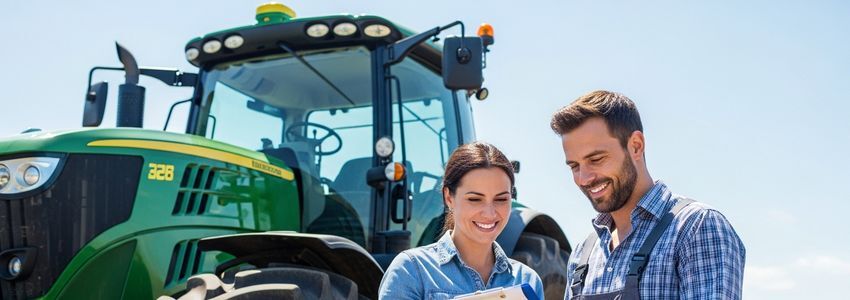
Tractors are the backbone of countless businesses - from large-scale farming operations and landscaping companies to construction sites and hobby farms. But with new tractors routinely costing $30,000 to over $250,000, purchasing one outright is out of reach for most small business owners. That is where tractor financing comes in. Whether you need a compact utility tractor for a landscaping crew or a high-horsepower row crop tractor for commercial agriculture, the right financing program can put you in the seat without draining your operating capital.
This guide covers everything you need to know about tractor financing - how it works, what lenders look for, what rates to expect, and how to get approved fast.
In This Article
- What Is Tractor Financing?
- Types of Tractor Financing
- How Tractor Financing Works
- Who Qualifies for Tractor Financing?
- Rates, Terms, and Loan Amounts
- New vs. Used Tractor Financing
- Tractor Financing with Bad Credit
- Tractor Financing at a Glance
- How Crestmont Capital Can Help
- Real-World Scenarios
- Frequently Asked Questions
- How to Get Started
What Is Tractor Financing?
Tractor financing is a form of equipment financing that allows businesses and individuals to purchase or lease a tractor by spreading the cost over time rather than paying the full price upfront. The tractor itself typically serves as collateral for the loan, which means lenders can often offer more favorable terms than unsecured business loans.
Unlike general business loans that can be used for any purpose, tractor financing is specifically structured around the purchase of agricultural, landscaping, or construction equipment. This distinction matters because it affects how lenders assess risk, set repayment terms, and evaluate collateral value.
Tractor financing is used by a wide range of businesses and operators:
- Commercial farmers and agribusinesses
- Hobby farmers and small-scale agricultural operations
- Landscaping and lawn care companies
- Golf courses and sports turf managers
- Construction and excavation contractors
- Municipalities and government entities
- Vineyards and orchards
- Ranches and livestock operations
According to the U.S. Small Business Administration, equipment financing is one of the most common forms of financing sought by small businesses, and agricultural equipment consistently ranks among the highest-value assets financed each year.
Ready to Finance Your Tractor?
Get competitive rates and flexible terms from the #1 business lender in the U.S. Apply in minutes - no obligation.
Apply Now ->Types of Tractor Financing
There are several ways to finance a tractor, each with its own advantages depending on your business situation, cash flow, and long-term goals.
Equipment Loans
An equipment loan is the most straightforward option. You borrow a lump sum to purchase the tractor, make fixed monthly payments over the loan term, and own the equipment outright once the loan is paid off. The tractor serves as collateral, which often results in lower interest rates compared to unsecured options. Equipment loans work well for businesses that want to build equity in their equipment and keep the tractor long-term.
Equipment Leasing
With a lease, you make monthly payments to use the tractor for a set period - typically 24 to 60 months - but you do not own it at the end unless you exercise a purchase option. Leasing typically has lower monthly payments than a loan and may offer more flexibility for businesses that need to upgrade equipment frequently. Operating leases, in particular, can keep the asset off your balance sheet.
Agricultural Equipment Financing Programs
Major tractor manufacturers like John Deere, Case IH, and Kubota offer in-house financing programs specifically designed for agricultural equipment. These programs may feature promotional rates (sometimes as low as 0% APR during promotional periods) for qualified buyers but often require strong credit scores and may limit flexibility on terms.
SBA Loans
The SBA 7(a) loan program can be used to finance tractor purchases as part of a broader business financing package. While SBA loans offer excellent rates and long terms, the application process is more involved and approval times are longer - typically 30 to 90 days. They are best suited for established businesses with strong credit histories. Learn more about SBA loans through Crestmont Capital.
Working Capital Loans
If you need to purchase a smaller tractor or attachment and prefer not to use equipment-specific financing, a working capital loan can provide funds quickly with less paperwork. These are unsecured loans with higher rates but faster approval times.
Business Line of Credit
A business line of credit gives you revolving access to funds you can draw on as needed. For businesses that purchase attachments, parts, or smaller equipment regularly, a line of credit provides flexibility that a term loan cannot match.
How Tractor Financing Works
The tractor financing process follows a similar structure to other equipment financing, though agricultural lenders often have specialized knowledge about residual values and seasonal cash flows.
Here is how the typical process unfolds:
- Identify the tractor you need - Know the make, model, year, and price before applying. Lenders will want this information to assess collateral value.
- Submit your application - Provide basic business and personal financial information. Most lenders require 1-2 years of tax returns or bank statements.
- Receive a credit decision - Equipment financing decisions often come within 24 to 72 hours for smaller amounts. Larger loans may take longer.
- Review and sign the loan or lease agreement - Understand your rate, term, monthly payment, and any fees before signing.
- Funds are disbursed - For equipment loans, funds go directly to the dealer or seller. For leases, the leasing company purchases the equipment and leases it to you.
- Make monthly payments - Payments begin immediately (or after a deferred period if negotiated) and continue through the term.
Key Insight: Many agricultural lenders offer seasonal payment structures that align with harvest cycles. Instead of equal monthly payments, you may be able to defer payments during off-seasons and make larger payments when revenue is highest - a significant advantage for farming operations.
Who Qualifies for Tractor Financing?
Qualification requirements vary by lender and loan type, but here is what most lenders evaluate when reviewing tractor financing applications.
Credit Score Requirements
Most conventional equipment lenders prefer a personal credit score of 640 or higher. For the best rates, aim for 700+. However, specialized agricultural and equipment lenders often work with lower scores, particularly when the borrower has strong collateral and cash flow. Some lenders offer programs for scores as low as 550 to 600, though rates will be higher.
Time in Business
Established businesses with at least 2 years of operating history will qualify for the widest range of programs. Newer businesses (1-2 years) can still qualify, particularly with strong personal credit or a substantial down payment. Startups face the most restrictions but may qualify through SBA programs or manufacturer financing with a larger down payment.
Revenue and Cash Flow
Lenders want to see that your business generates enough revenue to comfortably cover the loan payment. A common rule of thumb is that monthly debt payments should not exceed 30 to 40% of monthly gross revenue. For seasonal businesses, lenders look at annualized revenue rather than month-by-month figures.
Down Payment
Many tractor financing programs require no down payment for qualified borrowers, especially for newer equipment. However, putting 10 to 20% down can improve your rate and terms significantly. For used equipment or borrowers with lower credit scores, lenders may require 15 to 25% down.
Collateral
The tractor itself is the primary collateral. For newer equipment, lenders are comfortable financing up to 100% of the value. For used equipment - especially older or high-hour machines - lenders may cap financing at 70 to 85% of the estimated resale value. Having additional collateral (other business equipment, real estate) can strengthen your application.
Rates, Terms, and Loan Amounts
Tractor financing rates and terms vary widely depending on the lender type, your creditworthiness, the age and type of equipment, and the loan amount.
Interest Rates
- Manufacturer financing (promotional): 0% to 2.9% APR (for qualified buyers during promotions)
- Bank and credit union equipment loans: 5% to 10% APR
- Online equipment lenders: 7% to 20% APR
- SBA 7(a) loans: Prime + 2.25% to 4.75% (currently approximately 10% to 13%)
- Alternative lenders (lower credit): 15% to 35% APR or higher factor rates
Loan Terms
- Short-term: 12 to 36 months (higher payments, less total interest)
- Mid-term: 36 to 60 months (most common for mid-size tractors)
- Long-term: 60 to 84+ months (for large commercial tractors over $100,000)
Loan Amounts
Most equipment lenders can finance tractors ranging from $10,000 for small compact utility models up to $500,000 or more for large commercial row crop or orchard tractors. The minimum loan amount is often $5,000 to $10,000 - smaller purchases may be better handled with a line of credit or working capital loan.
By the Numbers
Tractor Financing - Key Statistics
$30K+
Average starting price for a new utility tractor
$250K+
Cost of large commercial row crop tractors
24 Hrs
Typical equipment loan approval time with online lenders
84 Mo
Maximum term available for large tractor financing
New vs. Used Tractor Financing
One of the most common decisions tractor buyers face is whether to purchase new or used. Both options have distinct financing implications.
Financing a New Tractor
New tractors come with manufacturer warranties, the latest technology, and no maintenance backlog. From a financing perspective, new tractors are easier to finance because lenders can easily verify their value and condition. Manufacturers often run zero-percent or low-rate promotional financing programs that can save thousands of dollars in interest - particularly for buyers with strong credit. The downside is the higher purchase price and the accelerated depreciation in the first few years.
Financing a Used Tractor
Used tractors offer a lower purchase price and slower depreciation, which can make the overall ownership cost lower. From a financing standpoint, used tractors present more complexity. Lenders will typically require an appraisal or use market data (such as auction results) to determine current value. They may finance only 70 to 85% of that value, requiring a larger down payment. Interest rates on used equipment are also slightly higher - typically 1 to 3 percentage points more than comparable new equipment.
Our post on Equipment Financing 101 covers the broader framework for choosing between new and used equipment financing, which applies directly to tractor purchases.
Pro Tip: When financing a used tractor, always get a pre-purchase inspection from a qualified mechanic or agricultural equipment specialist. Lenders may require it, and it protects you from financing a machine with hidden mechanical problems that could significantly reduce its value or require expensive repairs shortly after purchase.
Comparison: New vs. Used Tractor Financing
| Factor | New Tractor | Used Tractor |
|---|---|---|
| Purchase Price | Higher | Lower (20-50% less) |
| Interest Rates | Lower (0-10%) | Slightly higher (7-15%) |
| Down Payment Required | 0-10% | 10-25% |
| Warranty Coverage | Full manufacturer warranty | Limited or none |
| Loan Terms Available | Up to 84 months | Up to 60 months typically |
| Depreciation | Faster in year 1-3 | Slower and more stable |
Tractor Financing with Bad Credit
A low credit score does not automatically disqualify you from tractor financing. Agricultural and equipment lenders understand that many operators - particularly farmers - experience financial setbacks due to factors outside their control, such as droughts, commodity price swings, or equipment failures. As a result, many lenders are more flexible with credit requirements than conventional bank lenders.
Here are strategies to get approved for tractor financing with bad credit:
Work with Specialty Equipment Lenders
Online and alternative equipment lenders specialize in working with borrowers who have credit scores below 640. These lenders look at the full financial picture - revenue trends, cash flow, and business performance - rather than just a credit score. They can often approve financing in 24 to 48 hours, even for borrowers with prior collections or late payments.
Offer a Larger Down Payment
Putting 20 to 30% down reduces the lender's risk and can make the difference between approval and denial when credit is challenged. It also reduces your monthly payments and total interest cost.
Provide Additional Collateral
If you own other valuable business assets - additional equipment, commercial real estate, or vehicles - pledging them as additional collateral can strengthen your application and help you qualify for better terms.
Consider a Lease
Equipment leases sometimes have more flexible credit requirements than loans. Because the leasing company retains ownership of the equipment, they face less risk and may approve applicants who would be denied for a traditional loan.
Use a Co-Signer
A business partner or family member with strong credit who co-signs the loan takes on responsibility for the debt, which significantly reduces lender risk and can unlock better rates and approval odds.
Crestmont Capital's bad credit equipment financing program is specifically designed for borrowers with challenging credit histories who need equipment to operate and grow their businesses.
Bad Credit? We Can Still Help.
Crestmont Capital works with all credit profiles. Get a fast, no-obligation quote for tractor financing today.
Get My Quote ->How Crestmont Capital Can Help with Tractor Financing
Crestmont Capital is the #1-rated business lender in the United States, with deep expertise in equipment financing across every major industry - including agriculture, landscaping, and construction. When you apply for tractor financing through Crestmont, you benefit from access to a wide network of equipment lending partners, competitive rates, and a fast, streamlined approval process.
Here is what sets Crestmont Capital apart:
- Loans from $10,000 to $5 million - Whether you need a compact utility tractor or a fleet of commercial ag equipment, we can structure the right deal.
- Approval in 24 to 48 hours - Our equipment financing process is designed to move fast, so you don't miss a planting window or a busy season.
- Flexible terms up to 84 months - Match your payments to your cash flow with terms that work for your operation.
- New and used equipment - We finance tractors of all ages, models, and conditions.
- All credit profiles considered - Our lending network includes options for borrowers at every credit level.
- Seasonal payment options - We can structure payment schedules that account for seasonal revenue patterns.
Our equipment financing programs cover everything from compact tractors for landscaping companies to high-horsepower commercial tractors for large-scale farming operations. We also offer agricultural equipment financing specifically for farm and agribusiness operators.
Our team has helped hundreds of agricultural and landscaping businesses get the equipment they need to operate efficiently and grow profitably. From hobby farmers expanding their operations to established agribusinesses upgrading aging fleets, Crestmont Capital has the financing solutions to make it happen.
The blog post on Agricultural Business Loans is a great companion resource if you are a farming operation looking at broader financing needs beyond just a single tractor purchase.
Real-World Tractor Financing Scenarios
Understanding how tractor financing works in practice can help you make the right decision for your situation. Here are six real-world scenarios that illustrate the range of businesses that benefit from tractor financing.
Scenario 1: The Growing Landscaping Company
A landscaping business owner in Texas is growing rapidly and has signed several new commercial contracts that require significant mowing and grading work. He needs a 60 HP utility tractor with a front loader and box blade. The tractor costs $55,000 new. With a 640 credit score and three years of business history, he qualifies for a 60-month equipment loan at 9.5% APR, with no down payment. His monthly payment is approximately $1,145 - well within reach given the revenue from his new contracts.
Scenario 2: The Hobby Farmer Expanding Operations
A hobby farmer in North Carolina runs a small operation growing specialty crops on 40 acres. She has been using rented equipment but is tired of the scheduling issues and wants to own her own compact utility tractor. She finds a used Kubota M7 for $28,000 with 1,200 hours on the meter. Despite having a 590 credit score from a prior medical debt collection, she qualifies for a used equipment loan through a specialty lender with 20% down ($5,600) at 14% APR over 48 months. Her monthly payment is $596.
Scenario 3: The Commercial Farmer Upgrading the Fleet
A multi-generation farming operation in Iowa needs to replace two aging row crop tractors. The owner selects two John Deere 8R Series tractors at $185,000 each, totaling $370,000. With strong business credit, 15 years of farming history, and consistent revenue, he qualifies for manufacturer promotional financing at 3.9% APR over 72 months. His total monthly payment for both tractors is approximately $5,700.
Scenario 4: The Golf Course Adding Turf Equipment
A golf course in Florida needs a new compact tractor with a finish mower and aerator attachments for turf maintenance. Total equipment cost is $42,000. The course has strong revenue but carries some short-term debt. After working with Crestmont Capital, the owner structures a 48-month equipment loan at 8.75% APR with a $5,000 down payment, reducing the financed amount to $37,000 and the monthly payment to $930.
Scenario 5: The Vineyard Needing Specialized Equipment
A small vineyard in California needs a narrow vineyard tractor for working between vine rows. These specialized tractors run $75,000 to $100,000 new. The vineyard owner has seasonal income concentrated in the fall harvest period. A specialty ag lender structures a 60-month loan with a seasonal payment structure - lower payments from November through March and higher payments from April through October when revenue is strongest.
Scenario 6: The Construction Contractor Adding a Utility Tractor
A concrete contractor in Ohio uses a utility tractor with a bucket loader for site prep and material handling. His current machine broke down beyond repair and he needs a replacement fast. Crestmont Capital's fast-funding equipment loan process delivers approval in 24 hours on a $48,000 used tractor loan at 12% APR over 36 months, with a $9,600 down payment. He is back to work within 72 hours of applying.

Documents You Need for Tractor Financing
Preparing your documentation in advance can significantly speed up the approval process. Here is what most tractor financing lenders require:
Basic Business Documents
- Completed loan or lease application
- Business bank statements (last 3-6 months)
- Business tax returns (last 1-2 years)
- Business license or registration
- EIN (Employer Identification Number)
Equipment Information
- Equipment invoice or purchase agreement from the dealer
- Make, model, year, serial number, and hours (for used equipment)
- Dealer contact information
- For used equipment: inspection report or appraisal
Personal Financial Information
- Personal tax returns (last 1-2 years)
- Valid government-issued photo ID
- Personal financial statement (for larger loans)
Tip: For loans under $150,000, many equipment lenders offer a simplified "one-page application" process that only requires a few months of bank statements and basic business information - no tax returns needed.
Industry Note: According to a Forbes Finance Council analysis, equipment financing is one of the most efficient forms of small business financing because the asset itself secures the loan, resulting in faster approvals and lower rates compared to unsecured alternatives. For agricultural and landscaping businesses, this makes tractor financing particularly attractive compared to general-purpose working capital loans.
Tips for Getting Approved and Getting the Best Rate
Whether you are applying for the first time or looking to upgrade existing equipment, these strategies can help you secure better terms on your tractor financing.
Check Your Credit Before Applying
Review your personal and business credit reports before submitting any application. Dispute any errors or outdated negative items that could be dragging down your score. Even a modest improvement in your score can move you into a better rate tier. You can request free credit reports from the major bureaus through AnnualCreditReport.com.
Get Multiple Quotes
Do not settle for the first offer you receive. Dealer financing may be convenient, but it is not always the best deal. Working with an independent equipment financing specialist like Crestmont Capital gives you access to multiple lending programs and lets you compare offers before committing.
Consider the Total Cost, Not Just the Monthly Payment
A longer term means lower monthly payments but more total interest paid over the life of the loan. Use an amortization calculator to compare the total cost of different term lengths. Sometimes paying slightly more each month with a shorter term saves thousands of dollars in interest.
Time Your Purchase Strategically
Manufacturers often run promotional financing at the end of model years (typically late summer through fall) as dealers clear inventory to make room for new models. These promotions can include 0% APR for 12 to 24 months or significant rebates that dramatically reduce your total cost.
Maintain Strong Business Bank Account Balances
Many alternative lenders rely heavily on bank statement analysis. Keeping consistent balances - ideally above $10,000 average daily balance - signals financial stability and improves your odds of approval at favorable rates.
Work with an Equipment Financing Specialist
Rather than applying directly to banks (which often have strict agricultural lending criteria), work with a specialist who has relationships with multiple ag equipment lenders. This increases your chances of approval and access to programs tailored to your industry. Our small business loans team can help navigate your options and match you with the right program.
Frequently Asked Questions
What credit score do I need for tractor financing?
Most traditional lenders prefer a credit score of 640 or higher. However, specialty equipment and agricultural lenders work with scores as low as 550 to 600, particularly when you have strong business cash flow, a solid down payment, or additional collateral. For the best interest rates, aim for a score of 700 or above.
How much can I borrow for a tractor?
Equipment lenders can typically finance from $10,000 up to $5 million or more for tractor purchases. The exact amount you qualify for depends on your credit profile, business revenue, time in business, and the value of the equipment you are purchasing. For most small to mid-size businesses, financing of $20,000 to $250,000 is readily available.
Can I finance a used tractor?
Yes, most equipment lenders finance used tractors. Lenders will assess the machine's current market value, age, and condition when determining how much they will lend. Generally, lenders will finance 70 to 85% of the appraised value of used equipment. The interest rates on used tractor loans are typically 1 to 3 percentage points higher than on new equipment.
Is it better to finance or lease a tractor?
It depends on your situation. Financing (taking out a loan) is better if you plan to keep the tractor long-term, want to build equity, or need to customize the machine. Leasing is better if you want lower monthly payments, prefer to upgrade equipment regularly, or want flexibility at the end of the term. Many farmers and ag businesses prefer to own their equipment, making loans more common in that sector.
How long does it take to get approved for tractor financing?
With online equipment lenders, approval can come within 24 to 48 hours for loans under $150,000. Larger loans or SBA financing typically take 1 to 4 weeks. Traditional bank loans generally take 2 to 6 weeks. If you need equipment fast, working with a specialty equipment lender like Crestmont Capital gives you the fastest approval timeline.
Do I need a down payment for tractor financing?
Not always. Many lenders offer 100% financing on new tractors for qualified borrowers with strong credit (640+). For used tractors or borrowers with lower credit scores, a down payment of 10 to 25% may be required. Offering a down payment, even when not required, typically results in better interest rates and lower monthly payments.
Can a startup or new business get tractor financing?
Yes, though options are more limited. Manufacturer financing programs sometimes have options for newer businesses. Specialty equipment lenders may approve startups with a strong personal credit score (680+) and a larger down payment (20 to 30%). Some lenders also offer startup equipment financing programs specifically for businesses less than 2 years old.
What types of tractors can be financed?
Virtually all types of tractors can be financed, including compact utility tractors, utility tractors, row crop tractors, orchard tractors, vineyard tractors, track tractors, articulated four-wheel-drive tractors, and specialized agricultural equipment. Brands such as John Deere, Kubota, New Holland, Case IH, Massey Ferguson, and AGCO are all commonly financed through equipment lenders.
Can I finance tractor attachments and implements?
Yes. Most equipment lenders will bundle attachments and implements into the tractor financing package when purchased at the same time. Items like front loaders, box blades, finish mowers, rotary tillers, hay balers, and other implements can typically be included in the loan. If purchased separately later, they may require a separate loan, which could have a higher minimum loan amount threshold.
What interest rates should I expect for tractor financing?
Interest rates range widely based on your credit profile and the lender type. Manufacturer promotional financing can be as low as 0% APR for limited periods. Bank equipment loans typically run 5% to 10% APR. Online equipment lenders charge 7% to 20% APR. Alternative lenders for lower credit borrowers may charge 15% to 35% or use a factor rate structure. Shop multiple lenders to find the best rate for your situation.
Is tractor financing available for landscaping companies?
Absolutely. Landscaping companies are among the most common users of tractor financing. Whether you need a compact utility tractor, a zero-turn mower, or a larger machine for grading and site prep, equipment lenders are very familiar with the landscaping industry. Crestmont Capital regularly helps landscaping businesses finance equipment through programs tailored to their seasonal revenue patterns.
Can I refinance my tractor loan?
Yes. If market rates have dropped since you took out your original loan or your credit has improved significantly, refinancing your tractor loan can reduce your interest rate and lower your monthly payments. You can refinance with the same lender or a different one. The process is similar to the original loan - an appraisal of the equipment's current value, a credit check, and standard underwriting.
Do I need to insure a financed tractor?
Yes. Virtually all equipment lenders require proof of insurance as a condition of the loan. At minimum, lenders require physical damage coverage (comprehensive and collision) on the tractor for the duration of the loan. Some lenders also require liability coverage. Your lender will be listed as a loss payee on the policy, meaning insurance proceeds go to them if the tractor is totaled or stolen before the loan is paid off.
What happens if I default on a tractor loan?
If you default on a tractor loan, the lender has the right to repossess the equipment. This will also result in significant damage to your credit score and may trigger personal liability if you signed a personal guarantee. If you are struggling with payments, contact your lender immediately. Many lenders will work with you on a payment deferral or loan modification rather than go through the cost and complexity of repossession.
Can I get tractor financing through the SBA?
Yes. The SBA 7(a) loan program can be used to purchase tractors and other agricultural or construction equipment as part of a business financing package. SBA loans offer excellent rates and long terms (up to 10 years for equipment), but the approval process takes longer than conventional equipment financing - typically 30 to 90 days. The SBA does not lend directly; you apply through an SBA-approved lender. SBA 504 loans can also be used for major equipment purchases of $150,000 or more. Learn more from the SBA's official 7(a) loan page.
How to Get Started
Identify the tractor make, model, year, and asking price before applying. Having this information ready speeds up the approval process significantly.
Complete our quick application at offers.crestmontcapital.com/apply-now - takes just a few minutes. No impact to your credit score for the initial inquiry.
A Crestmont Capital equipment financing advisor will review your application and match you with the best available program for your credit profile and business situation.
Once approved, funds are disbursed directly to the dealer or seller. Many customers have their tractor delivered within 72 hours of starting the application process.
Conclusion
Tractor financing is one of the most practical and accessible ways for agricultural businesses, landscaping companies, and construction operators to acquire the equipment they need without depleting their working capital. With loan options ranging from manufacturer promotional programs to specialized agricultural lenders and flexible alternative financing, there is a tractor financing solution for virtually every business situation - regardless of credit score, time in business, or equipment type.
The key is to understand your options, prepare your documentation, and work with a lender who understands your industry. Whether you are financing a $20,000 compact utility tractor for a growing lawn care business or a $200,000 commercial row crop tractor for a family farming operation, tractor financing can make your purchase affordable while preserving the cash flow your business needs to thrive.
Crestmont Capital is ready to help you get the financing you need - fast, competitive, and tailored to your operation. Start your application today and put your new tractor to work.
Start Your Tractor Financing Application Today
Fast approvals, competitive rates, all credit profiles considered. Apply in minutes with no obligation.
Apply Now ->Disclaimer: The information provided in this article is for general educational purposes only and is not financial, legal, or tax advice. Funding terms, qualifications, and product availability may vary and are subject to change without notice. Crestmont Capital does not guarantee approval, rates, or specific outcomes. For personalized information about your business funding options, contact our team directly.