Acquiring essential heavy equipment is a critical step for growth in construction, agriculture, and logistics. For versatile machines like telehandlers, securing the right telehandler financing is just as important as choosing the right model. This guide provides a comprehensive overview of your options, helping you make an informed decision that preserves capital and fuels your business expansion.
In This Article
- What Is Telehandler Financing?
- Why Finance a Telehandler Instead of Paying Cash?
- How Does the Financing Process Work?
- Types of Telehandler Financing Options
- Who Qualifies for Telehandler Financing?
- Telehandler Financing: By the Numbers
- How Crestmont Capital Streamlines Your Financing
- Real-World Financing Scenarios
- Financing vs. Leasing vs. Paying Cash
- Your Next Steps to Secure Financing
- FAQ
What Is Telehandler Financing?
Telehandler financing is a type of business funding used to acquire a telescopic handler, also known as a teleporter or boom lift. Instead of paying the full purchase price upfront, businesses can make periodic payments over a set term. This financial tool allows companies to obtain critical equipment while preserving their working capital for other operational needs.
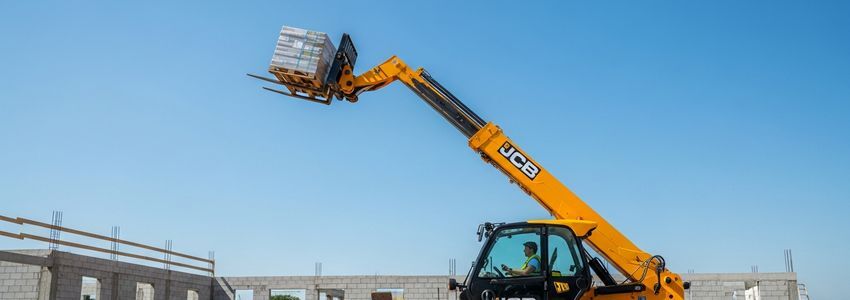
A telehandler is one of the most versatile pieces of equipment on any job site. Combining the capabilities of a forklift with the reach of a crane, it can lift, move, and place materials with precision. They are indispensable in construction for lifting materials to upper floors, in agriculture for stacking hay bales, in warehousing for managing inventory, and even in event management for setting up large structures.
The cost of these machines varies significantly based on size, lift capacity, reach, and condition. A new telehandler can range from $50,000 for a compact model to over $250,000 for a high-capacity, long-reach unit. Used equipment typically costs between $20,000 and $100,000. Financing makes these high-value assets accessible without draining a company's cash reserves.
Why Finance a Telehandler Instead of Paying Cash?
While paying cash might seem like the simplest option, financing offers strategic advantages that savvy business owners leverage for growth. It is often a more financially prudent decision that supports long-term stability and scalability. Here are the key reasons why financing is a powerful choice.
Preserve Working Capital
Cash flow is the lifeblood of any business. A large cash purchase can deplete your reserves, leaving you vulnerable to unexpected expenses or unable to seize new opportunities. Financing allows you to keep your cash on hand for payroll, marketing, inventory, and other daily operating costs that drive revenue.
Acquire Better Equipment
Financing can bridge the gap between the equipment you can afford with cash and the equipment you truly need. A more capable, newer, or more efficient telehandler can boost productivity, reduce downtime, and improve safety. Spreading the cost over time makes top-tier equipment attainable, providing a better return on your investment.
Key Insight: Financing turns a large capital expenditure into a manageable operating expense, aligning the cost of the equipment with the revenue it generates over its lifespan.
Potential Tax Advantages
Financing agreements and leases often come with significant tax benefits. Under Section 179 of the IRS tax code, businesses may be able to deduct the full purchase price of qualifying new or used equipment in the year it is put into service. Additionally, the interest paid on an equipment loan is typically tax-deductible. Always consult with a tax professional to understand the specific benefits for your business.
Scalability and Fleet Management
As your business grows, so will your equipment needs. Financing provides a predictable and repeatable process for acquiring additional assets. Instead of waiting to accumulate enough cash for each new purchase, you can use financing to scale your fleet in alignment with new contracts and increasing demand, ensuring you never have to turn down a job due to a lack of equipment.
Ready to Add a Telehandler to Your Fleet?
Don't let a large upfront cost slow your growth. Discover your financing options with Crestmont Capital and get the equipment you need to succeed.
Get a Free Quote TodayHow Does the Financing Process Work?
Securing telehandler financing is a straightforward process, especially when working with an experienced lender like Crestmont Capital. While specifics can vary, the journey from application to acquisition generally follows a clear path. Understanding these steps can help you prepare and ensure a smooth, efficient experience.
Step 1: Application
The first step is to complete a simple financing application. This can often be done online in just a few minutes. You will provide basic information about your business, such as its legal name, address, time in business, and annual revenue, as well as details about the telehandler you wish to purchase.
Step 2: Documentation Review
After submitting your application, a financing specialist will review your information. For smaller financing amounts, an application alone may be sufficient. For larger requests or newer businesses, you may be asked to provide additional documents like bank statements, financial statements, or an equipment invoice from the seller.
Step 3: Credit Approval and Term Sheet
Once your information is verified, the lender will perform a credit check and assess your company's financial health. If approved, you will receive a term sheet or financing proposal. This document outlines the offered loan amount, interest rate, repayment term (length of the loan), and any down payment requirements.
Step 4: Finalizing the Agreement
After you review and accept the terms, the lender will generate the final financing documents for your signature. You will sign the agreement, and the lender will work directly with the equipment vendor or private seller to coordinate payment. This step ensures the seller is paid promptly so you can take possession of your telehandler.
Step 5: Funding and Equipment Acquisition
With the paperwork complete, the lender funds the purchase. You can then arrange for the delivery of your telehandler and put it to work immediately. Your first payment will typically be due 30 days after the funding is complete, allowing you to start generating revenue with your new asset before the first bill arrives.
Types of Telehandler Financing Options
There is no one-size-fits-all solution for business financing. The best option for your company depends on your financial situation, business goals, and how you plan to use the equipment. Here are the most common types of equipment financing available for telehandlers.
Equipment Finance Agreement (EFA)
An EFA is a straightforward loan specifically for purchasing equipment. You borrow the funds to buy the telehandler, and the equipment itself serves as collateral for the loan. You make regular monthly payments for a fixed term, and at the end of the term, you own the equipment outright. This is a popular choice for businesses that plan to use the telehandler for its entire useful life.
Equipment Leasing
With equipment leasing, you pay to use the telehandler for a specific period rather than to own it. Monthly lease payments are often lower than loan payments, and leases can offer more flexibility. Common lease options include a Fair Market Value (FMV) lease, where you can buy the equipment at its market value at the end of the term, or a $1 Buyout lease, which functions more like a traditional loan and results in ownership.
SBA Loans
Small Business Administration (SBA) loans are partially guaranteed by the government, which allows lenders to offer favorable terms, such as lower interest rates and longer repayment periods. While the application process can be more intensive and take longer than other options, an SBA loan can be an excellent low-cost financing tool for well-established, creditworthy businesses. You can learn more about these programs directly from the SBA's official website.
Working Capital Loans
If you need funds for more than just the telehandler, a working capital loan might be a good fit. These small business loans provide a lump sum of cash that can be used for various business needs, including equipment purchases, inventory, payroll, or expansion. They offer flexibility but may have shorter terms and higher rates than a dedicated equipment loan.
Who Qualifies for Telehandler Financing?
Lenders evaluate several factors to determine a business's eligibility for financing. While requirements vary between lenders and loan products, most focus on a few key areas. Strengthening these aspects of your business will improve your chances of securing favorable terms.
Credit Score
Both your personal and business credit scores play a significant role. Most lenders look for a personal credit score of 600 or higher. A stronger credit history demonstrates reliability and can help you qualify for lower interest rates and better terms. Businesses with limited credit history can still qualify, but may face higher rates or down payment requirements.
Time in Business
Lenders prefer to work with established businesses that have a proven track record. The standard minimum is typically one to two years in business. Startups and newer companies can still obtain financing, but they may need to provide a strong business plan, proof of industry experience, or a larger down payment to mitigate the lender's risk.
Annual Revenue
Your company's revenue demonstrates its ability to handle monthly payments. Lenders will look at your bank statements or financial records to verify consistent cash flow. While there is no universal revenue threshold, a healthy and stable income stream is crucial for approval.
Pro Tip: Even if you have bad credit, financing is still possible. Lenders like Crestmont Capital specialize in working with businesses across the credit spectrum and can often find solutions when traditional banks cannot.
Down Payment
A down payment reduces the amount you need to finance, lowering the lender's risk and your monthly payment. While some programs offer 100% financing for highly qualified applicants, a down payment of 10% to 20% is common. A larger down payment can also help businesses with weaker credit or less time in business secure an approval.
Telehandler Financing: By the Numbers
Understanding the market and typical financing structures can provide valuable context as you plan your equipment acquisition. The telehandler market is a significant segment of the heavy equipment industry, reflecting its importance across multiple sectors. According to recent industry analysis covered by publications like Forbes, the demand for this equipment continues to grow.
How Crestmont Capital Streamlines Your Financing
Navigating the world of equipment financing can be complex, but it doesn't have to be. Crestmont Capital simplifies the process, providing expert guidance and tailored solutions that align with your business goals. We understand the unique challenges faced by contractors, farmers, and warehouse managers.
Unlike traditional banks that often have rigid requirements and lengthy approval times, Crestmont Capital offers flexibility and speed. Our streamlined application process can be completed in minutes, with approvals often granted the same day. We have a vast network of lending partners, which allows us to find competitive rates and terms for businesses of all sizes and credit profiles.
Our team of financing specialists is dedicated to your success. We take the time to understand your specific needs, whether you are buying a new machine from a dealer or a used telehandler from a private seller. We handle the paperwork and coordinate with the seller, letting you focus on what you do best: running your business. For a deeper dive into financing heavy machinery, explore our complete heavy equipment financing guide.
Experience the Crestmont Capital Difference
Get fast, flexible, and reliable financing from a partner who understands your industry. Let our experts find the perfect solution for your telehandler purchase.
Apply NowReal-World Financing Scenarios
To better illustrate how telehandler financing works in practice, let's look at a few common scenarios for different types of businesses. These examples show how financing can be adapted to meet specific operational and financial needs.
Scenario 1: The Growing Construction Company
A general contractor wins a large multi-story building project and needs a high-reach telehandler to lift materials to the upper floors. The required machine costs $180,000, a significant cash outlay. Instead of depleting their capital, they secure an equipment finance agreement for the full amount with a 60-month term. This allows them to get the machine on-site immediately and pay for it with the revenue generated from the new contract. This approach is a cornerstone of effective construction equipment financing.
Scenario 2: The Modern Agricultural Operation
A large farm needs to replace its aging telehandler before the busy harvest season. They need a reliable machine for stacking hay, loading feed, and other farm tasks. They find a well-maintained used model for $65,000. They opt for a $1 Buyout lease over 48 months. This gives them a lower monthly payment than a traditional loan and they own the equipment at the end of the term for just one dollar, allowing them to benefit from its long-term use on the farm.
Scenario 3: The Expanding Warehouse and Logistics Firm
A third-party logistics (3PL) company is opening a new distribution center and needs two compact telehandlers for loading and unloading trucks and managing inventory in narrow aisles. The total cost is $110,000. They choose an FMV lease for 36 months because technology in this space evolves quickly. This provides the lowest possible monthly payment and gives them the option to upgrade to newer, more efficient models at the end of the lease term, keeping their fleet modern and productive.
Scenario 4: The Equipment Rental Business
An equipment rental company wants to add three new telehandlers to its fleet to meet rising local demand. Since their business is cyclical, they work with a lender to structure a financing plan with seasonal payments. This plan requires higher payments during the busy spring and summer months and lower payments during the slower winter season, aligning their loan obligations with their cash flow and ensuring financial stability throughout the year.
Financing vs. Leasing vs. Paying Cash: A Comparison
Choosing the right acquisition method is a critical financial decision. Each option has distinct advantages and disadvantages. This table breaks down the key differences to help you determine the best path for your business.
| Feature | Equipment Financing (EFA) | Equipment Leasing | Paying Cash |
|---|---|---|---|
| Ownership | You own the equipment at the end of the term. | Lender retains ownership. You may have an option to buy at the end. | You own the equipment immediately. |
| Upfront Cost | Low. Typically first payment and a small down payment. | Lowest. Often just the first and last month's payment. | Highest. 100% of the purchase price is due upfront. |
| Monthly Payment | Moderate. Based on the full asset value over the term. | Low. Based on the asset's depreciation, not its full value. | None. The cost is paid in full. |
| Tax Implications | Potential Section 179 deduction and interest is deductible. | Lease payments are often treated as a fully deductible operating expense. | Potential Section 179 deduction, but no interest to write off. |
| Flexibility | Good. You can sell or trade in the asset at any time (once the loan is paid off). | Excellent. Easy to upgrade to new technology at the end of the lease term. | Low. Your cash is tied up in a depreciating asset. |
| Impact on Cash Flow | Minimal. Preserves working capital for other business needs. | Minimal. Preserves working capital with the lowest payments. | Significant. Major reduction in available cash reserves. |
| Best For | Businesses planning for long-term ownership and use of the asset. | Businesses that want lower payments and the ability to upgrade equipment regularly. | Businesses with very large cash reserves and no immediate need for capital. |
Your Next Steps to Secure Financing
Acquiring a telehandler for your business is an exciting step toward greater efficiency and growth. With a clear understanding of your financing options, you are ready to move forward. Follow these simple steps to get the equipment you need quickly.
Your Equipment is Waiting
The path to owning your next telehandler starts here. Complete our simple application and get a decision in hours, not weeks.
Start Your ApplicationFrequently Asked Questions
1. What is telehandler financing?
Telehandler financing is a type of business loan or lease specifically designed to help companies acquire a new or used telehandler. Instead of paying the full price in cash, you make regular payments over a set period, allowing you to conserve capital and manage cash flow effectively.
2. What are typical interest rates for telehandler financing?
Interest rates vary widely based on several factors, including your credit score, time in business, annual revenue, and the type of financing you choose. Rates are competitive and are tailored to your business's financial profile. A strong profile will secure more favorable rates.
3. Can I finance a used telehandler?
Yes, absolutely. Crestmont Capital offers financing for both new and used telehandlers. Financing a used machine can be a great way to get the equipment you need at a lower cost. We can finance equipment purchased from a dealer or a private seller.
4. What is the minimum credit score needed to qualify?
While a higher credit score (650+) will generally result in better terms, we have programs available for a wide range of credit profiles. We encourage businesses with credit scores of 600 or even lower to apply, as we can often find solutions that traditional banks cannot offer.
5. How long are the repayment terms?
Repayment terms are flexible and can be structured to fit your budget. Typical terms for telehandler financing range from 24 to 84 months (2 to 7 years), with some programs extending up to 120 months for highly qualified buyers and high-value equipment.
6. Is a down payment required?
A down payment is not always required. We offer 100% financing programs for well-qualified businesses. However, providing a down payment of 10-20% can lower your monthly payments and may help you get approved if you have a weaker credit profile or are a newer business.
7. How quickly can I get funded?
Our process is designed for speed. After you submit your application, you can often receive an approval within a few hours. Funding can typically be completed in as little as 24-48 hours, allowing you to acquire your telehandler without delay.
8. What is the difference between an equipment loan and a lease?
With an equipment loan (or EFA), you are the owner of the telehandler from day one and build equity with each payment. With a lease, you are paying to use the equipment for a set term. Leasing often has lower monthly payments and makes it easier to upgrade to new equipment, while a loan is better for long-term ownership.
9. Can a startup business get telehandler financing?
Yes, startups can qualify for financing. While lenders typically prefer at least one year in business, we have specific programs designed for new companies. Startups may be asked to provide a solid business plan, demonstrate industry experience, or make a larger down payment.
10. Does the application require a hard credit pull?
Our initial application process uses a soft credit pull, which does not affect your credit score. This allows us to provide you with a preliminary offer. A hard credit pull is only conducted later in the process, once you decide to move forward with a specific financing offer.
11. Are there any tax benefits to financing a telehandler?
Yes, there can be significant tax advantages. Section 179 of the IRS code may allow you to deduct the full purchase price of the equipment. Additionally, interest on a loan or payments on certain leases can often be deducted as business expenses. We recommend consulting with your tax advisor for details specific to your situation.
12. What documents do I need to apply?
For most applications, our simple one-page form is all that is needed to get started. For larger funding amounts or more complex situations, we may request the last 3-6 months of business bank statements and an invoice for the equipment you are purchasing.
13. Can I finance a telehandler from a private seller?
Yes. We can facilitate financing for equipment purchased from a private party, an auction, or a dealership. Our team will coordinate with the seller to ensure a smooth and secure transaction, handling the payment and paperwork on your behalf.
14. What happens at the end of a lease term?
At the end of a lease, you have several options depending on the lease structure. With a Fair Market Value (FMV) lease, you can return the equipment, renew the lease, or purchase it for its current market value. With a $1 Buyout lease, you pay $1 and take full ownership of the telehandler.
15. Why should I choose Crestmont Capital over my bank?
Crestmont Capital specializes in equipment financing and offers a faster, more flexible process than most traditional banks. We work with a wider range of credit profiles, require less documentation, and provide approvals in hours, not weeks. Our focus is solely on helping businesses like yours get the funding they need to grow.
Disclaimer: The information provided in this article is for general educational purposes only and is not financial, legal, or tax advice. Funding terms, qualifications, and product availability may vary and are subject to change without notice. Crestmont Capital does not guarantee approval, rates, or specific outcomes. For personalized information about your business funding options, contact our team directly.