Sublimation printing equipment financing gives print-on-demand shops, apparel decorators, and custom merchandise businesses a way to acquire dye-sublimation printers, heat presses, and industrial dryers without draining working capital. Whether you are outfitting your first shop or scaling from a garage operation into a full production facility, financing lets you get the machinery producing revenue now while you pay for it over time. This guide breaks down how sublimation printing equipment financing works, what it costs, who qualifies, and how to choose the right funding structure for your business.
In This Article
What Is Sublimation Printing Equipment Financing?
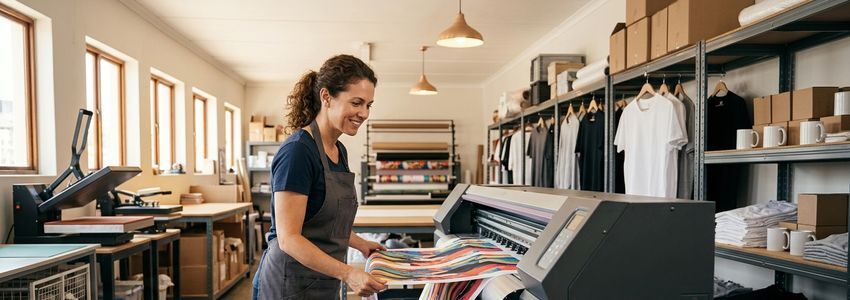
Sublimation printing equipment financing is a funding structure that lets a business purchase or lease the machinery needed for dye-sublimation printing, then pay for it in fixed installments over an agreed term instead of paying the full purchase price upfront. The equipment itself, whether a large-format sublimation printer, a rotary heat press, a swing-away press, or a convection dryer, typically serves as the collateral for the loan or lease, which makes approval easier than an unsecured loan and often means a faster funding timeline.
Sublimation is a specialized print process that uses heat to transfer dye from special transfer paper directly into polyester fabric or polymer-coated surfaces, producing vibrant, permanent, wash-resistant graphics. Because the process depends entirely on precision hardware, from calibrated printers to heat presses that hold exact temperature and pressure, most sublimation shops cannot scale production without investing in more or better equipment. Financing exists specifically to bridge that gap between the equipment a shop needs and the cash a shop has on hand.
Unlike screen printing, which requires separate screens and setup for each color and design, sublimation prints full-color, photo-quality graphics in a single pass, which is part of why demand for sublimation capacity has grown so quickly among small custom apparel and promotional product businesses. That efficiency advantage is also why equipment quality matters so much. A faster, more reliable printer and press setup directly increases how many orders a shop can turn around in a given week, which is the core economic argument for financing better equipment sooner rather than waiting to save up cash.
Lenders that specialize in commercial equipment financing, including Crestmont Capital, structure these deals around the expected useful life and resale value of the equipment. A sublimation printer or industrial heat press is a durable, income-producing asset, which makes it a strong fit for equipment financing compared to unsecured working capital.
Key Stat: The global print-on-demand market, which includes sublimation-based production, was valued at roughly $10 billion in 2024 and is projected to grow at a compound annual rate near 18% through the next decade, according to industry market research. Small and mid-size shops are a major driver of that growth because sublimation equipment allows low-minimum, high-margin custom production. Small businesses overall account for the majority of U.S. firms, according to Census Bureau data, and equipment upgrades are consistently cited as a key growth lever for manufacturers and producers of physical goods.
Key Benefits of Financing Sublimation Printing Equipment
Buying sublimation equipment outright can tie up tens of thousands of dollars that a growing shop needs for materials, marketing, payroll, and rent. Financing spreads that cost out while the equipment is already generating revenue.
- Preserve working capital. Keep cash available for blanks, ink, transfer paper, and day-to-day operating expenses instead of locking it into hardware.
- Predictable monthly payments. Fixed-rate structures make budgeting simple and protect you from cash flow surprises.
- Faster equipment upgrades. Sublimation technology moves quickly, and financing makes it easier to upgrade to faster printers or larger-format presses as your order volume grows.
- Potential tax advantages. Many equipment financing structures allow businesses to deduct payments or depreciation; a tax professional can confirm what applies to your specific situation.
- Approval based on the asset, not just credit history. Because the equipment secures the loan, financing is often more accessible to newer businesses than a traditional unsecured loan.
- Match payments to revenue. Terms can be structured around your production season, which matters for shops with seasonal spikes like back-to-school apparel or holiday custom gifts.
Ready to Upgrade Your Print Shop?
Get fast, flexible financing from the #1 business lender in the U.S. No obligation, apply in minutes.
Apply Now →How Sublimation Printing Equipment Financing Works
The process is more straightforward than most business owners expect, especially compared to a traditional bank loan. Lenders that focus on equipment financing streamline underwriting because the collateral reduces their risk.
Most sublimation equipment financing follows a similar sequence from application to funded purchase. Understanding each step helps you prepare the right documents and avoid delays.
- Identify the equipment and total project cost. Get a quote from your equipment vendor, including the printer, heat press, dryer, and any installation costs, so the lender can finance the full package rather than piecing together funding later.
- Submit a simple application. Most equipment financing applications ask for basic business information, time in business, and revenue, rather than the extensive documentation a bank requires.
- Provide supporting financial documents. Depending on the loan size, lenders may request recent bank statements, a voided check, and sometimes tax returns or financial statements.
- Receive underwriting decision. Because the equipment secures the loan, decisions are often returned within one to two business days for standard equipment amounts.
- Review and sign the financing agreement. Confirm the rate, term, monthly payment, and any end-of-term buyout or ownership terms before signing.
- Funding is sent to the vendor or reimbursed to you. The lender pays the equipment vendor directly, or in some cases reimburses you if you already made the purchase.
- Equipment is delivered and installed. Your shop begins production while you make fixed payments over the agreed term, commonly 24 to 72 months for sublimation equipment.
By the Numbers
Sublimation Printing and Print-on-Demand — Key Statistics
~$10B
Estimated global print-on-demand market size in 2024
~18%
Projected annual growth rate for print-on-demand production
60%
Share of the print-on-demand market held by apparel products
1-2 Days
Typical underwriting turnaround for standard equipment financing
Types of Equipment You Can Finance
Sublimation printing equipment financing is not limited to a single machine. Most shops finance a full production package so every piece of the workflow is covered under one payment.
- Large-format sublimation printers. Wide-format inkjet printers loaded with dye-sublimation ink, used to print designs onto transfer paper before the heat-transfer step.
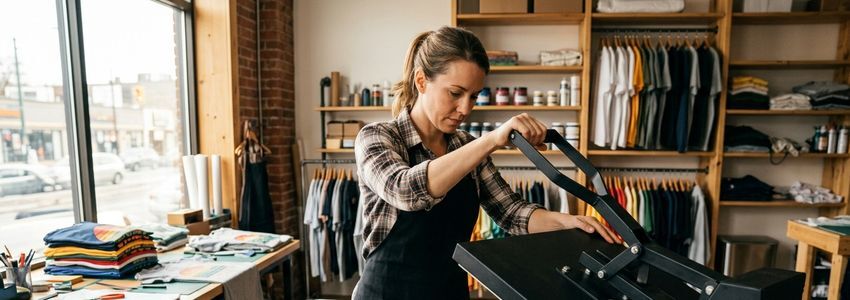
- Heat presses. Flat, swing-away, clamshell, and rotary heat presses that transfer the printed design onto fabric, tumblers, or hard substrates under heat and pressure.
- Calendar heat presses (rotary/roll presses). Continuous-feed presses used for high-volume fabric and yardage sublimation, common in higher-output apparel shops.
- 3D vacuum heat presses. Used for curved or irregular surfaces such as mugs, phone cases, and specialty promotional items.
- Convection and infrared dryers. Curing equipment used to set ink and prepare transfer paper before the pressing step.
- Cutting and finishing equipment. Vinyl and fabric cutters, trimmers, and packaging equipment that round out a full production line.
- Software and RIP (raster image processor) systems. Color management and print production software that some lenders will bundle into the financed equipment package.
Because a full sublimation production line often includes several interconnected machines, many shops prefer to finance the entire package at once through a single equipment loan or lease rather than piecing together financing for each machine separately.
Who This Financing Is Best For
Sublimation printing equipment financing tends to make the most sense for a specific set of business situations rather than every print shop at every stage.
- Print-on-demand and custom apparel businesses scaling beyond a single desktop printer and heat press into a production-capable setup.
- Promotional products and specialty gift businesses adding sublimation to an existing embroidery or screen printing operation to offer more product variety.
- Team and sports apparel decorators who need faster turnaround for jerseys, uniforms, and fan gear during peak seasons.
- Existing shops replacing aging equipment where a newer, faster printer or press would meaningfully increase throughput and order capacity.
- Businesses with seasonal demand spikes, such as holiday gift production, back-to-school apparel, or event merchandise, that need extra capacity for a limited window.
Pro Tip: If your shop is brand new with no revenue history yet, a smaller starter financing amount on a single printer and press combo is often easier to qualify for than financing a full multi-machine production line right away. You can add equipment financing again later once you have a track record.
Financing Options Compared
Equipment financing is not the only way to fund new machinery. Here is how it compares to the other financing tools sublimation business owners commonly consider.
| Financing Type | Best For | Collateral | Typical Term |
|---|---|---|---|
| Equipment Financing | Purchasing printers, presses, and dryers you will own | The financed equipment itself | 24-72 months |
| Equipment Leasing | Shops that want lower payments or plan to upgrade often | Leased equipment (may not be owned at end of term) | 12-60 months |
| Working Capital Loan | Covering payroll, materials, or a mix of expenses beyond equipment | Typically unsecured or blanket lien | 3-18 months |
| Business Line of Credit | Ongoing flexible access to funds for materials or seasonal swings | Varies by lender | Revolving, no fixed term |
For most sublimation shops purchasing a printer, press, and dryer package they intend to keep and use for years, equipment financing is typically the most cost-effective structure because it is priced against the specific durable asset. Leasing can make sense if you expect to upgrade equipment every couple of years as sublimation technology improves. A business line of credit or working capital loan is a better fit for covering blanks, ink, and labor rather than the machinery itself.
One factor many shop owners overlook is total cost of ownership rather than just the sticker price of the machine. A cheaper printer that runs slower, uses more ink per print, or breaks down more often can end up costing more over a three-year financing term than a higher-quality machine with a slightly higher monthly payment. When comparing financing offers, it helps to look at the all-in cost, including any documentation fees, down payment requirements, and end-of-term buyout amounts, not just the headline monthly payment.
It is also worth asking whether the financing structure allows for early payoff without a penalty. Sublimation shops that have a strong season can sometimes pay down equipment financing faster than scheduled, and knowing your payoff terms upfront avoids surprises later. Lenders differ significantly on this point, so it is a fair question to ask before signing any agreement.
How Crestmont Capital Helps
Crestmont Capital is rated the #1 business lender in the country and specializes in getting small business owners the equipment financing they need without the slow timelines of a traditional bank. For sublimation printing businesses, that means straightforward equipment financing and equipment leasing options sized to fit a single heat press upgrade or a full multi-machine production line. The U.S. Small Business Administration notes that access to capital for equipment and fixed assets remains one of the most common funding needs among growing small businesses, which is exactly the gap equipment financing is designed to fill.
If your shop already runs screen printing or heat-transfer apparel decoration alongside sublimation, it is worth reviewing how equipment financing worked for similar decoration businesses. Our guide to financing t-shirt printing and heat press machines and our breakdown of screen printing equipment financing both cover adjacent decoration equipment that many sublimation shops run side by side.
Beyond the equipment itself, Crestmont also offers working capital financing for shops that need to stock up on blanks and consumables ahead of a busy season, so equipment and inventory funding can work together rather than competing for the same cash. Industry coverage from Forbes has repeatedly highlighted custom apparel and print-on-demand as one of the more accessible manufacturing niches for new entrepreneurs, largely because equipment financing lowers the barrier to entry compared to industries requiring large real estate investments.
Get Your Production Line Funded
Crestmont Capital works with print and apparel businesses nationwide to fund equipment fast. See your options with no obligation.
Apply Now →Real-World Scenarios
The following scenarios illustrate how sublimation printing equipment financing plays out for different types of businesses. Names and specific figures are illustrative examples for educational purposes.
Scenario 1: The Home-Based Shop Going Commercial. A one-person Etsy shop producing sublimated tumblers and t-shirts on a desktop printer starts receiving wholesale orders from local sports teams. She uses equipment financing to add a wide-format printer, a rotary heat press, and a convection dryer, moving into a small commercial unit and increasing order capacity roughly fourfold within six months.
Scenario 2: The Screen Printer Adding Sublimation. An established screen printing shop wants to offer full-color, all-over sublimated apparel to compete for orders screen printing cannot handle. Financing the new sublimation printer and press line lets the shop add a new revenue stream without touching cash reserved for ink and blanks inventory.
Scenario 3: The Team Uniform Supplier Scaling for Season. A youth sports uniform supplier needs to double press capacity before spring registration season. Short-term equipment financing on two additional heat presses lets the shop take on new league contracts it would otherwise have to turn down.
Scenario 4: The Promotional Products Company Replacing Aging Equipment. A promotional products company running a five-year-old sublimation printer sees rising maintenance costs and slower output. Refinancing into a newer, faster printer through equipment financing reduces downtime and increases daily unit output enough to justify the new monthly payment.
Scenario 5: The Multi-Location Franchise Add-On. A regional custom gift retailer with three storefronts decides to centralize sublimation production at one location to serve all three stores rather than shipping out fulfillment. Equipment financing covers a larger-capacity printer and dual heat presses sized for the combined order volume of all locations, and the centralized setup cuts per-unit production costs.
Common Mistakes to Avoid When Financing Sublimation Equipment
A few recurring mistakes can turn an otherwise good financing decision into a costly one. Knowing what to watch for ahead of time helps you negotiate better terms and avoid unnecessary expense.
- Underestimating consumable and maintenance costs. The printer and press are only part of the ongoing cost. Ink, transfer paper, and routine maintenance add up, and shops that finance based on the machine price alone sometimes underfund working capital for these ongoing needs.
- Financing more capacity than current order volume supports. It is tempting to buy the largest, fastest machine available, but a shop doing $3,000 a month in orders may struggle to justify payments sized for a machine built to produce ten times that volume. Match equipment capacity to realistic near-term demand, with room to grow.
- Skipping vendor comparison. Sublimation printer and press pricing varies by manufacturer and dealer. Getting quotes from more than one vendor before locking in financing terms can meaningfully change your total project cost.
- Not accounting for installation, training, and calibration time. New equipment often needs a break-in period before it runs at full efficiency. Building a short ramp-up period into your financial projections avoids cash flow strain in the first month or two of payments.
- Ignoring the resale or trade-in value of existing equipment. If you are upgrading rather than adding equipment, your current printer or press may have resale or trade-in value that can offset the new financing amount. Ask your vendor about trade-in programs before financing the full replacement cost.
Frequently Asked Questions
What is sublimation printing equipment financing?
It is a funding structure that lets a business purchase or lease dye-sublimation printers, heat presses, dryers, and related production equipment while paying for it in fixed installments over time instead of all at once.
What equipment qualifies for sublimation printing financing?
Large-format sublimation printers, flat and rotary heat presses, 3D vacuum presses, calendar presses, convection and infrared dryers, cutting equipment, and related software systems can typically be included in a financing package.
How much does sublimation printing equipment cost to finance?
Costs vary widely depending on scale, from a few thousand dollars for a starter printer and press combo to well over $100,000 for a full industrial production line. Financing terms and monthly payments are structured around the specific equipment quote from your vendor.
Do I need good credit to qualify for equipment financing?
Because the equipment itself secures the loan, requirements are generally more flexible than an unsecured loan. Lenders still review credit and business financials, but the collateral reduces the emphasis placed on credit score alone.
How long does approval and funding take?
Standard equipment financing amounts are often approved within one to two business days, with funding to the vendor following shortly after signed documents are returned.
Can a brand-new sublimation business qualify?
Newer businesses can often qualify, especially for smaller equipment amounts. Lenders will typically look at personal credit, any existing revenue, and the specific equipment being financed.
What is the difference between financing and leasing sublimation equipment?
Financing is structured toward ownership at the end of the term, similar to a loan. Leasing often has lower monthly payments and may include an end-of-term option to purchase, renew, or upgrade to newer equipment.
Can I finance a full production line, not just one machine?
Yes. Most sublimation shops finance a printer, heat press, and dryer together as a single package, along with cutting or finishing equipment where applicable, rather than financing each machine separately.
What documents are typically required to apply?
Common requirements include a completed application, an equipment quote from the vendor, recent business bank statements, and basic business information. Larger amounts may also require tax returns or financial statements.
Is used sublimation equipment eligible for financing?
Many lenders will finance used equipment in good working condition, though terms and rates may differ from new equipment financing. Discuss the specific make, model, and condition with your lender.
What happens if my equipment needs vary by season?
Some financing structures can be tailored around seasonal cash flow, with payment schedules that account for predictable slower and busier periods, so payments align better with when your revenue actually comes in.
Are there tax benefits to financing equipment instead of paying cash?
Depending on how the financing is structured, there may be relevant deductions or depreciation benefits. Every business situation is different, so consult a qualified tax professional to understand what applies to you.
Can I add equipment financing on top of an existing business loan?
In many cases, yes. Because equipment financing is secured against the specific asset being purchased, it can often be layered alongside an existing working capital loan or line of credit without conflicting terms, though this depends on your specific lenders and agreements.
What interest rates should I expect on sublimation equipment financing?
Rates depend on factors like time in business, credit profile, the age and type of equipment, and the requested term length. Newer or higher-risk applications typically see higher rates than established shops with strong revenue and credit history, so it is worth comparing more than one quote before signing.
How do I get started with sublimation printing equipment financing?
Get a written quote from your equipment vendor for the printer, press, and any supporting equipment, then submit a simple application with a lender that specializes in equipment financing to review your options and terms.
Don't Let Equipment Costs Slow You Down
See your financing options for sublimation printers, heat presses, and dryers today. No obligation.
Apply Now →Next Steps
Contact your sublimation equipment vendor for pricing on the specific printer, press, and dryer package you need.
Pull recent bank statements and be ready to describe your business's time in operation and current revenue.
Submit your application and equipment quote to a lender that specializes in commercial equipment financing.
Once approved, review your rate and term, sign your agreement, and get your production line up and running.
Conclusion
Sublimation printing equipment financing gives print-on-demand shops, apparel decorators, and promotional product businesses a practical way to acquire the printers, heat presses, and dryers they need without exhausting cash reserves. With the print-on-demand and dye-sublimation market continuing to expand, having the right production capacity in place can be the difference between turning away orders and scaling to meet demand. Whether you are financing your first printer and press combo or upgrading a full production line, matching the right financing structure, term, and payment schedule to your business puts you in a stronger position to grow.
Disclaimer: The information provided in this article is for general educational purposes only and is not financial, legal, or tax advice. Funding terms, qualifications, and product availability may vary and are subject to change without notice. Crestmont Capital does not guarantee approval, rates, or specific outcomes. For personalized information about your business funding options, contact our team directly.