Hot tub and spa retailer financing gives dealers the capital to stock showroom inventory, fund floor plan lines, and expand delivery and installation operations without draining cash reserves. For a hot tub and spa retailer, the right financing structure can mean the difference between a showroom stocked with the models customers actually want and one limited to whatever cash on hand allows.
In This Article
What Is Hot Tub and Spa Retailer Financing?
Hot tub and spa retailer financing refers to the business loans, lines of credit, and inventory funding tools that dealers use to buy showroom stock, cover floor plan balances, fund delivery vehicles, and build out retail space. Unlike a loan for a homeowner buying a single hot tub, this is business-side financing designed for the dealership itself.
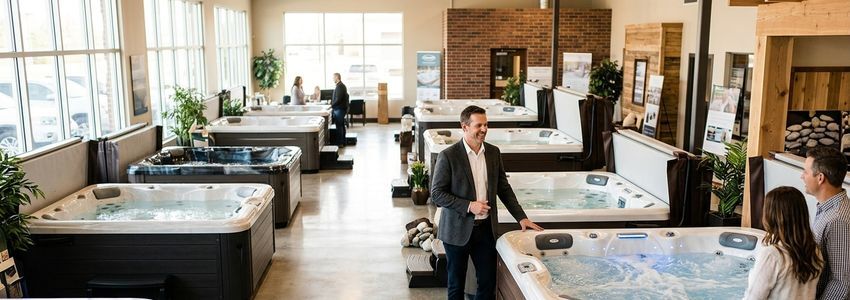
Retailers in this niche carry some of the heaviest per-unit inventory costs in the specialty retail world. A single portable hot tub can run anywhere from $4,000 to $18,000 wholesale, and a swim spa or in-ground spa installation can run well past $25,000 in equipment cost alone before labor. Carrying even a modest showroom floor of 10-15 units ties up six figures in capital that could otherwise fund marketing, payroll, or a second location.
That is where dedicated retailer financing comes in. Instead of paying cash for every unit on the floor, dealers use structured financing to acquire inventory, manage seasonal cash flow swings, and keep enough working capital on hand to cover payroll and operating costs through slower winter months in colder climates.
Key Stat: The North American hot tub market is projected to grow from roughly $2.8 billion in 2025 to $3 billion in 2026, and offline retail channels still account for more than 76% of total sales revenue, according to industry market research cited by Pool & Hot Tub Alliance-aligned trade publications.
Key Benefits of Retailer Financing
- Preserve cash flow: Keep working capital available for payroll, marketing, and unexpected expenses instead of locking it into showroom inventory.
- Stock a fuller showroom: Carry more models, sizes, and price points so walk-in customers find what they want instead of waiting on a special order.
- Smooth out seasonality: Spring and early summer typically drive the heaviest buying season; financing helps retailers stock up ahead of demand without a cash crunch.
- Fund delivery and installation: Many dealers need flatbed trucks, cranes, or forklifts to deliver and place heavy units; equipment financing covers this separately from inventory.
- Support showroom buildout or expansion: A second location or remodeled showroom floor requires commercial real estate or leasehold improvement financing.
- Maintain vendor relationships: Paying manufacturers promptly (rather than slow-paying) often preserves better wholesale pricing and priority allocation during high-demand periods.
Ready to Stock Your Showroom?
Get fast, flexible financing from the #1 business lender in the U.S. No obligation - apply in minutes.
Apply Now →How Hot Tub and Spa Retailer Financing Works
Retailer financing typically follows one of a few structures, each suited to a different need on the dealership's balance sheet. Understanding the mechanics helps you choose the right tool instead of defaulting to whatever your bank offers first.
- Apply and submit documentation. Lenders typically request 3-6 months of business bank statements, a basic business profile, time in business, and sometimes a current inventory list or manufacturer agreements.
- Underwriting review. The lender evaluates monthly revenue, existing debt obligations, time in business, and (for inventory-secured financing) the wholesale value of the units being financed.
- Approval and funding structure. Depending on the product, you receive a lump-sum term loan, a revolving line of credit, or a floor plan facility tied specifically to inventory units.
- Inventory purchase or capital deployment. Funds are used to purchase units from manufacturers, cover a delivery vehicle purchase, or fund a showroom remodel.
- Repayment. Term loans repay on a fixed schedule; floor plan lines typically repay (or "curtail") as each unit sells, freeing that portion of the credit line for the next purchase.
Floor plan financing, specifically, functions differently than a standard term loan. The inventory itself serves as collateral, and the lender advances funds against each unit as it's invoiced from the manufacturer. As units sell at retail, the dealer pays down the corresponding balance, which then becomes available again for the next order. This revolving structure is standard in the auto, RV, marine, and powersports dealer worlds, and it applies just as effectively to hot tub and spa inventory.
Types of Financing Available to Hot Tub and Spa Retailers
Inventory / Floor Plan Financing
A revolving facility secured by the wholesale value of showroom units. As units sell, the balance on that unit clears and the credit becomes available again. This is the closest financing analog to what automotive and marine dealers have used for decades, adapted for the spa and hot tub retail niche.
Business Line of Credit
A flexible, revolving credit line not tied to specific inventory units. Useful for covering marketing spend, payroll gaps during slow seasons, or a quick opportunity to buy discontinued models at a discount from a manufacturer.
SBA 7(a) Loans
SBA-backed term loans can fund inventory, working capital, equipment, and in some cases leasehold improvements, often with longer repayment terms and competitive rates compared to conventional bank financing. According to the U.S. Small Business Administration, the 7(a) program approved roughly 70,000 loans in fiscal year 2024 totaling more than $31 billion, with an average loan size near $479,000.
Equipment Financing
Covers the trucks, trailers, forklifts, and cranes dealers need to deliver and install heavy spa and hot tub units. Because the equipment itself secures the loan, approval criteria are often more flexible than unsecured working capital products.

Commercial Real Estate Financing
For dealers opening a second showroom, relocating to a higher-traffic location, or purchasing their existing leased space, commercial real estate financing funds the purchase or major renovation of the physical retail location.
By the Numbers
Hot Tub and Spa Retailer Financing - Key Statistics
$3B
Projected North American hot tub market size in 2026
76%
Share of hot tub sales still happening through offline/showroom retail
$31.1B
Total SBA 7(a) loan volume approved in FY2024
63 Days
Average U.S. dealer inventory turnover cycle across comparable floor-planned retail sectors
Who This Financing Is Best For
Hot tub and spa retailer financing is built for dealership owners managing physical inventory, not for homeowners shopping for a single unit. It fits a specific set of business profiles particularly well.
- Independent hot tub and spa dealers carrying multiple brands or models on a showroom floor.
- Pool and spa retailers expanding into hot tubs and swim spas as a complementary product line.
- Multi-location retailers needing inventory financing that scales across several showrooms.
- Seasonal-heavy operations in regions where spring and early summer drive the bulk of annual sales volume.
- Dealers transitioning from a single-location model to a second or third showroom location.
Comparing Your Financing Options
Each financing type serves a different purpose on a dealer's balance sheet. The table below breaks down how the major options compare across key decision factors.
| Financing Type | Best For | Typical Terms | Collateral |
|---|---|---|---|
| Floor Plan / Inventory Financing | Ongoing showroom stock purchases | Revolving, pay down per unit sold | Financed inventory itself |
| Business Line of Credit | Cash flow gaps, marketing, opportunistic buys | Revolving, draw as needed | Often unsecured or blanket lien |
| SBA 7(a) Loan | Larger capital needs, lower rates | Up to 10-25 years depending on use | Varies by use of proceeds |
| Equipment Financing | Delivery trucks, cranes, forklifts | 2-7 years | Financed equipment |
| Commercial Real Estate Financing | New or expanded showroom location | 10-25 years | The property itself |
How Crestmont Capital Helps Hot Tub and Spa Retailers
Crestmont Capital works with specialty retailers, including hot tub and spa dealers, to structure financing around how the business actually operates, not a one-size-fits-all template. Depending on your current needs, that might mean an inventory financing facility to stock the showroom ahead of peak season, a flexible business line of credit to smooth out cash flow between seasons, or an SBA loan for a larger capital project like a showroom buildout.
If you are planning a new location or purchasing your existing retail space, commercial real estate financing can fund the purchase or renovation without disrupting working capital earmarked for inventory. Dealers expanding into adjacent product categories, like watercraft or outdoor living equipment, often benefit from reviewing how other specialty dealers structure financing; our guide to watercraft dealer business loans covers many of the same floor plan and inventory concepts in a closely related retail niche.
Crestmont's application process is built for speed. Most dealers can complete the initial application in minutes and receive a funding decision quickly, without the lengthy underwriting timelines common at traditional banks.
Stock Up Before Your Peak Season
Flexible inventory and working capital financing built for retail dealers. No obligation to apply.
Get Started →Pro Tip: Align your financing draw schedule with manufacturer order lead times. Many spa manufacturers require 60-90 days of lead time for custom orders, so financing approved well ahead of peak season avoids stockouts during your highest-margin months.
Real-World Scenarios
Scenario 1: Stocking Up for Spring Buying Season
An independent hot tub dealer in the Midwest historically sees 60% of annual sales between March and July. Rather than paying cash for a limited number of units, the dealer uses a floor plan line to stock 20 units across three price tiers ahead of the season, allowing walk-in customers to buy and take delivery within days instead of waiting on a special order.
Scenario 2: Adding a Swim Spa Line
A spa retailer wants to add swim spas as a new product category to capture customers who want exercise and relaxation in one unit. Swim spas carry a higher per-unit cost, so the dealer uses a business line of credit to fund the initial order of display models without disrupting cash reserved for existing hot tub inventory.
Scenario 3: Opening a Second Showroom
After two years of strong sales at a single location, a dealer identifies a second market 40 minutes away with no direct spa retail competitor. The dealer uses commercial real estate financing to purchase a retail space and equipment financing to fund a delivery truck for the new territory.
Scenario 4: Surviving a Slow Winter
A spa retailer in a seasonal climate experiences a predictable cash flow dip every January and February. A business line of credit covers payroll and lease payments during the slow months, repaid as spring sales pick back up.
Scenario 5: Replacing an Aging Delivery Fleet
A dealer's 12-year-old flatbed delivery truck finally breaks down during peak season. Equipment financing allows the dealer to replace it within days rather than scrambling for cash or renting equipment at a premium.
Frequently Asked Questions
Next Steps
Estimate the showroom stock and seasonal buying volume you want to fund.
Have 3-6 months of bank statements ready to speed up underwriting.
Submit your application with Crestmont Capital in minutes.
Stock your showroom and fund operations before demand ramps up.
Your Showroom Shouldn't Wait on Cash Flow
See what financing options are available for your dealership today. No obligation - apply in minutes.
Apply Now →Conclusion
Hot tub and spa retailer financing is what lets independent dealers compete on showroom depth, delivery speed, and seasonal readiness, without tying up every dollar of working capital in inventory. Whether you need a revolving floor plan facility to stock units ahead of spring demand, a line of credit to smooth out a slow winter, or an SBA loan to fund a second showroom, matching the financing structure to the specific need keeps your dealership capital-efficient and ready to grow. Crestmont Capital works with specialty retailers to structure financing around how the business actually runs, not a generic template, so your showroom is stocked and your cash flow stays healthy through every season.
Disclaimer: The information provided in this article is for general educational purposes only and is not financial, legal, or tax advice. Funding terms, qualifications, and product availability may vary and are subject to change without notice. Crestmont Capital does not guarantee approval, rates, or specific outcomes. For personalized information about your business funding options, contact our team directly.