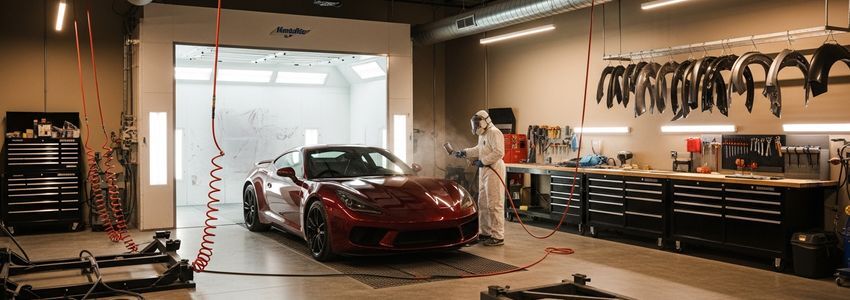
Running a paint and body shop is rewarding, but the financial demands are relentless. Between spray booths, frame straighteners, paint mixing systems, labor costs, and the constant need to upgrade equipment to meet modern repair standards, shop owners face significant capital requirements at every stage of growth. Whether you are just starting out, expanding to a second location, or replacing aging equipment, paint and body shop business loans can provide the capital you need to keep your shop competitive and profitable.
This guide covers every financing option available to collision and auto paint shop owners, walks you through qualification requirements, and helps you identify the right loan product for your specific situation.
- Why Financing Matters for Paint and Body Shops
- Best Loan Types for Paint and Body Shop Owners
- How Much Can You Borrow?
- How to Qualify for a Shop Loan
- Top Uses of Capital for Body Shops
- Paint Shop Financing: By the Numbers
- Getting Approved with Bad Credit
- The Application Process
- How to Choose the Right Lender
- Next Steps to Get Funded
- Frequently Asked Questions
Why Financing Matters for Paint and Body Shops
The auto body repair and collision industry is capital intensive by nature. According to the U.S. Small Business Administration, automotive service businesses routinely require access to financing to manage equipment lifecycle costs and seasonal cash flow variability. Paint booths alone can cost $30,000 to $100,000 or more, and modern ADAS calibration equipment often runs $20,000 to $60,000 per unit.
Beyond equipment, paint and body shops face additional financial pressures including parts inventory, insurance requirements, rent or property costs, payroll, and marketing. Many shops also experience seasonal slowdowns in winter months that can strain working capital. Accessing affordable financing at the right time can be the difference between a thriving shop and one that struggles to keep the lights on.
The good news is that paint and body shop business loans are widely available, and lenders view collision and auto paint businesses favorably because they generate consistent, repeat revenue from a broad customer base.
Ready to Fund Your Shop's Growth?
Crestmont Capital offers fast, flexible financing for paint and body shops. Apply in minutes and get funded in as little as 24 hours.
Apply Now →Best Loan Types for Paint and Body Shop Owners
Understanding the different types of financing available is the first step to making a smart borrowing decision. Each loan type serves a different purpose, and the best choice depends on what you need the money for, how quickly you need it, and the financial health of your business.
1. Small Business Term Loans
Term loans provide a lump sum of capital repaid over a fixed period with regular payments. They are ideal for large, planned investments like buying new equipment, renovating your shop, or expanding to a second location. You can typically borrow from $10,000 to $500,000, with repayment terms ranging from 1 to 10 years. Small business loans from alternative lenders often fund faster than bank loans, sometimes within 24 to 48 hours.
2. Equipment Financing
Equipment financing is purpose-built for purchasing business equipment. The equipment itself serves as collateral, which makes approval easier and rates more competitive. This is one of the most popular options for body shops investing in paint booths, frame racks, welders, ADAS calibration systems, or compressors. With equipment financing, you can often finance 100% of the purchase price with no money down, preserving your working capital for operational needs.
3. Business Line of Credit
A business line of credit gives you revolving access to funds up to a set limit. You draw what you need, pay it back, and draw again. This is a powerful tool for managing cash flow gaps between insurance payouts, covering payroll during slow periods, or taking advantage of parts supplier discounts. Lines of credit typically range from $10,000 to $250,000 for small and mid-size shops.
4. SBA Loans
SBA loans are government-backed loans offered through partner lenders. The SBA 7(a) program offers up to $5 million, making it well-suited for major expansions, real estate purchases, or acquisition financing. SBA loans carry the lowest interest rates among small business loan options, typically prime plus 2.5% to 4.5%. The tradeoff is a longer approval process, usually 30 to 90 days, and more extensive documentation requirements.
5. Short-Term Business Loans
Short-term business loans offer quick capital with repayment periods of 3 to 18 months. They are ideal for urgent needs like emergency equipment repairs, a sudden opportunity to purchase inventory at a discount, or bridging a temporary cash flow gap. Approval is fast, sometimes within hours, but rates are higher than traditional term loans.
6. Invoice Financing
Many body shops work with fleet accounts, insurance companies, or fleet management services that pay on net-30 or net-60 terms. Invoice financing lets you access up to 85% to 95% of the value of outstanding invoices immediately, instead of waiting weeks for payment. This can significantly improve cash flow without taking on traditional debt.
Before taking on any debt, make sure you understand the repayment schedule and have a clear plan for how the capital will generate revenue. Equipment purchases that improve throughput, reduce cycle time, or allow you to take on new types of repairs typically offer the strongest return on investment.
How Much Can You Borrow?
Loan amounts for paint and body shop business loans vary widely based on the type of financing, your shop's revenue, your credit profile, and your lender. Here is a general breakdown:
- Equipment financing: $5,000 to $500,000+ (up to 100% of equipment cost)
- Term loans (alternative lenders): $10,000 to $500,000
- SBA 7(a) loans: Up to $5 million
- Business line of credit: $10,000 to $250,000
- Short-term loans: $5,000 to $250,000
- Invoice financing: Based on outstanding receivables, typically up to 90% of invoice value
According to data from Forbes, the average small business loan amount is approximately $663,000 through traditional banks, though alternative lenders often approve smaller amounts much more quickly. Most independent body shops seeking growth capital borrow between $25,000 and $250,000.
How to Qualify for a Shop Loan
Lenders evaluate several factors when reviewing a paint and body shop loan application. Understanding these requirements in advance helps you prepare a stronger application and improve your chances of approval.
Credit Score
Your personal credit score is typically the most important factor, especially for newer businesses. Most alternative lenders require a minimum score of 550 to 600, while SBA loans and bank loans generally require 650 to 700 or higher. If your credit is imperfect, bad credit business loans are available with more flexible criteria.
Time in Business
Most lenders require at least 6 to 12 months in business for term loans and lines of credit. Equipment financing is sometimes available for newer shops, especially when the equipment itself serves as strong collateral. SBA loans typically require 2 or more years of operating history.
Annual Revenue
Lenders want to see that your shop generates sufficient revenue to service the debt. Most alternative lenders require minimum annual revenue of $100,000 to $150,000. Banks may require $250,000 or more. Shops with strong, consistent revenue from insurance accounts or fleet clients are viewed very favorably.
Business Bank Statements
Most alternative lenders review 3 to 6 months of business bank statements to verify cash flow, average daily balance, and deposit frequency. Having organized financial records is important. According to CNBC's small business coverage, financial disorganization is one of the top reasons lenders decline applications.
Collateral
Equipment loans use the purchased equipment as collateral. For other loan types, lenders may require a general lien on business assets or a personal guarantee. Some lenders offer unsecured options for borrowers with strong credit and revenue history.
Top Uses of Capital for Body Shops
Understanding how your peers are deploying capital can help you prioritize your own financing strategy. Here are the most common uses of paint and body shop business loans:
Equipment Purchases and Upgrades
The most common use of financing in the collision repair industry is equipment acquisition. Modern paint booths with advanced filtration and curing systems, computerized frame straightening equipment, welding systems, ADAS calibration tools, and color-matching technology are major investments that directly impact your shop's capacity, quality, and ability to attract insurance contracts.
Shop Renovation and Expansion
Expanding bay capacity, adding a dedicated detail area, upgrading your waiting room, or renovating your facility to meet insurance network certification standards are all strong investments. Lenders view shop improvements favorably because they directly increase revenue potential.
Working Capital and Cash Flow Management
Insurance payouts can take 30 to 60 days or longer. During that time, you still need to pay employees, purchase parts, and cover overhead. A working capital loan or line of credit bridges this gap, keeping your shop running smoothly while you wait for reimbursements.
Inventory and Supplies
Keeping adequate supplies of primers, paints, clearcoats, body filler, and consumables ensures your technicians are never waiting on materials. Bulk purchasing often unlocks supplier discounts, and inventory financing or a line of credit makes this possible without straining cash flow.
Marketing and Customer Acquisition
Many body shop owners underinvest in marketing. Loans can fund digital advertising campaigns, website development, local SEO, and referral programs that drive a steady flow of customers beyond insurance referrals.
Payroll and Staffing
Skilled technicians are difficult to find and even harder to retain. Using a line of credit to cover payroll during slow periods or to fund competitive compensation packages can be a strategic investment in long-term shop productivity.
Need Equipment Financing for Your Shop?
Fund your next paint booth, frame rack, or calibration system with equipment financing. No money down options available.
Get Equipment Financing →Paint Shop Financing: By the Numbers
Paint and Body Shop Industry Financing Overview
Sources: SBA.gov, industry estimates, Crestmont Capital internal data
Getting Approved with Bad Credit
If your credit score is below 600, you still have options. Many alternative lenders focus more on your business's revenue and cash flow than your personal credit score. Here is what you can do to improve your chances:
- Show strong revenue: Consistent monthly deposits of $10,000 or more demonstrate your ability to repay. Lenders often approve borrowers with lower credit scores if cash flow is strong.
- Consider equipment financing: Since the equipment serves as collateral, equipment loans are more accessible for borrowers with imperfect credit.
- Provide a larger down payment: Offering 10% to 20% down reduces lender risk and can help offset a lower credit score.
- Add a co-signer: A co-signer with strong credit can dramatically improve your approval odds and interest rate.
- Work with specialty lenders: Some lenders specialize in bad credit business loans and evaluate applications holistically rather than relying solely on credit scores.
Traditional banks often take 2 to 4 weeks to approve a small business loan, and rejection rates are high. Alternative lenders like Crestmont Capital can approve and fund your loan in as little as 24 hours with minimal paperwork, making them a popular choice for body shop owners who need capital quickly.
The Application Process
Applying for a paint and body shop business loan is simpler than most owners expect, especially with alternative lenders. Here is what the process typically looks like:
- Pre-qualify online: Most lenders offer a quick pre-qualification that takes 5 to 10 minutes and does not impact your credit score.
- Submit documents: You will typically need 3 to 6 months of business bank statements, a government-issued ID, and basic business information. Some applications require tax returns for larger loan amounts.
- Review your offer: Once approved, you will receive a loan offer outlining the amount, rate, term, and payment schedule. Review the APR carefully and compare offers if you applied to multiple lenders.
- Accept and get funded: Accept your offer electronically, and funds are typically deposited within 24 to 48 hours for alternative lenders, or 3 to 7 business days for SBA and bank loans.
If you want to learn more about how other automotive shop owners approach financing, check out our guides on auto body shop loans and auto repair shop loans for additional context on what lenders look for in the automotive services industry.
How to Choose the Right Lender
Not all lenders are created equal, and choosing the right financing partner can save your business thousands of dollars over the life of the loan. Here are the key factors to evaluate:
Speed of Funding
If you need capital quickly, an alternative online lender is typically your best bet. They can often fund within 24 to 48 hours, compared to weeks or months for SBA and bank loans. According to research cited by Bloomberg, alternative lenders now account for a significant share of small business lending volume, largely due to their speed and accessibility.
Total Cost of Capital
Compare the Annual Percentage Rate (APR), not just the interest rate or factor rate quoted. A short-term loan with a 1.3 factor rate might look affordable until you calculate the equivalent APR, which can exceed 40% to 60%. Long-term loans from banks and the SBA carry much lower effective rates, though they take longer to obtain.
Repayment Flexibility
Some lenders offer daily or weekly repayment, while others bill monthly. Choose a repayment schedule that aligns with your cash flow. Revenue-based options that adjust payments to match your monthly sales can be especially helpful for shops with seasonal variation.
Lender Reputation
Work with established lenders that are transparent about their fees and terms. Read reviews, check for BBB accreditation, and make sure there are no prepayment penalties or hidden origination fees.
Once you secure your first loan and repay it successfully, you build a track record that can lead to larger credit lines, lower rates, and faster approvals in the future. The best financing relationships are long-term partnerships, not one-time transactions.
Next Steps to Get Funded
How to Get Your Paint and Body Shop Loan in 5 Steps
Apply for a Paint and Body Shop Loan Today
Get the capital your shop needs to grow. Fast approvals, competitive rates, and funding in as little as 24 hours.
Start Your Application →Frequently Asked Questions
What types of loans are available for paint and body shop owners?
Paint and body shop owners can access several loan types including small business term loans, equipment financing, business lines of credit, SBA loans, short-term loans, and invoice financing. The right loan depends on your specific need, whether it is purchasing equipment, managing cash flow, or funding an expansion.
How much can a body shop owner borrow?
Loan amounts vary based on lender and loan type. Alternative lenders typically offer $10,000 to $500,000, while SBA loans can reach up to $5 million. Equipment financing is often sized to cover 100% of the equipment purchase price, which for a commercial paint booth can range from $30,000 to $150,000 or more.
What credit score do I need to get a paint shop business loan?
Most alternative lenders require a minimum personal credit score of 550 to 600. Traditional bank loans and SBA loans typically require 650 or higher. Some equipment financing programs are available for scores as low as 500 if the shop has strong revenue and the equipment provides solid collateral coverage.
How fast can I get funded?
Alternative lenders can fund paint and body shop loans in as little as 24 to 48 hours after approval. SBA loans take 30 to 90 days on average. Traditional bank loans typically take 2 to 4 weeks. If you need urgent capital, working with a direct lender like Crestmont Capital offers the fastest path to funding.
Can I finance a paint booth with a business loan?
Yes. Equipment financing is specifically designed for large purchases like commercial paint booths. The booth serves as collateral, which keeps rates competitive and approval rates high. Many lenders offer 100% financing with no down payment for shops with 12 or more months in business and adequate revenue.
What documents do I need to apply for a body shop loan?
Most alternative lenders require 3 to 6 months of business bank statements, a government-issued ID, and basic business information including EIN and business license. Larger loans or SBA applications may also require 2 years of business tax returns, a balance sheet, and profit and loss statements.
Can I get a loan for my body shop with bad credit?
Yes. Several lenders offer body shop loans for owners with credit scores below 600. Equipment financing is particularly accessible because the equipment provides collateral. Revenue-based lenders may approve applications based primarily on monthly cash flow rather than credit score. Having strong and consistent bank deposits significantly improves your chances.
How do SBA loans work for body shops?
SBA loans are government-backed loans issued by participating banks and credit unions. The SBA guarantees a portion of the loan, reducing lender risk and enabling lower interest rates. Body shops can use SBA 7(a) loans for equipment, renovation, real estate, working capital, or acquisition. The process takes longer than alternative lending but offers the most competitive rates for qualified borrowers.
What is the interest rate on a paint shop business loan?
Interest rates vary based on loan type, credit profile, and lender. SBA loans typically carry rates of prime plus 2.5% to 4.5%. Bank term loans range from 6% to 12% APR. Alternative lender term loans range from 12% to 45% APR. Equipment financing typically falls between 5% and 25% APR. Short-term loans often carry factor rates that translate to 30% to 80%+ APR.
Do I need collateral for a body shop loan?
It depends on the loan type. Equipment financing uses the purchased equipment as collateral, making it accessible without additional assets. Term loans from traditional banks typically require collateral such as business assets or real estate. Many alternative lenders offer unsecured loans based on revenue and credit history, though unsecured loans typically carry higher rates.
Can a new body shop get a business loan?
Startup and newer shops face more limited options than established businesses. Most traditional term loans require 6 to 12 months of operating history. Equipment financing is available earlier in some cases. If you are brand new, consider SBA microloans ($50,000 and under), CDFI loans, or equipment financing programs designed for newer businesses. Strong personal credit and a down payment significantly help.
What is invoice financing and how does it help body shops?
Invoice financing lets body shops access cash from outstanding invoices before they are paid. If your shop performs fleet work or insurance repairs that pay on net-30 or net-60 terms, you can get an advance of 85% to 95% of the invoice value immediately. This eliminates cash flow gaps without taking on traditional debt and repays automatically when your customer pays.
What is the difference between a business line of credit and a term loan for a body shop?
A term loan provides a one-time lump sum with fixed payments over a set period, ideal for specific purchases like equipment or renovation. A business line of credit provides revolving access to funds you can draw and repay repeatedly, making it better for ongoing cash flow management. Many successful shops use both products simultaneously.
How do I improve my chances of getting approved for a body shop loan?
Improve your approval odds by maintaining organized financial records, keeping a healthy average bank balance, paying existing debts on time to build credit, avoiding NSF or overdraft fees, having a clear plan for how the loan will be used, and working with a lender experienced in automotive services businesses.
Is Crestmont Capital a good option for paint and body shop loans?
Crestmont Capital is a direct lender that specializes in small business financing across all industries, including automotive services. We offer multiple loan products, fast approvals, and flexible criteria designed to help shop owners at all stages of growth. Our application takes minutes, and qualified applicants receive funding in as little as 24 hours. Visit our small business loans page to learn more or apply today.
Disclaimer: The information provided in this article is for general educational purposes only and is not financial, legal, or tax advice. Funding terms, qualifications, and product availability may vary and are subject to change without notice. Crestmont Capital does not guarantee approval, rates, or specific outcomes. For personalized information about your business funding options, contact our team directly.