
 (800) 949-0401
Auto Body Shop Loans: The Complete Financing Guide for Shop Owners
Running an auto body shop is a capital-intensive business. Whether you need to upgrade your paint booth, replace a frame straightening machine, hire additional technicians, or simply bridge the gap between insurance payouts and your payroll cycle, body shop financing gives you the flexibility to grow and operate without interruption. This guide breaks down every auto body shop loan option available in 2026, how to qualify, and how Crestmont Capital helps collision repair businesses access the funding they need - fast.
In This Article
- What Is Auto Body Shop Financing?
- Types of Loans for Auto Body Shops
- Key Benefits of Body Shop Financing
- How Auto Body Shop Loans Work
- Who Qualifies for Body Shop Financing
- Best Uses for Auto Body Shop Loans
- Equipment Financing for Collision Repair Shops
- How Crestmont Capital Helps
- Real-World Financing Scenarios
- Frequently Asked Questions
- How to Get Started
What Is Auto Body Shop Financing?
Auto body shop financing refers to any business loan or credit product specifically used to fund the operations, equipment, or expansion of a collision repair or auto body business. These loans can cover a wide spectrum of needs, from purchasing a new paint booth or frame machine to covering payroll during a slow season or funding a second shop location.
Unlike general small business loans, body shop financing is often structured around the unique cash flow patterns of the collision repair industry. Shops frequently deal with delayed insurance payments, high equipment costs, and fluctuating vehicle volume - making access to flexible capital critical for sustained growth. Lenders familiar with this space understand these dynamics and structure loan products accordingly.
Auto body shops of all sizes can benefit from financing. Whether you operate a one-bay shop or a multi-location DRP (Direct Repair Program) facility, there are loan products designed to match your scale, revenue, and goals.
Industry Snapshot: According to IBISWorld, the auto body repair industry in the U.S. generates over $47 billion in annual revenue - yet many shop owners still struggle to access the working capital needed to grow, modernize equipment, or weather cash flow gaps from insurance delays.
Types of Loans Available for Auto Body Shops
Body shop owners have access to a variety of financing products. The right loan depends on your specific need, your time in business, and the loan amount required. Here is a breakdown of the most common options available in 2026.
Working Capital Loans
A working capital loan provides short-to-medium term funds to cover day-to-day operational costs. For auto body shops, this is especially valuable when insurance checks are delayed, when a supplier invoice comes due before a job closes, or when you need to bridge a seasonal lull. These loans are typically unsecured and can fund in as little as one to three business days. Learn more about how unsecured working capital loans can keep your shop running smoothly between payment cycles.
Equipment Financing
Collision repair shops are equipment-heavy businesses. Frame straightening machines, paint booths, spot welders, ADAS calibration tools, and lifts represent significant capital investments. Equipment financing lets you purchase or lease this equipment while spreading the cost over 24 to 84 months. The equipment itself serves as collateral, which often means lower rates and higher approval odds even for shops with limited credit history. Explore equipment financing options designed for commercial auto and industrial applications.
Business Line of Credit
A business line of credit works like a credit card for your shop - you draw funds when you need them, pay back what you use, and the credit replenishes. This is ideal for auto body shops that want ongoing liquidity without taking on a fixed loan payment every month. Lines of credit work particularly well for managing parts inventory costs, handling unexpected repairs to shop equipment, or covering payroll when a large DRP job is still in progress. See how a business line of credit can give your shop flexible, on-demand access to capital.
SBA Loans
For larger financing needs such as buying a building, acquiring another shop, or funding a major renovation, SBA loans offer some of the most competitive rates available to small businesses. The SBA 7(a) program supports loan amounts up to $5 million with extended repayment terms and government-backed guarantees that reduce lender risk. However, SBA loans require stronger credit profiles, more documentation, and longer processing times. They are best suited for established auto body shops with strong financials seeking long-term capital. Learn about SBA loan programs that may be available for your shop.
Term Loans
Traditional term loans provide a lump sum of capital repaid over a fixed period with regular payments. For auto body shops, term loans are well-suited for planned investments like facility upgrades, purchasing a property, or expanding to a second location. Terms typically range from one to five years for shorter-term products and up to 25 years for SBA-backed commercial loans.
Revenue-Based Financing
Revenue-based financing ties your repayments to your shop's actual revenue. Instead of a fixed monthly payment, you repay a percentage of your gross receipts each period. When business is slow, your payment is lower. When the shop is busy, you repay faster. This structure is particularly appealing for shops with seasonal fluctuations or variable cash flow tied to insurance cycle timing. Find out how revenue-based financing can flex with your shop's revenue cycles.
Merchant Cash Advance
A merchant cash advance provides an upfront lump sum in exchange for a portion of future credit card or debit card sales. For auto body shops that process a high volume of card payments, MCAs offer a fast approval path - often within 24 to 48 hours. Because repayment is tied to sales volume, MCAs are best used for short-term needs where the effective cost of capital is offset by the urgency of the opportunity or expense.
Need Financing for Your Auto Body Shop?
Get fast, flexible funding from the #1 business lender in the U.S. Approval decisions in as little as 4 hours. No obligation to apply.
Apply Now →Key Benefits of Body Shop Financing
Auto body shop owners who access capital at the right time gain a real competitive advantage. Here are the core benefits that make collision repair financing worth pursuing:
- Modernize equipment without depleting cash: Stay competitive with the latest ADAS calibration tools, welding technology, and paint matching systems - without drawing down your operating reserves.
- Bridge insurance payment gaps: Insurers can take weeks to process claims. Working capital loans and lines of credit keep your shop running smoothly during that wait.
- Hire and retain skilled technicians: Qualified body technicians are in high demand. Financing gives you the payroll flexibility to bring on talent when you need it.
- Expand to meet DRP demand: Direct Repair Program contracts often require specific equipment and capacity standards. Financing lets you meet those requirements and capture more insurer-referred business.
- Manage parts and inventory costs: Pre-buying parts at favorable pricing or maintaining a well-stocked inventory is easier with a revolving credit facility.
- Reduce tax liability through Section 179: Equipment financed for your shop may qualify for significant tax deductions under Section 179, potentially recovering a meaningful portion of your investment in the first year.
How Auto Body Shop Loans Work
The application and funding process for body shop financing is straightforward when you work with a lender experienced in the auto repair sector. Here is a step-by-step overview of how the process typically unfolds.
Step 1: Define Your Funding Need
Before you apply, get clear on what the capital is for and how much you need. Equipment purchases require a specific quote. Working capital needs should be estimated against your operating expenses and payment cycle. Having a clear purpose strengthens your application and helps lenders match you to the right product.
Step 2: Gather Basic Documentation
Most alternative lenders require a minimal document package for initial approval. Typical requirements include three to six months of business bank statements, a government-issued ID, and basic business information (time in business, monthly revenue, industry type). SBA loans and larger term loans will require full financial statements, tax returns, and a detailed business plan.
Step 3: Submit Your Application
Online applications through lenders like Crestmont Capital take as little as five to ten minutes to complete. Once submitted, you can receive a decision in as little as a few hours for working capital and equipment loans, or several days for larger SBA-backed products.
Step 4: Review Your Offer
Your offer will include the loan amount, interest rate or factor rate, repayment term, and any fees. Review these terms carefully and ask questions about prepayment penalties, origination fees, and any personal guarantee requirements before accepting.
Step 5: Receive Funding
Upon approval and contract signing, funds are deposited directly into your business bank account - often within one to three business days for working capital loans. Equipment financing may take slightly longer depending on whether the lender pays the vendor directly or disburses to you.
Who Qualifies for Auto Body Shop Financing
Qualification requirements vary significantly by loan type and lender. Here is a general guide to what most lenders look for when evaluating body shop loan applications.
| Loan Type | Min. Credit Score | Min. Time in Business | Min. Monthly Revenue |
|---|---|---|---|
| Working Capital Loan | 550+ | 6 months | $10,000+ |
| Equipment Financing | 580+ | 12 months | $8,000+ |
| Business Line of Credit | 600+ | 12 months | $15,000+ |
| SBA Loan | 680+ | 2 years | Varies |
| Revenue-Based Financing | 500+ | 6 months | $12,000+ |
These are general guidelines - actual requirements vary by lender. Factors like your average monthly revenue, industry experience, and existing debt obligations also influence approval decisions. Shops with lower credit scores can often still qualify through revenue-based financing or merchant cash advances, which place more weight on cash flow than credit history.
Best Uses for Auto Body Shop Loans
Auto body shops have highly specific capital needs. The following are the most common - and highest-ROI - ways collision repair business owners put financing to work.
Purchasing or Leasing Equipment
Equipment is the backbone of any body shop operation. Frame machines, paint booths, welding systems, and diagnostic tools represent the biggest single capital outlay for most shops. Financing this equipment preserves cash while allowing you to stay current with the technology customers and insurance companies expect. Industry data shows that shops with modern ADAS calibration equipment handle more insurance-referred repairs and close at higher labor rates.
Expanding Shop Capacity
Adding bays, increasing square footage, or opening a second location requires significant upfront investment. Term loans and SBA loans are well-suited to fund this type of expansion, giving you 5 to 25 years to repay against the long-term revenue the new capacity will generate.
Hiring and Training Technicians
The shortage of skilled auto body technicians is a significant industry challenge. According to the Auto Care Association, the gap between available positions and qualified workers continues to widen. Financing can cover signing bonuses, training programs, and the additional payroll costs of ramping up a new hire during the onboarding period before they reach full productivity.
Covering Insurance Payment Delays
One of the most common cash flow challenges for body shops is the lag between completing a repair and receiving payment from insurance companies. A working capital loan or line of credit bridges this gap, ensuring you can pay suppliers, keep the lights on, and meet payroll while waiting for insurer reimbursements to arrive.
Marketing and Customer Acquisition
Investing in digital marketing - Google Ads, SEO, reputation management - is increasingly important for shops that want to attract retail (non-DRP) customers. Financing a targeted marketing campaign can generate a measurable return, particularly in markets where you can capture more private-pay customers who are less constrained by insurer rate schedules.
Software and Shop Management Systems
Modern shop management software like CCC ONE, Mitchell, or Audatex integrates estimating, parts ordering, and workflow management into a single platform. These systems improve efficiency, reduce cycle times, and improve the customer experience. Financing the implementation cost is a smart use of capital when the resulting operational improvements increase throughput and reduce rework.
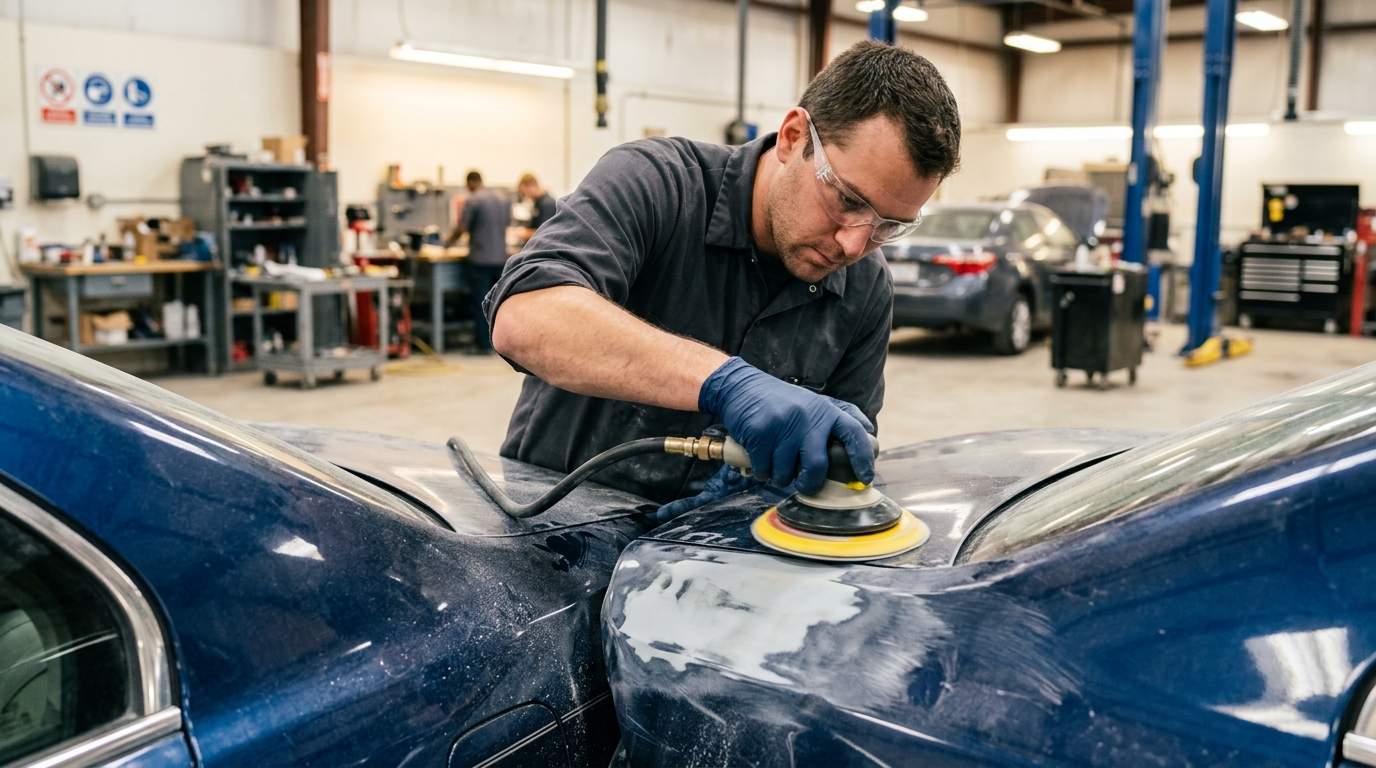
Equipment Financing for Collision Repair Shops
Equipment financing deserves its own section because it is the most common and most impactful use of capital for most auto body shops. Here is what you need to know about financing collision repair equipment specifically.
What Equipment Can Be Financed?
Virtually any piece of auto body or collision repair equipment can be financed, including:
- Paint booths and spray booths
- Frame straightening machines and measuring systems
- Welding and MIG welding systems
- ADAS (Advanced Driver Assistance Systems) calibration tools
- Aluminum repair stations
- Vehicle lifts and hydraulic equipment
- Color matching and paint mixing systems
- Dent repair and PDR tools
- Diagnostic and scanning tools
- Dust collection and air filtration systems
Lease vs. Buy: Which Is Better for Body Shop Equipment?
The decision to lease or buy equipment depends on how quickly the technology evolves and whether you want to preserve capital. For equipment like ADAS calibration tools that evolve rapidly, leasing allows you to upgrade at the end of the term. For more durable, long-lived assets like frame machines or paint booths, purchasing with a term loan may be more economical over a 10-to-15-year useful life. Review the Equipment Financing 101 guide for a full comparison of lease vs. buy considerations before making a decision.
Section 179 Advantage: Equipment purchased (not leased) for your auto body shop may qualify for full first-year expensing under Section 179. In 2026, the deduction limit is over $1 million, meaning a $150,000 paint booth could generate a significant tax benefit in year one. Consult your CPA for details.
How Crestmont Capital Helps Auto Body Shops
Crestmont Capital has worked with collision repair businesses across the country to provide fast, flexible financing tailored to the unique needs of the auto body industry. As the #1-rated business lender in the U.S., we offer a full suite of financing options with minimal paperwork and rapid approval timelines.
Here is what sets Crestmont Capital apart for body shop owners:
- Fast approvals: Working capital decisions in as little as 4 hours, with funding in 1 to 3 business days
- Flexible products: From short-term working capital to long-term equipment loans and SBA-backed programs
- No hard credit pull to apply: Get a pre-approval offer without affecting your credit score
- Loan amounts from $10,000 to $10 million: Scalable to your shop's size and growth stage
- Dedicated advisors: Work with a specialist who understands the collision repair business
Whether you are a single-bay shop looking to add a second lift or a multi-location operation seeking capital for a major equipment refresh, our team can structure a financing solution that works. Explore all of our small business financing options or apply directly to get started.
Ready to Grow Your Collision Repair Business?
Crestmont Capital offers fast, flexible body shop financing with approvals in hours, not weeks. Apply in minutes with no obligation.
Apply Now →Real-World Auto Body Shop Financing Scenarios
To make the financing landscape more concrete, here are six scenarios that illustrate how body shop owners use capital to solve real problems and pursue real opportunities.
Scenario 1: The Paint Booth Upgrade
A six-bay collision center in Phoenix has been using an aging paint booth that cannot meet modern waterborne paint requirements. Several insurance DRP programs are beginning to mandate waterborne compliance. The owner finances a new $120,000 downdraft paint booth over 60 months at $2,200 per month, qualifies for a Section 179 deduction reducing first-year tax liability significantly, and wins two new DRP contracts within 90 days of installation. The booth pays for itself in new insurance-referred volume within 18 months.
Scenario 2: Bridging an Insurance Payment Gap
A family-owned body shop in Atlanta completes $85,000 in repairs on a fleet of vehicles damaged in a hailstorm. The insurance payer requires 30 business days to process the claim. Payroll and supplier invoices are due within two weeks. The owner uses a $50,000 working capital line of credit to cover costs, repays the line when the insurance check arrives, and avoids any disruption to operations or supplier relationships.
Scenario 3: Hiring Two Certified Technicians
A growing shop in Denver has more work than its current team can handle but cannot afford to bring on two I-CAR Platinum certified technicians without additional capital. A $75,000 term loan covers six months of salary for both technicians while the owner ramps up production. Within the first quarter, the additional capacity generates enough incremental revenue to make the loan payments and show a net positive return.
Scenario 4: Acquiring a Neighboring Shop
A regional operator with three locations identifies a neighboring independent shop whose owner wants to retire. Using a combination of SBA 7(a) acquisition financing and a working capital supplement from Crestmont, the owner structures a deal to acquire the fourth location, absorb the existing customer base, and integrate it into the DRP network within 90 days. The deal is accretive to revenue from month one. Review our guide on business acquisition loans for a full breakdown of how acquisition financing works.
Scenario 5: ADAS Calibration Equipment Investment
As modern vehicles add cameras, radar, and sensors to every panel, calibration after a collision repair is now required for nearly every moderate-to-severe accident. A shop owner in Dallas finances a $45,000 mobile ADAS calibration system, enabling the shop to perform in-house calibration rather than subcontracting to dealers. The shop adds $800 to $1,400 per qualifying repair in revenue, increasing average repair order value by roughly 12%.
Scenario 6: Marketing Investment for Retail Growth
A body shop in Chicago relies entirely on DRP referrals, leaving it vulnerable to insurer network changes. The owner uses a $30,000 working capital loan to fund a six-month digital marketing campaign targeting retail customers in a 10-mile radius. By the end of the campaign, retail jobs account for 22% of monthly volume, up from 6%, reducing dependence on a single insurance partner and improving average repair margins.
Pro Tip: Shops that diversify between DRP work and retail repairs typically achieve higher profit margins and greater business resilience. Financing a targeted marketing strategy is one of the most effective ways to shift that mix without disrupting existing insurer relationships.
Frequently Asked Questions
Take the Next Step for Your Shop
From working capital to major equipment upgrades, Crestmont Capital has the right financing solution for your collision repair business. Apply in minutes and get a decision today.
Apply Now →How to Get Started
Complete our quick application at offers.crestmontcapital.com/apply-now - takes just a few minutes and does not affect your credit score to get started.
A Crestmont Capital advisor who understands the collision repair industry will review your needs and match you with the best financing option for your shop.
Receive your funds and put them to work - whether that means a new paint booth, additional technicians, or a marketing push for retail business. Funding often arrives within one to three business days of approval.
Conclusion
Body shop financing is not just a funding tool - it is a strategic asset for collision repair shop owners who want to grow, modernize, and compete at the highest level. Whether you need to bridge the gap between insurance payouts, invest in cutting-edge calibration equipment, or expand your shop's capacity to handle more DRP volume, the right financing structure can make it happen without disrupting your cash flow.
From short-term working capital to long-term SBA loans, the range of products available to auto body shop owners in 2026 is broader and more accessible than ever. The key is matching the right product to the right need - and working with a lender that understands the collision repair industry from the inside out.
Crestmont Capital is ready to help your shop access the capital it needs to reach the next level. Apply today and see how fast and flexible auto body shop financing can be.
For more guidance on financing your business, explore our related resources: Auto Repair Shop Loans: The Complete Financing Guide covers the broader auto repair landscape including general mechanical shops, while our Equipment Financing vs. Leasing guide helps you decide the best way to acquire new shop equipment.
Disclaimer: The information provided in this article is for general educational purposes only and is not financial, legal, or tax advice. Funding terms, qualifications, and product availability may vary and are subject to change without notice. Crestmont Capital does not guarantee approval, rates, or specific outcomes. For personalized information about your business funding options, contact our team directly.








