Creating a five-star wellness experience demands high-end equipment - and high-end equipment demands serious capital. Whether you're opening a new spa, expanding your sauna offerings, or replacing aging machines, the upfront cost of commercial spa and sauna equipment can run into tens of thousands of dollars. Commercial spa and sauna equipment leasing gives wellness business owners a practical alternative: access the equipment you need today, preserve your working capital, and keep your cash flow healthy while your business grows.
This guide covers everything you need to know - what qualifies, how leasing works, what it costs, who qualifies, and how Crestmont Capital helps spa and sauna businesses across the United States secure the financing they need to thrive.
In This Article
- What Is Commercial Spa and Sauna Equipment Leasing?
- Key Benefits for Wellness Businesses
- What Equipment Can Be Leased
- How the Leasing Process Works
- Types of Lease Structures
- Rates and Terms to Expect
- Leasing vs. Buying vs. Financing
- Who Qualifies
- How Crestmont Capital Helps
- Real-World Scenarios
- Frequently Asked Questions
- How to Get Started
What Is Commercial Spa and Sauna Equipment Leasing?
Commercial spa and sauna equipment leasing is a financing arrangement in which a business uses high-value wellness equipment for a set period in exchange for regular monthly payments - without purchasing the equipment outright. At the end of the lease term, the business typically has the option to purchase the equipment at fair market value, renew the lease, or return the equipment and upgrade to newer models.
Unlike a traditional purchase, leasing does not tie up large sums of capital in depreciating assets. Instead, it converts a large capital expenditure into predictable operating expenses. For spa owners, hotel wellness centers, resort operators, and standalone sauna studios, this structure makes it significantly easier to equip a world-class facility without depleting cash reserves needed for payroll, marketing, and day-to-day operations.
Leasing is distinct from rental in that leases typically run 24 to 72 months and carry terms similar to financing agreements. Rentals are generally short-term and more flexible but lack the ownership pathway that most business operators prefer. Understanding this distinction helps owners select the right structure for their long-term strategy.
Industry Insight: The global wellness economy exceeded $5.6 trillion in 2022 and continues to grow rapidly, according to the Global Wellness Institute. Spa and sauna facilities are among the fastest-growing segments, with consumer demand for steam rooms, infrared saunas, hydrotherapy pools, and cryotherapy chambers increasing year over year. Equipment leasing has become the go-to financing strategy for wellness operators looking to stay competitive without overextending their balance sheets.
Key Benefits of Leasing Spa and Sauna Equipment
Wellness business owners who choose leasing over purchasing outright consistently report several advantages that directly improve their financial position and competitive standing.
Preserve working capital. Instead of writing a $50,000 check for a sauna installation, you spread that cost over 48 to 60 months. That frees up cash for hiring therapists, stocking retail products, running marketing campaigns, and covering seasonal dips in revenue.
Access cutting-edge technology. Spa and sauna equipment evolves rapidly. Infrared sauna panels, halotherapy salt rooms, cryo chambers, and hydrotherapy systems all see meaningful technology improvements over short cycles. Leasing lets you upgrade when the lease ends rather than being locked into aging equipment you bought outright years ago.
Predictable monthly payments. Fixed lease payments make budgeting straightforward. You always know your monthly equipment cost, making financial planning and cash flow management much simpler than dealing with the irregular capital expenditures of ownership.
Potential operating expense treatment. In many lease structures, payments may qualify as business operating expenses. Work with your accountant to understand how your specific lease is classified and what deduction strategy best fits your situation.
Minimal credit impact compared to large loans. Because lease payments are typically lower than loan repayments for the same equipment value, the impact on your business's debt ratios remains manageable. This preserves borrowing capacity for other business needs like expansion or working capital lines of credit.
Soft payments on new installations. Some lenders offer deferred payment options for new spa builds or major renovations, allowing you to take delivery of equipment before revenue begins flowing - a critical advantage during the pre-opening period.
Ready to Upgrade Your Spa or Sauna Facility?
Get fast, flexible equipment leasing from the #1 business lender in the U.S. No obligation - apply in minutes.
Apply Now →What Equipment Can Be Leased?
One of the most common questions wellness operators ask is: what exactly qualifies for leasing? The answer is broad. Virtually any commercial-grade spa or sauna equipment with a useful life of at least two years and sufficient resale value qualifies for most lease programs.
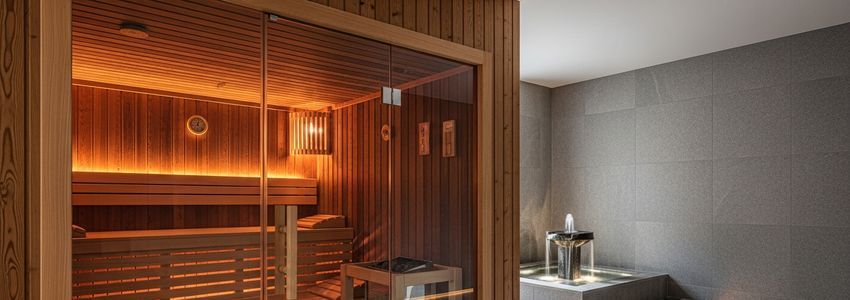
Sauna equipment: Traditional Finnish dry saunas, infrared sauna cabins (near, mid, and far-infrared), steam saunas, outdoor barrel saunas, sauna control systems, and custom sauna builds all qualify. Single-person cabins to multi-person commercial units all work within standard lease programs.
Hydrotherapy equipment: Commercial whirlpools, therapeutic soaking tubs, hot tubs, cold plunge pools, contrast therapy pools, and hydro-massage beds qualify for leasing. These are among the higher-ticket items in wellness facilities, making leasing especially valuable.
Steam and heat therapy: Steam generators, steam rooms with custom tile work components, infrared heating panels, heated flooring systems, and sauna heaters all qualify.
Wellness technology: Halotherapy salt therapy chambers, cryotherapy whole-body chambers and localized cryo devices, floatation tanks, sensory deprivation pods, LED light therapy panels, and red light therapy devices all qualify under most equipment leasing programs.
Massage and bodywork equipment: Hydraulic and electric massage tables, heated stone massage equipment, cupping sets, commercial massage chairs, and massage table warmers qualify.
Fitness and recovery: Commercial treadmills, stationary bikes, rowing machines, weight training equipment, compression therapy systems (like Normatec boots), and vibration therapy platforms qualify for leasing.
Salon and beauty equipment: Professional laser hair removal devices, IPL systems, microdermabrasion machines, facial steamers, professional pedicure chairs, manicure stations, and tanning beds qualify. Higher-cost aesthetic technology like laser systems and body contouring devices are particularly well-suited to leasing given their six-figure price tags.
For businesses exploring the full spectrum of spa equipment financing options, including custom configurations and bundled packages, Crestmont Capital's team can structure solutions that cover multiple equipment types in a single agreement.
By the Numbers
Commercial Spa and Sauna Industry - Key Statistics
$5.6T
Global wellness economy value (2022)
$25K+
Average cost of a commercial sauna installation
72 Mo.
Maximum lease term available for qualified borrowers
2-5 Days
Typical approval and funding timeline
How the Leasing Process Works
Understanding the step-by-step process removes the mystery from equipment leasing and helps spa owners approach the process with confidence.
Step 1 - Identify your equipment needs. Begin by creating a detailed list of all equipment you need with model numbers, quantities, and vendor quotes where possible. Lenders want to see a clear picture of what you're financing. Having vendor quotes in hand speeds up the approval process considerably.
Step 2 - Choose a lender. Work with a lender that specializes in commercial equipment leasing rather than a generic bank. Specialized lenders understand wellness equipment valuations, have faster approval processes, and offer more flexible structures. Crestmont Capital's team handles spa and wellness equipment leasing routinely and can structure agreements around your specific situation.
Step 3 - Submit your application. The typical application for equipment leasing is streamlined compared to traditional bank loans. For amounts under $150,000, most lenders require basic business information and recent bank statements. Larger amounts may require tax returns and financial statements.
Step 4 - Underwriting and approval. Lenders evaluate your business's time in operation, monthly revenue, creditworthiness, and the equipment's value and useful life. Approval decisions for well-qualified applicants can come within 24 to 48 hours.
Step 5 - Receive and review lease documents. Once approved, you'll receive the formal lease agreement outlining payment amounts, term length, end-of-term options, and any early termination provisions. Review these carefully before signing.
Step 6 - Equipment delivery and payment to vendor. After executing the agreement, the lender pays the equipment vendor directly. Your equipment is delivered and installed, and your lease payments begin.
Step 7 - End-of-lease decision. When the lease term concludes, you choose from: purchase the equipment at fair market value or a predetermined buyout price, renew the lease at reduced payments, or return the equipment and upgrade to newer models.

Types of Lease Structures
Not all leases are structured the same way. Understanding the main lease structures helps wellness operators select the approach that best matches their financial goals.
| Lease Type | How It Works | Best For | End-of-Term Option |
|---|---|---|---|
| $1 Buyout Lease | Higher monthly payments; ownership transfer for $1 | Businesses planning to own long-term | Own for $1 |
| Fair Market Value (FMV) | Lower monthly payments; buy at market value at end | Businesses wanting to upgrade frequently | Buy, return, or renew |
| 10% Option Lease | Moderate payments; purchase at 10% of original cost | Businesses wanting some certainty on buyout | Buy at 10% |
| Operating Lease | Treated as rental; equipment stays off balance sheet | Businesses prioritizing clean balance sheets | Return equipment |
| Finance/Capital Lease | Treated as purchase; equipment and liability on books | Businesses wanting ownership path from day one | Own the equipment |
The most common structure for spa and sauna equipment is the FMV lease because it delivers the lowest monthly payments and maximum flexibility for businesses that may want to upgrade their sauna or hydrotherapy systems as technology improves. Businesses with long-term ownership goals often prefer the $1 buyout or 10% option structures.
Rates and Terms to Expect
Interest rates on equipment leases depend on several factors: the applicant's credit profile, business age, revenue, the type of equipment, and market conditions. Here is a realistic breakdown of what wellness operators should expect.
Interest rates: For well-qualified borrowers with strong credit and established businesses, rates typically range from 5% to 12% APR. Borrowers with newer businesses, lower credit scores, or limited financials may see rates in the 12% to 24% range from alternative lenders. The type of equipment also matters - items with strong resale value command better rates.
Lease terms: Standard terms run 24, 36, 48, or 60 months. Some lenders extend to 72 months for large commercial installations. Longer terms reduce monthly payments but increase total cost. Shorter terms mean higher monthly payments but lower overall cost if you plan to own the equipment.
Down payments: Many equipment lease programs require no down payment, or a "first and last" payment equivalent to two months up front. This makes leasing accessible even for businesses with limited cash on hand.
Application fees: Fees vary but are typically minimal for equipment leasing - often $100 to $500 for documentation and processing. Beware of any lender charging large upfront fees before approval.
Payment Example: A 60-month FMV lease on $40,000 of sauna and hydrotherapy equipment at an estimated rate of 8% APR would produce monthly payments of approximately $810. That allows the business to deploy $40,000 of equipment while retaining those funds for operations, staffing, and marketing - with a straightforward end-of-term option to buy, renew, or upgrade.
Leasing vs. Buying vs. Equipment Financing
Wellness operators weighing their options often compare leasing to outright purchase and traditional equipment financing. Each approach has distinct advantages and the right choice depends on your business's cash position, growth plans, and ownership preferences.
Leasing vs. buying outright: Buying eliminates ongoing payment obligations and gives you full ownership immediately. But it requires significant upfront capital and removes that cash from your operating account. For a $60,000 sauna installation, that's $60,000 you can no longer use for payroll, supplies, marketing, or emergencies. Leasing spreads the cost and preserves liquidity.
Leasing vs. equipment financing: Equipment financing (also called an equipment loan) gives you immediate ownership while spreading payments over time. Monthly payments tend to be higher than leasing because you are paying down the full purchase price plus interest rather than just the depreciated value during the lease term. Financing is better if ownership is a priority from day one. Leasing is better if flexibility and lower payments are the priority.
Leasing vs. business line of credit: Using a business line of credit for equipment is possible but generally not recommended for large purchases. Lines of credit typically carry variable rates and are better suited to short-term working capital needs rather than funding multi-year asset acquisitions.
For most spa and sauna businesses - especially those opening new locations or upgrading existing facilities - leasing represents the most financially efficient approach. It maximizes the equipment you can deploy relative to the cash you preserve, and it aligns your cost structure with revenue generation.
Explore Flexible Equipment Leasing Options
Whether you need one sauna cabin or a full spa buildout, Crestmont Capital structures leases around your business - not the other way around.
Get Lease Options →Who Qualifies for Spa and Sauna Equipment Leasing?
Qualification requirements for equipment leasing are generally more accessible than traditional business loans, but lenders do evaluate certain factors. Here is what they look for.
Time in business: Most lenders prefer businesses operating for at least 12 months. Startups and businesses under 12 months may still qualify through startup-focused programs, but may face higher rates or down payment requirements. Crestmont Capital offers startup equipment financing programs specifically designed for newer businesses.
Credit score: A personal credit score of 600 or higher is the general threshold for standard programs. Scores above 680 access better rates. Borrowers with lower scores may qualify through alternative programs with adjusted terms. Your business credit history (if established) also plays a role.
Monthly revenue: Lenders want to see sufficient revenue to comfortably cover the lease payment. A general benchmark is that your monthly lease payment should not exceed 10% to 15% of your average monthly revenue. For most wellness businesses generating $20,000 or more in monthly revenue, accessing leases in the $25,000 to $75,000 range is quite achievable.
No active bankruptcies: Active bankruptcy proceedings typically prevent approval. Businesses that have discharged bankruptcy may qualify after 1 to 2 years with rebuilt credit and stable revenue.
Valid business entity: You must operate as a legitimate business entity - LLC, corporation, or sole proprietorship with proper licensing. Lenders verify that the business is in good standing with state authorities.
Good news for wellness businesses: Spa and sauna businesses often have strong qualification profiles because they operate in high-demand service sectors with recurring clientele, predictable membership revenue, and tangible high-value equipment as collateral for the lease. This typically translates to favorable lease terms for qualified applicants.
How Crestmont Capital Helps Spa and Sauna Businesses
Crestmont Capital is the #1 rated business lender in the United States, with a track record of helping wellness businesses access the equipment financing they need to grow. Our team understands the unique cash flow dynamics of spa and sauna businesses - the seasonal fluctuations, the high equipment costs relative to revenue, and the importance of offering clients cutting-edge experiences.
When you work with Crestmont Capital for commercial spa and sauna equipment leasing, you get access to:
Fast approvals. Many applications receive a decision within 24 to 48 hours. For time-sensitive equipment needs - like replacing a failed sauna before a busy weekend - this speed matters enormously.
Flexible structures. We work with FMV leases, $1 buyout leases, 10% option leases, and other structures to match your business's ownership goals and cash flow situation.
High approval rates. Because we work with a broad network of lenders and alternative financing sources, we achieve approval rates that exceed what traditional banks offer. Businesses that have been turned down by banks often find a viable path through Crestmont Capital.
Bundled equipment packages. Rather than applying separately for a sauna, a hydrotherapy pool, and massage tables, we can bundle all your equipment into a single lease agreement with one monthly payment. This simplifies management and often results in better overall terms.
No hard pitch, no obligation. Our team provides transparent guidance without high-pressure tactics. We'll show you exactly what you qualify for and what it costs before you sign anything.
Beyond equipment leasing, Crestmont Capital offers a full range of financing solutions for wellness businesses including unsecured working capital loans for operational expenses and equipment financing programs for businesses that prefer ownership from day one.
Real-World Scenarios: Spa and Sauna Leasing in Action
Understanding how leasing plays out in practice helps wellness operators visualize how it fits their specific situation.
Scenario 1 - New spa opening. A licensed aesthetician in Phoenix, Arizona is opening a boutique day spa. She needs two infrared sauna cabins, a hydro-massage bed, four facial treatment chairs, and a microdermabrasion system - total equipment cost approximately $85,000. Rather than depleting her startup capital, she secures a 60-month FMV lease through Crestmont Capital with a monthly payment of approximately $1,750. Her working capital remains intact to fund six months of operating costs while she builds her client base.
Scenario 2 - Hotel wellness center upgrade. A mid-size hotel in Florida wants to add a full sauna suite with traditional Finnish and infrared options, a cold plunge pool, and a halotherapy salt room to attract premium guests. The total cost is $175,000. Through a 60-month $1 buyout lease, the hotel acquires full ownership at term end while keeping monthly costs at approximately $3,600 - easily justified by the premium nightly rates the upgraded wellness amenity commands.
Scenario 3 - Spa technology upgrade. An established day spa in Chicago has operated for eight years and has strong revenue but aging equipment. They want to replace outdated tanning beds with modern red light therapy panels, upgrade their steam room generator, and add a cryotherapy chamber. Rather than purchasing outright or taking out a term loan, they lease through a 48-month FMV agreement, keeping monthly obligations low and preserving their established credit lines for marketing expansion.
Scenario 4 - Sauna studio startup. A wellness entrepreneur in Nashville is launching a dedicated sauna studio offering group and private infrared sauna sessions. With no prior business history, he would struggle to qualify for a traditional bank loan. Through Crestmont Capital's startup equipment financing program, he secures a 36-month lease on four infrared sauna cabins with first and last payment down. Revenue from day one covers the payments, and he owns the equipment at term end via a $1 buyout option.
Scenario 5 - Gym wellness expansion. A mid-size fitness center in Denver wants to add a recovery room with saunas, cold plunge tubs, and compression therapy devices to compete with newer boutique gyms. The $95,000 equipment package is funded through a bundled lease agreement through Crestmont Capital, resulting in a single monthly payment of approximately $1,950 over 60 months - which the owner projects will be offset within three months by the premium monthly membership tier members pay for recovery lounge access.
Scenario 6 - Medical spa equipment. A plastic surgeon's office in New York is adding a medical spa component with laser hair removal, body contouring, and skin resurfacing equipment. These devices cost between $30,000 and $120,000 each. Leasing through Crestmont Capital allows the practice to deploy three devices simultaneously with a bundled monthly payment, rather than tying up operating capital or taking a large bank loan. The revenue from the first month of operations covers the monthly lease.
Frequently Asked Questions
How to Get Started
Complete our quick application at offers.crestmontcapital.com/apply-now - takes just a few minutes. Have your equipment quotes or a list of equipment needs handy.
A Crestmont Capital equipment leasing advisor will review your needs, present your options, and help you select the lease structure that best fits your wellness business.
Once approved and documents are executed, the lender pays your vendor directly. Equipment is delivered, installed, and generating revenue - often within days of approval.
Conclusion
Commercial spa and sauna equipment leasing is one of the most practical and financially intelligent strategies available to wellness business owners. Whether you're building a new spa from scratch, expanding an existing facility, or upgrading aging equipment, leasing lets you access premium sauna cabins, hydrotherapy pools, cryotherapy chambers, and aesthetic technology without depleting your working capital or taking on the full burden of ownership from day one.
The key is working with a lender who understands the wellness industry, structures leases efficiently, and processes approvals quickly. Crestmont Capital has helped hundreds of wellness operators secure commercial spa and sauna equipment leasing with fast approvals, competitive rates, and flexible structures designed around their unique business needs. With the right financing partner, upgrading your facility is not a financial risk - it's an investment in growth.
Take the first step today. Visit offers.crestmontcapital.com/apply-now to apply or contact the Crestmont Capital team to discuss your specific equipment needs with a financing specialist.
Ready to Lease Your Spa and Sauna Equipment?
Join the wellness businesses across the U.S. that trust Crestmont Capital for fast, flexible equipment leasing. No obligation - get your options in minutes.
Apply Now →Disclaimer: The information provided in this article is for general educational purposes only and is not financial, legal, or tax advice. Funding terms, qualifications, and product availability may vary and are subject to change without notice. Crestmont Capital does not guarantee approval, rates, or specific outcomes. For personalized information about your business funding options, contact our team directly.