Running a nonprofit organization means constantly balancing limited budgets against growing operational needs. Technology evolves quickly, and the IT and office equipment your organization relies on today - computers, servers, printers, projectors, video conferencing systems - represents a significant capital investment that can strain even well-funded nonprofits. Nonprofit IT equipment leasing offers a practical, budget-friendly alternative to outright purchasing, enabling mission-driven organizations to access the technology they need without depleting reserves or taking on heavy debt.
Whether you lead a small community outreach program or manage a national advocacy organization, equipment leasing can transform how you allocate resources. This complete guide covers everything nonprofit leaders, executive directors, and operations managers need to know about leasing IT and office equipment - from the mechanics of how it works to specific equipment categories, qualification requirements, and how to get started today.
In This Article
- What Is IT and Office Equipment Leasing for Nonprofits?
- Key Benefits of Leasing IT Equipment for Nonprofits
- Types of IT and Office Equipment Nonprofits Can Lease
- How Nonprofit Equipment Leasing Works
- Leasing vs. Buying: A Side-by-Side Comparison
- Who Qualifies for Nonprofit Equipment Leasing?
- How Crestmont Capital Helps Nonprofit Organizations
- Real-World Scenarios: Nonprofits That Benefited from Leasing
- How to Get Started
- Frequently Asked Questions
What Is IT and Office Equipment Leasing for Nonprofits?
Equipment leasing is a financing arrangement in which an organization obtains the use of equipment - such as computers, network infrastructure, printers, or office furniture - through regular payments over an agreed term, rather than purchasing those items outright. For nonprofits, this model is particularly valuable because it preserves working capital and converts large capital expenditures into manageable, predictable operating expenses.
In a typical nonprofit IT equipment lease, the leasing company (known as the lessor) retains ownership of the equipment while the nonprofit (the lessee) uses it in exchange for monthly or quarterly payments. At the end of the lease term, which generally ranges from 24 to 60 months, the nonprofit may have the option to return the equipment, renew the lease, or purchase the equipment at its residual value.
Nonprofits can lease virtually any type of technology or office infrastructure, from desktop computers and laptops to phone systems, projectors, and complete server setups. This flexibility makes leasing a uniquely adaptable solution for organizations at every stage of growth - from small faith-based nonprofits working from a single location to large healthcare nonprofits operating across multiple sites serving thousands of clients each year.
Key Fact: According to the National Council of Nonprofits, more than 1.5 million nonprofit organizations operate in the United States, and technology access remains one of the top operational challenges cited by executive directors - especially for smaller organizations with annual budgets under $1 million. Equipment leasing directly addresses this challenge.
There are two primary lease structures nonprofits should understand: operating leases and capital (finance) leases. An operating lease is typically shorter-term and keeps equipment off the balance sheet, while a capital lease resembles a loan in that the equipment appears as an asset and the lease obligation appears as a liability on the organization's financial statements. Many nonprofits prefer operating leases because they allow for easier equipment upgrades and simpler accounting treatment under current financial reporting standards such as ASC 842.
The distinction matters for grant reporting as well. Many funders treat operating lease payments as allowable indirect or direct costs, making it easier to include these expenses in grant budgets. Organizations considering equipment leasing should consult with their CPA or financial officer to identify the structure that best fits their reporting and budgeting needs.
Key Benefits of Leasing IT Equipment for Nonprofits
Leasing IT and office equipment offers nonprofits a range of advantages that align well with the operational realities of mission-driven organizations. Understanding these benefits helps nonprofit leaders make informed decisions about how to equip their teams without compromising financial sustainability.
Preserved Cash Flow and Liquidity: Cash reserves are critical for nonprofits. Unlike a large upfront purchase that depletes available funds, leasing spreads costs over time. A nonprofit that would need to spend $80,000 upfront to purchase a full suite of computers and networking equipment can instead make predictable monthly payments - often under $2,000 per month - while keeping cash available for programs, staffing, and emergency reserves. This is particularly important for organizations that operate on thin margins between grant cycles.
Access to Current Technology: Outdated technology undermines staff productivity and can damage your organization's credibility with donors and institutional funders who expect operational efficiency. Equipment leases typically include upgrade options at the end of the term, so nonprofits can stay current with the latest computers, software platforms, and communication tools without the cost of continual outright purchases. This is particularly valuable in fast-moving sectors such as healthcare nonprofits, where medical office technology compliance requirements change regularly.
Predictable Budgeting: Grant-funded organizations must account for their expenses across specific budget periods. Fixed monthly lease payments simplify financial planning, making it easier to allocate costs across grants, track spending against budgets, and demonstrate responsible financial stewardship to funders. There are no surprise maintenance costs or sudden replacement expenses when equipment fails, as many leases include service agreements that cover repairs and replacements.
Simplified Equipment Management: Leasing companies often handle delivery, installation, and sometimes ongoing maintenance of leased equipment. At the end of a lease, returning or upgrading equipment is far simpler than managing the depreciation, resale, or disposal of owned assets - all of which carry their own administrative and financial burdens. For nonprofits with limited administrative capacity, this simplicity is a genuine operational advantage.
Flexible Structures to Fit Nonprofit Budgets: Many leasing providers offer structures designed with nonprofit cash flow patterns in mind, including deferred payment options, seasonal payment schedules, and fair market value leases that keep monthly costs low. These flexible structures respect the reality that nonprofit cash flow can be uneven due to grant cycles, seasonal donations, and event-based fundraising.
No Obsolescence Risk: Technology depreciates rapidly. A computer purchased today has a useful life of three to five years before performance begins to lag. When you own equipment, you bear the full risk of obsolescence. When you lease, you transfer that risk to the lessor. At lease end, you simply upgrade. This is especially important for nonprofits that cannot afford to be locked into aging technology that limits their effectiveness.
Ready to Equip Your Nonprofit for Less?
Crestmont Capital works with nonprofits of all sizes to structure flexible IT and office equipment leases that fit your budget and mission. No obligation - apply in minutes.
Apply Now →Types of IT and Office Equipment Nonprofits Can Lease
One of the most practical advantages of nonprofit IT equipment leasing is the breadth of equipment categories available. Nearly any piece of technology or office infrastructure that a modern nonprofit needs can be financed through a lease, giving organizations the freedom to build a complete operational setup without major upfront investment.
Computers and Workstations
Desktop computers, laptops, and all-in-one workstations are the backbone of any nonprofit's daily operations. Leasing allows organizations to provide every staff member with reliable, up-to-date computing equipment. Many nonprofits choose to lease entire computer fleets rather than purchase - simplifying lifecycle management and ensuring uniform performance across all team members, regardless of location.
Network Infrastructure and Servers
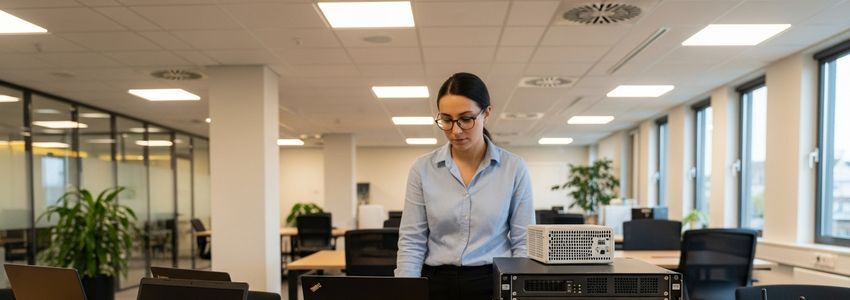
Routers, switches, firewalls, and on-premise servers represent significant capital costs but are essential for secure, reliable connectivity. Nonprofits that store sensitive client data - such as social service agencies, healthcare nonprofits, and legal aid organizations - particularly benefit from leasing current-generation network security equipment that meets compliance requirements without large capital outlays.
Printers, Copiers, and Multifunction Devices
High-volume printing is a reality for many nonprofits, from producing grant reports and donor acknowledgments to printing event materials and program guides. Leasing commercial-grade printers and multifunction devices gives nonprofits access to professional printing capacity with service agreements that often cover maintenance and consumables.
Audio-Visual and Presentation Equipment
Projectors, large-format displays, and video conferencing systems support board meetings, donor presentations, staff training sessions, and community events. As hybrid and remote work models become permanent fixtures for many nonprofits, high-quality video conferencing equipment has become essential infrastructure. Leasing these systems provides access to professional-grade AV technology at a fraction of the upfront purchase cost.
Phone and Communication Systems
Modern VoIP phone systems and unified communications platforms are critical for nonprofits that field high call volumes - think 211 helplines, crisis intervention services, or member associations. Leasing phone systems ensures these organizations can deploy enterprise-grade communication infrastructure with predictable monthly costs and the ability to scale as call volume grows.
Office Furniture and Workstation Systems
Office furniture - including desks, ergonomic chairs, filing systems, shelving, and reception area furnishings - can also be financed through leasing arrangements. This is particularly useful for nonprofits opening new offices, expanding into additional locations, or renovating existing spaces to better serve clients and staff.
Security and Surveillance Systems
Access control systems, security cameras, and monitoring infrastructure protect nonprofit facilities, staff, and the vulnerable clients they serve. Leasing security equipment allows nonprofits to implement comprehensive safety measures without major capital investment, which is especially important for shelters, community centers, childcare organizations, and healthcare nonprofits.
By the Numbers
Nonprofit IT Equipment Leasing - Key Statistics
1.5M+
Nonprofits operating in the U.S.
$73B
Annual U.S. equipment leasing market
80%
Of U.S. businesses use equipment financing or leasing
36-60
Typical lease term in months for IT equipment
How Nonprofit Equipment Leasing Works
Understanding the mechanics of nonprofit IT equipment leasing helps organizations enter agreements confidently and avoid common pitfalls. The process is straightforward and typically follows these stages from initial assessment through equipment deployment.
Step 1 - Identify Your Equipment Needs: Begin by inventorying your current technology and identifying gaps. What computers need replacing? What new systems would improve operations? Creating a clear equipment list with specific models, quantities, and budget ranges will help you request accurate lease quotes and ensure you are comparing like-for-like options across providers.
Step 2 - Choose Your Leasing Structure: Work with your financing partner to identify the most appropriate lease type. Operating leases (FMV leases) are often preferred by nonprofits because they typically offer lower monthly payments and easier upgrades. Finance leases (capital leases) provide a path to ownership and may be appropriate when the equipment has a long useful life and the organization intends to retain it beyond the initial lease term.
Step 3 - Apply and Get Approved: The application process for nonprofit equipment leasing is typically faster than traditional bank loans. Most lessors will request basic organizational information, recent financial statements or tax returns (Form 990 for 501(c)(3) organizations), and details about the equipment being financed. Approval timelines can range from same-day to a few business days for straightforward applications.
Step 4 - Review and Sign the Lease Agreement: Before signing, review the lease agreement carefully. Key terms to examine include the monthly payment amount, the lease term, upgrade and early termination options, end-of-lease choices, maintenance responsibilities, and any fees for late payments or lease modifications.
Step 5 - Receive and Deploy Equipment: Once the lease is signed, equipment is typically delivered and set up within one to two weeks. Many leasing partners coordinate logistics directly with equipment vendors, simplifying the process for your administrative team.
Step 6 - End-of-Lease Decision: At the end of the lease term, nonprofits typically have three choices: return the equipment and lease new upgraded technology, purchase the equipment at its fair market value or a predetermined buyout price, or extend the lease for an additional term.
Pro Tip: Always establish a dedicated point of contact with your leasing partner before signing. Responsive support matters when equipment issues arise mid-lease, and knowing exactly who to call saves valuable staff time and minimizes service disruptions for your program participants.
Leasing vs. Buying: A Side-by-Side Comparison
One of the most common questions nonprofit leaders ask is whether leasing or buying is the better choice for their organization. The answer depends on your cash position, technology needs, and long-term operational strategy.
| Factor | Leasing | Buying Outright |
|---|---|---|
| Upfront Cost | Little to none; first and last payment typical | Full purchase price required upfront |
| Monthly Cash Flow | Predictable fixed monthly payments | No monthly payments, but large upfront capital drain |
| Technology Upgrades | Easy - return and upgrade at end of lease term | Requires additional capital or sale of old equipment |
| Ownership | Lessor owns equipment (unless buyout exercised) | Organization owns equipment outright from day one |
| Balance Sheet Impact | Operating lease: expense only, off balance sheet | Asset and depreciation recorded on balance sheet |
| Maintenance | Often included or supported by the lessor | Organization bears full maintenance cost and risk |
| End-of-Life Disposal | Lessor handles; no disposal burden or liability | Organization must arrange disposal, donation, or resale |
| Best For | Organizations prioritizing cash flow and technology currency | Organizations with strong reserves and long equipment lifecycles |
For most nonprofits - particularly those that depend on grant funding, operate with lean budgets, or work in fast-moving technology environments - leasing offers a compelling combination of affordability and operational agility. For IT and office technology that evolves rapidly, leasing consistently delivers better value, more flexibility, and less organizational risk.
Who Qualifies for Nonprofit Equipment Leasing?
A common misconception is that nonprofits cannot qualify for equipment financing because they are not for-profit businesses. In reality, most leasing companies - including Crestmont Capital - work regularly with nonprofit organizations and understand their unique financial structures and funding models. Nonprofit leasing is a well-established financing category, and many lessors have specific programs tailored to the nonprofit sector.
The key qualification factors for nonprofit equipment leasing typically include:
Organizational Status: 501(c)(3) organizations, 501(c)(4) social welfare organizations, religious institutions, educational nonprofits, and other recognized tax-exempt entities are generally eligible. Your IRS determination letter confirming tax-exempt status is typically required as part of the application, and your Form 990 filing provides basic financial data that lessors use in underwriting.
Time in Operation: Most lessors prefer organizations that have been operating for at least one to two years. Newer nonprofits may still qualify, particularly if they have strong founding team credentials, committed grant funding, or a well-established fiscal sponsor. Startup organizations in the nonprofit sector are encouraged to explore all available options, as qualification criteria vary by provider.
Revenue and Financial Health: Unlike traditional bank loans, equipment lessors primarily focus on whether your organization can service the monthly lease payments based on current and projected revenue. Many lessors are comfortable with the revenue patterns typical of nonprofits - including seasonal fluctuations, grant-dependent income, and event-driven cash infusions - as long as overall financial stability is evident.
Creditworthiness: Organizational credit history and, in some cases, the credit of key principals (executive directors or board members) may be reviewed. Strong organizational credit simplifies the approval process and may result in more favorable lease terms and lower interest rates. Organizations with newer credit profiles may still qualify with additional documentation or a modest security deposit.
Equipment Type and Value: The type and value of equipment being leased also factors into qualification. Standard IT equipment such as computers, servers, and printers is considered low-risk and qualifies easily. More specialized or high-value equipment may require additional documentation or slightly stricter underwriting. Most equipment leasing transactions for nonprofits range from $10,000 to $500,000, though both smaller and larger arrangements are available.
See If Your Nonprofit Qualifies Today
Crestmont Capital's nonprofit financing specialists understand the unique needs of mission-driven organizations. Apply in minutes and receive a decision quickly - no obligation, no commitment.
Check Qualification →How Crestmont Capital Helps Nonprofit Organizations
Crestmont Capital is the #1 rated business lender in the United States, with deep experience serving organizations across every industry - including the nonprofit sector. Our team understands that nonprofits operate differently from for-profit businesses, and we structure our financing solutions to accommodate the realities of grant-funded revenue, fiscal year budgeting cycles, and mission-first financial priorities.
Our equipment leasing programs for nonprofits offer flexible terms from 24 to 60 months, competitive rates, and approval processes designed for speed and simplicity. We recognize that nonprofit leaders wear many hats and do not have time for lengthy, bureaucratic financing processes. Our streamlined application takes minutes to complete, and our specialists work to provide fast decisions - often within one to three business days for straightforward requests.
Beyond equipment leasing, Crestmont Capital offers a full suite of nonprofit business loans and financing solutions, including working capital funding, line of credit products, and equipment financing. Whether your organization needs to refresh its technology fleet, furnish a new office location, or fund a major operational expansion, our team can identify the right combination of financing tools to support your mission.
Our approach is built on transparency and partnership. We explain all lease terms clearly, answer questions without pressure, and work to structure arrangements that genuinely serve your organization's best interests - not just our own. We have helped hundreds of nonprofits access the equipment and capital they need to deliver greater impact in their communities.
For nonprofits exploring office equipment financing alongside IT leasing, Crestmont Capital can bundle multiple equipment categories into a single lease arrangement, simplifying administration and potentially improving overall terms. Our specialists are available to discuss your organization's specific needs and develop a customized financing strategy that supports your operational goals without straining your budget.
Real-World Scenarios: Nonprofits That Benefited from Leasing
Understanding how leasing works in practice helps nonprofit leaders envision how this approach could work for their own organizations. The following scenarios illustrate common situations where equipment leasing delivered measurable operational and financial benefits for nonprofits.
Scenario 1 - Social Services Agency Technology Refresh: A mid-sized social services agency serving 3,000 clients annually had a fleet of 45 desktop computers that were four to six years old, causing significant performance issues and security risks. Purchasing 45 new computers with peripherals would have cost approximately $90,000 outright - an impossible draw on reserves. Through a 48-month equipment lease, the agency refreshed its entire computer fleet for approximately $1,900 per month, kept its reserves intact, and included a service agreement that covered repairs and replacements throughout the term. Staff productivity improved measurably within the first month.
Scenario 2 - Community Health Center Communication Upgrade: A federally qualified health center needed to replace its aging phone system with a HIPAA-compliant VoIP platform to support telehealth services, accommodate remote staff, and improve patient communication. The full system cost would have been $45,000 upfront. Through a 36-month lease, the health center deployed the new phone system for under $1,400 per month, with the first payment deferred 60 days to align with its next grant disbursement cycle. The system went live within three weeks of signing, enabling the health center to launch its telehealth program on schedule.
Scenario 3 - Advocacy Organization Multi-Site Expansion: A regional advocacy nonprofit opened three new office locations simultaneously as part of a funded expansion initiative. Rather than purchasing office furniture and computers for each location - a combined cost of over $120,000 - the organization structured an equipment lease that covered all three sites under a single agreement. Monthly payments were allocated across the three office budgets within the organization's grant reporting system, simplifying financial tracking. The lease structure also included an upgrade option that aligned with the organization's planned technology refresh in three years.
Scenario 4 - Faith-Based Organization Conference Room Technology: A church-based nonprofit that provided community development services needed to upgrade its conference room with a professional video conferencing system, updated projector, and sound system for hybrid programming. The total equipment cost was approximately $28,000. Through a 36-month lease, the organization made fixed monthly payments of approximately $850, which fit comfortably within its general operating budget and could be justified as a direct program expense in its annual donor reports. The upgrade enabled the organization to host hybrid board meetings, partner presentations, and virtual training sessions - expanding its reach without expanding its footprint.
Scenario 5 - Environmental Nonprofit IT Infrastructure Build-Out: A growing environmental advocacy organization was scaling from 12 to 30 staff members as part of a multi-year campaign initiative. Equipping 18 new workstations, expanding network infrastructure, and deploying a new server for data storage would have cost over $65,000 upfront. The organization negotiated a 48-month fair market value lease with Crestmont Capital that covered all equipment needs for under $1,700 per month. The lease structure included a technology refresh option at month 36 that aligned with the campaign's planned conclusion, giving the organization maximum flexibility for its post-campaign phase.
How to Get Started
Complete our quick application at offers.crestmontcapital.com/apply-now - takes just a few minutes. Have your organization's basic financial information and equipment details ready.
A Crestmont Capital advisor with nonprofit experience will review your organization's needs and match you with the right leasing structure - whether that is an operating lease, a fair market value arrangement, or a finance lease tailored to your accounting requirements.
Upon approval - often within one to three business days - your equipment is ordered, delivered, and set up. Your nonprofit can begin benefiting from upgraded technology almost immediately, with no large capital outlay.
Frequently Asked Questions
Disclaimer: The information provided in this article is for general educational purposes only and is not financial, legal, or tax advice. Funding terms, qualifications, and product availability may vary and are subject to change without notice. Crestmont Capital does not guarantee approval, rates, or specific outcomes. For personalized information about your business funding options, contact our team directly.