How Farmers Can Lease Heavy Equipment: Balers, Combines, and More
Farm equipment leasing is one of the most practical ways for agricultural businesses to access the heavy machinery they need without the crushing weight of a full purchase price. Whether you run a grain operation, a hay farm, or a diversified crop enterprise, the ability to lease balers, combines, tractors, and other heavy equipment has transformed how modern farmers manage capital and keep pace with advancing technology. This guide covers everything you need to know about how farm equipment leasing works, who it benefits most, and how Crestmont Capital can help you find the right program for your operation.
In This Article
- What Is Farm Equipment Leasing?
- Key Benefits for Farmers
- What Heavy Equipment Can Be Leased?
- How the Leasing Process Works
- Types of Farm Equipment Leases
- Leasing vs. Buying: Side-by-Side Comparison
- Who Qualifies for Farm Equipment Leasing?
- How Crestmont Capital Helps Farmers
- Real-World Scenarios
- How to Get Started
- Frequently Asked Questions
What Is Farm Equipment Leasing?
Farm equipment leasing is a financing arrangement in which a lender or leasing company purchases heavy agricultural machinery on behalf of the farmer, who then makes fixed monthly payments over a set term to use that equipment. At the end of the lease, the farmer typically has the option to purchase the equipment at a predetermined residual value, return it, or enter a new lease on updated machinery.
Unlike a traditional equipment loan where the farmer owns the equipment from day one, a lease separates ownership from use. This distinction has meaningful implications for cash flow, balance sheet management, and how quickly a farming operation can upgrade to newer, more efficient machines. For high-cost items like combines, large round balers, and self-propelled forage harvesters - which routinely run $200,000 to $600,000 or more - leasing can be the most strategic path to keeping equipment current without locking capital into depreciating assets.
The agricultural equipment leasing market is substantial and growing. According to the Equipment Leasing and Finance Association (ELFA), equipment finance overall exceeds $1 trillion annually in the U.S., with agriculture representing a significant and expanding share of that volume. Farmers increasingly recognize that owning every piece of machinery is not always the most efficient allocation of business capital.
Key Insight: The average age of farm equipment in the United States continues to rise, meaning many operations are running older, less efficient machinery. Leasing provides a direct path to newer technology without the full capital outlay of a purchase.
Key Benefits for Farmers
Farm equipment leasing offers a range of advantages that go well beyond just spreading out payments. For small and mid-size agricultural operations in particular, leasing can be the difference between maintaining a competitive, productive farm and falling behind on equipment technology.
Preserve Capital for Operating Costs
Farming is capital-intensive across every dimension - seed, fertilizer, fuel, labor, and crop insurance all demand cash at critical moments in the season. Leasing heavy equipment means the bulk of your working capital stays available for these ongoing operating needs rather than being absorbed by an equipment purchase.
Access to Current Technology
Modern combines feature GPS-guided auto-steer, precision yield mapping, and variable-rate application systems that can meaningfully increase harvest efficiency. Balers have evolved to produce tighter, more consistent bales with reduced fuel consumption. Leasing lets you upgrade to these technologies at the end of each lease term rather than being locked into older machinery for the full depreciation cycle.
Predictable Monthly Payments
Fixed lease payments make budgeting far more straightforward than carrying unpredictable ownership costs - repairs, breakdowns, and unplanned maintenance can cost thousands at the worst possible time (mid-harvest). With many leases, maintenance is either included or structured to keep costs predictable.
Potential Balance Sheet Benefits
Depending on the lease structure, certain operating leases may be treated as operating expenses rather than capitalized debt, which can improve financial ratios relevant to other lenders and credit lines. (Your accountant should review the specific accounting treatment under current ASC 842 standards.)
Flexibility at Lease End
Farm operations evolve - crop mixes change, acreage expands or contracts, and market conditions shift. Leasing gives you options at the end of the term: buy the equipment if it's still the right fit, return it and upgrade, or adjust to a different configuration entirely.
Ready to Upgrade Your Farm's Equipment?
Get fast, flexible farm equipment leasing from Crestmont Capital - the #1 business lender in the U.S. No obligation, apply in minutes.
Apply Now →What Heavy Equipment Can Be Leased?
The range of agricultural machinery available through leasing programs is broad. Virtually any major piece of farm equipment with significant value qualifies for lease financing. Here are the most common categories farmers lease:
Combines and Grain Harvesters
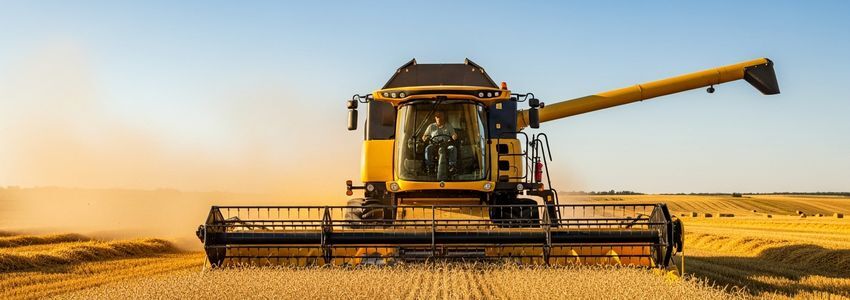
Self-propelled combine harvesters are among the most expensive pieces of farm equipment, with new models from John Deere, Case IH, and New Holland ranging from $350,000 to well over $500,000. Leasing a combine allows grain farmers to run a current-generation machine with updated technology without committing that level of capital to a single asset that sits idle much of the year.
Round and Square Balers
Large round balers and high-density square balers are essential for hay, straw, and biomass operations. A new large round baler runs $30,000 to $80,000; commercial-grade large square balers can exceed $150,000. These are ideal lease candidates because baling technology evolves consistently and many farms operate them only during specific windows of the season.
Tractors (Large Row-Crop and 4WD)
High-horsepower tractors - 200 HP and above - are frequently leased by row-crop operations. These machines carry significant value and are available through manufacturer lease programs as well as independent finance companies.
Forage Harvesters and Choppers
Self-propelled forage harvesters for silage corn and haylage operations represent some of the highest-value equipment on any farm. Multi-year leases make these machines accessible to dairy and beef operations that need capacity without ownership complexity.
Planters, Sprayers, and Tillage Equipment
Precision planters with individual row control, high-clearance sprayers, and variable-depth tillage tools are all frequently leased. Their high technology content makes them strong candidates for lease arrangements tied to shorter terms that match the technology refresh cycle.
Grain Handling and Storage Equipment
Grain dryers, conveyors, and auger systems can also be financed through equipment lease programs, particularly when part of a broader infrastructure upgrade.
By the Numbers
Farm Equipment Leasing - Key Statistics
$600K+
Cost of a new top-spec combine harvester
$1T+
Annual U.S. equipment finance volume (ELFA)
2-7 Yrs
Typical farm equipment lease terms available
2M+
Farms in the U.S. that could benefit from equipment financing
How the Leasing Process Works
Understanding how the farm equipment leasing process works from application to delivery helps farmers prepare effectively and move quickly when opportunity arises - especially important during pre-planting and pre-harvest windows when equipment needs are most urgent.
Step 1: Identify the Equipment
Determine exactly what equipment you need - the make, model, year, and configuration. Knowing whether you want new or used equipment, and whether you have a dealer relationship in mind, helps lenders structure the right program. Many leasors can finance through any authorized dealer.
Step 2: Apply for Lease Financing
Complete a lease application with your chosen lender. At Crestmont Capital, the application can be completed online in minutes. You'll typically need to provide basic information about your farming operation, revenue, and the specific equipment being financed.
Step 3: Credit Review and Approval
The lender reviews your business and personal credit history, farm revenue, and overall financial profile. For agricultural businesses, lenders also consider the nature of the operation, crop types, and acreage. Approvals for qualified applicants can come within 24 to 48 hours.
Step 4: Lease Terms Presented
Once approved, your lender presents lease term options - typically covering the monthly payment, term length (commonly 3 to 7 years for heavy farm equipment), residual value (the buyout option at lease end), and any applicable seasonal payment structures.
Step 5: Documentation and Funding
After you accept terms, final documentation is completed and the lender funds the purchase directly to the equipment dealer. You take delivery of the equipment and begin making payments per the agreed schedule.
Step 6: End-of-Lease Options
At the end of the lease term, you have three typical paths: exercise a purchase option (buying the equipment at the predetermined residual value), return the equipment and enter a new lease on updated machinery, or simply return the equipment with no further obligation.
Seasonal Payment Structures: Many agricultural lenders - including Crestmont Capital - can structure lease payments around farm cash flow cycles. This means higher payments during and after harvest when revenue is flowing, and reduced or deferred payments during planting or winter months when cash is tighter.
Types of Farm Equipment Leases
Not all leases are structured the same way. Understanding the key differences between lease types helps farmers choose the arrangement that best aligns with their financial goals and operational preferences.
Operating Lease (True Lease)
In an operating lease, the leasing company retains ownership of the equipment throughout the term. The farmer makes periodic payments for use of the asset, and at the end of the lease, the equipment typically reverts to the lessor unless a purchase option is exercised. Operating leases often have lower monthly payments because there is no expectation of the farmer building equity in the equipment.
Finance Lease (Capital Lease)
A finance lease - also called a capital lease or $1 buyout lease - is structured so the farmer effectively acquires the equipment over the lease term. Payments are higher because they incorporate the full equipment value plus financing cost, and the farmer takes ownership at the end for a nominal amount (often $1). This structure makes sense when the farmer knows they want to own the equipment long-term.
TRAC Lease (Terminal Rental Adjustment Clause)
Common in commercial and agricultural equipment, a TRAC lease sets a guaranteed residual value. If the equipment sells for more than the residual at lease end, the farmer receives a refund; if it sells for less, the farmer may owe the difference. TRAC leases typically offer lower monthly payments than outright purchase financing.
Seasonal / Irregular Payment Leases
Designed specifically for agricultural businesses, these leases allow payment amounts to vary across the year - matching the uneven revenue cycles inherent in farming. Rather than equal monthly payments, farmers make larger payments during harvest and post-harvest months and smaller payments during slower periods.
Leasing vs. Buying: Side-by-Side Comparison
The decision between leasing and purchasing farm equipment is rarely simple. Both approaches have genuine advantages, and the best choice depends on your farm's cash flow, growth plans, equipment needs, and long-term strategy. The table below provides a direct comparison across the most important dimensions.
| Factor | Leasing | Buying (Loan or Cash) |
|---|---|---|
| Upfront Cost | Low or none - often first payment only | Down payment typically 10-25% |
| Monthly Payments | Lower (based on depreciation + cost) | Higher (based on full value) |
| Ownership | Lender owns; farmer has use rights | Farmer owns immediately |
| Technology Upgrade | Easy - return and re-lease at term end | Must sell or trade used equipment |
| Depreciation Risk | Stays with lessor | Farmer bears full depreciation |
| Seasonal Payments | Often available through ag lenders | Rarely available on standard loans |
| End-of-Term Flexibility | Buy, return, or upgrade | Own outright; sell when ready |
| Balance Sheet Impact | Operating leases may not appear as debt | Loan appears as liability |
Who Qualifies for Farm Equipment Leasing?
A wide range of agricultural operations qualify for farm equipment leasing, from established family farms to growing commercial enterprises. Lenders evaluate applicants across several dimensions, and understanding these criteria helps you prepare for a strong application.
Time in Business
Most lenders prefer farming operations with at least 1 to 2 years of history, though some programs accommodate newer operations with strong personal credit and collateral. Established farms with longer track records and documented revenue generally receive the most favorable terms.
Revenue and Cash Flow
Lenders want to see that the farm generates sufficient income to cover lease payments. For agricultural operations, lenders often use Schedule F from federal tax returns, along with bank statements showing seasonal deposit patterns consistent with crop or livestock revenue cycles.
Credit Profile
Both business and personal credit are typically reviewed. A minimum personal credit score in the 600s is often a baseline for standard lease programs, though stronger credit scores above 680 unlock better rates and terms. Farms with established business credit - including trade references and existing equipment loans handled responsibly - have an advantage.
Equipment Value
The equipment itself serves as collateral in most lease arrangements. Lenders consider the make, model, age, condition, and resale market for the specific equipment being leased. Well-established brands with strong resale value (John Deere, Case IH, New Holland, AGCO) are typically easier to finance than obscure or older equipment with limited secondary markets.
Farm Type and Operation
Row crop operations, hay producers, dairy farms, vegetable growers, and livestock enterprises all regularly qualify for equipment leasing. Lenders experienced in agricultural finance understand the seasonal nature of farm income and structure programs accordingly.
Note on Startups and New Operations: Even newer farm operations may qualify through startup equipment financing programs that weigh the farmer's personal credit and business plan alongside farm revenue. Talk to a Crestmont Capital specialist about options for operations under two years old.
Find Out If Your Farm Qualifies Today
Crestmont Capital specializes in agricultural equipment financing for farms of every size. Get a decision in as little as 24 hours.
Check Your Options →How Crestmont Capital Helps Farmers
Crestmont Capital is a nationally recognized business lender rated #1 in the country, with a proven track record of helping agricultural businesses access the equipment and capital they need to grow. Our team understands the unique financial rhythms of farming operations and structures lease programs that work with - not against - the realities of agricultural cash flow.
Through Crestmont Capital's agricultural equipment financing programs, farmers can lease combines, balers, tractors, sprayers, and virtually any other major farm equipment with flexible terms, competitive rates, and personalized service. We work with new and used equipment from all major manufacturers, and our relationships with equipment dealers across the country mean we can often facilitate funding quickly - sometimes in as little as 24 to 48 hours for straightforward applications.
Our equipment leasing programs include options for seasonal payment structures that align with harvest revenue cycles, making it possible to keep lease payments manageable even during lower-income periods of the year. We also offer equipment lines of credit through our equipment lines of credit program, which give established farm operations the flexibility to draw on available credit as equipment needs arise rather than applying for individual leases each time.
For farm operations looking at expansion or diversification, Crestmont Capital also provides access to broader small business financing options including working capital loans, lines of credit, and SBA-backed programs that can address the full spectrum of a farm's financial needs - not just equipment.
Real-World Scenarios
The following scenarios illustrate how different types of farming operations can benefit from farm equipment leasing. These are representative examples of how lease financing works in practice.
Scenario 1: The Mid-Size Grain Farm Upgrading its Combine
A 1,500-acre corn and soybean operation in central Illinois had been running a 10-year-old combine that was costing increasing amounts in repairs and downtime during harvest. A new precision combine with auto-steer, moisture sensing, and GPS yield mapping was priced at $420,000 - well beyond what the farm wanted to pay outright given its capital needs for inputs. Through a 5-year lease with seasonal payment structure, the operation accessed the new combine with payments concentrated in October through December after harvest revenue arrived. The farm reduced harvest losses and fuel consumption, with the equipment improvement paying for itself within three harvest seasons.
Scenario 2: The Hay Producer Leasing Round Balers
A hay and forage producer in Kentucky operates approximately 800 acres of mixed grass and alfalfa. The farm needed two new large round balers to handle production but didn't want to absorb the $130,000 capital outlay for two units. Through a 3-year equipment lease with an early buyout option, the operation leased both balers simultaneously. The lower monthly payments versus outright purchase kept the farm's operating loan capacity available for fertilizer and seed purchases, which was the higher-priority use of credit at the time.
Scenario 3: The Dairy Farm Leasing a Self-Propelled Forage Harvester
A 300-cow dairy operation in Wisconsin grows corn silage and haylage to feed its herd. The operation had been custom hiring for forage harvesting at $8,000 to $12,000 per season, but growing acreage and timing conflicts with custom operators were creating crop quality issues. Leasing a self-propelled forage harvester on a 4-year term gave the farm control over harvest timing, eliminated custom hire costs, and improved silage quality - with measurable improvement in milk production efficiency from better-fermented feed.
Scenario 4: The Beginning Farmer Accessing Equipment Through Leasing
A first-generation farmer starting a 400-acre row crop operation had strong personal credit but limited farm operating history. Through a startup equipment lease program, the farmer was able to access a row-crop tractor and planter combination that would have been impossible to purchase outright. The lower entry cost of leasing allowed the operation to get productive in the first season while preserving capital for land rent, seed, and inputs.
Scenario 5: The Diversified Farm Upgrading Its Sprayer
A diversified operation growing vegetables, small grains, and soybeans needed to upgrade to a self-propelled high-clearance sprayer with GPS and variable-rate technology to comply with state pesticide application standards and improve coverage efficiency. The existing pull-type sprayer was adequate but outdated. A 5-year lease on a new self-propelled unit reduced application time, improved coverage uniformity, and eliminated the need to hire a licensed applicator for certain applications - saving the farm approximately $15,000 per year in custom application fees.
How to Get Started
Make a list of the equipment you need - make, model, new or used - and have a rough estimate of the cost so your application can move quickly.
Complete Crestmont Capital's quick online application at offers.crestmontcapital.com/apply-now - takes just a few minutes and there is no obligation.
A Crestmont Capital advisor will review your farm's profile and structure a lease program that fits your cash flow, equipment goals, and seasonal revenue patterns.
Once terms are finalized, funding goes directly to the dealer and you take delivery of your equipment - often within days of approval.
Conclusion
Farm equipment leasing is one of the most practical, flexible, and financially strategic tools available to modern agricultural businesses. Whether you need a new combine for grain harvest, balers for hay production, a forage harvester for a dairy operation, or a precision planter for row crops, farm equipment leasing gives you access to current-generation machinery without the full capital commitment of an outright purchase.
The ability to structure payments around seasonal cash flow, avoid large down payments, access technology upgrades at lease end, and keep working capital available for inputs and operations makes leasing an increasingly preferred path for farmers across the country. With the right lender and the right lease structure, this approach can genuinely improve both your farm's productivity and its financial resilience.
Crestmont Capital has the agricultural finance expertise, the product range, and the speed to help your farm get the equipment it needs on terms that make sense. Contact us today or apply online to get started.
Start Your Farm Equipment Lease Application
Crestmont Capital - the #1 business lender in the U.S. Fast decisions, flexible terms, agricultural expertise.
Apply Now →Frequently Asked Questions
What is farm equipment leasing and how does it work?
Farm equipment leasing is a financing arrangement in which a lender purchases agricultural machinery on behalf of the farmer, who then makes regular payments over a defined term in exchange for use of the equipment. At the end of the term, the farmer can buy the equipment at a predetermined residual value, return it, or enter a new lease. It allows farmers to access expensive machinery without a large upfront capital outlay.
What types of farm equipment can be leased?
Virtually any major agricultural equipment can be leased, including combines, round and square balers, tractors, forage harvesters, planters, sprayers, grain dryers, and tillage tools. New and used equipment from major brands including John Deere, Case IH, New Holland, AGCO, Claas, and Kubota all qualify for lease financing through Crestmont Capital.
How long are typical farm equipment lease terms?
Farm equipment lease terms typically range from 2 to 7 years, with 3 to 5 years being most common for major equipment like combines and forage harvesters. Shorter terms are more common for equipment with rapid technology change cycles, while longer terms may be offered for stable machinery like basic tillage equipment or storage systems.
Can lease payments be structured around farm cash flow cycles?
Yes. Agricultural lenders like Crestmont Capital regularly structure seasonal or skip-payment lease programs that align payments with the realities of farm cash flow. This can mean larger payments during harvest and post-harvest months and reduced or deferred payments during planting or winter. This approach is one of the key advantages of working with a lender that understands agricultural businesses.
What credit score is needed to lease farm equipment?
Most standard farm equipment lease programs look for a minimum personal credit score in the 600s, though terms improve significantly with scores above 680 or 700. Lenders also consider farm revenue, operating history, and debt-to-income ratios. Farmers with strong revenue but challenged credit may still qualify depending on the overall financial picture of the operation.
Is leasing or buying farm equipment better?
The right choice depends on your farm's specific financial situation and goals. Leasing is generally better when you want lower monthly payments, flexibility to upgrade equipment at lease end, or need to preserve capital for operating costs. Buying makes more sense when you plan to hold equipment long-term, want to build equity, or if the equipment has strong residual value. Many farms use a mix of both strategies for different equipment categories.
Can I lease used farm equipment?
Yes. Used farm equipment can be leased, though the terms may differ from new equipment leases. Lenders consider the age, condition, and resale market for the specific equipment. Generally, used equipment that is less than 10-15 years old and in good working condition can qualify for lease financing. Crestmont Capital offers used equipment financing and leasing programs specifically designed for pre-owned agricultural machinery.
What happens at the end of a farm equipment lease?
At the end of a farm equipment lease, you typically have three options: exercise the purchase option and buy the equipment at the predetermined residual value, return the equipment to the lessor with no further obligation, or enter a new lease on updated equipment. Your lender will notify you of the approaching lease end and present your options in advance so you can plan accordingly.
How quickly can I get approved for farm equipment leasing?
At Crestmont Capital, qualified applicants can receive approval decisions in as little as 24 to 48 hours for straightforward farm equipment lease applications. Funding is typically completed within a few business days of final documentation, allowing you to take delivery of equipment quickly - which matters greatly during time-sensitive planting or harvest windows.
What documents do I need to apply for farm equipment leasing?
Typical documentation for farm equipment lease applications includes recent federal tax returns (Schedule F for farm income), business and personal bank statements from the past 3-6 months, information about the specific equipment being leased, and basic business information. For larger transactions, a lender may request additional financial statements or balance sheet information. Crestmont Capital's application process is designed to be straightforward and efficient.
Are there minimum or maximum lease amounts for farm equipment?
Farm equipment lease programs typically start around $10,000 to $25,000 for smaller equipment and can extend to several million dollars for large fleets or multiple machines. Most major agricultural equipment - combines, balers, forage harvesters, large tractors - falls well within standard lease program parameters. Crestmont Capital works with both smaller farm operations and large commercial enterprises across a wide range of equipment values.
Can I lease equipment from any dealer or only specific ones?
Through Crestmont Capital's independent lease financing, you can generally work with the dealer of your choice - whether that is a local equipment dealer, a franchise dealer, or a private seller. Independent lease financing gives you more flexibility than manufacturer captive programs, which are limited to specific brand dealerships. This means you can shop for the best equipment deal and the best financing terms independently.
What is a residual value in a lease and how is it determined?
The residual value is the predetermined price at which you can purchase the equipment at the end of the lease term. It is set at the beginning of the lease based on projections of how much the equipment will be worth when the lease concludes. Higher residual values result in lower monthly payments (because you are financing a smaller portion of the total value) but mean a larger buyout payment if you decide to purchase. Your lender establishes the residual based on equipment type, expected depreciation, market conditions, and lease term.
Does leasing farm equipment affect my ability to get other loans?
Depending on the lease structure, leasing may affect your debt-to-income ratio and available credit lines differently than a traditional equipment loan. Operating leases may not appear as debt on your balance sheet under certain accounting treatments, potentially preserving your borrowing capacity for operating lines of credit and other loans. Your accountant can help you understand the specific implications of a lease vs. loan for your operation's financial reporting.
How does Crestmont Capital compare to manufacturer financing programs?
Manufacturer captive finance programs (John Deere Financial, CNH Industrial Capital, etc.) are convenient and competitive at their best, but they are limited to specific brands and may have stricter credit requirements or less flexibility in payment structures. Crestmont Capital as an independent lender offers the ability to finance any brand, provides more customized seasonal payment structures, and can sometimes offer more competitive rates or greater flexibility for applications that do not fit manufacturer program parameters. Many farmers work with both types of financing at different times.
Disclaimer: The information provided in this article is for general educational purposes only and is not financial, legal, or tax advice. Funding terms, qualifications, and product availability may vary and are subject to change without notice. Crestmont Capital does not guarantee approval, rates, or specific outcomes. For personalized information about your business funding options, contact our team directly.