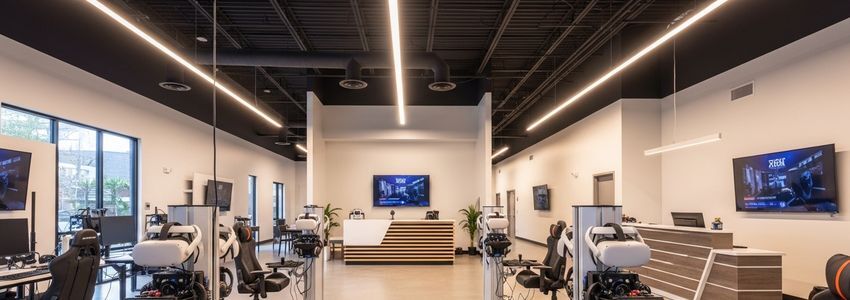
Virtual reality arcade financing is the funding strategy that separates successful VR venue owners from those who never open their doors. The VR entertainment market is booming - global revenue is projected to surpass $12 billion by 2028 - but the upfront capital requirements for premium headsets, gaming rigs, motion platforms, and build-out costs can run from $50,000 to well over $500,000. For most entrepreneurs, that figure demands a smart financing plan rather than a cash purchase.
This guide covers every financing option available to VR arcade owners in 2026: equipment loans, business lines of credit, SBA loans, operating leases, and revenue-based financing. You will find real numbers, qualification benchmarks, and a clear path to getting funded so you can focus on building the immersive experience your customers want.
In This Article
- What Is Virtual Reality Arcade Financing?
- Why VR Arcades Need Financing
- Financing Options for VR Arcades
- Equipment Financing and Leasing for VR Hardware
- How to Apply for VR Arcade Financing
- How Crestmont Capital Helps VR Arcade Owners
- Real-World Financing Scenarios
- Comparing Your Financing Options
- Who Qualifies for VR Arcade Financing?
- Frequently Asked Questions
- How to Get Started
What Is Virtual Reality Arcade Financing?
Virtual reality arcade financing refers to the range of business funding products - equipment loans, leases, SBA loans, working capital lines, and revenue-based financing - used to acquire VR hardware, software licenses, build out a physical location, and cover operating costs during the launch phase of a VR entertainment business.
Unlike a standard retail purchase, VR arcade equipment depreciates rapidly. Headset technology cycles roughly every two to three years, meaning many business owners choose operating leases specifically to preserve the option to upgrade without being saddled with obsolete hardware. Other operators prioritize ownership from day one using term loans, treating VR headsets and gaming PCs as capital assets that generate long-term returns.
The financing structure you choose affects your monthly cash flow, your balance sheet, and your ability to refresh equipment as the technology improves. Understanding each option clearly is the first step toward building a VR arcade that runs profitably from launch.
Market Insight: According to Statista, the global location-based VR entertainment market grew at a compound annual rate of over 30% between 2020 and 2024. Investor and lender interest in the sector has followed suit, making qualified VR arcade operators increasingly bankable borrowers.
Why VR Arcades Need Financing
The capital requirements for a professional VR arcade are substantial and multi-layered. A single premium VR station - headset, gaming PC, motion platform, and controllers - can cost $8,000 to $25,000. A 10-station arcade therefore requires $80,000 to $250,000 in hardware alone, before accounting for facility costs, software licenses, marketing, and working capital reserves.
Here is a typical startup cost breakdown for a mid-size VR arcade with 8 to 12 stations:
- VR headsets and hardware: $60,000 - $150,000
- Gaming PCs and servers: $40,000 - $80,000
- Motion platforms and haptic accessories: $20,000 - $60,000
- Software licenses and content subscriptions: $10,000 - $30,000 annually
- Facility build-out, partitions, and flooring: $30,000 - $120,000
- POS systems, booking software, and networking: $8,000 - $20,000
- Working capital (3 to 6 months operating expenses): $25,000 - $75,000
Total startup costs typically range from $193,000 on the conservative end to well over $535,000 for a premium multi-zone venue. Very few entrepreneurs have that much capital sitting idle. Financing allows operators to open doors faster, preserve personal liquidity, and scale equipment in phases as revenue grows.
By the Numbers
Virtual Reality Arcade Industry - Key Statistics
$12B+
Projected global VR entertainment market by 2028
30%+
Annual compound growth rate for location-based VR venues
$500K+
Typical funding needed for a premium multi-zone VR arcade
2-3 Yrs
Typical VR hardware refresh cycle before technology obsolescence
Financing Options for VR Arcades
Several distinct financing products are available to VR arcade owners, each with different structures, terms, and best-use cases. Understanding how they differ allows you to stack or sequence them strategically rather than defaulting to the first option available.
Equipment Loans
An equipment loan is a term loan specifically secured by the VR hardware you purchase. The equipment itself serves as collateral, which typically results in lower interest rates compared to unsecured business loans. Terms range from 24 to 84 months, and many lenders will finance up to 100% of the equipment cost. At the end of the loan term, you own the hardware outright.
Equipment loans work best when you plan to use the hardware for five or more years and want to build equity in your assets. They are also useful when you expect to modify equipment heavily - something operating lessors often restrict.
Equipment Leasing (Operating Lease)
An operating lease lets you use VR equipment for a fixed monthly payment without owning it. At the end of the lease term, you can return the hardware, renew at updated terms, or purchase it at fair market value. This structure is ideal for VR arcades precisely because technology evolves so rapidly. A two-year lease on Meta Quest Pro headsets today means you can upgrade to the next generation in 2027 without being underwater on a depreciated asset.
Monthly payments on an operating lease are typically lower than equivalent loan payments, preserving cash flow for operations and marketing. The trade-off is that you never own the equipment and may pay more in total cost over a long operating period.
SBA Loans
The U.S. Small Business Administration guarantees several loan programs suited to VR arcade startups and expansions. The SBA 7(a) loan is the most common, offering up to $5 million with terms up to 10 years for equipment and 25 years for real estate. Interest rates are tied to the prime rate plus a lender spread, making SBA 7(a) loans among the most competitive long-term capital available to small businesses.
The SBA 504 loan pairs with a Certified Development Company to finance fixed assets - equipment and real estate - at fixed rates. For a VR arcade owner purchasing or building out a permanent location, the 504 program can cover up to 40% of project costs at below-market fixed rates. Down payments are typically 10% to 20%.
Business Line of Credit
A business line of credit functions like a corporate credit card: you draw funds as needed, pay interest only on what you use, and replenish the line as you repay. Lines typically range from $25,000 to $500,000 for established businesses. For VR arcade owners, a line of credit is ideal for covering software subscription renewals, unexpected equipment repairs, seasonal payroll fluctuations, and marketing campaigns timed to peak entertainment seasons.
Working Capital Loans
An unsecured working capital loan provides a lump sum for general operating expenses rather than capital asset purchases. Approval is typically faster than SBA or traditional bank loans, with funding available in as little as 24 to 72 hours in many cases. Terms range from 6 to 36 months. Working capital loans are useful for covering the gap between opening day and break-even while your VR arcade builds a customer base.
Revenue-Based Financing
Revenue-based financing advances a lump sum in exchange for a fixed percentage of daily or weekly revenue until the advance is repaid. This model is popular with entertainment businesses because repayments flex with actual business performance - during slow winter months, you pay less; during summer peaks, you pay more. There is no fixed monthly payment to stress over during slow periods.
Ready to Finance Your VR Arcade?
Crestmont Capital has helped hundreds of entertainment business owners secure the funding they need. Apply in minutes - no obligation.
Apply Now →Equipment Financing and Leasing for VR Hardware
The most common path for VR arcade owners is equipment financing or equipment leasing because the hardware itself serves as the foundation of the business model. Here is a closer look at how these products work for specific VR arcade assets.
VR Headsets and Head-Mounted Displays
Premium standalone headsets like the Meta Quest Pro, PlayStation VR2, or Varjo XR-4 range from $1,500 to $8,500 per unit. PC-tethered systems from Pimax or Valve can exceed $12,000 per station when paired with a high-performance gaming rig. Equipment lenders treat headsets as eligible collateral under standard business equipment financing programs, with terms typically of 36 to 60 months.
Gaming PCs and Processing Servers
VR requires serious computing power. A workstation-grade gaming PC capable of running modern VR titles at high frame rates - essential for preventing motion sickness - runs $3,000 to $8,000 per unit. A 10-station arcade may require a centralized server rack alongside individual unit PCs. These assets qualify for equipment loans and leases under IT equipment financing programs.
Motion Platforms and Haptic Systems
Full-body immersion platforms from manufacturers like DOF Reality, Mertek, or Positron add $5,000 to $30,000 per station. Haptic vests, gloves, and full-body suits can add another $2,000 to $10,000 per setup. These assets are financed as specialty entertainment equipment, similar to arcade gaming machines, simulators, or theme park ride equipment.
Facility Build-Out and Tenant Improvements
Many VR arcade owners combine equipment loans with SBA loans or commercial real estate financing to cover the physical build-out. Padded flooring, acoustic partitions, safety barriers, ventilation upgrades, and ADA-compliant entry modifications are all eligible costs under SBA 7(a) and 504 programs when they are permanently affixed to the leased premises.
Pro Tip: Many lenders allow a "soft cost" allocation of 10% to 20% of the total financed amount to cover ancillary items like installation, initial software licenses, and delivery. Ask your lender specifically about soft-cost inclusion before finalizing your loan application.

How to Apply for VR Arcade Financing
The application process for VR arcade financing varies by product, but most lenders follow a similar information-gathering sequence. Being prepared with documentation before you apply significantly accelerates approval timelines.
Documentation You Will Need
- Business financials: Two years of business tax returns (or personal returns for startups), year-to-date profit and loss statements, and balance sheets
- Bank statements: Three to six months of business bank statements demonstrating cash flow
- Business plan: For SBA loans and larger requests, a narrative business plan with financial projections showing revenue ramp-up and break-even timeline
- Equipment quote or invoice: From your VR hardware vendor or system integrator, detailing equipment descriptions, quantities, and costs
- Lease or property agreement: If financing a build-out, your signed commercial lease or letter of intent
- Personal identification and credit authorization: Government-issued ID and signed authorization to pull personal and business credit
Credit Score Benchmarks by Product
Different financing products carry different credit thresholds. Equipment loans from bank-affiliated lenders typically require a minimum personal FICO score of 650 to 680. SBA loans require at least 640, with 680 or above significantly improving your rate. Alternative working capital lenders and revenue-based financing providers often approve borrowers with scores in the 550 to 620 range, albeit at higher factor rates.
If your credit score needs improvement, Crestmont Capital can connect you with programs designed for borrowers rebuilding credit, including bad credit equipment financing programs that evaluate cash flow and business performance rather than credit score alone.
How Crestmont Capital Helps VR Arcade Owners
Crestmont Capital is the number one business lender in the United States, specializing in fast, flexible funding for entertainment businesses including VR arcades, fitness centers, hospitality venues, and specialty retail. Our team understands the specific capital needs of VR arcade operators - from the high up-front hardware investment to the seasonal cash flow patterns of location-based entertainment.
We offer a full suite of financing products for VR arcade owners:
- Equipment loans and leases for VR headsets, gaming PCs, motion platforms, and AV systems
- SBA 7(a) and 504 loans for larger projects including permanent location build-outs and multi-location expansions
- Unsecured working capital loans for operating expenses, software subscriptions, and marketing campaigns
- Business lines of credit for ongoing operational flexibility
- Revenue-based financing for operators who want repayment tied to actual revenue performance
Our application process is simple, our decisions are fast, and our team includes specialists who understand the entertainment industry. Most equipment loan decisions are made within 24 to 48 business hours, and funding can be in your account within days of approval.
Get Funded for Your VR Arcade - Fast
From equipment loans to SBA programs, Crestmont Capital has every financing option your VR venue needs. Speak with a specialist today.
Apply Now →Real-World Financing Scenarios
Understanding how other VR arcade owners have structured their financing can help you identify the approach that fits your situation.
Scenario 1: The Startup with Strong Personal Credit
A first-time VR arcade owner in Austin, Texas, wants to open a 10-station venue in a 3,000 square foot strip mall space. Total projected startup costs are $320,000: $180,000 in VR hardware, $90,000 in build-out, and $50,000 in working capital reserves. With a personal credit score of 710 and no prior business history, she qualifies for a $250,000 SBA 7(a) loan at an 8.5% rate over 10 years - covering the build-out and partial hardware - combined with a $70,000 equipment lease on the headsets and gaming PCs. Monthly blended payment: approximately $4,200.
Scenario 2: Existing Entertainment Business Expanding into VR
A family entertainment center in Orlando, Florida, operating for five years with $1.2 million in annual revenue wants to add eight VR stations to its existing floor plan. The owner applies for a $120,000 equipment loan secured by the new hardware. With two years of tax returns showing profitability, a 680 credit score, and existing banking relationship, the loan is approved in 36 hours at 9.2% over 48 months. Monthly payment: approximately $3,000. The expansion is cash-flow positive within four months based on projected per-session revenue.
Scenario 3: Rapid Expansion Using a Line of Credit
A VR arcade chain operating three locations in the Pacific Northwest uses a $300,000 revolving line of credit to fund hardware replacements and new software titles across all three locations as demand evolves. Rather than applying for a new term loan every time a generation of headsets becomes available, the team draws on the line, makes monthly interest payments while generating revenue from the new hardware, and replenishes the line from operating income. This rolling financing model keeps all three locations running current-generation technology without disrupting long-term debt structure.
Scenario 4: Revenue-Based Financing for a Seasonal Venue
A VR arcade attached to a ski resort in Colorado generates 70% of annual revenue between November and April. The owner uses revenue-based financing to purchase a new fleet of headsets in October, before peak season. Repayment is set at 12% of daily revenue. High-season payments naturally accelerate repayment, and the advance is fully repaid by mid-April - just as the slow season begins. The owner avoids carrying a large fixed monthly loan payment through June, July, and August when the resort is quiet.
Scenario 5: Startup with Challenged Credit
A prospective VR arcade owner in Detroit, Michigan, has a 590 credit score due to a medical debt that has since been resolved, but his business concept is strong and he has $30,000 in personal savings as a down payment. He approaches Crestmont Capital, which structures a $140,000 equipment-secured loan using the VR hardware as primary collateral and the down payment as a 17.6% equity injection. The loan is approved with a 13.9% rate over 48 months. Monthly payment: approximately $3,850. Within 18 months, the business is generating sufficient revenue to refinance at a lower rate.
Industry Note: According to the Equipment Leasing and Finance Association (ELFA), entertainment and recreation equipment represented one of the fastest-growing categories in commercial leasing during 2023 and 2024, with virtual reality hardware specifically cited as a high-demand asset class among leasing intermediaries.
Comparing Your Financing Options
| Financing Type | Best For | Typical Amount | Terms | Min. Credit Score |
|---|---|---|---|---|
| Equipment Loan | Hardware ownership, 5+ year use | $25K - $2M+ | 24 - 84 months | 620+ |
| Equipment Lease | Tech that needs frequent upgrades | $10K - $1M+ | 12 - 60 months | 600+ |
| SBA 7(a) Loan | Full build-out, long-term projects | Up to $5M | Up to 10 years (equip.) | 640+ |
| SBA 504 Loan | Real estate + fixed assets | Up to $5.5M | 10 - 25 years | 650+ |
| Business Line of Credit | Ongoing operational flexibility | $25K - $500K | Revolving (annual review) | 650+ |
| Working Capital Loan | Launch phase operating costs | $10K - $500K | 6 - 36 months | 550+ |
| Revenue-Based Financing | Seasonal venues, variable revenue | $10K - $500K | Revenue-driven (no fixed term) | 530+ |
Who Qualifies for VR Arcade Financing?
Qualification criteria vary by lender and product type, but the core factors evaluated for any VR arcade financing application are credit health, business cash flow, time in business, and the quality of the underlying business plan.
Startups and Pre-Revenue Applicants
Lenders view startups with higher risk, but many programs exist specifically for pre-revenue businesses. SBA microloans (up to $50,000), startup-focused equipment leases, and equipment-secured term loans all have pathways for applicants who can demonstrate a credible business plan, relevant industry experience, and sufficient personal credit. A down payment of 10% to 30% significantly improves approval odds for new operators.
Crestmont Capital's startup equipment financing program is specifically designed for new businesses in exactly this situation - operators with strong concepts and personal creditworthiness who simply need a lender willing to underwrite on the strength of the business model rather than years of operating history.
Established Entertainment Businesses
VR arcade owners with two or more years of operating history and consistent revenue are typically the easiest applicants to finance. Most programs are accessible to established operators with 600+ credit scores and 3+ months of positive cash flow history. Larger loan amounts, longer terms, and lower rates all become available as business history lengthens.
Multi-Location Operators
VR arcade chains or multi-location entertainment businesses can access commercial credit facilities well above $1 million, enterprise equipment leasing programs with volume discounts, and SBA 504 programs for real estate-secured long-term assets. At this scale, a commercial financing advisor - rather than a simple online application - is the most efficient path to the best terms.
How to Get Started
Complete our quick application at offers.crestmontcapital.com/apply-now - it takes just a few minutes and there is no obligation.
A Crestmont Capital advisor familiar with entertainment equipment financing will review your needs, your hardware quote, and your build-out plan, then match you with the right product and term structure.
Receive your funds and purchase your VR hardware, complete your build-out, and open your venue - often within days of final approval. Equipment lease funding can be same-day for approved applicants.
Conclusion
Virtual reality arcade financing is not a one-size-fits-all decision. The right approach depends on your credit profile, your timeline, whether you want to own or lease equipment, and how much flexibility you need in monthly payments as your business ramps up. Equipment loans deliver ownership and equity. Operating leases deliver flexibility and lower monthly payments. SBA loans deliver the lowest long-term rates for qualified borrowers. Working capital and revenue-based financing deliver speed when traditional programs move too slowly for an opportunity at hand.
What remains constant is the fundamental opportunity: VR entertainment is growing rapidly, consumers are eager for premium immersive experiences, and lenders have recognized the asset class as bankable. The question is not whether virtual reality arcade financing is available - it is which structure fits your specific situation best.
Crestmont Capital specializes in helping entertainment business owners navigate exactly that question. Our team works with VR arcade operators at every stage, from pre-revenue startups to established multi-location chains, to structure financing that accelerates growth without overextending cash flow. Apply today and speak with a specialist who understands your industry.
Start Your VR Arcade Financing Application
Join hundreds of entertainment business owners who have used Crestmont Capital to fund their vision. Fast decisions. Flexible terms. No obligation.
Apply Now →Frequently Asked Questions
Disclaimer: The information provided in this article is for general educational purposes only and is not financial, legal, or tax advice. Funding terms, qualifications, and product availability may vary and are subject to change without notice. Crestmont Capital does not guarantee approval, rates, or specific outcomes. For personalized information about your business funding options, contact our team directly.