
Modern law practice demands more than legal expertise - it requires the right technology infrastructure to compete and serve clients effectively. A professional, fully equipped video conferencing room has become essential for law firms of every size. Whether you're conducting remote depositions, meeting with out-of-state clients, collaborating with co-counsel, or presenting evidence in virtual court proceedings, your firm's technology setup directly affects your professional reputation and operational efficiency. The challenge: quality video conferencing infrastructure carries a significant upfront cost. Law firm video conferencing room financing offers a practical path to equipping your firm without depleting working capital.
In This Article
- What Is Video Conferencing Room Financing for Law Firms?
- Why Law Firms Need Dedicated Video Conferencing Rooms
- Understanding Video Conferencing Room Equipment and Costs
- Financing Options for Law Firm Video Conferencing Rooms
- How Law Firm Technology Financing Works
- By the Numbers: Video Conferencing in Legal Practice
- Financing vs. Leasing vs. Paying Cash: Comparison
- Who Qualifies for Law Firm Technology Financing
- How Crestmont Capital Helps Law Firms
- Real-World Scenarios
- FAQ
- How to Get Started
What Is Video Conferencing Room Financing for Law Firms?
Law firm video conferencing room financing refers to any funding arrangement that allows a legal practice to acquire, install, and operate professional-grade video conferencing technology without paying the full cost upfront. This can take the form of equipment loans, technology leases, lines of credit, or broader business financing that covers the full scope of a conference room build-out.
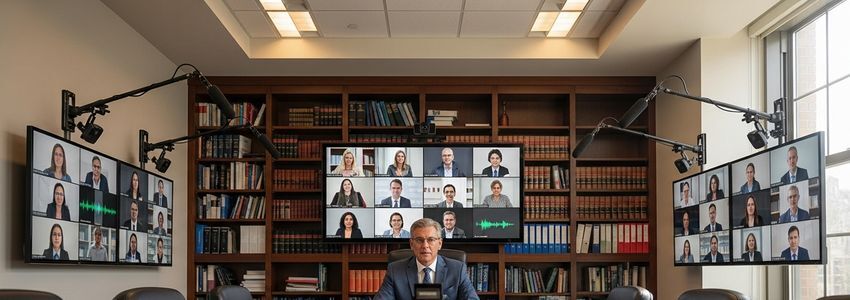
Unlike general consumer video calling on a laptop, a true professional video conferencing room for a law firm typically includes multiple high-resolution displays, ceiling or wall-mounted cameras with pan-tilt-zoom capabilities, high-fidelity microphone arrays, acoustic wall treatments, professional lighting systems, secure network infrastructure, and integrated control systems. The combined investment for a fully equipped room typically ranges from $15,000 to well over $100,000 depending on room size and feature requirements.
Financing spreads that investment over time, preserving cash flow while giving the firm immediate access to the infrastructure needed to compete in today's remote-first legal environment. Many lenders treat this as technology equipment financing - the same category used for medical imaging equipment, manufacturing machinery, or restaurant equipment - with the technology itself often serving as collateral for the loan.
Why Law Firms Need Dedicated Video Conferencing Rooms
The legal industry's relationship with remote technology has transformed permanently. The courts, clients, and opposing counsel all now expect law firms to have reliable, professional video capabilities. A law firm that cannot conduct virtual proceedings smoothly is at a competitive disadvantage in ways that directly affect client acquisition and retention.
Remote depositions have become a standard practice across virtually every litigation practice area. In many jurisdictions, courts now permit or require virtual appearances for hearings, status conferences, and even evidentiary proceedings. A law firm with a dedicated, purpose-built video conferencing room can conduct these proceedings from a controlled, professional environment rather than a makeshift laptop setup that projects an unprofessional image to clients and opposing counsel alike.
Client expectations have also shifted fundamentally. Corporate clients, in particular, expect law firms to offer seamless virtual meeting capabilities. A firm that cannot provide a polished, secure video environment risks losing engagements to competitors who can. High-value clients in finance, real estate, technology, and healthcare have become accustomed to boardroom-quality video calls and may perceive a poor setup as a signal about the firm's overall operational sophistication.
Industry Shift: According to a survey by the American Bar Association, more than 70% of attorneys now conduct at least some client meetings virtually, and remote depositions have been adopted as standard practice by a majority of litigation teams nationwide.
There are also practice efficiency gains to consider. A properly configured conferencing room eliminates the need for attorneys to travel to client offices or court locations for routine status conferences and meetings. Over the course of a year, eliminating even modest travel can reclaim dozens of billable hours per attorney while reducing overhead costs. The return on investment for a well-financed conferencing room often manifests within 12 to 18 months through time savings alone.
Ready to Upgrade Your Law Firm's Technology?
Get fast, flexible financing for your video conferencing room and technology infrastructure. Competitive rates, quick approvals - no obligation.
Apply Now →Understanding Video Conferencing Room Equipment and Costs
Before exploring financing options, it helps to understand what a professional law firm video conferencing room actually requires and what those components cost. The investment varies substantially based on room size, usage frequency, and desired functionality.
Core Display and Camera Systems
The visual experience is central to any professional video conferencing setup. High-resolution commercial displays (typically 55" to 85" screens) for participant viewing run $1,500 to $5,000 per screen. Many law firms install dual or triple displays to show both participants and shared documents simultaneously. Professional-grade PTZ (pan-tilt-zoom) cameras that provide flexibility for different room configurations and meeting formats range from $500 to $5,000 each. High-end 4K cameras with advanced auto-tracking and AI framing features cost more but significantly elevate production quality.
Audio Infrastructure
Audio quality is arguably more important than video in legal settings where precise communication is essential. Ceiling-mounted or tabletop microphone arrays designed for conference rooms range from $500 to $8,000 depending on room size and pickup patterns. Professional speaker systems designed for voice clarity rather than music reproduction add $1,000 to $5,000. Acoustic panels, sound baffles, and other room treatments that prevent echo and outside noise infiltration add $2,000 to $15,000 but are critical investments for depositions and court proceedings.
Control and Network Systems
Professional touchscreen control panels that manage all room functions from a single interface run $2,000 to $10,000. These systems allow attorneys to start meetings, control cameras, adjust audio levels, and share content without fumbling with multiple devices. Network infrastructure upgrades - switches, access points, cabling, and dedicated internet connections for the conferencing room - add $3,000 to $20,000 depending on the firm's existing infrastructure and security requirements.
Furniture and Room Design
Purpose-built conference tables with integrated power and data ports, ergonomic seating, proper room lighting (including supplemental LED panels designed to flatter on-camera appearances), and privacy blinds or window treatments collectively add $5,000 to $30,000 to total project cost. Many law firms also invest in branded backgrounds or custom millwork that reinforces firm identity in virtual meetings.
Software and Integration
Platform licenses for enterprise-grade video conferencing services, secure file sharing integrated into the room system, recording and transcript solutions for depositions, and e-discovery platform integrations add recurring costs of $500 to $5,000 per year. While these are often operational expenses rather than capital expenditures, some financing arrangements can incorporate software costs into the overall funding package.
Financing Options for Law Firm Video Conferencing Rooms
Law firms have several financing pathways available, each with distinct advantages depending on the firm's financial profile, preference for ownership versus flexibility, and how the technology investment fits into the firm's broader capital strategy.
Equipment Loans
Equipment loans are term loans secured by the technology being purchased. The law firm owns the equipment outright and makes fixed monthly payments over the loan term, typically 24 to 72 months. Interest rates generally range from 6% to 18% depending on creditworthiness, time in business, and loan amount. At the end of the term, the equipment is fully owned with no residual payment required. This structure works well for firms that want to own their technology infrastructure and plan to use the equipment for its full useful life.
Technology Leasing
Equipment leasing allows a firm to use the technology for a defined term (typically 24 to 48 months) in exchange for monthly payments, with options at lease end to purchase the equipment at fair market value, return it, or renew the lease. Leasing typically offers lower monthly payments than a purchase loan, which can be attractive for firms that prioritize cash flow management. It also provides built-in technology refresh flexibility - at lease end, the firm can upgrade to newer systems rather than owning aging equipment.
Business Lines of Credit
A business line of credit provides flexible access to capital that can be drawn as needed and repaid on a revolving basis. This is ideal for firms undertaking phased technology upgrades across multiple conference rooms, since funds can be accessed for each phase without applying for a new loan each time. Lines of credit typically carry higher interest rates than term loans but offer more flexibility and can be reused as the balance is repaid.
SBA Loans
SBA loans - particularly the SBA 7(a) program - can fund law firm technology investments as part of broader working capital or equipment financing. SBA loans offer longer repayment terms (up to 10 years for equipment) and competitive interest rates, but the application process is more involved and approval timelines are longer than conventional equipment financing. They work best for larger, comprehensive projects where the extended repayment term meaningfully reduces monthly payment burden.
Working Capital Loans
Working capital loans provide general-purpose funding that can be used for any business purpose, including technology upgrades. These are often unsecured, rely on the firm's revenue and cash flow for qualification rather than specific collateral, and can be approved and funded within days. While interest rates are typically higher than equipment-specific loans, the speed and simplicity make them attractive for firms that need to move quickly on a technology project.
How Law Firm Technology Financing Works
The process of securing financing for a law firm video conferencing room is more straightforward than many attorneys expect. The following steps outline a typical path from initial interest to funded project.
Step 1 - Assess your technology needs and budget. Before approaching lenders, develop a detailed scope of work. Get quotes from at least two or three audiovisual integrators who specialize in legal or professional environments. A clear project budget and vendor quote helps lenders understand exactly what is being financed and allows for faster approval.
Step 2 - Review your firm's financial position. Lenders will look at the firm's revenue history (typically 6-24 months of bank statements), credit profile, and time in business. Most law firms - even newer practices with two or more years of history - present strong financing profiles given the professional nature of the business and relatively stable revenue patterns.
Step 3 - Apply for financing. Equipment financing applications are generally straightforward. For loans under $150,000, many lenders can approve based on a simple one-page application plus bank statements. Larger projects may require tax returns, a balance sheet, and profit/loss statements. Crestmont Capital specializes in fast approvals that don't require extensive documentation for qualified applicants.
Step 4 - Receive approval and funding. Upon approval, funds are typically disbursed directly to your AV vendor or deposited into the firm's account within one to five business days. The lender establishes the repayment schedule, and the firm begins making monthly payments while the integrator proceeds with installation.
Step 5 - Install, configure, and go live. Professional AV integrators typically complete a conference room installation within one to three days. After testing and calibration, the firm has a fully operational professional video conferencing environment.
By the Numbers
Video Conferencing in Modern Legal Practice
70%+
of attorneys now conduct at least some client meetings virtually
$15K-$100K+
Typical investment range for a professional law firm conference room
1-5 Days
Typical funding timeline after equipment financing approval
12-18 Mo.
Typical ROI timeline through time savings on travel and efficiency gains
Financing vs. Leasing vs. Paying Cash: Comparison
| Factor | Equipment Loan | Technology Lease | Pay Cash |
|---|---|---|---|
| Upfront Cost | Low (down payment only) | Very low (first/last payment) | Full purchase price |
| Ownership | Yes - from day one | No (option to buy at end) | Yes - immediate |
| Monthly Cash Flow Impact | Fixed, predictable payments | Lower fixed payments | No payments, but capital depleted |
| Technology Upgrade Flexibility | Moderate | High - easy to upgrade at end | Low - own aging equipment |
| Approval Required | Yes | Yes | No |
| Best For | Long-term use, ownership preferred | Cash flow priority, want to upgrade | Firms with excess cash reserves |
Who Qualifies for Law Firm Technology Financing
Law firms are generally excellent candidates for equipment and technology financing. Lenders view professional services practices favorably because of their relatively predictable revenue, established client relationships, and the professional nature of the practice. Here are the typical qualification criteria:
Time in business: Most lenders require at least 12 to 24 months of operating history. Established law firms with several years of operation have the strongest profiles. Newer firms or recently promoted associates starting their own practices may still qualify, particularly if supported by strong personal credit.
Annual revenue: For equipment loans in the $20,000 to $100,000 range, lenders typically want to see annual revenue of at least $150,000 to $300,000. Larger firms undertaking more substantial projects benefit from higher revenue multiples that support larger loan amounts.
Credit profile: Both business and personal credit scores factor into most decisions. A personal FICO score above 650 with no recent major derogatory events is a reasonable baseline for conventional equipment financing. Firms with stronger profiles (700+) access more competitive rates and terms.
Bank account health: Lenders review bank statements looking for consistent deposits, positive average balances, and absence of chronic overdrafts. Law firms that handle client trust accounts alongside operating accounts should present their operating account history to lenders.
Good news for law firms: Even solo practitioners and small firms with 2-5 attorneys often qualify for technology financing based on consistent revenue and professional practice history. The legal industry's low default rates make law firms attractive borrowers across most lender categories.
How Crestmont Capital Helps Law Firms Finance Technology Infrastructure
Crestmont Capital specializes in business financing for professional services firms, including law practices of all sizes. We understand that a law firm's technology infrastructure directly impacts its ability to serve clients and compete in a market where remote and hybrid legal services are now standard. Our equipment financing solutions are designed to fund exactly these kinds of projects.
Our approach is straightforward: we work with law firms to match the right financing structure to their specific situation. A solo practitioner upgrading a single conference room has different needs than a 30-attorney firm building out three state-of-the-art video deposition suites. We evaluate each firm's full financial picture and recommend the financing approach - whether equipment loan, line of credit, or SBA-backed option - that best serves both the immediate project and the firm's longer-term financial health.
For law firms that also need broader support - from revolving lines of credit for managing operating cash flow to SBA loans for larger capital investments - Crestmont Capital provides access to the full spectrum of business lending products under one roof. This makes us a valuable long-term financing partner as your firm grows and its capital needs evolve.
Our application process is designed to be non-disruptive for busy professionals. Most law firm financing applications can be completed in under 10 minutes online, and we can provide indicative approval decisions within 24 hours for qualified applicants. Funding typically follows within two to five business days of final approval.
Build the Professional Video Presence Your Clients Expect
Crestmont Capital works with law firms of all sizes to fund technology infrastructure quickly and efficiently. Flexible terms, competitive rates.
Get Financing →Real-World Scenarios: How Law Firms Use Video Conferencing Financing
Scenario 1: The Solo Litigation Practitioner
A litigation attorney operating as a solo practitioner wants to set up a professional video deposition suite to handle the growing volume of remote depositions in her practice. The total project - two displays, a professional camera, tabletop microphone array, and acoustic panels - comes to $22,000. She secures a 48-month equipment loan at a competitive rate, resulting in a monthly payment under $600. The investment pays for itself within the first year: she eliminates travel costs for depositions that previously required a two-hour round trip, freeing two to three hours of billable time per deposition session.
Scenario 2: The Growing Mid-Size Firm
A 15-attorney firm handling corporate transactions and commercial litigation wants to upgrade all three of its main conference rooms to professional video conferencing capability. The total project cost is $85,000. Rather than financing each room separately, the firm secures a single equipment financing arrangement that covers the entire project. This allows the AV integrator to coordinate a single installation project, reducing disruption to firm operations and enabling economies of scale in procurement.
Scenario 3: The Boutique Real Estate Law Firm
A boutique firm specializing in commercial real estate transactions regularly meets with developers, lenders, and municipal officials across multiple states. Rather than flying to meetings or using informal video calls, the firm invests $45,000 in a high-end conferencing suite with a 4K display wall, professional lighting, and integrated collaboration tools. They use a business line of credit to fund the build-out, drawn in two tranches as the project phases complete. The enhanced professional image helps close a major client relationship that generates far more than the cost of the system in year one.
Scenario 4: The Multi-Office Regional Firm
A regional firm with four offices wants standardized video conferencing rooms at each location to facilitate seamless internal collaboration between practice groups. A coordinated financing arrangement covers all four room build-outs simultaneously, ensuring technology consistency across offices. The firm uses SBA loan proceeds with extended repayment terms to keep monthly payments manageable while undertaking the full project scope.
Scenario 5: The Estate Planning Practice Expanding Into Virtual Services
An estate planning attorney wants to expand her practice by offering virtual estate planning consultations to clients who cannot easily visit the office - including elderly clients, clients managing serious illness, and clients who live at a distance. She finances a secure, HIPAA-aware video conferencing setup with private meeting room capability for $18,000 through a short-term equipment loan. The virtual service line adds a meaningful new revenue stream while reducing geographic constraints on her practice area.
Scenario 6: The Immigration Law Firm
An immigration practice serving clients across multiple countries needs a conferencing setup capable of supporting international calls with high reliability, clear audio for interpreters, and the ability to securely share document images. The firm invests in a premium system with redundant connectivity and funds it through a combination of equipment financing for the hardware and a working capital loan for the installation and software setup. The result is a professional environment that dramatically improves the client experience for vulnerable individuals navigating a stressful process.
Frequently Asked Questions
How to Get Started
Get at least one detailed quote from a professional AV integrator who specializes in legal or corporate environments. A solid project scope and cost estimate strengthens your financing application.
Complete our quick application at offers.crestmontcapital.com/apply-now. The application takes under 10 minutes and we work with law firms of all sizes.
A Crestmont Capital advisor will review your application and match you with the right financing structure. Most law firm applications receive decisions within 24-48 hours.
Once approved and funded (typically 2-5 business days), your AV integrator can begin installation. Most professional video conferencing room installations complete within 1-3 business days.
Conclusion
Law firm video conferencing room financing has become an essential consideration for modern legal practices. As virtual proceedings, remote depositions, and video-first client service become the norm rather than the exception, the firms that invest in professional-grade video infrastructure gain a concrete competitive advantage. The good news is that quality technology doesn't require depleting firm capital - the right financing structure makes professional video conferencing accessible through manageable monthly payments that align with the business value the technology delivers.
Whether you're a solo practitioner setting up your first dedicated conferencing suite or a regional firm standardizing video capability across multiple offices, Crestmont Capital has the financing solutions to make it happen quickly and efficiently. Our equipment financing, business lines of credit, and broader small business financing options give law firms the capital flexibility to invest in the technology their clients expect and their practice demands.
Ready to Build Your Law Firm's Video Conferencing Room?
Apply today and get a financing decision within 24-48 hours. Flexible terms for law firms of all sizes - from solo practitioners to regional firms.
Apply Now →Disclaimer: The information provided in this article is for general educational purposes only and is not financial, legal, or tax advice. Funding terms, qualifications, and product availability may vary and are subject to change without notice. Crestmont Capital does not guarantee approval, rates, or specific outcomes. For personalized information about your business funding options, contact our team directly.