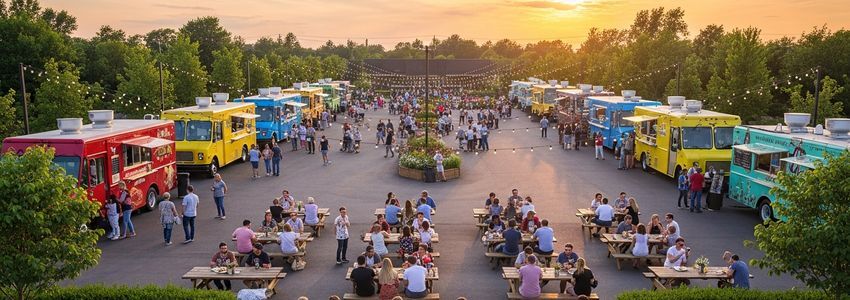
Food truck parks have transformed the American dining landscape, creating communal gathering spaces where diverse cuisines converge under one roof. As a food truck park owner or aspiring operator, securing the right financing can make the difference between a thriving destination and a missed opportunity. This guide covers everything you need to know about food truck park business loans, from startup costs to expansion financing.
- What Is a Food Truck Park Business?
- Food Truck Park Startup Costs and Capital Needs
- Types of Loans for Food Truck Parks
- How to Qualify for Food Truck Park Financing
- SBA Loan Options for Food Truck Parks
- Alternative Financing Options
- Equipment and Infrastructure Financing
- Managing Cash Flow and Working Capital
- Financing Food Truck Park Expansion
- How to Apply for a Food Truck Park Loan
- Next Steps
- Frequently Asked Questions
What Is a Food Truck Park Business?
A food truck park is a dedicated venue where multiple mobile food vendors operate simultaneously, sharing infrastructure, seating, and amenities. Unlike individual food trucks that move from location to location, food truck parks offer permanent or semi-permanent gathering spaces that create a consistent revenue stream for park operators who earn income through vendor fees, event hosting, and on-site sales.
The food truck industry has experienced remarkable growth over the past decade. According to data from the U.S. Small Business Administration, food and beverage businesses represent one of the most active segments for small business lending. Food truck parks occupy a unique position in this ecosystem - they serve as landlords, hospitality operators, and community anchors simultaneously.
Food truck parks generate revenue through several channels:
- Vendor rental fees - Daily, weekly, or monthly stall rentals from food truck operators
- Event hosting - Private events, festivals, and catered gatherings
- Beverage operations - On-site bar, craft beer garden, or beverage kiosk
- Entertainment revenue - Live music, activities, and programming
- Merchandise and branding - Branded merchandise and co-marketing opportunities
Understanding these revenue streams is critical when approaching lenders, because food truck park financing requires demonstrating the viability of a multi-dimensional business model.
Food Truck Park Startup Costs and Capital Needs
Before approaching lenders, food truck park owners need a clear picture of their capital requirements. The costs vary significantly based on location, scale, and whether you are building from scratch or renovating an existing space. Understanding these costs helps you determine how much financing you need and which loan products best fit your situation.
Core Infrastructure Costs
The foundation of any food truck park is its physical infrastructure. These expenses represent the largest portion of startup capital and often require long-term financing:
- Land lease or purchase - $2,000 to $10,000 per month for lease, or $150,000 to $1,000,000+ for purchase depending on market
- Site preparation and grading - $15,000 to $80,000
- Electrical hookups for food trucks - $25,000 to $100,000 (30-amp and 50-amp service per stall)
- Water and sewer connections - $10,000 to $50,000
- Paving and surface work - $20,000 to $75,000
- Outdoor seating areas - $15,000 to $60,000
- Lighting and security systems - $10,000 to $40,000
- Restroom facilities - $30,000 to $120,000 (permanent structure) or $500 to $2,000/month (portable rental)
Amenities and Business Infrastructure
Beyond the physical setup, food truck parks require additional investment to create a compelling guest experience:
- Covered outdoor structures - $25,000 to $150,000
- Bar or beverage station - $20,000 to $80,000
- Stage and entertainment infrastructure - $10,000 to $50,000
- WiFi and point-of-sale systems - $5,000 to $20,000
- Landscaping and aesthetics - $5,000 to $30,000
- Permits and licensing - $1,000 to $15,000
- Initial marketing and launch - $5,000 to $25,000
Types of Loans for Food Truck Parks
Food truck park owners have access to a range of financing products, each suited to different needs and stages of business development. Understanding which loan type fits your situation can save time and improve your approval odds.
Term Loans
Traditional small business loans provide a lump sum with fixed repayment terms. These are well-suited for large capital expenditures like site development, construction, or major renovations. Term lengths typically range from 3 to 10 years for food truck park loans, with interest rates varying based on creditworthiness and loan size.
SBA Loans
SBA-guaranteed loans offer some of the most competitive rates and terms available for small business owners. The SBA 7(a) program is particularly useful for food truck park development, offering up to $5 million with 10-year terms for working capital and 25-year terms for real estate. However, approval takes longer - typically 60 to 90 days.
Business Lines of Credit
A business line of credit provides flexible, revolving access to capital. This is ideal for managing seasonal cash flow variations, covering vendor incentives, or handling unexpected maintenance expenses. Lines of credit typically range from $25,000 to $500,000 for established businesses.
Equipment Financing
Dedicated equipment financing covers infrastructure like electrical panels, covered structures, sound systems, and commercial kitchen facilities. The equipment itself serves as collateral, which can make approval easier than unsecured loans.
Short-Term Business Loans
Short-term business loans offer faster access to capital with terms of 3 to 18 months. These are useful for covering gap expenses, launching marketing campaigns, or bridging the time between park opening and reaching stable vendor occupancy.
| Loan Type | Best For | Loan Amount | Term | Speed |
|---|---|---|---|---|
| SBA 7(a) Loan | Major development, real estate | Up to $5M | Up to 25 years | 60-90 days |
| Term Loan | Construction, major upgrades | $50K - $2M+ | 1-10 years | 1-2 weeks |
| Line of Credit | Cash flow, seasonal gaps | $25K - $500K | Revolving | 3-7 days |
| Equipment Financing | Electrical, structures, A/V | $10K - $500K | 2-7 years | 1-3 days |
| Short-Term Loan | Launch costs, marketing | $10K - $250K | 3-18 months | 24-48 hours |
| Working Capital Loan | Payroll, operations, vendor fees | $10K - $500K | 6 months - 3 years | 24-72 hours |
How to Qualify for Food Truck Park Financing
Lenders evaluate food truck park loan applications using the same core criteria applied to other hospitality and real estate businesses, but with some specific considerations for this unique business model.
Credit Score Requirements
Your personal and business credit scores play a central role in approval and rate determination. Here is what most lenders look for:
- Excellent (720+) - Access to the best rates and terms, including SBA loans
- Good (680-719) - Standard approval with competitive terms from most lenders
- Fair (640-679) - Approval possible with collateral or higher down payment
- Challenged (below 640) - Alternative lenders may still fund; expect higher rates
If your credit needs work before applying, Crestmont Capital offers bad credit business loans designed for operators who need access to capital while rebuilding their credit profile.
Time in Business
Most traditional lenders prefer at least 2 years of business history. However, startups can still access financing through SBA loans, equipment financing, and alternative lenders who focus more heavily on the business plan and collateral than historical revenue.
Revenue and Cash Flow Documentation
For established food truck parks, lenders typically want to see:
- 12-24 months of bank statements
- Tax returns for 2-3 years
- Profit and loss statements
- Vendor lease agreements demonstrating recurring income
- A current accounts receivable aging report if applicable
Collateral and Personally Guarantees
Larger food truck park loans often require collateral in the form of real estate, equipment, or personal assets. Most lenders also require a personal guarantee from owners holding 20% or more equity in the business.
SBA Loan Options for Food Truck Parks
The Small Business Administration offers several loan programs that food truck park operators can access through approved lenders. According to SBA.gov, the agency helped facilitate hundreds of billions in small business lending in recent years, with hospitality and food service operations representing a significant portion of borrowers.
SBA 7(a) Loans
The SBA 7(a) is the most versatile program for food truck park financing. It can cover land acquisition, construction, equipment, and working capital within a single loan. Key benefits include:
- Loan amounts up to $5 million
- Down payments as low as 10-15% for well-qualified borrowers
- Terms up to 10 years for working capital, 25 years for real estate
- Below-market interest rates tied to the prime rate
SBA 504 Loans
If your food truck park involves purchasing land or constructing a permanent facility, the SBA 504 program offers long-term, fixed-rate financing at some of the lowest rates available. The 504 program requires a 10% down payment from the borrower, with SBA covering 40% and a conventional lender covering the remaining 50%.
SBA Microloans
For smaller funding needs - such as improving an existing park or adding infrastructure - the SBA Microloan program offers up to $50,000 through nonprofit lenders. These are particularly accessible for newer operators or those with limited credit history.
For a full breakdown, see our guide to SBA loans for small businesses.
Alternative Financing Options
Not every food truck park operator qualifies for traditional bank financing or SBA loans. Alternative lenders fill a critical gap, offering faster approvals, more flexible qualification criteria, and products tailored to cash-flow-intensive hospitality businesses.
Fast Business Loans
When you need capital quickly - for a vendor incentive program, emergency infrastructure repair, or a time-sensitive lease opportunity - fast business loans from alternative lenders can fund in 24 to 48 hours. While rates are higher than bank loans, the speed and flexibility often justify the cost for specific use cases.
Merchant Cash Advances
If your food truck park processes credit card transactions directly - through on-site beverage sales, event ticketing, or merchandise - a merchant cash advance can provide capital based on your expected future sales volume. Repayments are made as a percentage of daily revenue, which aligns repayment with your actual cash flow patterns.
Revenue-Based Financing
Similar to MCAs but often with more favorable terms, revenue-based financing provides capital in exchange for a fixed percentage of monthly revenue until the advance is repaid. This can be a strong fit for food truck parks with relatively predictable monthly vendor income from stall rentals.
Business Loans for No Credit Check
If credit is a barrier, certain alternative lenders focus on business performance metrics rather than credit scores. Business loans with no credit check evaluate your bank statements, cash flow, and revenue history to make underwriting decisions. These options provide access to capital for operators who are rebuilding credit or who have thin credit profiles.
Equipment and Infrastructure Financing
One of the most strategic ways to fund a food truck park is through dedicated equipment financing, which treats your physical infrastructure as collateral against the loan. This approach often results in better rates than unsecured loans and preserves your working capital for operations.
What Equipment Financing Covers
For food truck parks, equipment financing can fund a wide range of infrastructure investments:
- Electrical distribution systems - 30-amp and 50-amp pedestals for each truck stall
- Covered outdoor structures - Shade canopies, pergolas, and modular pavilions
- Commercial sound systems - Speakers, amplifiers, and stage equipment for events
- Lighting systems - String lights, pathway lighting, and security cameras
- Outdoor furniture - Tables, chairs, benches, and bar stools
- Commercial refrigeration - Walk-in coolers or beer garden equipment
- Point-of-sale systems - Contactless payment terminals and kiosks
- Waste management infrastructure - Dumpster enclosures, recycling stations
Advantages of Equipment Financing for Food Truck Parks
Equipment loans typically offer:
- 100% financing for the equipment cost in many cases
- Faster approval than traditional business loans
- Lower rates because the equipment serves as collateral
- Potential tax advantages through Section 179 deductions
- Preservation of your existing working capital and credit lines
Managing Cash Flow and Working Capital
Food truck parks face unique cash flow challenges. Revenue is often concentrated on weekends and during warm-weather months, while expenses - particularly rent or mortgage, insurance, and staff costs - remain relatively constant year-round. Effective cash flow management through strategic financing can smooth these seasonal fluctuations and keep your operation healthy.
Seasonal Revenue Patterns
Understanding your seasonal revenue cycle is critical for both managing cash flow and presenting a credible loan application. Most food truck parks in colder climates see revenue drop 40-60% during winter months, while warm-weather markets may experience year-round stability with summer peaks. Build this seasonality into your financial projections and demonstrate to lenders how you plan to bridge seasonal gaps.
Working Capital Strategies
Several financing strategies help food truck park owners maintain adequate working capital:
- Revolving line of credit - Draw during slow months, repay during peak seasons
- Invoice financing - Convert outstanding vendor invoices to immediate cash
- Short-term working capital loans - Bridge specific gaps between slow and peak periods
- Vendor deposit structures - Collect monthly vendor fees in advance to reduce cash flow gaps
According to reporting by CNBC, cash flow management remains one of the top challenges for small business operators, with many citing irregular revenue timing rather than insufficient profitability as the core issue.
Building Reserves
Financial experts and experienced food truck park operators generally recommend maintaining 2-3 months of operating expenses in liquid reserves. This buffer protects against unexpected repairs, vendor vacancies, or weather-related closures that can temporarily impact revenue.
Financing Food Truck Park Expansion
Once your food truck park achieves stable occupancy and consistent cash flow, expansion financing becomes a strategic tool for growing your market presence, adding revenue streams, and building enterprise value.
Adding Vendor Stalls
Expanding vendor capacity is the most straightforward growth move for an established food truck park. Adding 3-5 additional stalls requires electrical infrastructure investment, permitting, and potentially additional seating - typically costing $15,000 to $50,000 per stall in total infrastructure costs. This investment typically pays back within 12-18 months through increased vendor rental income.
Adding a Permanent Bar or Restaurant
Many successful food truck parks add a permanent bar or beverage service operation to increase revenue per customer visit. This requires a larger investment - typically $80,000 to $200,000 for full bar build-out - but dramatically improves average revenue per visitor and creates a more compelling destination experience.
Opening a Second Location
Operators who have proven the concept at one location increasingly pursue multi-location strategies. Opening a second food truck park benefits from your existing vendor relationships, operational systems, and brand recognition. Lenders look favorably on expansion applications from operators with demonstrated profitability at existing locations.
For operators pursuing multi-location growth, long-term business loans with terms of 5-10 years provide the capital needed while keeping monthly payments manageable during the ramp-up period of the new location.
Industry data from the U.S. Census Bureau shows that hospitality businesses that successfully open a second location within 5 years of their first tend to grow at significantly faster rates than single-location operators, benefiting from economies of scale in marketing, staffing, and vendor negotiations.
How to Apply for a Food Truck Park Loan
A well-prepared loan application dramatically improves your approval odds and can result in better rates and terms. Here is a systematic approach to preparing your food truck park financing application.
Step 1: Know Your Numbers
Before approaching any lender, compile a clear picture of your financial situation:
- Personal credit score and business credit score
- Monthly revenue for the past 12-24 months
- Current outstanding business debt
- Available collateral (real estate, equipment)
- Exact amount needed and specific use of funds
Step 2: Prepare Your Documents
Gather these documents before starting applications:
- 2-3 years of personal and business tax returns
- 12-24 months of business bank statements
- Current year-to-date profit and loss statement
- Balance sheet
- Vendor lease agreements showing contracted income
- Business license and permits
- Site lease or property deed
- Business plan with financial projections (especially for startups)
Step 3: Compare Lenders
Different lender types offer different advantages for food truck park financing:
- Traditional banks - Best rates but slowest approval and stricter requirements
- SBA lenders - Excellent terms for qualified applicants; longer process
- Online alternative lenders - Fast approval, flexible requirements, higher rates
- Credit unions - Competitive rates for members, community focus
- Direct lenders like Crestmont Capital - Streamlined process, fast decisions, flexible programs
According to a 2024 report by Forbes, small business owners who compare at least 3 lenders before accepting a loan save an average of 15-30% on total financing costs over the life of their loan.
Next Steps to Fund Your Food Truck Park
-
Assess Your Funding NeedsCalculate your total capital requirement with a detailed line-item budget. Include construction, infrastructure, equipment, permits, initial marketing, and 3 months of operating reserves. This number drives your loan selection.
-
Check Your Credit ProfilePull your personal credit report and any available business credit scores. Identify and resolve any errors. If scores need improvement, implement credit-building strategies for 60-90 days before applying for larger loans.
-
Organize Your Financial DocumentsCompile tax returns, bank statements, P&L statements, lease agreements, and permits. For startups, prepare a detailed business plan with 3-year financial projections, a competitive analysis, and site permits.
-
Determine the Right Loan TypeMatch your funding need to the right product. Use SBA loans for large capital projects, equipment financing for infrastructure, lines of credit for working capital, and short-term loans for urgent needs.
-
Apply with Crestmont CapitalSubmit your application to Crestmont Capital for a fast, no-obligation review. Our advisors specialize in hospitality and food service financing and can identify the best product for your specific situation.
-
Execute Your Growth PlanOnce funded, deploy capital according to your business plan timeline. Track ROI on each expense category and maintain your lender relationship by communicating proactively about your progress.
Frequently Asked Questions About Food Truck Park Business Loans
How much does it cost to start a food truck park?
Can I get a loan to start a food truck park with no business history?
What credit score do I need to get a food truck park loan?
How long does it take to get approved for food truck park financing?
Do food truck park loans require collateral?
What is the difference between a food truck park loan and a food truck loan?
Can I use an SBA loan to buy land for a food truck park?
How does seasonal revenue affect my loan eligibility?
What happens if vendor occupancy drops and I cannot make loan payments?
Can I get financing if I have bad credit but strong business revenue?
What documents do I need to apply for a food truck park loan?
What interest rates can I expect on food truck park loans?
Is a food truck park a good investment?
Can I use a business line of credit to manage food truck park cash flow?
How does Crestmont Capital help food truck park owners get financed?
Disclaimer: The information provided in this article is for general educational purposes only and is not financial, legal, or tax advice. Funding terms, qualifications, and product availability may vary and are subject to change without notice. Crestmont Capital does not guarantee approval, rates, or specific outcomes. For personalized information about your business funding options, contact our team directly.