
 (800) 949-0401
Food Safety Equipment Financing for Restaurants: The Complete Guide
In the competitive restaurant industry, maintaining the highest standards of food safety is not just a regulatory requirement-it is a cornerstone of your brand's reputation and long-term success. Acquiring the necessary state-of-the-art equipment to meet these standards often involves a significant capital investment. This is where food safety equipment financing for restaurants provides a critical solution, allowing owners to obtain essential assets without depleting their working capital.
In This Article
- What Is Food Safety Equipment Financing?
- Types of Food Safety Equipment You Can Finance
- How Food Safety Equipment Financing Works
- Benefits of Financing Food Safety Equipment
- Types of Financing Options for Food Safety Equipment
- How Crestmont Capital Helps Restaurant Owners
- Real-World Scenarios
- How to Qualify for Food Safety Equipment Financing
- Comparison Table - Financing Options
- Frequently Asked Questions
- How to Get Started
- Conclusion
What Is Food Safety Equipment Financing?
Food safety equipment financing is a specialized financial product designed to help restaurant owners purchase or lease the equipment necessary to store, prepare, and serve food safely. Unlike a traditional business loan that provides a lump sum of cash for general purposes, this type of financing is tied directly to the acquisition of specific assets. The equipment itself typically serves as the collateral for the loan, which can make the approval process faster and more accessible for many business owners.
This financial tool allows you to break down the substantial cost of essential equipment into manageable, fixed monthly payments over a predetermined term. By doing so, you can preserve your cash flow for other critical operational needs like payroll, inventory, and marketing. Whether you are launching a new restaurant, expanding an existing one, or simply upgrading outdated machinery to meet new health codes, equipment financing provides a strategic pathway to acquire the tools you need to operate safely and efficiently. It bridges the gap between the need for high-quality equipment and the reality of budget constraints, ensuring that safety and compliance are never compromised due to a lack of immediate capital.
Types of Food Safety Equipment You Can Finance
A modern commercial kitchen relies on a wide array of specialized equipment to maintain food safety standards. Financing can cover nearly any piece of equipment that contributes to the safe handling, preparation, and storage of food. Here are some of the most common types of food safety equipment that restaurants finance.
Commercial Refrigerators and Freezers
Proper temperature control is the first line of defense against foodborne illness. Commercial-grade refrigerators and freezers are designed for the rigors of a restaurant environment, offering precise temperature management, rapid cooling capabilities, and durability. This category includes reach-in coolers, under-counter refrigerators, and large-scale walk-in coolers and freezers, all of which are essential for keeping perishable ingredients out of the "danger zone" (40°F to 140°F) where bacteria multiply rapidly.
Walk-In Coolers and Blast Chillers
For high-volume establishments, walk-in coolers are indispensable for bulk storage of produce, dairy, and meats. Blast chillers and shock freezers take temperature control a step further by rapidly lowering the temperature of cooked foods, moving them through the danger zone quickly to prevent bacterial growth. This process is a key component of many Hazard Analysis Critical Control Point (HACCP) plans and is crucial for restaurants that prepare food in large batches for later use.
Temperature Monitoring Systems
Automated temperature monitoring systems provide 24/7 oversight of all your cold storage units. These systems use sensors to track temperatures in real-time and send alerts to your phone or computer if a unit deviates from its set range. This technology helps prevent catastrophic food loss due to equipment failure and provides a digital log for health inspectors, demonstrating your commitment to compliance.
Commercial Dishwashers and Sanitizing Stations
Cleanliness is paramount in a kitchen. High-temperature commercial dishwashers are engineered to wash and sanitize dishes, glassware, and utensils at temperatures that kill harmful bacteria, a standard that residential models cannot meet. In addition to dishwashers, dedicated sanitizing stations, including three-compartment sinks and handwashing stations with specific temperature and soap requirements, are mandatory for maintaining a hygienic environment.
HACCP Monitoring Systems
HACCP is a systematic approach to food safety that identifies and controls potential biological, chemical, and physical hazards. Modern HACCP monitoring systems often involve software and hardware that help you track critical control points throughout the food production process. This can include digital thermometers, data loggers for cooking and cooling times, and software to manage and document your entire food safety plan, making compliance easier and more accurate.
Food Preparation Surfaces and Storage Equipment
The surfaces where food is prepared must be non-porous, durable, and easy to clean and sanitize. Stainless steel is the industry standard for prep tables, countertops, and shelving due to its resistance to corrosion and bacteria. Proper food storage equipment, such as food-grade containers with tight-fitting lids, color-coded cutting boards to prevent cross-contamination, and shelving units that keep food stored off the floor, are also critical and financeable assets.
Ventilation and Exhaust Systems
Commercial kitchen ventilation systems, including exhaust hoods and fans, are vital for more than just comfort. They remove smoke, grease, and airborne pathogens from the cooking area, improving air quality and reducing the risk of fire. A properly functioning system is a requirement for both employee safety and food safety, as it helps prevent contaminants from settling on food and prep surfaces.
Thermometers and Probes
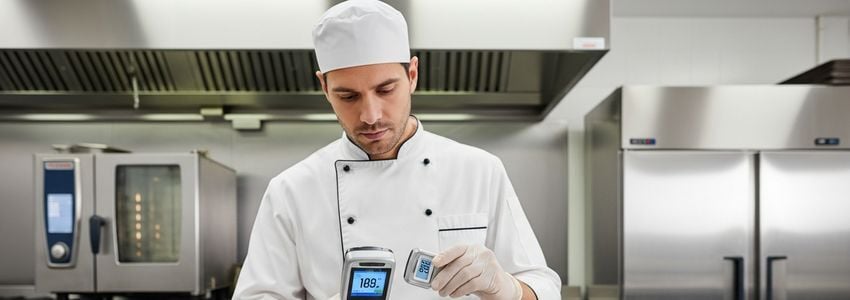
Accurate thermometers are a simple but non-negotiable tool. A well-equipped kitchen needs a variety of them, including calibrated food probes to check internal cooking temperatures, infrared thermometers for surface checks, and refrigerator/freezer thermometers to monitor storage units. Financing can help you invest in high-quality, reliable digital thermometers that provide precise readings essential for daily safety checks.
Ready to Finance Your Food Safety Equipment?
Ensure your restaurant meets the highest standards of safety and compliance. Get the capital you need for essential kitchen upgrades quickly and easily.
Apply NowHow Food Safety Equipment Financing Works
Navigating the process of food safety equipment financing for restaurants is typically more straightforward and faster than securing a traditional bank loan. Lenders specializing in equipment financing, like Crestmont Capital, have streamlined the process to help you get the necessary assets into your kitchen with minimal delay. Here is a step-by-step breakdown of how it generally works.
- Identify Your Equipment Needs and Get a Quote: The first step is to determine exactly what equipment you need. Research different brands and models to find the best fit for your kitchen's workflow and volume. Once you have selected the items, obtain a formal quote or invoice from the equipment vendor. This document will be essential for your financing application as it details the exact cost of the assets.
- Submit a Simple Application: The application process for equipment financing is designed for speed. You will typically fill out a one-page online form that asks for basic information about your business, such as its legal name, time in business, and estimated annual revenue. You will also need to submit the vendor's quote for the equipment you wish to finance.
- Underwriting and Approval: Once your application is submitted, the lender's underwriting team will review your business's financial health. This review is often less stringent than a bank's, focusing on factors like cash flow, time in business, and credit history. Because the equipment itself acts as collateral, the risk for the lender is reduced, which often leads to higher approval rates and faster decisions-sometimes within a few hours.
- Review and Sign the Financing Agreement: Upon approval, you will receive a financing agreement that outlines all the terms, including the total amount financed, the monthly payment, the interest rate, and the length of the term. It is crucial to review these documents carefully. Your dedicated financing advisor will walk you through the details and answer any questions to ensure you are comfortable with the agreement before you sign.
- Funding and Equipment Acquisition: After you sign the agreement, the lender handles the rest. Crestmont Capital will pay the equipment vendor directly on your behalf. The vendor then releases the equipment for shipment and delivery to your restaurant. This direct-funding process is efficient and eliminates the need for you to manage large cash transfers. You get your equipment, and your payment schedule begins as agreed upon.
This entire process, from application to funding, can often be completed in as little as 24 to 48 hours, a stark contrast to the weeks or even months it can take to secure a traditional bank loan. The focus is on getting your restaurant the tools it needs to operate safely and successfully without unnecessary bureaucratic delays.
Benefits of Financing Food Safety Equipment
Opting to finance your food safety equipment rather than purchasing it outright with cash offers a host of strategic advantages for restaurant owners. These benefits extend beyond simple cost management, impacting your operational efficiency, compliance, and overall financial health.
Preserve Working Capital and Maintain Liquidity
The most significant benefit of financing is the preservation of cash flow. High-quality commercial kitchen equipment comes with a substantial price tag. Paying for it all at once can drain your working capital, leaving you vulnerable to unexpected expenses or unable to invest in other growth opportunities like marketing or hiring. Financing converts a large, prohibitive capital expenditure into a predictable, manageable monthly operating expense, keeping your cash reserves free for day-to-day needs.
Ensure Health Code Compliance
Health departments have strict regulations regarding the type and condition of equipment used in commercial kitchens. Outdated or malfunctioning equipment can lead to failed inspections, fines, or even temporary closure. Financing allows you to acquire modern, compliant equipment immediately, ensuring you meet or exceed all local and federal food safety standards. This proactive approach protects your business from regulatory penalties and demonstrates a commitment to public health.
Improve Operational Efficiency and Consistency
Newer equipment is not just safer-it is also more efficient. Modern refrigerators hold temperatures more consistently, new dishwashers clean faster and more effectively, and advanced cooking technology can reduce preparation times. Upgrading your equipment through financing can lead to lower utility bills, reduced food spoilage, and improved workflow for your kitchen staff. This boost in efficiency translates directly to better service and a stronger bottom line.
Enhance Your Restaurant's Reputation
Customers are more aware of food safety than ever before. A clean, modern, and well-equipped kitchen is a sign of a professionally run establishment that prioritizes the well-being of its patrons. While customers may not see your walk-in cooler, the quality and safety of the food you serve are a direct reflection of your back-of-house operations. Investing in top-tier safety equipment helps build a reputation for quality and care, fostering customer trust and loyalty.
Potential Tax Advantages
Financing and leasing equipment can offer significant tax benefits. Under Section 179 of the IRS tax code, businesses may be able to deduct the full purchase price of qualifying new or used equipment in the year it is placed into service. Additionally, lease payments are often treated as operating expenses and can be fully deducted from your taxable income. These advantages can substantially lower the net cost of acquiring your equipment. (Note: It is essential to consult with a tax professional to understand the specific implications for your business).
Flexible and Predictable Budgeting
Equipment financing agreements come with fixed monthly payments over a set term. This predictability makes budgeting and financial forecasting much simpler. You know exactly how much you need to allocate each month, eliminating the financial uncertainty that comes with aging equipment prone to expensive, unexpected repairs. This stability is invaluable for managing the tight margins of the restaurant industry.
The Restaurant Industry: By the Numbers
Understanding the landscape helps you make smarter financing decisions.
1M+
There are over 1 million restaurant locations in the United States, creating a highly competitive market where efficiency is key. (Census.gov)
85%+
Approval rates for equipment financing often exceed 85% for established businesses, making it highly accessible.
24-84
Financing terms are flexible, typically ranging from 24 to 84 months to match your budget and cash flow needs.
Compliance is Crucial
Health regulations mandate specific equipment for temperature control and sanitation to prevent foodborne illness.
Types of Financing Options for Food Safety Equipment
When seeking food safety equipment financing for restaurants, you will encounter several different financial products. Each is structured differently and offers unique advantages depending on your business goals, from long-term ownership to minimizing monthly payments. Understanding these options will help you choose the best path forward for your establishment.
Equipment Finance Agreement (EFA)
An Equipment Finance Agreement, often called an equipment loan, is a straightforward financing option. Under an EFA, the lender provides the funds to purchase the equipment, and you make regular principal and interest payments over a fixed term. You are the owner of the equipment from day one, and the equipment serves as the collateral for the loan. Once you have made all the payments, you own the equipment free and clear. This is an excellent choice if you plan to use the equipment for its entire functional lifespan and want to build equity in your business assets.
$1 Buyout Lease
Also known as a capital lease, a $1 Buyout Lease functions very similarly to an equipment loan. You make regular lease payments for the duration of the term, and at the end, you have the option to purchase the equipment for a nominal amount-typically $1. Because ownership is virtually guaranteed, this structure is often treated as a purchase for tax purposes, allowing you to potentially take advantage of the Section 179 deduction. This is a popular option for restaurant owners who want the benefits of ownership with the structured payments of a lease.
Fair Market Value (FMV) Lease
An FMV lease, or operating lease, is a true rental agreement. You are paying to use the equipment for a specific period. Because you are not paying for the full value of the equipment, the monthly payments for an FMV lease are typically lower than those for an EFA or a $1 Buyout Lease. At the end of the lease term, you have several options: you can purchase the equipment for its fair market value, return the equipment to the lender, or renew the lease. This is an ideal solution for equipment that quickly becomes obsolete (like some technology-based monitoring systems) or if you prefer to have the lowest possible monthly payment and regularly upgrade to the latest models. Explore our equipment leasing options to learn more.
Working Capital Loans
While not strictly equipment financing, a small business loan for working capital can be used to purchase equipment. This type of loan provides a lump sum of cash that can be used for various business needs, including equipment acquisition. It offers more flexibility but may come with different terms and qualification requirements than a loan secured by the equipment itself. It can be a good option if you need to fund equipment alongside other expenses, like a small renovation or an increase in inventory.
How Crestmont Capital Helps Restaurant Owners
At Crestmont Capital, we understand that the restaurant industry operates on tight margins and demanding schedules. Our mission is to provide financial solutions that are as efficient and reliable as the equipment you need to finance. We specialize in helping restaurant owners navigate the complexities of funding, offering a partnership built on speed, flexibility, and industry expertise.
We recognize that one size does not fit all. Our team of financing specialists works directly with you to understand your specific needs, from the type of equipment you require to your unique cash flow situation. We then tailor a financing package that aligns perfectly with your business goals, whether that is a loan structured for ownership or a lease designed for low monthly payments. Our deep knowledge of the food service sector means we can provide insightful guidance on the best financial tools for your specific situation, from a small cafe to a large-scale catering operation.
Our application process is designed to be fast and hassle-free, allowing you to apply online in minutes. We pride ourselves on rapid credit decisions, often providing approvals in just a few hours. This speed ensures that you can move quickly to acquire equipment, whether you are responding to an unexpected breakdown or seizing a growth opportunity. With Crestmont Capital, you gain a dedicated financial partner committed to supporting the safety, compliance, and success of your restaurant. Our specialized restaurant equipment financing programs are built to serve you.
Upgrade Your Kitchen with Confidence
Don't let capital constraints compromise your food safety standards. We provide fast, flexible financing solutions tailored for restaurants.
See Your Financing OptionsReal-World Scenarios - How Restaurants Use Financing
To better understand the practical application of food safety equipment financing for restaurants, let's explore a few common scenarios that business owners face.
Scenario 1: The New Fine-Dining Establishment
The Challenge: A chef is opening a new upscale restaurant and needs to equip the kitchen from scratch. The centerpiece of their HACCP plan is a high-end blast chiller and a vacuum sealer for sous-vide cooking, a combined cost of $45,000. This is a significant upfront expense on top of all the other startup costs.
The Solution: The chef uses an equipment finance agreement to fund the entire equipment package. By financing, they preserve their initial operating capital for inventory, staffing, and marketing for the grand opening. They secure a 60-month term with predictable monthly payments, allowing them to install the best possible equipment for food safety and quality from day one without compromising their cash position.
Scenario 2: The Established Pizzeria's Compliance Upgrade
The Challenge: A family-owned pizzeria has been using the same walk-in cooler for 20 years. It is becoming unreliable, and a recent health inspection noted fluctuating temperatures. The health department has given them 30 days to replace the unit to avoid fines.
The Solution: The owner needs to act fast. They get a quote for a new, energy-efficient walk-in cooler for $25,000. They apply for financing with Crestmont Capital and are approved the same day. The lender pays the vendor directly, and the new cooler is installed within a week, long before the health department's deadline. The financing prevents a major disruption to their business and ensures they remain compliant.
Scenario 3: The Expanding Coffee Shop Chain
The Challenge: A coffee shop with three locations is expanding to two new cities. The owner wants to standardize their equipment across all five locations to ensure consistent quality and safety, focusing on new under-counter refrigerators and high-temperature dishwashers for sanitizing mugs and utensils.
The Solution: The owner bundles the equipment for both new locations into a single $75,000 financing package. They opt for an FMV lease to keep monthly payments low across their growing enterprise. This strategy allows them to outfit the new cafes with top-of-the-line equipment while maintaining healthy cash flow for the other expenses associated with a multi-location expansion.
Scenario 4: The Local Bakery's Technology Update
The Challenge: A successful bakery wants to improve its quality control and documentation process. They decide to invest in an automated temperature monitoring system for their proofers and refrigerators, which costs $15,000 including installation and software subscriptions.
The Solution: The bakery owner uses a bakery equipment financing plan to acquire the system. Because the technology may evolve, they choose a 36-month FMV lease. This gives them access to the latest safety technology with a low monthly payment and the flexibility to upgrade to a newer system when the lease ends, ensuring they always have the best tools for compliance and quality assurance.
How to Qualify for Food Safety Equipment Financing
Qualifying for food safety equipment financing is often more accessible than qualifying for a traditional bank loan. Lenders in this space place a strong emphasis on the overall health of your business and the value of the asset being financed. While specific requirements vary by lender, here are the general criteria you can expect.
- Time in Business: Most lenders prefer to work with businesses that have been in operation for a certain period, typically at least six months to two years. An established operational history demonstrates stability and a track record of generating revenue. However, specialized programs are often available for startups, especially if the owner has strong personal credit and industry experience.
- Business and Personal Credit Score: Your credit history is a key factor. Lenders will look at both your business credit profile and your personal credit score. While a high score is beneficial, a perfect score is not always necessary. Many alternative lenders, like Crestmont Capital, can work with a wide range of credit profiles, including those that may not meet the strict requirements of a traditional bank.
- Annual Revenue: Lenders will want to see that your restaurant generates sufficient revenue to comfortably handle the new monthly payment. They will typically look at your recent bank statements to verify cash flow and assess the financial health of your business. Having consistent monthly deposits is a strong positive indicator.
- Required Documentation: The application process is typically streamlined. You will usually need to provide the following:
- A completed application form.
- An official quote or invoice from the equipment vendor.
- Your last three to six months of business bank statements.
- For larger financing amounts, you may be asked for additional financial documents like tax returns or a profit and loss statement.
Because the equipment serves as collateral, the qualification criteria can be more flexible. The lender has a tangible asset to secure the loan, which reduces their risk and increases your chances of approval, even if your business is relatively new or your credit is not perfect.
Comparison Table - Financing Options
Choosing the right financing structure is crucial. This table breaks down the key differences between the most common options for food safety equipment financing.
| Feature | Equipment Finance Agreement (Loan) | $1 Buyout Lease | Fair Market Value (FMV) Lease |
|---|---|---|---|
| Ownership | You own the equipment from the start. | You own the equipment after the final $1 payment. | The lender owns the equipment. You are renting it. |
| Monthly Payment | Typically higher, as you are paying off the full value plus interest. | Similar to a loan payment, covering the full equipment cost. | Lowest monthly payment, as you only pay for the equipment's depreciation during the term. |
| End-of-Term Option | You own the equipment free and clear. | Pay $1 and you officially own the equipment. | Return the equipment, renew the lease, or purchase it for its Fair Market Value. |
| Tax Benefits | Potential for Section 179 deduction and depreciation. | Often qualifies for Section 179 deduction as a capital expense. | Lease payments may be fully deductible as an operating expense. |
| Best For | Restaurants that want to own equipment with a long useful life and build equity. | Businesses that want guaranteed ownership with the payment structure of a lease. | Restaurants wanting the lowest payments and the ability to upgrade equipment frequently. |
Frequently Asked Questions
1. What is the minimum amount I can finance for food safety equipment?
Most financing companies have a minimum transaction amount, which typically starts around $5,000. However, this can vary. At Crestmont Capital, we work to accommodate a wide range of needs, so it is always best to discuss your specific equipment costs with one of our financing specialists.
2. Can I finance used or refurbished food safety equipment?
Yes, absolutely. Financing is available for both new and used equipment. This can be a great way to save money, especially if you are purchasing from a reputable dealer that offers a warranty on their refurbished items. The financing terms may sometimes differ slightly for used equipment compared to new.
3. How long does the entire financing process take?
The process is designed for speed. After submitting a simple online application, you can often receive a credit decision within a few hours. Once you approve the terms and sign the documents, funding can occur in as little as 24 hours. The entire process from application to the vendor being paid is typically completed in 1-3 business days.
4. Will applying for equipment financing affect my personal credit score?
Most business financing applications will involve a credit check. For sole proprietorships or new businesses, this may include a look at the owner's personal credit. While the initial inquiry (a "soft pull") may not affect your score, a "hard pull" will be conducted once you decide to move forward with an offer, which can have a small, temporary impact on your score.
5. Do I need a down payment to finance my equipment?
Many equipment financing programs do not require a significant down payment. It is common to see financing that covers 100% of the equipment cost. In some cases, particularly for startups or businesses with challenged credit, a lender may ask for one or two advance payments or a small down payment to lower the risk.
6. Can a startup restaurant qualify for food safety equipment financing?
Yes, startups can qualify. While lenders prefer an established business history, many have specific programs for new businesses. Approval for startups often relies more heavily on the owner's personal credit score, a solid business plan, and sometimes a slightly larger down payment. Lenders like Crestmont Capital are experienced in funding new ventures.
7. Can I bundle multiple pieces of equipment from different vendors into one financing agreement?
Yes, this is a common and efficient practice. You can bundle multiple pieces of equipment, even from different suppliers, into a single financing agreement. This simplifies the process, leaving you with one application and one convenient monthly payment for all your new assets.
8. What happens if the financed equipment breaks down or needs repairs?
You are responsible for the maintenance and repair of the equipment, just as you would be if you paid cash for it. The manufacturer's warranty will still apply to new equipment. It is always a good idea to understand the warranty terms before purchasing and consider a maintenance plan for critical assets.
9. Are there penalties for paying off my equipment loan early?
This depends on the specific terms of your financing agreement. Some loans may have prepayment penalties, while others do not. It is an important question to ask your financing advisor when you are reviewing the terms of your offer. Crestmont Capital is transparent about all terms, including prepayment options.
10. How is my interest rate or factor rate determined?
Your rate is determined by several factors, including your personal and business credit scores, your time in business, your annual revenue and cash flow, the type and cost of the equipment, and the length of the financing term you choose. A stronger financial profile will generally result in a more favorable rate.
11. What is Section 179 and how does it relate to equipment financing?
Section 179 of the IRS tax code allows businesses to deduct the full purchase price of qualifying equipment during the tax year it was placed into service. This is an incentive created by the U.S. government to encourage businesses to invest in themselves. Both equipment loans and capital leases (like a $1 Buyout) often qualify for this powerful deduction. Always consult with your tax advisor for details specific to your business.
12. Can I finance soft costs like installation, shipping, and training?
Yes, many lenders allow you to roll these "soft costs" into your total financing package. This is a major advantage, as it allows you to finance the total cost of making the equipment operational, not just the sticker price. This can include delivery fees, installation charges, and initial staff training costs.
13. What is the difference between a loan and a lease?
The primary difference is ownership. With a loan (or EFA), you are the owner from the start. With a true lease (like an FMV lease), the lender owns the equipment and you pay to use it. A capital lease (like a $1 Buyout) is a hybrid that functions like a loan but is structured as a lease, with ownership transferring to you at the end for a nominal fee.
14. Why should I choose a specialty lender like Crestmont Capital over my local bank?
Specialty lenders like Crestmont Capital offer several advantages over traditional banks for equipment financing. We have a deeper understanding of the restaurant industry, a much faster and simpler application process, higher approval rates, and more flexible qualification criteria. Banks often have a lengthy, document-heavy process and may be less willing to finance single assets or work with small businesses. For more information, check out our dedicated restaurant business loans page.
15. What happens at the end of an FMV lease term?
At the end of a Fair Market Value (FMV) lease, you have three primary options. You can (1) purchase the equipment for its current fair market value, (2) return the equipment to the lender with no further obligation, or (3) renew the lease, often at a lower monthly payment. This flexibility is a key benefit of an FMV lease.
How to Get Started
Securing financing for your essential food safety equipment is a straightforward process. Follow these simple steps to get the capital you need to protect your customers and your business.
Identify Your Equipment Needs
Determine the specific pieces of food safety equipment your restaurant requires. Research models, features, and vendors to find the best fit for your operational needs and budget.
Request a Vendor Quote
Once you have selected your equipment, obtain a formal quote or invoice from the supplier. This document is necessary for the financing application as it specifies the exact cost to be financed.
Complete Our Simple Application
Fill out Crestmont Capital's secure, one-page online application. It takes just a few minutes and requires only basic information about you and your business. Upload your equipment quote along with the application.
Review Your Approval and Terms
You will receive a credit decision quickly, often within hours. A dedicated financing advisor will contact you to discuss your approval and walk you through the specific terms of your financing agreement.
Receive Your Equipment
After you sign the financing documents, we handle the rest. We pay your vendor directly, and they will arrange for the delivery and installation of your new food safety equipment. You can put your new assets to work immediately.
Protect Your Business and Your Customers
Take the first step toward a safer, more compliant kitchen. Our simple application takes less than 5 minutes to complete.
Apply for Financing TodayConclusion
In the highly regulated and competitive restaurant world, investing in proper food safety equipment is non-negotiable. It is the bedrock of compliance, operational efficiency, and customer trust. However, the high cost of this essential equipment can present a significant barrier for many business owners. Food safety equipment financing for restaurants provides a powerful and strategic solution, transforming a daunting capital expenditure into a manageable and predictable operational expense.
By preserving your cash flow, financing empowers you to acquire the best tools for the job without sacrificing liquidity needed for daily operations and growth. From advanced refrigeration and HACCP monitoring systems to high-performance sanitation stations, financing makes a state-of-the-art, compliant kitchen accessible to restaurants of all sizes. It is an investment not just in machinery, but in the long-term health, reputation, and success of your business. By partnering with a dedicated lender like Crestmont Capital, you can navigate the process with confidence and secure the assets you need to thrive.
Disclaimer: The information provided in this article is for general educational purposes only and is not financial, legal, or tax advice. Funding terms, qualifications, and product availability may vary and are subject to change without notice. Crestmont Capital does not guarantee approval, rates, or specific outcomes. For personalized information about your business funding options, contact our team directly.








