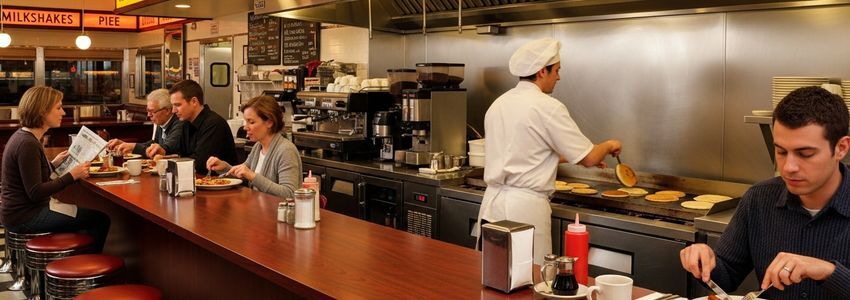
Running a diner is one of the most rewarding ventures in the American food service industry. From the sizzle of the griddle at breakfast to the late-night rush on weekends, diners occupy a special place in the hearts of communities across the country. But keeping that operation humming requires real capital - for equipment upgrades, staffing, renovations, and the unexpected costs that come with any food business. That is where diner business loans come in.
Whether you are opening your first diner, expanding a beloved local spot, or simply trying to smooth out seasonal cash flow, financing options exist to meet your needs. This guide covers everything diner owners need to know about business loans - from qualification requirements and loan types to application tips and how Crestmont Capital can help you secure fast, flexible funding.
In This Article
What Is a Diner Business Loan?
A diner business loan is any type of commercial financing used to fund operations, expansion, equipment, or working capital needs of a diner or short-order restaurant. These loans function similarly to standard small business loans but are tailored to the specific cash flow patterns, asset base, and growth cycles of food service businesses.
Diners often operate on thin margins with high fixed costs - rent, labor, food inventory, and utilities all must be paid regardless of how many customers walk through the door on a given week. A business loan helps bridge those gaps and gives diner owners the capital to invest in growth rather than simply survive month to month.
Diner loans can be structured as term loans, revolving credit lines, equipment financing, or merchant cash advances, depending on the use case and the owner's credit profile. They are available from banks, credit unions, SBA-approved lenders, and alternative online lenders like Crestmont Capital.
Industry Context: According to the National Restaurant Association, over one million restaurant locations operate in the United States, generating more than $997 billion in annual sales. Diners and short-order restaurants represent a significant portion of this sector, serving millions of Americans daily.
Why Diners Need Financing: The Real Costs of Running a Diner
Diner owners face a unique financial landscape. Unlike tech startups or professional service firms, diners require constant reinvestment in physical assets - commercial grills, refrigerators, deep fryers, dishwashers, and Point of Sale systems all have limited lifespans. When one breaks down, the diner can lose hundreds or thousands of dollars in revenue every day it is offline.
Beyond equipment, the modern diner must invest in staff training and retention, food safety compliance, marketing, and - increasingly - digital ordering systems and delivery integrations. These investments are critical to staying competitive but require capital that many small diner operators simply do not have on hand.
Common Reasons Diner Owners Seek Loans
- Equipment replacement or upgrade: Commercial grills, walk-in coolers, espresso machines, and dishwashers can cost $5,000 to $50,000 or more per unit
- Renovation and remodeling: Refreshing the look of an aging diner to attract new customers and retain regulars
- Working capital: Covering payroll, food costs, and utilities during slow seasons or unexpected revenue dips
- Expansion: Opening a second location or adding seating capacity to an existing diner
- Marketing and technology: Investing in a new POS system, loyalty program, or social media advertising
- Inventory purchasing: Stocking up on food inventory before a busy season at favorable wholesale prices
- Lease improvements: Making tenant improvements when signing a new lease on a better location
- Emergency repairs: Fixing a broken HVAC system, roof leak, or plumbing issue that cannot wait
Ready to Fund Your Diner's Next Chapter?
Get fast, flexible financing built for food service businesses. Apply in minutes with no obligation.
Apply Now →Types of Loans Available for Diner Owners
There is no single "diner loan" product - instead, diner owners can access a range of financing tools, each suited to different needs and financial situations. Understanding the options available helps you match the right loan to the right use case.
1. Working Capital Loans
A working capital loan provides fast, flexible cash to cover day-to-day operating expenses. These loans are ideal for diner owners who need to bridge a temporary cash flow gap - such as a slow January following the holiday season, or a period of repair-related closures. Repayment terms typically range from 3 to 24 months, and funding can arrive in as little as 24 to 48 hours with an online lender like Crestmont Capital.
2. Equipment Financing
Equipment financing is purpose-built for purchasing commercial kitchen equipment. The equipment itself serves as collateral, which often makes approval easier and rates more competitive than unsecured loans. Diner owners can use equipment financing for commercial refrigerators, flat-top grills, ovens, exhaust hoods, dishwashers, and point-of-sale terminals. Loan terms typically run 2 to 7 years, aligned with the useful life of the equipment.
3. Business Line of Credit
A business line of credit gives diner owners revolving access to capital up to a set limit. Draw what you need, repay it, and draw again. This flexible structure is ideal for managing the irregular cash flows common in the restaurant industry, covering inventory purchases, or handling unexpected repair costs without taking out a new loan each time.
4. SBA Loans
SBA loans - particularly the SBA 7(a) program - offer some of the most competitive rates and longest repayment terms available to small business owners. A diner that qualifies for an SBA 7(a) loan can borrow up to $5 million with repayment terms up to 10 years for working capital or 25 years for real estate. The trade-off is a longer approval process, typically 30 to 90 days, and more stringent documentation requirements.
5. Merchant Cash Advance (MCA)
A merchant cash advance provides an upfront lump sum in exchange for a percentage of future credit and debit card sales. Because repayment scales with daily revenue, MCAs are attractive to diners with strong card transaction volume but inconsistent monthly revenue. However, the effective cost of an MCA - expressed as a factor rate rather than an APR - is typically higher than other loan types.
6. Restaurant Equipment Leasing
Equipment leasing allows diner owners to use commercial kitchen equipment without purchasing it outright. Lease payments are typically lower than loan payments for equivalent equipment, and at the end of the lease term you can upgrade to newer equipment - keeping your diner competitive without large capital outlays.
How Diner Business Loans Work
Understanding the mechanics of a diner business loan helps you prepare a strong application and set realistic expectations for the funding process.
Quick Guide
How Diner Business Loans Work - At a Glance
Complete a short application with basic business and financial information. Most online lenders require just 5 to 10 minutes to fill out the initial form.
Provide bank statements, tax returns, and proof of ownership. SBA loans require more documentation; working capital loans often need just 3 months of bank statements.
The lender reviews your file and presents loan terms including loan amount, interest rate, repayment schedule, and any fees. Review everything carefully before accepting.
Upon accepting the offer and signing documents, funds are typically deposited directly into your business bank account - often within 24 to 72 hours with alternative lenders.
Diner Industry - Key Statistics
By the Numbers
Diner Business Loans - Key Statistics
$997B
U.S. restaurant industry annual sales (National Restaurant Association)
~1M
Restaurant locations operating in the U.S. today
3-9%
Typical net profit margin range for full-service diners
24-48h
Typical funding time with alternative lenders like Crestmont Capital
How to Qualify for a Diner Business Loan
Lender requirements vary significantly depending on the loan type and the lender's risk appetite. That said, most diner business loans involve the following qualification criteria:
Credit Score
Your personal credit score plays a major role in loan approval, especially for newer businesses without an established business credit history. Most traditional banks and SBA lenders require a minimum credit score of 650 to 680. Alternative lenders and online platforms like Crestmont Capital often approve applicants with scores as low as 550 to 600, depending on other factors. If your credit score needs work, check out our guide on building your business credit score.
Time in Business
Most lenders prefer at least 6 to 12 months of operating history, though some require 2 years. Brand-new diners may qualify for startup financing programs, SBA microloan programs, or equipment financing backed by the equipment's value rather than business revenue history.
Annual Revenue
Lenders use your monthly and annual revenue to determine how much you can afford to borrow and repay. Many alternative lenders require a minimum of $8,000 to $10,000 per month in gross revenue. Higher-revenue diners typically qualify for larger loan amounts and more favorable rates.
Documentation Typically Required
- 3 to 6 months of business bank statements
- Business and personal tax returns (1 to 2 years)
- Business license and proof of ownership
- Profit and loss statement
- Accounts receivable/payable schedule (for larger loans)
- Lease agreement (if applicable)
Pro Tip: Diners that use modern POS systems (like Toast, Square, or Clover) often have access to detailed revenue and transaction data that makes the documentation process faster. Some lenders can pull this data directly, speeding up approval significantly.
How Crestmont Capital Helps Diner Owners
Crestmont Capital is one of the nation's leading small business lenders, with a specific focus on helping food service businesses like diners access the capital they need - fast. Unlike traditional banks that may take weeks or months to process a loan application, Crestmont Capital can often provide funding decisions within hours and transfer funds within 24 to 48 hours.
Our team understands the unique challenges diner owners face: tight margins, equipment-heavy operations, seasonal fluctuations, and the constant pressure to stay competitive in a crowded market. We offer a suite of financing solutions designed specifically to address these needs.
Why Diner Owners Choose Crestmont Capital
- Flexible loan amounts: From $10,000 for a small equipment purchase to $500,000 or more for a major expansion
- Fast approvals: Most applications reviewed within hours, with funding in 24 to 48 hours
- Minimal paperwork: Our streamlined process requires far less documentation than traditional bank loans
- Multiple product types: Working capital loans, equipment financing, lines of credit, and more
- Bad credit options: We work with diner owners who have less-than-perfect credit scores
- Dedicated advisors: Speak with a specialist who understands food service financing, not just a generic loan officer
Whether you need restaurant equipment financing for a new commercial kitchen setup or a working capital loan to bridge a slow month, Crestmont Capital has a solution tailored to your situation.
Crestmont Capital - Rated #1 Business Lender
Fast funding, flexible terms, and a team that understands the restaurant industry. Get your free quote today.
Get My Free Quote →Real-World Scenarios: How Diners Use Business Loans
To bring this to life, here are six realistic scenarios showing how diner business loans create tangible results for restaurant owners across the country.
Scenario 1: Replacing a Broken Commercial Refrigerator
Maria runs a family diner in suburban Ohio. Her walk-in refrigerator failed on a Monday morning, threatening thousands of dollars in food inventory and forcing her to cancel the week's specials. With equipment financing from Crestmont Capital, she secured $22,000 within 48 hours, replaced the refrigerator the next day, and was back to full operations by Wednesday. The loan was repaid over 36 months, with payments structured to align with her peak revenue days.
Scenario 2: Expanding the Dining Room
James owns a popular breakfast diner in Nashville, Tennessee. He had a consistent 45-minute wait for weekend tables but could not accommodate the demand in his current 1,800 square-foot space. Using a $65,000 term loan from Crestmont Capital, he expanded into the adjacent vacant unit, adding 18 tables and increasing his weekend revenue by 40% within three months of reopening.
Scenario 3: Surviving a Slow January
Lisa's diner in coastal Maine generates strong summer revenue from tourist traffic but faces a sharp drop in January and February. Each year, payroll and rent come due even when customer counts are down 60%. A $30,000 working capital line of credit from Crestmont Capital allows her to draw funds in January and repay them from summer revenue - eliminating the annual stress cycle that had threatened to force her to close.
Scenario 4: Upgrading to a Modern POS System
David runs three diners in the Dallas-Fort Worth area. His legacy cash register system was causing order errors and slowing table turns during peak hours. He used a $15,000 business loan to install an integrated POS and digital ordering system, which reduced order errors by 30% and cut average table turn time from 42 to 34 minutes - a meaningful improvement that increased daily covers by an estimated 15%.
Scenario 5: Opening a Second Location
Grace's diner in Phoenix has been the neighborhood's favorite for breakfast and lunch for 12 years. When a second location became available on the other side of town, she needed $120,000 for build-out, equipment, and three months of operating capital. Crestmont Capital provided an SBA-backed loan with a 10-year repayment term, keeping monthly payments manageable while Grace focused on training the new team and building a customer base.
Scenario 6: Weathering a Health Inspection Closure
Mike's diner in Chicago received a temporary closure notice from the health department due to a rodent issue traced to a gap in the building's foundation. He needed $8,000 for pest remediation and structural repairs fast. A working capital loan from Crestmont Capital was funded within 24 hours, allowing Mike to complete the repairs, pass re-inspection, and reopen within four days - minimizing the revenue loss and reputational damage from a longer closure.
Comparing Diner Loan Options: A Quick Reference
| Loan Type | Best For | Funding Speed | Typical Terms |
|---|---|---|---|
| Working Capital Loan | Cash flow gaps, payroll, inventory | 24-48 hours | 3-24 months |
| Equipment Financing | Purchasing kitchen equipment | 2-5 days | 2-7 years |
| Business Line of Credit | Recurring needs, flexibility | 1-5 days | Revolving |
| SBA 7(a) Loan | Large purchases, expansion | 30-90 days | Up to 10-25 years |
| Merchant Cash Advance | High card-volume diners, fast cash | 24 hours | Varies with revenue |
Frequently Asked Questions
How much can a diner owner borrow with a business loan?
Loan amounts for diner owners typically range from $5,000 to $500,000 or more, depending on your revenue, creditworthiness, time in business, and the loan type. Working capital loans from alternative lenders often start at $10,000, while SBA loans can reach $5 million. Your lender will assess your financials and determine the maximum amount you qualify for based on your debt service coverage ratio and monthly cash flow.
What credit score do I need to get a diner business loan?
Credit score requirements vary by lender and loan type. Traditional banks and SBA lenders typically require a personal credit score of 650 or higher. Alternative lenders like Crestmont Capital work with scores as low as 550, focusing more on your business revenue and cash flow than your credit score alone. If your score is below 600, you may still qualify for short-term working capital loans or merchant cash advances.
How fast can I get a diner business loan?
Speed depends on the lender and loan type. Alternative lenders like Crestmont Capital can often provide same-day or next-day approval decisions and transfer funds within 24 to 48 hours of signing. SBA loans take significantly longer - typically 30 to 90 days from application to funding due to the government guarantee process. Equipment financing from a specialty lender typically falls in between, at 2 to 5 business days.
Can I get a diner loan with bad credit?
Yes. Several financing products are available to diner owners with less-than-perfect credit. Merchant cash advances focus primarily on your monthly credit card volume rather than credit scores. Equipment financing uses the equipment as collateral, reducing credit risk. Some alternative lenders specifically target underserved borrowers with higher approval rates. You may pay a higher rate than prime borrowers, but funding is achievable even with credit scores in the 550 to 600 range.
What documents do I need to apply for a diner business loan?
Basic documentation typically includes 3 to 6 months of business bank statements, your last 1 to 2 years of personal and business tax returns, a copy of your business license, and proof of ownership. Larger loans may also require profit and loss statements, a balance sheet, your lease agreement, and a business plan. Alternative lenders like Crestmont Capital typically require less paperwork than traditional banks.
Can I use a diner business loan for payroll?
Yes. Working capital loans and business lines of credit can be used to cover payroll during slow periods. This is one of the most common uses for short-term business financing among restaurant owners. Keeping your staff paid during a slow January or after an unexpected closure is critical for retaining experienced employees who might otherwise find work elsewhere.
What interest rates should I expect on a diner business loan?
Interest rates vary significantly based on loan type, lender, credit score, and business financials. SBA 7(a) loans typically range from 11% to 15% APR. Equipment financing rates often run 6% to 12% APR. Working capital loans from alternative lenders typically carry rates from 15% to 45% APR due to the higher risk and shorter terms involved. Merchant cash advances are priced using factor rates (typically 1.15 to 1.45) rather than traditional interest rates, making direct comparison difficult.
Do I need collateral to get a diner business loan?
Not always. Equipment financing uses the financed equipment itself as collateral, so no additional assets are required. Working capital loans from alternative lenders are often unsecured, meaning they require no collateral pledge beyond a personal guarantee. SBA loans and bank term loans may require business assets, real estate equity, or a personal guarantee depending on loan size and the lender's requirements.
How does seasonal cash flow affect my diner loan options?
Seasonal cash flow is very common in the diner industry, especially for locations in tourist areas or colder climates. Lenders who work with restaurant businesses understand this pattern and often offer flexible repayment structures that account for seasonal dips. A business line of credit is particularly well-suited for seasonal operators because you can draw funds during slow months and repay during peak season without paying interest on unused credit.
Can a new diner with no operating history get a loan?
Startup diners face more limited options but are not without resources. SBA microloan programs provide up to $50,000 for startups and early-stage businesses. Equipment financing is often available for new diners because the equipment itself serves as collateral. Some lenders also consider restaurant industry experience - if you have 10 years of experience as a chef or general manager, that may offset the lack of business history. A strong business plan and adequate personal credit will also help your cause.
What is the difference between a term loan and a line of credit for a diner?
A term loan provides a lump sum upfront that you repay over a fixed period with regular payments. It is best for one-time, known expenses like a renovation or large equipment purchase. A line of credit provides revolving access to a set amount of capital that you can draw, repay, and draw again. It is best for ongoing or unpredictable expenses, such as seasonal cash flow management or recurring inventory purchases. Many diner owners benefit from having both available.
How does equipment financing work for diner kitchen equipment?
With equipment financing, the lender pays for the equipment directly and you repay the loan over a set term, typically 2 to 7 years. The commercial kitchen equipment serves as collateral for the loan, which often means better rates and easier approval than unsecured loans. You own the equipment at the end of the repayment period. Equipment leasing works similarly but you return or upgrade the equipment at the end of the lease rather than taking ownership.
Can I use a diner business loan to open a second location?
Yes. Expansion loans are available for diner owners looking to open a second location. A combination of products is often used: an SBA 7(a) loan for the long-term build-out and equipment, and a working capital loan for initial operating costs and inventory. Lenders will evaluate your existing diner's performance, your personal credit, and your projected financials for the new location before approving an expansion loan.
What happens if my diner has trouble repaying a business loan?
If you anticipate difficulty making payments, contact your lender immediately. Many lenders offer deferment, restructuring, or modified repayment plans for borrowers who communicate proactively. Defaulting without communication results in collections activity, damage to your credit score, and potential seizure of collateral. Crestmont Capital works with clients to find workable solutions rather than immediately escalating to collections - but early communication is essential.
Is Crestmont Capital a good option for diner business loans?
Yes. Crestmont Capital specializes in small business financing, including loans for food service businesses like diners. We offer working capital loans, equipment financing, business lines of credit, and SBA-backed products with fast approvals and minimal paperwork. Our team understands the unique cash flow challenges diners face, and we structure financing solutions accordingly. You can apply online in minutes and receive a decision often the same day.
How to Get Started
Complete our quick application at offers.crestmontcapital.com/apply-now - it takes just a few minutes and requires no commitment.
A Crestmont Capital advisor will review your diner's financials and match you with the right financing product for your specific needs and goals.
Receive your funds and put them to work - replacing equipment, covering payroll, expanding your space, or whatever your diner needs most. Funding often arrives within 24 to 48 hours of approval.
Your Diner Deserves the Best Financing
Apply today and see how much your diner qualifies for. No obligation, no hard credit pull at application.
Apply Now →Conclusion
Diner business loans are one of the most powerful tools available to food service entrepreneurs. Whether you need to replace aging equipment, hire additional staff, renovate your dining room, or simply bridge a slow month, the right financing product can make the difference between staying open and falling behind.
The key is matching the right loan type to your specific need - using equipment financing for large kitchen purchases, working capital loans for operational cash flow, and lines of credit for ongoing flexibility. Understanding qualification requirements, gathering documentation in advance, and working with a lender who understands the restaurant industry can significantly improve your approval odds and the terms you receive.
Crestmont Capital is here to help diner owners across the United States access fast, flexible capital with minimal hassle. With approval decisions often within hours and funding in 24 to 48 hours, we make it easy for busy diner operators to get the financing they need and get back to doing what they do best - feeding their communities.
Ready to take the next step? Apply for a diner business loan today and see how Crestmont Capital can help your restaurant reach its full potential.
Disclaimer: The information provided in this article is for general educational purposes only and is not financial, legal, or tax advice. Funding terms, qualifications, and product availability may vary and are subject to change without notice. Crestmont Capital does not guarantee approval, rates, or specific outcomes. For personalized information about your business funding options, contact our team directly.