
 (800) 949-0401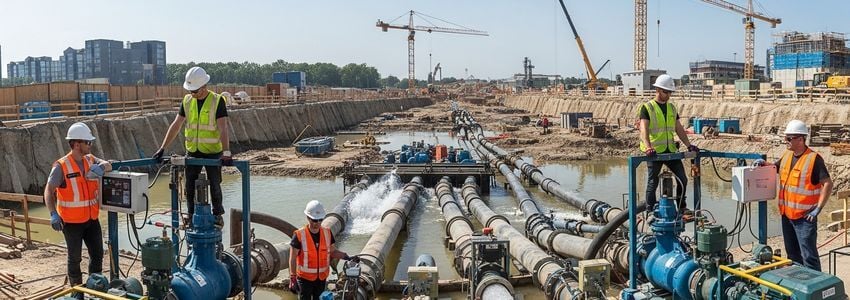
Dewatering Contractor Business Loans: The Complete Financing Guide
As a dewatering contractor, your business is the unseen foundation of major construction, mining, and municipal projects, ensuring stability by controlling groundwater. This critical role requires significant investment in powerful, specialized equipment and the working capital to manage large-scale jobs. Securing the right dewatering contractor business loans is not just an option-it's a fundamental component of your company's growth, stability, and ability to seize profitable opportunities in a competitive market.In This Article
What Is Dewatering and How Does Financing Help?
Dewatering is the process of removing groundwater or surface water from a specific area, typically a construction site, mine, or excavation pit. This is not simply pumping out a puddle; it is a highly technical engineering discipline crucial for creating a safe, dry, and stable environment for subsequent work. Without effective dewatering, foundations could fail, trenches could collapse, and entire projects could be jeopardized. The business model for a dewatering contractor involves providing these specialized services to general contractors, land developers, municipalities, and industrial clients. Projects can range from short-term trench dewatering for a utility installation to long-term, complex groundwater control for a deep foundation or tunnel. **Common Dewatering Techniques Include:** * **Wellpoint Systems:** A series of small-diameter wells are installed around the excavation site and connected to a header pipe. A vacuum pump then draws water from the ground, lowering the water table across a wide area. * **Deep Well Systems:** Larger, deeper wells with submersible pumps are used for significant drawdowns or when dealing with less permeable soil. * **Sump Pumping:** The most basic method, involving collecting water in a low-lying area (a sump) and pumping it out. It is best suited for managing surface water or minor seepage. * **Ejector (Eductor) Well Systems:** These use a high-pressure water jet to create a vacuum, drawing groundwater up. They are effective in low-permeability soils where wellpoints might struggle. **Why Financing is Essential for Dewatering Contractors** The dewatering industry is exceptionally capital-intensive. The barrier to entry and the cost of expansion are significant, making strategic financing a cornerstone of a successful operation. Here’s why: 1. **High Equipment Costs:** A single high-capacity centrifugal or submersible pump can cost tens of thousands of dollars. A complete wellpoint system, including pumps, wellpoints, header pipes, and generators, can easily exceed $250,000 to $500,000. Building a fleet capable of handling multiple large projects requires millions in capital investment. 2. **Long Payment Cycles:** As a subcontractor, you often face extended payment terms from general contractors. It is not uncommon to wait 60, 90, or even 120 days for an invoice to be paid. During this time, you still have to cover payroll, fuel, insurance, and maintenance costs. Financing provides the necessary cash flow to bridge these gaps. 3. **Mobilization and Demobilization Costs:** Before a project even begins, you incur substantial costs for transporting heavy equipment, setting up systems, and preparing the site. These upfront expenses must be paid long before the first project payment arrives. 4. **Payroll for Skilled Labor:** Operating sophisticated dewatering systems requires a skilled crew of operators, technicians, and supervisors. Consistent, on-time payroll is non-negotiable for retaining top talent, and financing ensures you can meet this obligation regardless of client payment schedules. 5. **Growth and Expansion:** When a major opportunity arises-like a large infrastructure project or a new industrial client-you need to act fast. Having access to capital allows you to acquire the necessary equipment and hire the crew to take on bigger, more profitable jobs without hesitation. In short, dewatering contractor business loans are the engine that powers your operations. They transform capital-intensive challenges into manageable investments, enabling you to build a powerful equipment fleet, maintain healthy cash flow, and scale your business effectively.Types of Financing for Dewatering Contractors
No two dewatering businesses are exactly alike, and neither are their financing needs. A contractor needing a single replacement pump has different requirements than one bidding on a multi-year tunnel project. Understanding the various financing options available is the first step toward securing the right capital for your specific situation. **Equipment Financing and Leasing** This is the most common and critical type of financing for dewatering contractors. It is used specifically to purchase or lease new or used equipment. * **How it Works:** You secure a loan for the total cost of the equipment. The equipment itself serves as the collateral for the loan, which often means less stringent credit requirements and no need to pledge other business or personal assets. * **Best For:** Acquiring high-cost assets like wellpoint systems, submersible pumps, centrifugal pumps, generators, HDPE pipes, and monitoring technology. * **Key Benefits:** Allows you to preserve working capital for other needs, offers predictable monthly payments, and may provide significant tax advantages through Section 179 deductions, which allow you to deduct the full purchase price of qualifying equipment in the year it's placed in service. **Working Capital Loans** These are short-term loans designed to cover everyday operational expenses and smooth out cash flow. * **How it Works:** You receive a lump sum of cash that you can use for any business purpose. Repayment is typically made over a shorter term, often from 6 to 24 months, with fixed regular payments. * **Best For:** Covering payroll during a slow payment period, paying for fuel and maintenance, purchasing consumable supplies, or covering upfront mobilization costs for a new project. * **Key Benefits:** Fast funding (often within 24-48 hours), flexible use of funds, and a straightforward application process. They are essential for navigating the unpredictable cash flow cycles of the construction industry. **Business Line of Credit** A business line of credit provides a revolving credit limit that you can draw from as needed, similar to a credit card. * **How it Works:** You are approved for a maximum credit amount (e.g., $150,000). You can draw any amount up to that limit, and you only pay interest on the funds you've actually used. As you repay the balance, your available credit is replenished. * **Best For:** Managing unexpected expenses (e.g., a major pump repair), seizing sudden opportunities (e.g., buying materials at a discount), or covering fluctuating operational costs. * **Key Benefits:** Ultimate flexibility. It acts as a financial safety net, ensuring you have access to capital precisely when you need it without having to reapply for a new loan each time. **SBA Loans** Backed by the U.S. Small Business Administration, SBA loans offer some of the most favorable terms available. * **How it Works:** The SBA doesn't lend money directly but guarantees a portion of the loan made by a lending partner like Crestmont Capital. This reduces the lender's risk, allowing them to offer lower interest rates and longer repayment terms. The two most common types are the 7(a) loan for general business purposes and the 504 loan for major fixed assets like real estate and heavy equipment. * **Best For:** Significant business expansion, purchasing a commercial property for your operations, or financing a very large package of new equipment. * **Key Benefits:** Long repayment periods (up to 10 years for equipment, 25 for real estate) and competitive interest rates. The main drawback is a more extensive application process and longer funding timeline. According to the SBA, they backed over $43 billion in loans in FY2023, demonstrating their crucial role in supporting American small businesses. **Accounts Receivable Financing (Factoring)** This option allows you to convert your unpaid invoices into immediate cash. * **How it Works:** You sell your outstanding invoices to a factoring company at a discount. The company advances you a large percentage of the invoice value (e.g., 80-90%) upfront and then collects the full amount from your client. Once collected, they pay you the remaining balance minus their fee. * **Best For:** Businesses with reliable but slow-paying clients that need to unlock cash tied up in receivables to cover immediate expenses. * **Key Benefits:** Provides very fast access to cash based on the creditworthiness of your clients, not your own. It can be a vital tool for managing cash flow when dealing with large general contractors.Fund Your Next Dewatering Project
Get the capital you need for pumps, payroll, and growth. Fast, simple applications.
Apply Now →How Crestmont Capital Helps Dewatering Contractors
At Crestmont Capital, we are more than just a lender; we are a strategic financing partner dedicated to the success of specialized trades like dewatering. We understand that your business operates in a high-stakes environment where equipment reliability and cash flow are paramount. Our position as a top-rated U.S. business lender is built on providing tailored solutions that address the specific challenges you face every day. Our specialized equipment financing programs are designed for the high-cost assets dewatering contractors rely on. We finance everything from individual submersible pumps to complete multi-million dollar deep well systems, offering flexible terms that align with your project revenue and business goals. We recognize that your equipment is your revenue source, and we structure our financing to get those assets working for you as quickly as possible. For daily operational needs and bridging payment gaps, our working capital loans provide the liquidity to manage payroll, fuel, and mobilization costs without draining your reserves. The process is fast and streamlined because we know that in your industry, opportunities and emergencies do not wait. To prepare for the unexpected and give you the agility to act fast, a flexible business line of credit from Crestmont Capital ensures you're never caught off guard. Whether it's an emergency repair or a chance to bid on a last-minute project, having a ready source of capital can be the difference between profit and loss. For contractors planning significant long-term growth, such as building a new facility or undertaking a massive fleet expansion, we also facilitate SBA loans. Our experts navigate the complexities of the SBA process on your behalf, helping you secure the most advantageous long-term financing available. The capital needs of dewatering contractors often mirror those in related fields, and our extensive experience providing construction business loans gives us a deep understanding of the project-based financial landscape you operate in.How the Application Process Works
We believe that securing business financing should be straightforward and fast, allowing you to focus on running your business, not on paperwork. Our process is designed for efficiency and transparency. **Step 1: Simple Online Application** It all starts with our secure online application, which can be completed in just a few minutes from any device. You will provide basic information about your business, its owners, and your financing needs. **Step 2: Submit Key Documentation** To get a complete picture of your business's financial health, we typically request a few key documents. This may include: * Recent business bank statements (3-6 months) * Recent business tax returns * A quote or invoice for the equipment you wish to finance * A list of current business debts Our secure online portal makes it easy to upload these documents safely and quickly. **Step 3: Rapid Review and Approval** Once your application and documents are submitted, our team of underwriting specialists gets to work immediately. We leverage technology and industry expertise to review your file quickly. For many of our financing products, we can provide a decision and a range of offers within hours, not days or weeks. **Step 4: Receive Your Funding** After you review and accept the best offer for your business, we finalize the paperwork electronically. The funds are then transferred directly to your business bank account or, in the case of equipment financing, directly to the equipment vendor. For working capital and lines of credit, funds can often be available in as little as 24 hours.By the Numbers
Dewatering Contractor Industry at a Glance
$8.9 Billion
Projected global dewatering pump market size by 2030, indicating strong and sustained demand for contractor services.
$1.9 Trillion
Annual value of construction put in place in the United States, a primary driver of the dewatering market. (Source: U.S. Census Bureau)
75%
Of small business owners who apply for financing seek funds for expansion or new equipment, a common need for dewatering contractors.
24-48 Hours
Typical funding time for working capital and equipment loans, providing the speed necessary to solve urgent business needs.
Who Qualifies for Dewatering Business Loans?
Lenders evaluate several factors to determine your business's eligibility for financing. While specific requirements vary by loan product, here are the core criteria we look at for dewatering contractors: * **Time in Business:** Most lenders prefer to see a business with a proven track record. For many of our loan products, a minimum of one to two years in operation is ideal. However, we do have programs available for businesses with as little as six months of history, especially for equipment financing where the asset provides security. * **Credit Score:** Both your personal (FICO) and business credit scores are important indicators of your financial responsibility. A personal credit score of 650 or higher will open up more options with better rates and terms. While we have solutions for scores as low as 600, a stronger credit profile will always result in more favorable financing. * **Annual Revenue:** Your business's revenue demonstrates its ability to generate the cash flow needed to support loan payments. A minimum annual revenue of $150,000 to $250,000 is a common threshold for many loan products. Higher revenues can qualify you for larger loan amounts and better terms. * **Cash Flow and Profitability:** Beyond top-line revenue, we analyze your business bank statements to assess the health of your cash flow. We look for consistent monthly deposits, a stable average daily bank balance, and the ability to operate profitably. Strong, predictable cash flow is one of the most important factors in getting approved. * **Collateral:** For secured loans like equipment financing, the equipment you are purchasing serves as the collateral. This makes these loans easier to qualify for than unsecured loans. For other types of financing, a personal guarantee from the business owner(s) is typically required. In some cases, for very large loans, other business assets or real estate may be used as collateral.Real-World Financing Scenarios
To better understand how these financing products work in practice, let's look at some common situations faced by dewatering contractors and the solutions that help them succeed. **Scenario 1: The Emergency Pump Replacement** * **The Challenge:** A contractor's primary 8-inch diesel pump fails catastrophically in the middle of a critical foundation dewatering project. A replacement is needed immediately to avoid costly project delays and penalties. The new pump costs $85,000. * **The Solution:** The contractor applies for **equipment financing** with Crestmont Capital. Because of the urgent need and the straightforward nature of the request, the application is approved within hours. Funds are wired directly to the equipment dealer the next day, and the new pump is delivered to the job site within 48 hours of the initial failure, keeping the project on track. **Scenario 2: Winning a Large Municipal Contract** * **The Challenge:** A growing dewatering company wins a $1.2 million contract to provide groundwater control for a new city sewer tunnel. The contract requires them to purchase a new, specialized deep well system costing $300,000 and have enough cash on hand for mobilization, insurance, and the first month of payroll, totaling another $150,000. * **The Solution:** The company secures a long-term **SBA 7(a) loan**. While the application process takes several weeks, the favorable terms-a 10-year repayment period and a low interest rate-make the monthly payments easily manageable within the project's budget. This allows them to acquire the necessary assets and working capital to execute the large contract profitably. **Scenario 3: Bridging a 90-Day Payment Gap** * **The Challenge:** A contractor completes a major phase of a commercial construction project and submits a $200,000 invoice. However, the general contractor's payment terms are net-90. In the meantime, the contractor has a $70,000 payroll due in two weeks and needs to purchase fuel and supplies for another ongoing job. * **The Solution:** The contractor takes out a $100,000 **working capital loan**. They receive the funds in their account in 24 hours, allowing them to meet payroll without stress and keep their other projects running smoothly. They structure the loan with a 12-month term, and once the large invoice is paid, they can choose to pay the loan off early. **Scenario 4: Proactive Fleet Expansion** * **The Challenge:** A successful contractor notices an increase in demand for their services and wants to add a second full crew to bid on more projects simultaneously. This requires a new truck, a complete wellpoint pump system, and various support equipment, estimated to cost $225,000. * **The Solution:** The owner establishes a **business line of credit** for $100,000 and secures an **equipment financing** package for the $225,000 in new assets. The equipment loan covers the major purchases with a fixed monthly payment. The line of credit provides a flexible buffer to hire new staff, cover initial fuel and marketing costs, and manage the expenses of the new crew until their projects start generating consistent revenue.Don't Let Capital Hold You Back

Secure the financing you need to take on bigger jobs and grow your dewatering business.
Apply Now →Financing Dewatering Equipment and Technology
Your equipment fleet is the heart of your dewatering business. The ability to finance the right assets-from heavy-duty pumps to sophisticated monitoring technology-is what separates industry leaders from the competition. A strategic financing plan allows you to acquire modern, reliable equipment that increases efficiency, reduces downtime, and improves job site safety. **Key Dewatering Assets You Can Finance:** * **Pumps:** This is the largest category of investment. Financing is available for all types: * **Centrifugal Pumps (Trash Pumps):** Costing from $10,000 for smaller models to over $150,000 for large, sound-attenuated diesel units. * **Submersible Pumps:** Ranging from $5,000 for small electric models to $200,000+ for high-capacity hydraulic or electric pumps used in mining and deep wells. * **Wellpoint Piston Pumps:** Specialized vacuum-assisted pumps essential for wellpoint systems, often costing between $50,000 and $120,000. * **Complete Dewatering Systems:** Instead of financing individual components, you can bundle an entire system into one loan. A complete wellpoint system, including the pump, hundreds of wellpoints, header pipes, and swing joints, can range from $50,000 to over $500,000 depending on scale. * **Support Equipment:** A dewatering operation is more than just pumps. Financing covers all necessary support assets: * **Generators:** From portable units to large trailer-mounted generators ($15,000 - $100,000+). * **Piping and Hoses:** Large quantities of HDPE or steel pipe and lay-flat discharge hoses represent a significant capital outlay. * **Filtration and Treatment Systems:** Water treatment tanks, filter presses, and separation systems required for environmentally sensitive projects. * **Technology and Monitoring:** Modern dewatering relies on technology to optimize performance and reduce labor costs. You can finance: * **Telemetry and Remote Monitoring Systems:** Control panels that allow you to monitor pump performance, fuel levels, and flow rates remotely from a smartphone or computer. * **Flow Meters and Sensors:** Critical for accurate data collection and project reporting. * **GPS and Fleet Management Software:** For tracking your trucks, equipment, and crews efficiently. **Leasing vs. Buying Dewatering Equipment** Equipment financing can be structured as a loan (to buy) or a lease. Each has distinct advantages: * **Buying (Equipment Loan):** You own the equipment at the end of the term. This is ideal for core assets you will use for many years. It builds equity in your business and allows for potential tax benefits through depreciation and Section 179. * **Leasing (Fair Market Value or $1 Buyout):** Leasing often requires a lower down payment and results in lower monthly payments. It is an excellent option for technology that may become outdated or for taking on a specific long-term project where you need equipment you may not use afterward. A $1 buyout lease functions very similarly to a loan, while a Fair Market Value (FMV) lease gives you the option to return the equipment, renew the lease, or purchase it at its market value at the end of the term.Managing Cash Flow as a Dewatering Contractor
Even the most profitable dewatering business can fail if it cannot manage its cash flow effectively. The project-based nature of the industry, with its high upfront costs and delayed payments, makes cash flow management a constant challenge. Strategic financing is a key tool, but it works best when combined with sound financial practices. 1. **Develop a Detailed Cash Flow Forecast:** Don't just look at your bank balance. Create a 13-week or 6-month cash flow forecast that projects your incoming revenue (from confirmed projects) and all your outgoing expenses (payroll, loan payments, fuel, rent, insurance). This will help you anticipate shortfalls long before they become a crisis. 2. **Negotiate Favorable Payment Terms:** Whenever possible, negotiate for better payment terms with your clients. This could include: * **Mobilization Payments:** A percentage of the contract value paid upfront to cover your initial setup costs. * **Progress Payments:** Billing monthly or upon completion of specific milestones rather than waiting until the very end of the job. * **Prompt Payment Clauses:** Including language in your contract that applies interest or penalties for late payments. 3. **Use a Business Line of Credit Strategically:** Your line of credit should be your primary tool for managing short-term cash flow fluctuations. Use it to cover expenses during the gap between invoicing and getting paid, then pay it down immediately once the client payment arrives. This minimizes your interest costs and keeps the credit available for the next cycle. 4. **Maintain a Cash Reserve:** In addition to your line of credit, strive to build and maintain a cash reserve equivalent to 3-6 months of fixed operating expenses. This emergency fund provides a crucial buffer against unexpected major repairs, project delays, or economic downturns. 5. **Monitor Job Profitability in Real-Time:** Use accounting or project management software to track the actual costs (labor, fuel, materials) of each job against your bid. As a recent Forbes Advisor article on the construction industry highlights, technology adoption is a key differentiator for profitable companies. Knowing which jobs are most profitable helps you refine your bidding strategy and focus on the most lucrative work.Frequently Asked Questions
Ready to Discuss Your Financing Options?
Our specialists are standing by to help you find the perfect funding solution for your business. Apply in minutes.
Apply Now →How to Get Started
Apply in Minutes
Fill out our simple, secure online application. It takes less than five minutes and won't impact your credit score.
Consult with a Specialist
A dedicated financing specialist will contact you to discuss your specific needs, review your options, and help you choose the best funding solution for your dewatering business.
Receive Your Funds
Once you've selected your offer, we'll finalize the documents and deposit the funds directly into your account, often in as little as 24 hours.
Conclusion
The dewatering industry is a vital, challenging, and capital-intensive field. Your success depends not only on your technical expertise but also on your financial agility. The ability to invest in reliable equipment, manage project-based cash flow, and seize growth opportunities is what sets a thriving business apart. Dewatering contractor business loans are not a debt to be feared but a tool to be leveraged. From equipment financing that builds your fleet to working capital loans that stabilize your operations, the right funding empowers you to bid more competitively, take on larger projects, and build a more resilient and profitable company. At Crestmont Capital, we understand the unique pressures and opportunities of your industry. We are committed to providing fast, flexible, and transparent financing solutions that help you achieve your goals. Don't let a lack of capital be the reason a project is delayed or an opportunity is missed. Partner with a lender who understands your business and is invested in your success.Disclaimer: The information provided in this article is for general educational purposes only and is not financial, legal, or tax advice. Funding terms, qualifications, and product availability may vary and are subject to change without notice. Crestmont Capital does not guarantee approval, rates, or specific outcomes. For personalized information about your business funding options, contact our team directly.








