
 (800) 949-0401
Mobile Crane Inspection Equipment Financing: The Complete Guide for Business Owners
Crane inspection equipment financing gives inspection companies a way to acquire load testing devices, non-destructive testing (NDT) tools, mobile inspection vehicles, and certification instruments without draining cash reserves. For mobile crane inspection businesses that live and die by having the right calibrated equipment on the truck, the ability to finance new gear rather than pay cash upfront can be the difference between winning a new commercial contract and turning it down.
Crane inspection is a specialized, regulated niche within the broader construction and industrial services economy. Companies that perform annual, periodic, and post-incident crane inspections need a growing toolkit: load cells, dynamometers, ultrasonic thickness gauges, magnetic particle testing kits, dye penetrant systems, laser alignment tools, and increasingly, drones for visual boom and structure inspections. This guide walks through how crane inspection equipment financing works, what structures are available, and how inspection business owners can use financing to grow their fleet and their client base.
In This Article
What Is Crane Inspection Equipment Financing?
Crane inspection equipment financing is capital structured specifically to help inspection companies purchase or lease the specialized tools, vehicles, and testing instruments they need to perform OSHA-driven and manufacturer-required crane inspections. This includes load testing systems, calibrated dynamometers, non-destructive testing kits, mobile inspection vans, and increasingly, drones and digital reporting software used to document findings.
Unlike a general business loan, equipment financing lets inspection companies borrow against the equipment itself, which typically means better rates and faster approval than an unsecured product. Because inspection equipment must stay calibrated and current with evolving testing standards, financing also gives business owners a practical way to refresh their toolkit every few years instead of running older, less accurate equipment into the ground.
Key Stat: According to Forbes, access to fast and flexible capital consistently ranks as one of the top-cited barriers to growth for small and mid-sized service businesses, especially in specialized industrial niches where equipment costs are high relative to overall revenue.
Key Benefits of Financing Crane Inspection Equipment
Financing your inspection equipment instead of paying entirely out of pocket offers several practical advantages for a growing inspection business.
- Preserve working capital - Keep cash on hand for payroll, insurance, and day-to-day operations instead of tying it all up in testing equipment.
- Win larger contracts faster - Bidding on bigger commercial or industrial inspection contracts often requires demonstrating current, calibrated equipment. Financing lets you upgrade before the bid deadline, not after you land the job.
- Stay current with testing standards - Load testing and NDT technology improves regularly. Financing makes it easier to replace aging equipment on a predictable schedule rather than waiting years to save up.
- Match payments to cash flow - Structured monthly payments are easier to budget around than a single large capital outlay.
- Potential tax advantages - Equipment financing and leasing structures can offer favorable treatment depending on your business's situation (always confirm specifics with your accountant).
- Build business credit - Consistent, on-time payments on a commercial financing account can help strengthen your business credit profile for future growth and larger equipment purchases.
How Crane Inspection Equipment Financing Works
The process for securing financing for crane inspection equipment is more straightforward than most first-time applicants expect. Here is the general flow from application to equipment in hand.
Quick Guide
How Crane Inspection Equipment Financing Works - At a Glance
Have a written estimate for the load testing, NDT equipment, or inspection vehicle you need.
Most lenders ask for recent bank statements, time in business, and the equipment quote.
Compare equipment financing, leasing, or working capital terms based on your cash flow.
Once approved, funds are released to purchase equipment so you can start taking on new inspection jobs.
Approval timelines for equipment financing are often measured in days, not weeks, especially for established inspection companies with clean bank statements and a solid history of contract work. That speed matters in this industry: a company that can bid on a large facility's annual crane inspection contract with updated, calibrated equipment already in hand has a real advantage over a competitor still saving up for the same gear.
Ready to Expand Your Inspection Fleet?
Get fast, flexible financing from the #1 business lender in the U.S. No obligation - apply in minutes.
Apply Now →Types of Financing Available for Crane Inspection Businesses
There is no single "crane inspection loan" product. Instead, business owners typically use one of several financing structures, each suited to a different situation.
Equipment Financing and Leasing
Equipment financing lets you borrow against the inspection equipment itself, which serves as collateral. This usually means lower rates and easier qualification than unsecured products, since the lender has recourse to the physical equipment. Leasing structures can also work well for businesses that want to preserve capital and upgrade to newer testing technology again in a few years.
SBA Loans
SBA-backed loans can be used for larger purchases, especially when a new inspection vehicle is bundled with a broader equipment upgrade. SBA loans typically offer longer terms and competitive rates, but the application and underwriting process takes longer than equipment financing.
Business Line of Credit
A revolving line of credit is useful for inspection companies that need flexibility for calibration services, smaller tool replacements, or unexpected repairs throughout the year, rather than one large upfront purchase.
Unsecured Working Capital Loans
For businesses that need funding fast and don't want to put up the equipment as collateral, working capital loans provide a lump sum based primarily on business revenue and bank statement history rather than hard collateral.
What Equipment Can Be Financed
Crane inspection is a highly technical field, and the toolkit required has expanded well beyond a tape measure and a clipboard. Understanding exactly what qualifies for financing helps business owners plan a realistic equipment roadmap.
Load testing systems. Dynamometers, load cells, and calibrated weight sets used to verify a crane's rated capacity under controlled conditions are among the most expensive and most frequently financed items in the inspection toolkit. These systems require periodic recalibration and eventual replacement, making them a natural fit for equipment financing rather than a one-time cash purchase.
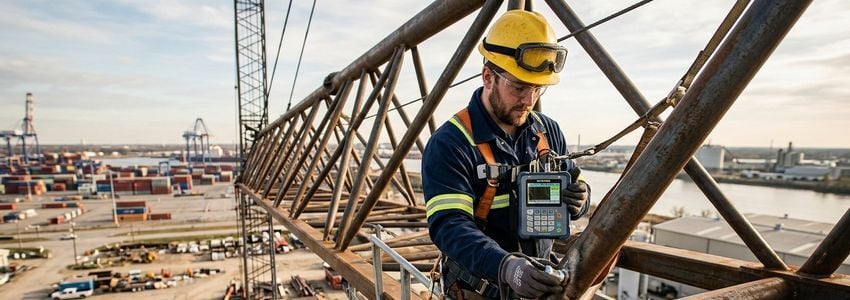
Non-destructive testing (NDT) equipment. Magnetic particle testing kits, dye penetrant systems, and ultrasonic thickness gauges are used to detect hairline cracks, corrosion, and structural fatigue in crane components without disassembling the equipment. NDT tools require specialized training to operate and represent a significant capital investment for a growing inspection company.
Mobile inspection vehicles. Many crane inspectors work out of a dedicated van or truck outfitted with testing equipment, generators, ladders, and safety gear. Financing a properly outfitted inspection vehicle allows a company to expand service territory and respond to emergency post-incident inspection calls more quickly.
Drones and visual inspection tools. Drone-based visual inspections of crane booms, towers, and structural components are becoming more common, especially for tower cranes and structures that are difficult or dangerous to access manually. Financing a commercial drone package alongside required certifications can open up new service lines.
Laser alignment and measurement tools. Precision laser alignment systems help inspectors verify structural geometry, boom deflection, and rail alignment on gantry and overhead crane systems, particularly for larger industrial and manufacturing facility contracts.
Reporting and documentation software and hardware. Ruggedized tablets, field-ready laptops, and inspection reporting software licenses are increasingly financeable alongside physical testing equipment, since digital documentation has become a standard client and regulatory expectation.
Who Crane Inspection Equipment Financing Is Best For
Crane inspection equipment financing is a strong fit for a range of businesses in the industrial services space, including:
The U.S. Small Business Administration notes that businesses serving regulated, compliance-driven industries often see steady, recurring demand once they establish a track record, making equipment investment in these niches a comparatively lower-risk growth strategy.
- Independent crane inspection companies performing annual and periodic OSHA-driven inspections
- Third-party inspection and testing firms expanding into crane and rigging services
- Construction equipment rental companies adding in-house inspection capability
- Industrial NDT and testing firms diversifying into crane inspection contracts
- Crane rental and service companies bringing inspection work in-house rather than outsourcing
- Engineering and consulting firms adding field inspection services to existing client relationships
If your company generates revenue from contract-based inspection work and adding or upgrading equipment would let you bid on more or larger jobs, crane inspection equipment financing is worth evaluating.
Using Equipment Financing to Win Larger Commercial Contracts
One of the most overlooked advantages of financing inspection equipment is the effect it has on your ability to bid on larger commercial and industrial contracts. Facility managers, general contractors, and crane rental companies awarding annual inspection contracts often require proof of current, calibrated equipment as part of the vendor qualification process.
A company still using outdated load testing equipment or lacking NDT capability may be disqualified from bidding on larger facility contracts entirely, regardless of the quality of its inspectors. Financing removes the chicken-and-egg problem: instead of waiting to win a big contract before investing in the equipment needed to service it, a company can acquire the equipment first and use it to qualify for the bid in the first place.
This is especially relevant for inspection companies looking to move from smaller, single-crane residential or light commercial jobs into larger manufacturing, shipping, or industrial facility contracts, where annual inspection volume and contract value are substantially higher. The equipment upgrade often pays for itself within the first one or two larger contracts won.
Comparing Your Financing Options
Choosing between financing structures comes down to how much capital you need, how quickly you need it, and whether you want the equipment itself to secure the loan.
| Financing Type | Best For | Typical Speed | Collateral |
|---|---|---|---|
| Equipment Financing | New load testing, NDT, or inspection tools | Days | The equipment itself |
| SBA Loan | Larger fleet or facility investments | Weeks to months | Varies, often broader business assets |
| Line of Credit | Ongoing calibration and smaller tools | Days | Typically unsecured |
| Working Capital Loan | Fast funding, revenue-based | Days | Unsecured |
How Crestmont Capital Helps Crane Inspection Business Owners
Crestmont Capital works with industrial service and inspection businesses across the country to structure financing that fits how their business actually operates, including the contract-based, sometimes unpredictable revenue patterns common in specialized inspection work.
Our equipment financing programs are built for exactly this kind of purchase: durable, technical equipment with a long useful life and real resale value. For companies specifically expanding their crane-related service lines, our crane financing and leasing programs are designed around the unique cost structure of crane-related equipment. If your project also involves broader capital needs, our SBA loan programs can help finance larger combined purchases.
For ongoing flexibility between larger purchases, a business line of credit gives you a reserve to draw on for calibration, smaller tool replacements, and unexpected repairs throughout the year. Businesses that need capital fast and don't want to tie up equipment as collateral often use our unsecured working capital loans, which are based primarily on business revenue rather than hard assets.
For a broader look at financing options across the crane services industry, our complete guide to crane financing is a useful companion resource covering financing strategy for crane purchases, rentals, and related equipment beyond inspection tools alone.
Real-World Scenarios
Scenario 1: The Two-Person Inspection Startup
A two-person crane inspection company operating out of a single pickup truck needed a calibrated load testing system and an NDT kit to bid on its first commercial facility contract. Using equipment financing, the owners acquired both within two weeks and won the contract, more than covering the monthly payment with the first quarter of billed inspection work.
Scenario 2: The Fleet Expansion
An established inspection company wanted to add a second fully outfitted mobile inspection vehicle to cover a growing service territory without waiting to build up cash reserves. A combination of equipment financing for the vehicle build-out and a line of credit for ongoing tool replacement let the company double its service radius within a single quarter.
Scenario 3: The Technology Upgrade
A mid-sized inspection firm was still using aging ultrasonic thickness gauges that were becoming difficult to calibrate and support. Rather than delaying replacement, the company used equipment financing to upgrade its entire NDT toolkit at once, improving inspection turnaround time and client satisfaction scores.
Scenario 4: The New Service Line
A crane rental company decided to bring crane inspection in-house instead of outsourcing to a third party, in order to capture that revenue directly. Equipment financing covered the initial load testing and NDT equipment purchase, and the new service line became profitable within its first year of operation.
Scenario 5: The Drone Inspection Pilot Program
An industrial inspection firm wanted to add drone-based visual inspections for tower cranes at height, a service few local competitors offered. Financing covered the commercial drone package and required certification training, allowing the firm to differentiate itself in bids for high-rise construction site contracts.
By the Numbers
Crane Inspection Equipment Financing - Key Statistics
33M+
Small businesses operating in the U.S., per the SBA
Days
Typical approval time for equipment financing
#1
Rated business lender in the U.S. - Crestmont Capital
2015
Year Crestmont Capital was founded
Pro Tip: Get your equipment vendor quote fully itemized before applying for financing. Lenders can move faster when the exact make, model, and calibration specifications are already documented in writing.
Common Mistakes to Avoid When Financing Inspection Equipment
Business owners new to equipment financing in this niche often stumble on a few predictable mistakes that can be avoided with a bit of planning.
Underestimating total equipment needs. Owners frequently finance the headline item, such as a load testing system, and forget to budget for calibration certificates, carrying cases, software licenses, or vehicle mounting hardware. Build a complete equipment list before applying so you are not caught short and forced to seek a second round of financing at less favorable terms.
Applying before getting a firm vendor quote. A rough verbal estimate is not enough for most lenders to underwrite quickly. Get a written, itemized quote before you apply, and your approval process will move noticeably faster.
Choosing the wrong financing structure for the timeline. An SBA loan can offer excellent long-term rates, but the underwriting process can take weeks to months. If your goal is to win a specific upcoming bid, equipment financing or a working capital loan is often a better fit even if the SBA rate looks more attractive on paper.
Ignoring resale and recalibration costs. Inspection equipment requires periodic recalibration to stay compliant with testing standards. Factor these ongoing costs into your overall budget rather than assuming the initial purchase is the only cost involved.
Skipping certification and training research. Some inspection equipment, particularly NDT tools and drones, requires operator certification before it can be used for billable client work. Confirm certification requirements and timelines before finalizing your equipment quote so your financed equipment does not sit idle while staff complete training.
Frequently Asked Questions
Don't Let Outdated Equipment Cost You Contracts
Fast, flexible financing for load testing systems, NDT tools, and mobile inspection vehicles. Apply in minutes, no obligation.
Apply Now →Next Steps
Conclusion
Crane inspection equipment financing gives inspection business owners a practical path to acquiring load testing systems, NDT tools, mobile inspection vehicles, and drones without waiting years to save the full cost in cash. Whether you're a two-person startup bidding on your first commercial contract or an established firm expanding your fleet, matching the right financing structure to your equipment needs and cash flow can mean the difference between winning the next bid or losing it to a better-equipped competitor.
Crestmont Capital works with industrial service and inspection operators nationwide to structure equipment financing, SBA loans, and working capital solutions built around how these businesses actually earn revenue. If you're ready to move forward on an equipment purchase, our team can walk you through options and get you a decision quickly.
Disclaimer: The information provided in this article is for general educational purposes only and is not financial, legal, or tax advice. Funding terms, qualifications, and product availability may vary and are subject to change without notice. Crestmont Capital does not guarantee approval, rates, or specific outcomes. For personalized information about your business funding options, contact our team directly.








