
 (800) 949-0401
Concrete Pumping Business Loans: The Complete Financing Guide for Concrete Pumping Owners
- The Concrete Pumping Industry at a Glance
- Why Concrete Pumping Businesses Need Financing
- Loan Types for Concrete Pumping Companies
- Equipment Financing for Pump Trucks and Booms
- How to Qualify for a Concrete Pumping Business Loan
- Concrete Pumping Financing at a Glance
- Best Uses for Loan Funds in Your Pumping Business
- How to Apply for a Concrete Pumping Business Loan
- Frequently Asked Questions
- Next Steps
Concrete pumping is one of the most capital-intensive service businesses in the construction industry. A single boom pump truck can cost $300,000 to $600,000 or more, and that is before you factor in insurance, trained operators, maintenance, and the working capital needed to float payroll between project invoices. Whether you are launching your first pumping operation or scaling an established fleet, the right financing can mean the difference between landing major commercial contracts and watching them go to a better-capitalized competitor.
This guide covers everything concrete pumping business owners need to know about securing a small business loan: the types of funding available, qualification requirements, how to use loan proceeds strategically, and what lenders actually look for when evaluating a pumping company.
The Concrete Pumping Industry at a Glance
The U.S. concrete pumping industry generates well over $3 billion in annual revenue and serves as an essential link in virtually every major construction project, from high-rise towers and highway bridges to parking structures, stadiums, and large residential developments. According to the U.S. Small Business Administration, construction-related service businesses represent one of the largest segments of small business activity in the country.
Concrete pumping contractors work alongside general contractors, concrete suppliers, and structural engineers to place concrete precisely where it is needed, often in locations that conventional chutes and wheelbarrows simply cannot reach. The industry includes:
- Boom pump operators who deploy truck-mounted articulating arms to pour concrete at height or distance
- Line pump operators who use flexible hose systems for flatwork, foundations, and smaller pours
- Specialty pumping companies that handle shotcrete, grout injection, and other high-pressure applications
Because construction projects are cyclical and payment terms often stretch 30 to 90 days after completion, even profitable pumping businesses frequently face cash flow gaps. Add in the cost of maintaining a multi-truck fleet plus operator wages, and it becomes clear why financing is not just helpful for concrete pumping owners -- it is often essential.
Why Concrete Pumping Businesses Need Financing
Concrete pumping operations face financial pressure from multiple directions simultaneously. Understanding the specific drivers of capital need helps you choose the right loan product rather than defaulting to whatever is easiest to obtain.
Equipment Acquisition and Replacement
A modern Putzmeister or Schwing boom pump truck represents one of the largest single capital expenditures in the construction services sector. Even a smaller 28-meter boom pump can run $250,000 to $350,000 new, while 52-meter and 58-meter high-reach units regularly exceed $700,000. Line pumps are less expensive, but still represent a significant investment at $30,000 to $80,000 per unit.
Because pumping equipment depreciates and requires increasingly expensive repairs as it ages, successful concrete pumping companies must continuously reinvest in their fleets to remain competitive and avoid costly breakdowns mid-pour.
Working Capital and Cash Flow Management
Construction projects commonly pay on a net-30 to net-90 schedule, and slow pay or disputed invoices can stretch that even further. Meanwhile, your operators need their paychecks every Friday, insurance premiums hit monthly, and concrete suppliers typically require faster payment terms than general contractors extend to you. A business line of credit or working capital loan bridges this recurring gap.
Business Expansion and Fleet Growth
Landing a large commercial contract often requires demonstrating that you have the equipment and crew capacity to complete the work. If you need to add a second boom pump to secure a contract that will generate $500,000 in revenue, waiting until you have saved enough cash is not always a viable strategy. Financing the equipment acquisition before locking in the contract is a calculated business move that many successful pumping operators use regularly.
Seasonal Demand and Slow Periods
In northern states especially, concrete pumping demand drops significantly in winter months, yet overhead costs continue. A working capital reserve funded through a line of credit or term loan helps operators weather the slow season without cutting into crew size or letting maintenance slide.
Loan Types for Concrete Pumping Companies
No single loan product works best for every situation. Concrete pumping businesses typically benefit from a combination of financing tools deployed strategically for different purposes.
Term Loans
A traditional business term loan provides a lump sum repaid over a set period with fixed or variable interest. Term loans are well-suited for planned investments like purchasing a second boom pump or renovating a maintenance yard. Repayment periods typically range from 1 to 10 years, with longer terms available through SBA loans.
Business Line of Credit
A revolving business line of credit is the most flexible financing tool for concrete pumping operators. You draw funds as needed and repay as project payments come in. Lines of credit are ideal for covering payroll gaps, insurance premiums, and unexpected repair costs without paying interest on capital you are not using.
Equipment Financing
Purpose-built equipment financing uses the pump truck or line pump as collateral, which typically results in lower interest rates than unsecured loans. Lenders are comfortable with concrete pumping equipment because it holds residual value and can be repossessed if necessary. Most equipment loans cover 80 to 100 percent of the purchase price with terms matching the useful life of the asset.
Equipment Leasing
Equipment leasing allows you to use a pump truck without owning it outright. This preserves capital and keeps your balance sheet cleaner, which can be beneficial when bidding on bonded public projects. At lease end, you typically have the option to purchase the equipment at a predetermined price. Leasing works especially well for companies that want to stay current with newer equipment models.
SBA Loans
The Small Business Administration's 7(a) and 504 loan programs offer some of the most favorable terms available to small business owners. SBA 7(a) loans are versatile and can fund equipment, working capital, or business expansion up to $5 million. SBA 504 loans are specifically designed for major fixed asset purchases and can finance boom pump trucks at below-market interest rates with long repayment terms. Explore your options at Crestmont Capital's SBA loan page.
Working Capital Loans
For concrete pumping businesses facing immediate cash needs, unsecured working capital loans can be funded in as little as 24 to 48 hours. While rates are higher than secured options, the speed and flexibility make them valuable for bridging payroll gaps, handling emergency repairs, or capitalizing on short-notice contract opportunities.
Ready to Finance Your Concrete Pumping Business?
Crestmont Capital specializes in construction service financing. Get pre-qualified in minutes with no impact to your credit score.
Apply Now -- Free, No ObligationEquipment Financing for Pump Trucks and Booms
Because the equipment is so central to the business model, equipment financing deserves dedicated attention for concrete pumping operators. Here is what you need to know.
New vs. Used Equipment
Most lenders will finance both new and used concrete pumping equipment, but underwriting differs. For new equipment, lenders typically require 10 to 20 percent down with terms up to 7 years. For used equipment, lenders look closely at age, mileage, and condition, and may require a third-party inspection. Equipment older than 10 years can be harder to finance but is not impossible.
Manufacturer Captive Financing
Putzmeister, Schwing, Alliance, and other major manufacturers occasionally offer promotional financing rates through their captive finance arms. These programs can be attractive when rates are low, but they typically require strong credit and may have restrictions on modifications or resale. Always compare manufacturer financing against independent lender options before committing.
Residual Value and Collateral
Concrete pump trucks hold their value relatively well compared to other construction equipment, which works in your favor when securing financing. Lenders see a clear collateral position, which reduces their risk and can translate to better rates and terms for you. Keeping detailed maintenance records and documentation of pump hours adds credibility to your loan application.
Fleet Financing
If you are financing multiple units simultaneously, blanket equipment financing or a fleet loan may offer administrative simplicity and potentially better rates through volume. Some lenders will consolidate multiple equipment loans into a single payment, simplifying cash flow management.
How to Qualify for a Concrete Pumping Business Loan
Lenders evaluate concrete pumping businesses using a mix of standard financial metrics and industry-specific factors. Understanding what they look for helps you prepare a compelling application.
Credit Score Requirements
For traditional bank loans and SBA financing, a personal credit score of 680 or above significantly improves your options. Many alternative lenders work with scores in the 600 to 650 range, especially when revenue and cash flow are strong. If your credit needs work, explore bad credit business loans designed for borrowers still building their credit profile.
Time in Business
Most conventional lenders want to see at least 2 years in business with documented revenue. Alternative lenders may work with businesses as young as 6 months, though terms will reflect the higher risk. Startups can often access equipment financing more readily than working capital loans because the equipment itself provides collateral.
Revenue and Cash Flow
Lenders typically want to see annual revenue of at least $150,000 to $200,000 for small working capital loans, with higher thresholds for equipment financing and larger credit lines. More important than the top-line number is demonstrating consistent positive cash flow after operating expenses. Three to six months of bank statements showing regular revenue deposits from known clients is highly persuasive.
Debt Service Coverage Ratio (DSCR)
The DSCR measures your ability to cover debt payments from operating income. Most lenders want a DSCR of 1.25 or above, meaning you generate $1.25 of net operating income for every $1.00 of debt service. For concrete pumping companies with significant existing equipment loans, this is a critical metric to calculate before applying.
Industry-Specific Considerations
Concrete pumping businesses face a few lender concerns specific to the industry:
- Liability exposure: Pump failures and spills can result in significant claims. Lenders want to see adequate general liability and equipment coverage, often $1 million to $5 million per occurrence.
- Customer concentration: If 80 percent of your revenue comes from a single general contractor, lenders will flag this as a risk. Diversifying your client base strengthens your application.
- Operator certification: Certified pump operators (through the American Concrete Pumping Association) demonstrate professionalism and reduce lender concerns about operational risk.
Concrete Pumping Financing at a Glance
Concrete Pumping Business Financing: Key Stats
Best Uses for Loan Funds in Your Pumping Business
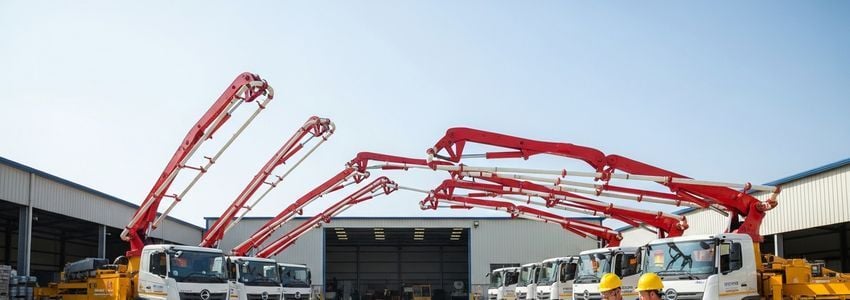
Once you secure financing, deploying capital strategically determines whether you generate a positive return on borrowed funds. Here are the highest-impact uses for concrete pumping business loans.
Fleet Expansion
Adding a second or third pump unit is the clearest path to revenue growth for most pumping operators. Each pump generates revenue independently, and having multiple units allows you to take on simultaneous contracts rather than turning work away. Calculate the expected annual utilization rate and revenue per unit before committing -- a well-utilized boom pump with an experienced operator should generate $400,000 to $800,000 or more in annual gross revenue depending on your market.
Fleet Upgrades and Modernization
Replacing aging equipment before it fails prevents the far more expensive scenario of a breakdown during a contracted pour. A pump failure mid-project can cost tens of thousands in damages, lost contracts, and reputation harm. Proactive replacement financed at favorable rates is almost always cheaper than reactive crisis spending.
Operator Hiring and Training
Skilled pump operators are among the most valuable employees in the concrete industry. Using loan proceeds to fund competitive wages, sign-on bonuses, and ACPA certification training expands your operational capacity and reduces the risk of costly mistakes. According to the U.S. Bureau of Labor Statistics, demand for construction equipment operators continues to grow, making operator retention a real competitive differentiator.
Working Capital Reserve
Maintaining a 90-day operating expense reserve funded through a line of credit protects your business from the cash flow volatility inherent in project-based work. This reserve lets you pay your crew, service equipment, and maintain insurance without stress even when project payments are slow to arrive.
Maintenance and Repair
Concrete pumps require regular maintenance of hydraulic systems, boom sections, pipes, clamps, and wear parts. A dedicated maintenance budget -- ideally funded before the need arises -- keeps downtime low and extends equipment life. Many pumping operators use a portion of their line of credit specifically to maintain a parts inventory for their highest-volume equipment.
Marketing and Business Development
Winning large commercial, municipal, and industrial contracts often requires significant business development investment: bonding capacity, professional estimating tools, insurance upgrades, and sometimes relationship-building through industry associations. Loan funds can seed these investments, which compound over time as you move up-market.
Need Funds Fast? Explore Fast Business Loans
Crestmont Capital's fast business loan options can get capital to your account in as little as 24 hours. No lengthy wait times.
Get Funded QuicklyIf you are also considering how to fund related specialty construction services, our guide to dewatering contractor business loans covers financing for another capital-intensive construction niche. For access and security installation contractors, see our post on access control installation business loans.
How to Apply for a Concrete Pumping Business Loan
A well-prepared loan application accelerates approval and often results in better terms. Here is how to approach the process systematically.
Documents You Will Need
Prepare these documents before beginning any application to avoid delays:
- Business and personal tax returns (2-3 years)
- Business bank statements (3-6 months most recent)
- Profit and loss statement and balance sheet (current year-to-date)
- Equipment list with valuations
- Business licenses, contractor licenses, and insurance certificates
- Accounts receivable aging report
- Contracts or letters of intent for upcoming projects (if available)
- Driver's license and EIN documentation
Choosing the Right Lender
Different lenders specialize in different borrower profiles:
- Traditional banks and credit unions offer the best rates but have the highest qualification standards and slowest processing times.
- SBA-approved lenders provide government-backed loans with favorable terms for qualified small businesses.
- Online and alternative lenders like Crestmont Capital specialize in construction service businesses, work faster, and have more flexible requirements -- ideal for operators who need capital quickly or whose financial profile is not perfect.
The Application Process
At Crestmont Capital, the application process is designed to be straightforward for construction business owners:
- Submit a brief online application describing your business and funding need
- Provide basic financial documentation (bank statements, tax returns)
- Receive a decision, often within 24 to 48 hours for working capital products
- Review and sign your loan agreement
- Receive funds, typically via ACH within 1 to 3 business days
For larger equipment loans and SBA products, the process may take 2 to 8 weeks, which is why it pays to start the application process before you reach a critical capital need. Learn more about fast business loans for concrete pumping operators who need capital on short timelines.
Frequently Asked Questions
What types of loans are available for concrete pumping businesses?
Concrete pumping businesses can access term loans, business lines of credit, equipment financing, equipment leasing, SBA 7(a) loans, SBA 504 loans, and unsecured working capital loans. The best option depends on your specific need -- equipment purchases, fleet expansion, and working capital gaps each call for different financing structures.
How much can a concrete pumping company borrow?
Loan amounts vary widely by product and lender. Working capital loans typically range from $25,000 to $500,000. Equipment financing can cover the full purchase price of pump trucks ranging from $30,000 to over $700,000. SBA loans can reach $5 million for qualified borrowers. Your actual approval amount will depend on revenue, credit score, and existing debt obligations.
What credit score do I need to get a concrete pumping business loan?
Traditional bank loans typically require a personal credit score of 680 or above. SBA loans prefer 680 to 700 minimum. Many alternative lenders work with scores in the 600 to 650 range, and some working capital products are available to borrowers with lower scores if revenue and cash flow are strong.
Can I finance a used concrete pump truck?
Yes. Most lenders will finance used concrete pumping equipment, though they may require a third-party inspection for older units. Equipment financing for used pumps typically requires 10 to 20 percent down, and terms may be shorter than for new equipment. The pump's condition, age, and documented maintenance history significantly affect lender willingness and terms.
How long does it take to get approved for a concrete pumping business loan?
Approval timelines vary by loan type. Working capital loans and lines of credit from alternative lenders can be approved and funded in 24 to 48 hours. Equipment financing typically takes 3 to 7 business days. SBA loans require 30 to 90 days for full approval and funding. Starting the process early is always advisable.
Do I need collateral for a concrete pumping business loan?
Equipment loans are secured by the pumping equipment itself. SBA loans may require a personal guarantee and lien on business assets. Some working capital loans and lines of credit are unsecured, meaning no specific collateral is pledged, though a personal guarantee is common. Unsecured products typically carry higher interest rates reflecting the increased lender risk.
What is the interest rate for a concrete pumping business loan?
Rates vary significantly by loan type, lender, and borrower qualifications. SBA 7(a) rates typically range from 10 to 13 percent. Equipment financing rates for qualified borrowers generally run 6 to 15 percent. Working capital loans from alternative lenders carry higher effective rates (often expressed as factor rates) reflecting faster approval and lower qualification thresholds. Always compare total cost of capital, not just the stated rate.
Can a concrete pumping startup get business financing?
Startups face more limited options than established businesses. Equipment financing is often the most accessible path since the pump truck provides collateral. SBA Microloan and SBA 7(a) programs can fund early-stage businesses with strong owner credit and a detailed business plan. Many alternative lenders require at least 6 months of operating history and documented revenue.
What if I have bad credit? Can I still get a concrete pumping business loan?
Bad credit reduces but does not eliminate your financing options. Equipment financing may still be available since the asset itself secures the loan. Some alternative lenders specialize in bad credit business loans for construction operators with strong cash flow. Expect higher interest rates and potentially shorter terms until your credit profile improves.
How do SBA loans work for concrete pumping companies?
The SBA does not lend money directly. Instead, it guarantees a portion of loans made by approved lenders, reducing lender risk and making capital more accessible at favorable rates. The SBA 7(a) program is the most versatile, covering working capital, equipment, and expansion. The SBA 504 program is designed for major fixed asset purchases like boom pump trucks and real estate, with below-market fixed rates.
What is equipment leasing and is it right for concrete pumping businesses?
Equipment leasing allows you to use a pump truck by making monthly payments without owning the asset outright. At lease end, you typically have options to purchase, return, or upgrade the equipment. Leasing preserves working capital and keeps your balance sheet lighter, which can help when bidding on bonded public contracts. The tradeoff is that you build no equity in the equipment during the lease term.
Can loan funds cover operator wages and training costs?
Yes. Working capital loans and business lines of credit can fund any legitimate operating expense, including operator wages, benefits, and ACPA certification training. Using loan proceeds to attract and retain skilled operators is a sound investment given the competitive market for experienced pump operators and the revenue those operators generate.
How does a business line of credit help concrete pumping companies?
A revolving business line of credit provides on-demand access to capital up to your approved limit. You draw only what you need and pay interest only on outstanding balances. This is ideal for managing the 30-to-90-day payment gaps common in construction, covering unexpected repair costs, and capitalizing on short-notice contract opportunities without the delay of applying for a new loan each time.
What documents do I need to apply for a concrete pumping business loan?
Typical documentation includes business and personal tax returns for the past 2 to 3 years, 3 to 6 months of bank statements, a current profit and loss statement, equipment list with valuations, business licenses, insurance certificates, and an accounts receivable aging report. For equipment loans, the invoice or purchase agreement for the equipment being financed is also required.
How do I choose the best lender for my concrete pumping business?
Start by assessing your timeline, credit profile, and the specific purpose of the funding. Traditional banks offer the best rates for qualified borrowers with time to wait. SBA lenders are ideal for major long-term investments. Alternative and online lenders like Crestmont Capital are best when you need capital quickly, have a less-than-perfect credit profile, or want a lender experienced with construction service businesses. Compare total cost of capital, not just interest rate, and read the fine print on prepayment penalties.
Get Your Concrete Pumping Business Financed Today
Whether you need equipment financing for a new boom pump or working capital to bridge project gaps, Crestmont Capital has the right solution. Apply in minutes.
Start Your ApplicationNext Steps
Your Action Plan
- Define your capital need. Determine exactly how much you need and for what purpose. Equipment purchases, working capital, and fleet expansion each point to different loan products.
- Pull your credit reports. Review your personal and business credit reports for errors before any lender does. Dispute inaccuracies through the bureaus to maximize your score.
- Organize your financial documents. Gather tax returns, bank statements, P&L, and equipment valuations. Having these ready cuts days off the application process.
- Calculate your DSCR. Divide your net operating income by your total annual debt service. If the result is below 1.25, work on increasing income or reducing other debt before applying.
- Compare lender options. Request quotes from at least two to three lenders -- including at least one SBA-approved lender -- to ensure you are getting competitive terms.
- Apply with Crestmont Capital. Submit your application online in minutes. Our team specializes in construction service financing and can structure the right solution for your concrete pumping business.
Disclaimer: The information provided in this article is for general educational purposes only and does not constitute financial, legal, or professional advice. Loan terms, rates, and availability vary by lender and borrower qualifications. Consult with a qualified financial professional before making financing decisions for your business.








