
 (800) 949-0401
Commercial Roofing Equipment Financing: The Complete Guide for Roofing Contractors
Roofing equipment financing gives roofing contractors a way to acquire tear-off machines, material lifts, compressors, safety systems, and delivery vehicles without draining working capital. For a trade where a single storm season can make or break annual revenue, having reliable equipment on hand is not optional. This guide breaks down how roofing equipment financing works, what it costs, which assets qualify, and how to choose the right funding path for your crew.
In This Article
What Is Commercial Roofing Equipment Financing?
Commercial roofing equipment financing is a funding arrangement that lets a roofing company acquire the tools and machinery it needs to run jobs, then pay for them over time instead of in one lump sum. The equipment itself typically secures the loan or lease, which means the lender has built-in collateral and the contractor does not have to pledge a home, vehicle, or other unrelated asset to qualify.
This category of financing covers a wide range of assets used on residential and commercial roofing crews: tear-off machines, shingle and material lifts, roofing cranes, compressors and nail guns, dump trailers, conveyor systems, safety and fall-protection gear, and the box trucks or flatbeds used to haul materials to the job site. Whether a contractor needs a single piece of equipment for a growing crew or a full package to outfit a new division, roofing equipment financing structures the purchase into predictable monthly payments.
Roofing is a capital-intensive trade with seasonal revenue swings, and equipment failures or shortages during peak storm season can cost a company far more in lost jobs than the financing itself. That is why so many roofing business owners treat equipment financing as a standard part of running the business rather than a last resort.
Key Benefits of Financing Roofing Equipment
Financing roofing equipment instead of paying cash preserves the working capital a contractor needs for payroll, materials, insurance, and unexpected repairs. Below are the advantages roofing business owners see most often:
- Preserves cash flow: Spreads a large equipment cost into fixed monthly payments instead of a single upfront outlay.
- Faster approvals than traditional bank loans: Because the equipment secures the financing, underwriting tends to move faster than unsecured lending.
- Keeps pace with storm-season demand: Contractors can scale up equipment quickly when a hailstorm or hurricane creates a surge in roofing work.
- Predictable budgeting: Fixed payment schedules make it easier to forecast job costs and profit margins.
- Access to newer, safer equipment: Financing makes it realistic to upgrade to equipment with better safety features and lower breakdown risk.
- Potential tax advantages: Many roofing companies structure equipment purchases to take advantage of standard business expense treatment (always confirm specifics with a tax professional).
- Flexible terms for different credit profiles: Options exist for established contractors with strong credit as well as newer companies still building a financial track record.
Key Stat: There are more than 36,000 roofing contractor businesses operating in the United States, according to Census Bureau data on NAICS code 238160 — a highly fragmented industry where reliable equipment can be a real competitive edge.
How Roofing Equipment Financing Works
The process for financing roofing equipment is straightforward and generally faster than applying for a traditional term loan. Most roofing contractors can move from application to funded equipment in a matter of days.
- Identify the equipment and get a quote. Whether it is a tear-off machine, material lift, or a used bucket truck, get a written quote or invoice from the dealer or seller.
- Submit a financing application. Most lenders ask for basic business information, time in business, and recent bank statements. Some equipment financing programs use simplified applications for amounts under a certain threshold.
- Underwriting review. The lender evaluates the business's cash flow, credit profile, and the type and value of the equipment being financed.
- Approval and terms. Once approved, the contractor receives a term sheet outlining the payment amount, term length, interest rate or factor rate, and any down payment requirement.
- Funding and equipment delivery. The lender pays the vendor directly (or reimburses the contractor for equipment already purchased, depending on the program), and the equipment is put to work.
- Ongoing payments. The contractor makes fixed monthly payments over the agreed term, typically 24 to 72 months depending on the equipment's useful life.
Ready to Equip Your Roofing Crew?
Get fast, flexible financing from the #1 business lender in the U.S. No obligation — apply in minutes.
Apply Now →Types of Roofing Equipment You Can Finance
Roofing equipment financing is not limited to one category of machinery. Lenders that specialize in commercial and construction equipment typically finance a broad range of assets used across the roofing trade, including:
- Tear-off machines and shingle removal equipment used to strip old roofing material quickly and safely.
- Material lifts and conveyors that move shingles, underlayment, and other materials from ground level to the roof deck.
- Roofing cranes and knuckle boom trucks for heavier commercial roofing jobs involving pallets of materials or metal roofing panels.
- Air compressors, nail guns, and pneumatic tools that speed up installation on both steep-slope and flat roofing systems.
- Dump trailers and debris haulers for job-site cleanup and material transport.
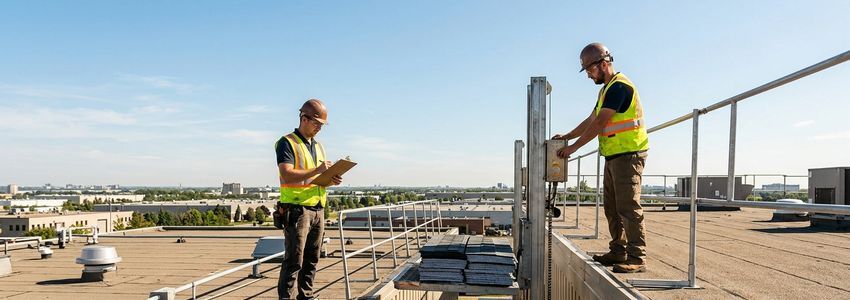
- Safety and fall-protection systems, including harnesses, anchor points, guardrail systems, and safety monitoring equipment.
- Box trucks, flatbeds, and service vans for hauling equipment, materials, and crews between job sites.
- Software and technology such as estimating tools, drone inspection equipment, and project management systems, which some lenders bundle into equipment financing packages.
New and used equipment can typically both be financed, which gives contractors flexibility to control costs while still getting the machinery their crews need.
By the Numbers
Equipment Financing for Small Businesses — Key Statistics
35%
of small businesses under $5M in revenue financed equipment in 2025
76.8%
industry-wide equipment financing approval rate in early 2026
$48K
median small business equipment loan amount
36K+
roofing contractor businesses operating in the U.S.
What Roofing Equipment Financing Costs
Pricing on roofing equipment financing depends heavily on the contractor's credit profile, time in business, and the type of equipment being financed. Industry data from early 2026 shows equipment loan rates for borrowers with strong credit (720+ FICO score) on new equipment generally landing between 6.5% and 8.5% APR, while borrowers with fair credit or those financing used equipment typically see rates 1.5 to 2.5 percentage points higher. Overall equipment loan pricing across the market can range more broadly, from roughly 8% up to 30% depending on the lender type, loan size, and risk profile.
Approval odds also vary meaningfully by lender type. Online and specialty equipment lenders tend to approve 78% to 84% of applications, small and community banks approve around 71%, and large national banks approve closer to 58%. Because roofing equipment is collateral-backed, small-ticket financing deals under $250,000 see especially strong approval rates, reported at roughly 80.9% industry-wide. This is one of the reasons equipment financing is often faster and more accessible for roofing contractors than an unsecured business loan of the same size.
Contractors should also factor in total cost of ownership, not just the monthly payment. A lower monthly payment on a longer term may cost more in total interest over the life of the loan, while a shorter term with a higher payment can reduce total interest paid. Comparing the annual percentage rate (APR) or factor rate across multiple lenders, rather than focusing solely on the payment amount, gives a clearer picture of the true cost.
Who Roofing Equipment Financing Is Best For
Roofing equipment financing tends to work best for contractors who need to preserve cash for materials, labor, and insurance while still keeping their fleet and tools current. It is a strong fit for:
- Growing roofing companies adding crews or expanding into commercial roofing that need additional lifts, cranes, or hauling equipment.
- Storm-response contractors who need to scale equipment quickly after a hailstorm or hurricane creates a surge in demand.
- Established roofing businesses replacing aging or unreliable equipment before it causes costly job delays.
- Newer roofing companies that need commercial-grade equipment but don't yet have the capital reserves to buy it outright.
- Contractors bidding larger commercial jobs that require heavier equipment, such as roofing cranes or material handling systems, than typical residential work.
Financing vs. Leasing vs. Buying Outright
Roofing contractors generally have three ways to acquire equipment: financing (a loan structure that builds toward ownership), leasing (paying for use of the equipment with an option to return, renew, or buy at term end), and buying outright with cash. Each has trade-offs depending on cash position, how long the equipment will be used, and how quickly it depreciates.
| Feature | Equipment Financing | Leasing | Buying Outright |
|---|---|---|---|
| Upfront cost | Low to none | Low to none | Full purchase price |
| Ownership at term end | Yes, outright | Depends on lease type | Immediate |
| Best for | Long-life equipment you'll use for years | Equipment that changes often or has short useful life | Companies with strong cash reserves |
| Impact on cash flow | Minimal, spread over time | Minimal, spread over time | Significant, one-time hit |
How Crestmont Capital Helps Roofing Contractors
Crestmont Capital works with roofing contractors across the country to structure construction equipment financing and heavy machinery financing that fits the seasonal cash flow patterns of the roofing trade. Rather than a one-size-fits-all loan product, Crestmont looks at how a contractor's revenue moves throughout the year and builds a payment structure around it.
For roofing businesses that want ongoing access to capital rather than a single equipment purchase, a business line of credit can supplement equipment financing by covering material costs, payroll during slow stretches, or unexpected repairs. Contractors planning a larger expansion, such as opening a second location or adding a commercial roofing division, may also want to explore SBA loan options alongside equipment-specific financing.
Crestmont has also published detailed guides on related roofing financing topics, including roofing business loans for contractors looking at working capital and growth funding, and a deep dive on roofing crane and material lift financing for contractors handling larger commercial jobs. These resources pair well with equipment financing decisions, since most growing roofing companies end up combining more than one type of funding as they scale.
Keep Your Crews Working Through Every Season
Talk to Crestmont Capital about equipment financing built around your roofing business's cash flow.
Apply Now →Real-World Scenarios
Storm season crew expansion: A regional roofing contractor sees a spike in leads after a major hailstorm hits their service area. Rather than turning away work, the company finances two additional tear-off machines and a material lift, allowing it to run two more crews simultaneously and capture the seasonal surge in demand.
Aging fleet replacement: A 15-year-old roofing company has been running the same dump trailer and compressor setup for nearly a decade. After a breakdown causes a missed deadline on a commercial re-roof, the owner finances new equipment instead of waiting to save up cash, avoiding future downtime.
Moving into commercial roofing: A residential roofing company wants to start bidding larger commercial flat-roof projects. Winning those bids requires a roofing crane and heavier material handling equipment than the company currently owns. Equipment financing lets them acquire the machinery needed to compete for commercial contracts without depleting cash reserves earmarked for payroll.
New contractor building out a fleet: A roofing business in its second year of operation has steady residential work but limited capital. Rather than delaying growth, the owner finances a starter package of tools, safety equipment, and a used flatbed truck, preserving cash for materials and marketing.
Safety compliance upgrade: After an OSHA inspection flags outdated fall-protection equipment, a roofing contractor finances a full safety system upgrade across all crews to stay compliant and reduce liability risk, spreading the cost over 36 months instead of paying in full immediately.
Frequently Asked Questions
Don't Let Equipment Gaps Cost You Jobs
See how quickly Crestmont Capital can get your roofing crew the equipment it needs.
Apply Now →Next Steps
Get quotes for the specific tear-off machines, lifts, or vehicles you're considering.
Most equipment financing applications move faster with 3-6 months of statements ready.
Submit your application and equipment details to get a term sheet.
Once funded, your crew has the tools to take on more jobs and bigger contracts.
Conclusion
Roofing equipment financing gives contractors a practical way to keep crews outfitted with reliable tear-off machines, lifts, safety gear, and vehicles without tying up the cash needed for payroll and materials. Whether you're scaling up for storm season, replacing aging equipment, or moving into larger commercial roofing jobs, structured financing can keep your business moving without the cash-flow strain of an all-at-once purchase. Crestmont Capital works with roofing contractors nationwide to structure equipment financing around the seasonal realities of the trade, helping crews stay equipped and ready for whatever the next job requires.
Disclaimer: The information provided in this article is for general educational purposes only and is not financial, legal, or tax advice. Funding terms, qualifications, and product availability may vary and are subject to change without notice. Crestmont Capital does not guarantee approval, rates, or specific outcomes. For personalized information about your business funding options, contact our team directly.








