
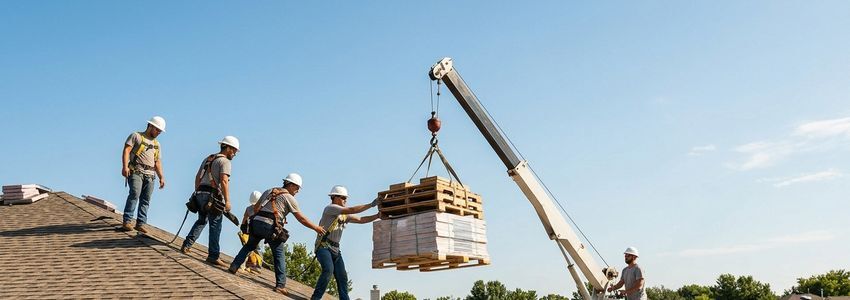
Roofing equipment financing has become one of the fastest ways for roofing contractors to add cranes, material lifts, and hoisting systems without draining cash reserves during peak season. A single mechanical shingle conveyor or truck-mounted crane can cost anywhere from $15,000 to well over $150,000, and most roofing companies simply cannot write that check without disrupting payroll, materials budgets, or bonding capacity.
Getting shingles, underlayment, and equipment onto a roof safely and efficiently is one of the biggest operational bottlenecks facing roofing contractors today. Manual labor to haul bundles up ladders slows every job, increases workers' compensation exposure, and eats directly into project margins. Cranes, truck-mounted hoists, and material lifts solve that problem, but the upfront cost keeps many contractors stuck with outdated or rented equipment long after it stops making financial sense.
In This Article
What Is Roofing Equipment Financing?
Roofing equipment financing is a category of commercial equipment loans and leases specifically structured to help roofing contractors acquire the machinery they need to run jobs efficiently. This includes truck-mounted cranes, shingle conveyors, material hoists, scissor lifts, boom lifts, and other equipment used to move materials, tools, and crews safely between the ground and the roofline.
Unlike a general-purpose business loan, equipment financing is typically secured by the equipment itself. That collateral structure lets lenders offer more competitive rates and terms than an unsecured working capital loan, because the crane or lift being purchased serves as security for the financing. For roofing contractors who already operate on thin margins between bidding season and material cost swings, that difference in rate and structure can be significant.
The financing can take several forms, including equipment loans where the contractor owns the asset from day one, equipment leases where monthly payments are often lower and ownership transfers at the end of the term, and lines of credit that can be drawn against repeatedly as new equipment needs arise throughout the year.
Why Cranes and Material Lifts Matter for Roofing Contractors
Material handling is the single biggest hidden cost center on most roofing crews. Every minute a laborer spends hand-carrying bundles up a ladder is a minute not spent installing, tearing off, or finishing a roof. Multiply that across a crew of six or eight workers over a full workday, and the productivity loss becomes obvious.
Cranes and material lifts change the math in several ways:
- Faster material staging. A truck-mounted crane or conveyor can move a full pallet of shingles to the roofline in the time it takes two laborers to hand-carry a single bundle up a ladder.
- Reduced workers' compensation exposure. Manual material handling is one of the leading causes of strain and overexertion injuries in roofing. Mechanized lifting reduces repetitive lifting injuries and the associated claims.
- Lower fall risk during material transport. Falls remain the leading cause of fatality in the construction industry, and much of that risk occurs during transitions on ladders while carrying loads. Mechanized lifts remove workers from that exposure during the material-moving phase of a job.
- Ability to bid more jobs simultaneously. Owning rather than renting equipment means a contractor is never blocked from taking a job because the rental yard's crane was already booked.
- Longer-term cost savings versus renting. Rental rates for truck cranes and material lifts add up fast across a full season. Contractors who run 30 or more jobs a year often reach the breakeven point on ownership well before the end of their first season.
Key Stat: Roofing consistently ranks among the most dangerous civilian occupations in the United States, with a fatal injury rate roughly 14.8 times higher than the average for all occupations, and falls account for the vast majority of those incidents. Equipment that removes workers from repeated ladder trips directly reduces that exposure.
Ready to Equip Your Crew?
Get fast, flexible financing for cranes, lifts, and roofing equipment from the #1 business lender in the U.S. No obligation, apply in minutes.
Apply Now →How Roofing Crane and Material Lift Financing Works
The process for financing roofing equipment follows a fairly consistent path regardless of the lender, though the speed and documentation requirements vary considerably between traditional banks and specialty equipment finance companies.
First, the contractor identifies the specific equipment needed, whether that is a new or used truck-mounted crane, a mechanical shingle conveyor, a scissor lift, or a boom lift. Having a quote or invoice from the equipment dealer in hand speeds up the entire process because the lender can underwrite against a known purchase price rather than an estimate.
Second, the contractor submits a financing application along with supporting documentation. For most equipment financing under $250,000, this is a streamlined process: a one or two-page application, several months of business bank statements, and basic business information. Larger purchases, such as a fully outfitted material handling truck, may require additional financial statements or tax returns.
Third, the lender underwrites the deal based on business cash flow, time in business, and the value and useful life of the equipment being financed. Because the equipment itself typically serves as collateral, approval decisions can often be made within 24 to 48 hours for standard equipment purchases.
Fourth, once approved, funds are typically disbursed directly to the equipment vendor, or in some cases to the contractor for equipment already identified and invoiced. Monthly payments then begin on a fixed schedule, structured to align with the useful life of the asset being financed.
Types of Crane and Material Lift Financing
Roofing contractors generally have four main financing structures to choose from, and the right choice depends on cash flow, tax strategy, and whether the goal is ownership or flexibility.
Equipment Loans
An equipment loan finances the full purchase price of a crane, lift, or material handling system, with the contractor owning the equipment immediately and building equity with every payment. This is typically the best option for contractors who plan to keep the equipment for its full useful life and want the depreciation benefit on their books.
Equipment Leasing
Leasing structures typically carry a lower monthly payment than an equivalent loan because the lender retains ownership of the asset until the end of the term. Many roofing contractors use leasing for equipment that may need to be upgraded every few years, such as scissor lifts or boom lifts subject to heavy wear.
SBA 7(a) and 504 Loans
The SBA 7(a) program can be used to finance equipment purchases and installation, with terms of up to 10 years for equipment and loan amounts up to $5 million. The SBA 504 program is specifically designed for long-life fixed assets and heavy machinery, often with lower down payment requirements and terms that can extend to 20 or 25 years depending on the asset.
Business Lines of Credit
A revolving line of credit gives contractors the flexibility to purchase smaller lift equipment or make emergency repairs to existing cranes without going through a full equipment financing application each time. This works well for contractors who need ongoing access to capital across a busy roofing season rather than a single large purchase.
By the Numbers
Roofing Industry and Equipment Financing Statistics
101K+
Roofing companies operating in the U.S. as of 2025
$92B+
Estimated U.S. roofing contractor market size
10 Years
Typical maximum term on an SBA 7(a) equipment loan
24-48 Hrs
Typical approval window for standard equipment financing
Who Should Consider This Financing
Roofing crane and material lift financing makes the most sense for a specific set of contractors, though the exact profile varies by business size and job volume.
- Established residential and commercial roofing contractors running 20 or more jobs per season who are currently paying recurring rental fees for cranes or lifts.
- Growing roofing companies that have outgrown a single crew and need a second or third crane to run parallel jobsites.
- Storm restoration and disaster response roofing contractors who need to mobilize quickly across multiple properties and cannot rely on rental availability during high-demand periods.
- Commercial roofing contractors working on flat roof and low-slope systems that require heavier material handling equipment for insulation boards, membrane rolls, and mechanical fastening systems.
- Contractors replacing aging equipment whose current crane or lift is generating higher maintenance costs than a financed replacement would cost monthly.
Contractors with less than a year in business, inconsistent cash flow, or credit challenges are not automatically excluded. Specialty equipment lenders like Crestmont Capital often work with a wider credit band than a traditional bank, structuring financing around the value of the equipment itself rather than relying solely on a strong balance sheet.
Seasonality is another factor worth weighing carefully. Roofing revenue tends to swing significantly between peak summer and fall months and slower winter periods in many regions. Financing structures with seasonal or step-payment options, where payments are lower during the off-season and higher during peak months, can help align debt service with actual cash flow rather than forcing a flat payment year-round. Not every lender offers this flexibility, so it is worth asking about payment structure options before committing to a specific financing plan.
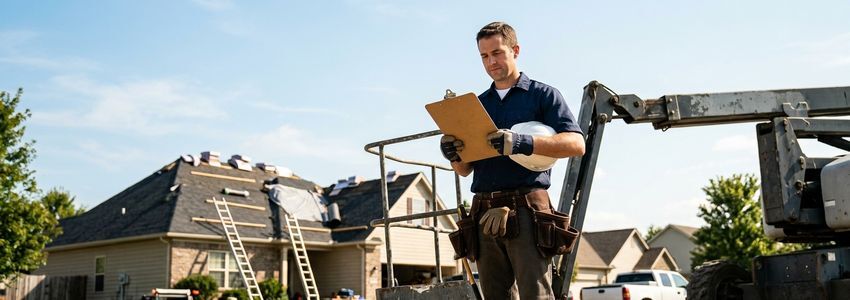
Financing Options Compared
Choosing between an equipment loan, a lease, and an SBA-backed loan depends heavily on how long the contractor plans to keep the equipment and how much of a down payment is available upfront.
| Financing Type | Best For | Typical Term | Ownership |
|---|---|---|---|
| Equipment Loan | Long-term ownership, tax depreciation | 3-7 years | Immediate |
| Equipment Lease | Lower monthly payment, frequent upgrades | 2-5 years | End of term (varies) |
| SBA 7(a) Loan | Large equipment purchases, lower rates | Up to 10 years | Immediate |
| Business Line of Credit | Smaller purchases, repairs, flexibility | Revolving | Immediate (on draw) |
Rental remains a reasonable short-term option for contractors testing a new type of equipment or handling a single unusual job. But for contractors who consistently need a crane or material lift on every jobsite, ownership through financing almost always produces a lower total cost over a multi-year horizon than continuous rental fees.
Interest rates and terms also vary based on the age of the equipment being financed. New equipment typically qualifies for the longest terms and most favorable rates because lenders can rely on manufacturer warranties and a longer projected useful life. Used equipment, while often a better value on a per-dollar-of-capacity basis, may come with slightly shorter terms or a higher down payment requirement depending on the age and condition of the specific unit. Getting a pre-purchase inspection on used cranes and lifts can help secure better financing terms by giving the lender more confidence in the equipment's remaining service life.
How Crestmont Capital Helps Roofing Contractors
Crestmont Capital works directly with roofing contractors to structure equipment financing around the realities of the trade: seasonal cash flow, tight bidding windows, and the need to move fast when a piece of equipment breaks down mid-job. Our underwriting process looks beyond a single credit score, factoring in business cash flow and the resale value of the equipment being financed.
For contractors specifically financing cranes, Crestmont offers dedicated crane financing programs, and for material lift purchases we structure financing through our scissor lift financing and boom lift financing programs. Both new and used equipment purchases are eligible, which matters for roofing contractors who often find strong value in well-maintained used cranes and lifts from equipment dealers and auctions.
For contractors looking at a broader equipment upgrade across the whole operation, our construction equipment financing program can bundle crane, lift, and other machinery purchases into a single structured financing package. And for roofing companies that qualify, our team can also walk through SBA loan options where a longer amortization period makes sense for a larger fleet purchase.
Contractors researching general financing strategy for the trade should also read our guide on roofing business loans, which covers working capital, growth financing, and how equipment purchases fit into a broader capital strategy. For a deeper dive specifically on crane financing structures across industries, our crane financing guide breaks down rates, terms, and qualification criteria in more detail.
Stop Renting. Start Owning.
See how much you could save by financing your own crane or material lift instead of paying rental fees all season long.
Apply Now →Real-World Scenarios
Scenario 1: Residential Roofing Contractor Adding a Second Crew
A residential roofing contractor running one crew and one rented truck crane wins enough new business to justify a second crew. Rather than continuing to split time and rental fees between two jobsites, the contractor finances a second truck-mounted crane through an equipment loan, allowing both crews to run simultaneously without waiting on shared equipment.
Scenario 2: Storm Restoration Company Scaling Fast
After a major hail event, a storm restoration roofing company needs to mobilize crews across a wide service area within days. Rental yards are already booked out by competitors making the same calls. The company finances two material lifts and a crane through a fast equipment loan approval, allowing it to accept jobs that would otherwise go to a competitor with available equipment.
Scenario 3: Commercial Roofing Contractor Upgrading for Flat Roof Work
A contractor that has historically focused on residential shingle roofs wins a bid for a large commercial flat roof replacement. The job requires moving heavy insulation boards and membrane rolls that standard shingle conveyors cannot handle. The contractor finances a heavier-duty material hoist system suited to commercial roofing, expanding into a new, higher-margin segment of the business.
Scenario 4: Established Contractor Replacing an Aging Crane
A 15-year-old truck crane starts requiring frequent repairs that add up to more than a monthly loan payment would cost on a new unit. The contractor runs the numbers, finances a replacement crane, and eliminates both the repair costs and the downtime risk of an unreliable machine during peak season.
Scenario 5: Small Crew Roofing Company Buying Its First Lift
A three-person roofing crew has relied entirely on ladders and manual carrying since the business started two years ago. As job volume grows, the physical toll on the crew becomes unsustainable. The owner finances a compact material lift through a smaller equipment loan, immediately increasing daily production capacity without adding headcount.
Pro Tip: When comparing rental costs to financing, calculate the total rental spend for a full roofing season, not just a single job. Most contractors are surprised to find they have already spent more than half the cost of a new machine on rental fees within a single busy season.
Frequently Asked Questions
What is roofing equipment financing?
Roofing equipment financing is a loan or lease used specifically to purchase machinery like cranes, material lifts, and hoisting systems for roofing operations. The equipment typically serves as collateral, which allows for more competitive rates than unsecured business financing.
Can I finance a used crane or material lift?
Yes. Most equipment lenders, including Crestmont Capital, finance both new and used equipment as long as the machine has verifiable value and a reasonable remaining useful life. Used equipment financing is common in the roofing industry due to the strong resale market for cranes and lifts.
How much can I borrow for a truck-mounted crane?
Loan amounts are generally tied to the equipment's purchase price, ranging from around $15,000 for smaller material handling units to well over $150,000 for a fully outfitted commercial-grade crane. SBA 7(a) loans can go up to $5 million for larger equipment packages.
What credit score do I need to qualify?
Requirements vary by lender. Traditional banks often require strong personal and business credit, while specialty equipment lenders may approve contractors with lower credit scores by weighting cash flow and the value of the financed equipment more heavily.
How fast can I get approved for equipment financing?
Standard equipment financing under $250,000 is often approved within 24 to 48 hours once basic documentation is submitted. Larger SBA-backed financing can take several weeks due to additional underwriting requirements.
Should I lease or take out a loan for a material lift?
If you plan to keep the equipment long term and want to build ownership equity, a loan is usually the better structure. If you want lower monthly payments and expect to upgrade equipment every few years, leasing often makes more sense.
Does financing cover both the crane and installation costs?
In many cases, yes. Equipment financing and SBA loans can often be structured to include installation, mounting, and delivery costs alongside the base equipment price, depending on the lender and the total transaction size.
Is it cheaper to buy or rent a crane for roofing jobs?
For contractors running more than a handful of jobs per season, buying is almost always cheaper over a multi-year period. Rental fees accumulate quickly, and contractors who calculate their total seasonal rental spend are often surprised how close it comes to a full financed payment schedule.
Can a new roofing business qualify for equipment financing?
Newer businesses can qualify, though options may be more limited than for established contractors. Lenders will typically look at industry experience, personal credit, and available down payment to offset the shorter operating history.
What is the difference between a scissor lift and a boom lift for roofing work?
Scissor lifts move straight up and down and are best suited for flat access needs, while boom lifts extend outward and upward, making them useful for reaching over obstacles or accessing steeper and more complex rooflines.
Are down payments required for equipment financing?
Some equipment loans require no down payment for well-qualified borrowers, while others may require 10 to 20 percent down, particularly for SBA-backed loans or larger equipment purchases. Terms vary based on creditworthiness and equipment type.
Can I refinance existing equipment I already own outright?
Yes, this is known as a sale-leaseback or equipment refinance. Contractors can use equity in owned cranes or lifts to free up working capital for other business needs while continuing to use the same equipment.
What documents are needed to apply?
Typical documentation includes a completed application, several months of business bank statements, an equipment quote or invoice, and basic business identification. Larger financing packages may require tax returns or financial statements.
Does financing equipment affect my ability to get other business loans?
Equipment financing is generally structured separately from working capital loans or lines of credit, so it does not necessarily limit access to other financing. Lenders will, however, factor existing debt obligations into future underwriting decisions.
How do I get started financing a crane or material lift?
Start by identifying the specific equipment and getting a quote from a dealer, then apply with a lender that specializes in construction and roofing equipment financing. Crestmont Capital can typically provide a decision within one to two business days for standard equipment purchases.
Don't Let Equipment Slow Down Your Season
Talk to our team about financing options for your next crane, lift, or material handling system.
Apply Now →Next Steps
Decide whether a crane, material lift, or hoist system best fits your current jobs and get a quote from a dealer.
Pull together a few months of business bank statements and any equipment quotes you have received.
Submit a simple application online and get a financing decision, often within one to two business days.
Once funded, get your new crane or lift on the jobsite and start moving materials faster and more safely.
Conclusion
Roofing equipment financing gives contractors a practical way to move beyond rental yards and outdated machinery, replacing recurring rental costs with a structured path to ownership. Whether the need is a truck-mounted crane for a growing residential operation, a heavy-duty material lift for commercial flat roof work, or a replacement for aging equipment that has become a maintenance liability, financing structures exist for nearly every stage of a roofing business.
The roofing industry remains one of the most physically demanding and safety-sensitive trades in construction, and mechanized material handling equipment directly addresses both productivity and worker safety at the same time. Contractors who evaluate their seasonal rental spend often find that financing a crane or material lift pays for itself faster than expected, while also freeing up crew time for the work that actually generates revenue: installing roofs.
If your roofing company is ready to stop renting and start owning the equipment your crews rely on every day, Crestmont Capital can help structure financing around your business's specific cash flow and job volume.
Disclaimer: The information provided in this article is for general educational purposes only and is not financial, legal, or tax advice. Funding terms, qualifications, and product availability may vary and are subject to change without notice. Crestmont Capital does not guarantee approval, rates, or specific outcomes. For personalized information about your business funding options, contact our team directly.



