
 (800) 949-0401
Charcuterie Production Equipment Financing: The Complete Guide for Charcuterie Producers
Charcuterie production equipment financing gives specialty meat producers, salumerias, and artisan curing businesses a way to acquire curing chambers, meat slicers, vacuum sealers, grinders, and smokehouses without draining working capital. A single commercial curing chamber can cost anywhere from $8,000 to well over $100,000, and most charcuterie producers need several pieces of specialized equipment before they cure their first batch of salami or prosciutto. Financing spreads that cost into manageable monthly payments so you can start production and generate revenue immediately.
In This Article
Whether you are launching a small-batch salumeria, scaling a farm-to-table charcuterie brand, or adding cured meat production to an existing butcher shop, this guide covers every financing option available in 2026, what equipment typically costs, how lenders evaluate applications, and how to structure a financing package that fits your production goals.
What Is Charcuterie Production Equipment Financing?
Charcuterie production equipment financing is a category of equipment financing designed specifically for businesses that cure, smoke, dry, ferment, and package specialty meat products. This includes salami, prosciutto, coppa, bresaola, pancetta, guanciale, chorizo, and a wide range of other cured meat products that require precise humidity control, temperature management, and food safety equipment throughout the production process.
Unlike a general small business loan, equipment financing is secured by the equipment itself, which typically makes approval faster and more accessible than unsecured lending products. According to the U.S. Small Business Administration, equipment financing remains one of the most accessible forms of small business credit, since the asset itself reduces lender risk. Instead of paying $40,000 or more in cash for a walk-in curing chamber, a charcuterie producer can finance the purchase over 24 to 84 months while the equipment generates revenue from day one.
Charcuterie production is one of the fastest-growing segments of the specialty food industry, but it is also one of the most equipment-intensive. A commercial curing chamber alone requires computer-controlled humidity and temperature systems that most consumer refrigeration units cannot replicate. Financing exists to help producers acquire this specialized equipment without the six-figure upfront cash outlay that would otherwise be required.
Industry Insight: The global charcuterie meat market was valued at approximately $41.5 billion in 2025, with projected growth of 5.8% to 7.2% annually through 2033. North America alone accounts for roughly $11.8 billion of that market, reflecting strong and sustained consumer demand for cured, smoked, and artisanal meat products.
Key Benefits of Charcuterie Equipment Financing
Financing a curing chamber, slicer, or smokehouse instead of paying cash offers several distinct advantages for charcuterie producers, especially those still building their production volume and customer base.
- Preserve working capital. Keep cash available for ingredients, packaging, labeling, marketing, and payroll rather than tying it all up in a single piece of equipment.
- Start production immediately. Acquire the curing chamber or slicer now and begin generating revenue from cured product sales while making fixed monthly payments.
- Match payments to your production cycle. Many charcuterie products require weeks or months of curing time before they can be sold. Financing terms can be structured to align with your cash conversion cycle.
- Build business credit. Consistent, on-time payments on an equipment loan strengthen your business credit profile, which helps you qualify for better terms on future expansion financing.
- Access newer, more efficient equipment. Modern curing chambers offer more precise humidity and temperature control, better food safety compliance, and greater production capacity than older units, which can directly improve product consistency and reduce spoilage losses.
- Potential tax advantages. Section 179 of the tax code may allow you to deduct the full purchase price of qualifying equipment in the year it is placed in service. Consult your tax advisor to confirm how this applies to your business.
Ready to Equip Your Charcuterie Business?
Get fast, flexible financing from the #1 business lender in the U.S. No obligation - apply in minutes.
Apply Now →How Charcuterie Equipment Financing Works
The financing process for charcuterie production equipment follows a similar path to other types of equipment financing, though lenders familiar with specialty food production understand the unique cash flow patterns of curing businesses, including extended aging periods before product can be sold.
Process Overview
The Charcuterie Equipment Financing Process
Request a formal quote for your curing chamber, slicer, grinder, or smokehouse from a manufacturer or equipment dealer.
Complete a straightforward financing application online, providing basic business and financial details.
The lender reviews your credit and business information, then presents your rate, term, and monthly payment.
Once approved, the lender pays the vendor directly and your equipment ships or is scheduled for installation.
Start production while repaying the loan in fixed monthly installments over your agreed term.
Because the equipment itself secures the loan, lenders are often willing to approve charcuterie producers with limited operating history, provided the owner has reasonable personal credit and a clear plan for the equipment's use. Approval decisions for equipment financing are frequently issued within 24 to 48 hours, with funding available in as little as two to five business days after final approval.
Types of Charcuterie Production Equipment You Can Finance
Charcuterie production requires a range of specialized equipment beyond what a typical commercial kitchen uses. Nearly all of the following equipment categories are eligible for financing, whether purchased new or used.
Curing Chambers
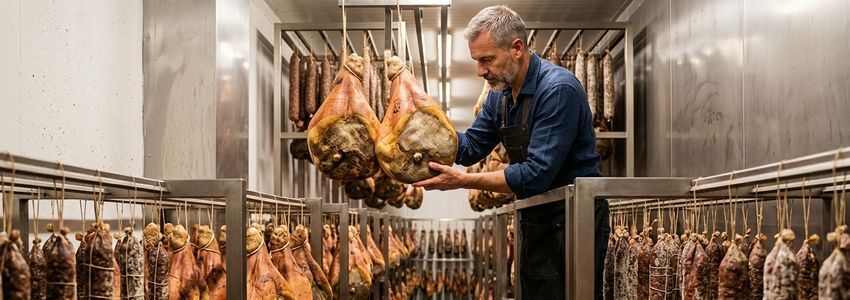
A curing chamber is the centerpiece of any serious charcuterie operation. These computer-controlled units maintain precise humidity (typically 65 to 85 percent) and temperature (usually 50 to 60 degrees Fahrenheit) over weeks or months, allowing whole muscle cuts and sausages to dry-cure safely. Commercial curing chambers range from compact walk-in units around $8,000 to large custom-built rooms exceeding $150,000 for high-volume producers.
Meat Slicers
Professional-grade slicers are essential for producing consistent, paper-thin slices of prosciutto, salami, and other cured products for retail packaging or food service. Commercial slicers range from $2,000 for entry-level manual-feed units to $15,000 or more for high-volume automatic slicers with integrated portion control.
Grinders and Mixers
Meat grinders and vacuum mixers prepare the ground meat and fat blends used in sausages, salami, and other emulsified or coarse-ground charcuterie products. Commercial units range from $3,000 to $30,000 depending on capacity and automation level.
Vacuum Sealers and Packaging Equipment
Vacuum sealing extends shelf life and is often required for retail distribution and food safety compliance. Chamber vacuum sealers and modified atmosphere packaging (MAP) systems typically range from $2,500 to $25,000 depending on throughput.
Smokehouses
Many charcuterie products, including some salami varieties, pancetta, and speck, incorporate a smoking step. Commercial smokehouses designed for meat production range from $10,000 for small units to $80,000 or more for large automated systems with programmable smoke and humidity cycles.
Stuffers and Casings Equipment
Sausage stuffers fill natural or synthetic casings with precision and consistency. Commercial hydraulic or pneumatic stuffers range from $2,000 to $20,000.
Refrigeration and Cold Storage
Walk-in coolers and freezers for raw material storage and finished product holding are commonly financed alongside curing chambers as part of a complete production buildout. See our guide on meat processing equipment financing for more on refrigeration and processing equipment.
By the Numbers
Charcuterie and Specialty Meat Industry Statistics
$41.5B
Global charcuterie meat market value in 2025
$11.8B
North American charcuterie market size, 2025
6-7%
Projected annual charcuterie market growth through 2033
38.5%
Share of charcuterie revenue from cured meats like salami and prosciutto
Charcuterie Equipment Costs and Financing Amounts
Understanding typical equipment costs helps you plan your financing request and set realistic expectations for monthly payments.
| Equipment Type | Entry-Level | Mid-Range | High-End / Custom |
|---|---|---|---|
| Curing Chamber | $8,000 - $20,000 | $20,000 - $60,000 | $60,000 - $150,000+ |
| Meat Slicer | $2,000 - $5,000 | $5,000 - $10,000 | $10,000 - $15,000+ |
| Grinder / Mixer | $3,000 - $8,000 | $8,000 - $18,000 | $18,000 - $30,000+ |
| Smokehouse | $10,000 - $25,000 | $25,000 - $50,000 | $50,000 - $80,000+ |
| Vacuum Sealer / MAP System | $2,500 - $8,000 | $8,000 - $15,000 | $15,000 - $25,000+ |
Sample Monthly Payment Estimates
| Equipment Cost | Rate (Example) | Term | Est. Monthly Payment |
|---|---|---|---|
| $15,000 | 10% | 36 months | ~$484/mo |
| $40,000 | 10% | 60 months | ~$850/mo |
| $90,000 | 11% | 72 months | ~$1,725/mo |
These figures are estimates only. Actual rates and payments depend on your credit profile, time in business, and the lender's underwriting criteria. Larger or custom-fabricated curing rooms may require a formal equipment appraisal before approval.
Who Charcuterie Equipment Financing Is Best For
Charcuterie equipment financing serves a wide range of specialty meat businesses at every stage of growth.
- Salumerias and dedicated charcuterie producers curing and selling salami, prosciutto, and other whole-muscle products
- Butcher shops adding an in-house curing and charcuterie program to an existing retail operation
- Farm-to-table meat producers vertically integrating from raising livestock to producing finished cured products
- Restaurants and gastropubs building an in-house charcuterie program for menu differentiation
- Specialty food brands scaling production to supply grocery, retail, and wholesale accounts
- Farmers market and direct-to-consumer sellers transitioning into licensed commercial production facilities
- Existing sausage and deli meat producers expanding into dry-cured product lines
Even charcuterie producers with limited operating history or imperfect credit often find financing options available, since the equipment itself serves as collateral. Working with a lender familiar with specialty food production, like Crestmont Capital, increases the likelihood of finding terms that fit your business model and curing timelines.
Qualification Requirements for Charcuterie Equipment Financing
Lenders evaluate several core factors when reviewing a charcuterie equipment financing application. Understanding these criteria helps you prepare a stronger application.
Credit Score
Most equipment lenders prefer a personal credit score of 650 or higher, though alternative and specialty lenders frequently work with scores as low as 580 to 600, particularly when the equipment itself provides strong collateral value.
Time in Business
Established charcuterie businesses with two or more years of operating history typically access the widest range of financing options and most competitive rates. Startups and newer producers can still qualify, especially with relevant culinary or food industry experience, though they may see shorter terms or a down payment requirement.
Annual Revenue
Lenders want to confirm your business can comfortably absorb the new monthly payment. As a general guideline, monthly equipment payments should not exceed 10 to 15 percent of monthly gross revenue.
Down Payment
Many lenders offer financing with no down payment for well-qualified borrowers. Newer businesses or those with limited credit history may be asked for 10 to 25 percent down.
Documentation
Standard documentation includes a completed application, three to six months of business bank statements, a vendor quote for the equipment, and government-issued identification. Larger financing requests may require tax returns, profit and loss statements, and a business plan.
Pro Tip: Because curing equipment tends to hold resale value and functions as strong collateral, charcuterie producers often qualify for more favorable equipment financing terms than they would for an unsecured working capital loan of the same amount.
How Crestmont Capital Helps Charcuterie Producers
Crestmont Capital, rated the #1 business lender in the United States, works with specialty food producers who need financing tailored to the realities of curing and aging production timelines. We understand that a curing chamber may not generate its first dollar of revenue for weeks or months after installation, and we structure financing accordingly.
Our equipment financing programs fund curing chambers, slicers, smokehouses, grinders, stuffers, vacuum sealers, and complete production buildouts. We also offer used equipment financing for producers acquiring pre-owned curing chambers or smokehouses, which can significantly reduce upfront costs while still delivering reliable production capacity.
Beyond equipment, our SBA loan programs support larger buildouts, including facility renovations and licensing costs for producers scaling into commercial USDA-inspected production. For ongoing ingredient purchasing, packaging costs, and seasonal cash flow needs, a business line of credit gives you flexible access to capital you can draw on as needed.
Our team reviews most applications within hours and issues funding decisions in one to three business days for qualified borrowers. Once approved, funds are typically available within days, allowing you to move forward with your curing chamber or production buildout without delay. Explore our related guide on butcher shop equipment financing if your charcuterie program is part of a broader retail meat operation.
Get Pre-Qualified in Minutes
Crestmont Capital works with charcuterie producers and specialty meat businesses of every size. Apply now and speak with a specialist who understands your production timeline.
Start Your ApplicationFinancing vs. Buying Outright: Which Is Better?
Many charcuterie producers debate whether to finance equipment or pay cash outright. The right answer depends on your cash position, growth plans, and comfort with debt.
The Case for Financing
Financing makes the most sense when you want to preserve cash for ingredients, packaging, marketing, and the extended aging periods that delay revenue on cured products. If a $50,000 curing chamber financed at 10 percent generates significantly more than that in annual product sales once at full capacity, the cost of financing is a minor expense relative to the return. Federal programs have also increasingly focused on strengthening small and regional meat and specialty food production. According to an AP News report, the USDA has directed hundreds of millions of dollars toward expanding small and mid-sized meat and specialty food processing capacity nationwide, underscoring the growing importance of small producers in the broader food supply chain.
The Case for Buying Outright
Paying cash can make sense if your business holds substantial reserves and you prefer to avoid a monthly obligation altogether, or if a vendor offers a meaningful discount for cash payment. Some established producers with strong balance sheets simply prefer owning equipment free and clear from day one.
The Hybrid Approach
Some producers put 20 to 30 percent down and finance the remainder, reducing monthly payments and total interest while still preserving a portion of working capital. This approach often balances risk and flexibility effectively for growing charcuterie businesses.
Market Context: According to Forbes, the specialty food market has consistently outpaced the broader food market in growth, driven by consumer demand for artisanal, transparent, and premium food products, a trend that directly benefits small and mid-sized charcuterie producers.
Real-World Financing Scenarios
These examples illustrate how charcuterie producers commonly structure equipment financing in practice.
Scenario 1: The First Salumeria
A chef with a decade of restaurant experience opens a dedicated salumeria producing small-batch salami and prosciutto. She needs a $45,000 walk-in curing chamber but wants to preserve cash for her first six months of ingredient purchasing and rent. She finances the chamber over 60 months at 11 percent, resulting in a payment of roughly $978 per month. Her first cured products reach market in month three, and wholesale accounts with two local restaurants cover the payment well before her products even hit retail shelves.
Scenario 2: Butcher Shop Adding a Curing Program
An established butcher shop with five years in business wants to add an in-house charcuterie line to differentiate from competitors. Total equipment cost, including a curing chamber, slicer, and stuffer, comes to $62,000. With strong revenue history and a 700 credit score, the shop qualifies for a 60-month loan at 9 percent, paying approximately $1,287 per month. New cured product sales generate an additional $4,500 in monthly revenue within the first year.
Scenario 3: Farm-to-Table Producer Scaling Production
A farm that has sold whole and half hogs directly to consumers for years wants to add value-added charcuterie production to increase margins. A $30,000 combination financing package covering a curing chamber and vacuum sealer is structured over 48 months. The farm uses existing hog inventory as raw material, meaning most of the financed cost goes directly to equipment rather than ingredients, accelerating the path to profitability.
Scenario 4: Specialty Brand Expanding Wholesale Capacity
A regional charcuterie brand selling through farmers markets wants to scale into grocery store distribution. This requires a licensed commercial facility with a $120,000 large-format curing room and additional slicing and packaging equipment. An SBA loan combined with equipment financing covers the full buildout, with a 10-year term keeping monthly payments manageable as the brand ramps up wholesale accounts.
Scenario 5: Restaurant Group Building an In-House Program
A three-location restaurant group wants to produce its own charcuterie boards in-house rather than purchasing from third-party suppliers. A $35,000 equipment package, including a curing chamber and slicer, is financed over 36 months at 10 percent, with a payment of approximately $1,130 per month. The group saves an estimated $2,800 per month on wholesale charcuterie costs across its three locations, making the investment cash-flow positive from month one.
Frequently Asked Questions
Take the Next Step Toward Funding Your Curing Room
Crestmont Capital has helped specialty food and meat producers across the country secure the equipment financing they need. Let's get your charcuterie business funded.
Apply Now - No ObligationHow to Get Started with Charcuterie Equipment Financing
Complete our quick application at offers.crestmontcapital.com/apply-now - it takes just a few minutes and does not affect your credit score.
A Crestmont Capital advisor familiar with specialty food production will review your equipment needs and match you with the right financing product.
Most charcuterie equipment financing decisions are made within one to three business days, with funds available shortly after approval.
Conclusion
Charcuterie production equipment financing gives specialty meat producers a practical path to acquiring the curing chambers, slicers, smokehouses, and packaging equipment their businesses need without draining cash reserves. Whether you are opening your first salumeria, adding a curing program to an existing butcher shop, or scaling a growing charcuterie brand into wholesale and retail distribution, financing allows you to acquire the right equipment now and let the resulting product sales help cover the cost over time.
Crestmont Capital, the #1 rated business lender in the United States, understands the unique production timelines and equipment needs of charcuterie and specialty meat businesses. Our team can help you structure financing that aligns with your curing schedule, growth plans, and cash flow.
Apply now and get a funding decision in as little as 24 hours.
Disclaimer: The information provided in this article is for general educational purposes only and is not financial, legal, or tax advice. Funding terms, qualifications, and product availability may vary and are subject to change without notice. Crestmont Capital does not guarantee approval, rates, or specific outcomes. For personalized information about your business funding options, contact our team directly.








