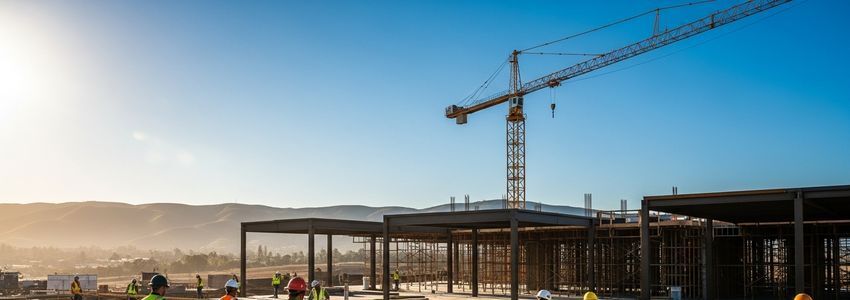
California's construction industry is one of the most active in the United States. From infrastructure overhauls in Los Angeles to commercial developments in Silicon Valley and residential booms in San Diego, construction companies across the state are in constant demand - yet constantly undercapitalized. Business loans for California construction companies provide the financial foundation that contractors, developers, and specialty trade firms need to bid larger projects, hire skilled workers, acquire heavy equipment, and bridge the gap between invoice and payment.
This guide covers everything California contractors need to know about business financing: loan types, qualification requirements, how Crestmont Capital can help, and a step-by-step path to securing funding for your next project.
In This Article
- Why California Construction Companies Need Financing
- Types of Business Loans for California Contractors
- How Construction Business Loans Work
- California Construction Financing by the Numbers
- How to Qualify for a Construction Business Loan
- Comparing Loan Options for California Contractors
- How Crestmont Capital Helps California Construction Businesses
- Real-World Financing Scenarios
- How to Get Started
- Frequently Asked Questions
Why California Construction Companies Need Financing
California's construction sector contributes more than $300 billion annually to the state's GDP, employing over 900,000 workers across residential, commercial, and civil categories. Despite that scale, most construction firms - especially contractors with under 50 employees - operate on tight margins and face persistent cash flow challenges that make ongoing financing essential rather than optional.
Several structural realities of the California construction market create a persistent need for capital. Payment cycles in construction are notoriously long. A general contractor may complete a major phase of work in March, submit a pay application, and not receive full payment until May or June. During that gap, payroll still runs weekly, subcontractors expect payment within 30 days, materials suppliers require deposits, and insurance premiums come due regardless of when clients pay.
Industry Fact: According to the Associated General Contractors of America, the average construction firm waits 60 to 90 days to receive payment after submitting a pay application. That gap represents the single largest cash flow challenge in the industry.
California adds another layer of complexity. Labor costs in California rank among the highest in the nation, with prevailing wage requirements on public projects pushing skilled trades above $80 per hour fully loaded. Environmental compliance costs, union obligations, workers' compensation insurance, and bonding requirements all create financial demands that vary sharply from one market to the next.
At the same time, the state's construction pipeline is extraordinary. The California Department of Transportation alone plans to spend more than $15 billion annually on transportation infrastructure. Private development in the tech corridor, multifamily residential construction, and healthcare facility expansion all generate ongoing demand. Contractors who can secure working capital and equipment financing are positioned to win larger contracts, move faster, and outbid underfunded competitors.
Types of Business Loans for California Contractors
Not every construction company has the same financing need. A specialty electrical contractor scaling from residential to commercial work has different requirements than a civil contractor managing a $20 million highway project. Understanding the available loan types allows California contractors to match financing to their specific situation.
Working Capital Loans
Working capital loans are short-term financing tools designed to cover operating expenses during periods when revenue lags behind costs. For construction companies, this typically means covering payroll, materials, subcontractor invoices, and overhead between pay application submissions and receipt of payment. Terms range from 6 to 24 months, with funding available in as little as 48 hours from an alternative lender.
Equipment Financing
California contractors rely on an enormous range of equipment - excavators, cranes, concrete mixers, compactors, forklifts, scaffold systems, and specialty tools that can cost hundreds of thousands of dollars. Equipment financing allows companies to acquire machinery through structured loans where the equipment itself serves as collateral. Repayment periods typically align with the equipment's useful life, and ownership transfers at payoff.
Equipment Leasing
Equipment leasing is an alternative to outright purchase that preserves cash flow and provides access to updated equipment without long-term depreciation risk. Operating leases keep equipment off the balance sheet, while capital leases function similarly to financing. For California contractors who need specialized equipment for a specific project duration, leasing often provides superior economics to purchasing.
SBA Loans
SBA loans - particularly the SBA 7(a) program - offer among the most competitive terms available to California construction companies. With amounts up to $5 million, repayment periods up to 25 years for real estate or 10 years for working capital, and interest rates tied to the prime rate, SBA loans are the gold standard for established contractors with strong financials. The SBA 504 program is ideal for owner-occupied commercial real estate or major equipment purchases.
Business Line of Credit
A business line of credit provides revolving access to capital up to a set limit. Contractors draw funds as needed and only pay interest on the outstanding balance. Lines of credit are well-suited to the unpredictable cash flow patterns of construction, where a single delayed payment or change order dispute can create a temporary capital shortfall that needs immediate resolution.
Construction Loans
For contractors developing their own real estate or building owner-occupied facilities, construction loans provide draw-based funding tied to project milestones. These loans convert to permanent financing at project completion and are typically structured through commercial banks with strong local market presence in California.
Invoice Financing and Factoring
California contractors with large outstanding receivables can access capital immediately by leveraging those invoices. Invoice financing allows companies to borrow against unpaid invoices, while factoring involves selling those invoices to a third party at a discount. Both solutions convert receivables to cash without waiting for client payment cycles.
Need Financing for Your California Construction Business?
Crestmont Capital funds construction companies across California with fast, flexible financing. No obligation - apply in minutes.
Apply Now →How Construction Business Loans Work
The mechanics of a business loan for a California construction company follow a straightforward sequence, though the details vary by loan type and lender. Understanding the process helps contractors prepare accurately and avoid common delays.
Step 1: Define Your Need. The most important step in securing a construction business loan is identifying exactly what the capital will accomplish. Lenders want to see a clear connection between the funding request and a business outcome - whether that's covering payroll on a specific project, purchasing equipment for a new contract, or building a buffer reserve for bidding season.
Step 2: Gather Financial Documentation. Lenders typically require 3 months of business bank statements, the last 2 years of business tax returns, a current profit and loss statement, and a balance sheet. For SBA loans or larger facilities, additional documentation including accounts receivable aging reports, contractor license information, and bonding documentation may be required.
Step 3: Submit Your Application. With alternative lenders like Crestmont Capital, the application process is streamlined. Basic company information, financial statements, and the funding amount are typically all that's required to receive a same-day decision on smaller requests.
Step 4: Underwriting and Approval. Lenders evaluate creditworthiness, cash flow stability, time in business, and the purpose of the loan. Alternative lenders weigh bank statement performance heavily, while traditional banks and SBA lenders focus more on tax returns and personal credit scores.
Step 5: Funding. Upon approval, funds are wired directly to your business bank account. Working capital loans and lines of credit from alternative lenders can fund within 24 to 72 hours. SBA loans and traditional bank loans typically require 30 to 90 days from application to funding.
California Construction Financing by the Numbers
By the Numbers
California Construction Industry - Key Statistics
$300B+
Annual contribution to California GDP
900K+
Construction workers employed statewide
60-90
Average days to receive payment after invoicing
$5M
Maximum SBA 7(a) loan amount available
How to Qualify for a Construction Business Loan
Qualification requirements vary significantly by lender type and loan product. California contractors with different credit profiles, revenue histories, and time in business will qualify for different programs. Here is a clear breakdown of what lenders typically look for.
Alternative Lender Requirements
Alternative lenders like Crestmont Capital offer the most accessible qualification criteria. Most programs require a minimum of 6 months in business, at least $150,000 in annual revenue, and a personal credit score of 550 or higher. Bank statements showing consistent deposit activity are the primary underwriting tool. These lenders can fund within 24 to 72 hours and do not require extensive collateral documentation for most working capital programs.
Traditional Bank Requirements
Commercial banks typically require a minimum of 2 years in business, strong personal credit (usually 680+), detailed financial statements, and collateral to back the loan. The tradeoff is lower interest rates and longer repayment terms. Banks are best suited for established California contractors with clean financials who have time for a 30 to 60-day underwriting process.
SBA Loan Requirements
SBA loans have the most rigorous qualification process but offer the best long-term terms. Requirements include 2+ years in business, personal credit of 650+, demonstrated ability to repay from business cash flow, adequate collateral when available, and a completed SBA application package including personal financial statements, business financial statements, and a business plan for startup or expansion scenarios.
Equipment Financing Requirements
Construction equipment financing is often easier to qualify for than unsecured loans because the equipment itself serves as collateral. Lenders focus heavily on the equipment's value relative to the loan amount. Even contractors with challenged credit can often secure equipment financing with a larger down payment or by choosing equipment with strong resale value.
Pro Tip: California contractors bidding on public projects are typically required to be bonded. A strong bonding relationship and bond capacity history can significantly improve your profile with lenders, as it signals project management capability and financial stability.
Comparing Loan Options for California Contractors
| Loan Type | Best For | Amount Range | Speed to Fund | Min. Credit Score |
|---|---|---|---|---|
| Working Capital Loan | Payroll, materials, overhead | $25K - $500K | 24 - 72 hours | 550+ |
| Equipment Financing | Heavy machinery, vehicles | $25K - $5M+ | 3 - 7 days | 600+ |
| Business Line of Credit | Flexible recurring needs | $10K - $500K | 3 - 5 days | 600+ |
| SBA 7(a) Loan | Long-term growth, best rates | $50K - $5M | 30 - 90 days | 650+ |
| Invoice Financing | Unlocking outstanding receivables | Up to 90% of invoice | 1 - 3 days | 550+ |
| Traditional Bank Loan | Established businesses, low rates | $100K - $10M+ | 30 - 60 days | 680+ |
Ready to Fund Your Next California Construction Project?
Our team specializes in construction financing across California. Get matched with the right program for your business size and project type.
Get Funded Today →
How Crestmont Capital Helps California Construction Businesses
Crestmont Capital is rated the #1 business lender in the United States, and California construction companies represent one of our most active client segments. We understand the specific financial rhythms of the construction industry - the long payment cycles, the equipment-intensive nature of the work, the seasonal variability in project volume, and the importance of moving quickly when a contract opportunity arises.
Our team works directly with California general contractors, specialty subcontractors, civil engineering firms, commercial builders, and residential developers to structure financing that fits the project, not just the balance sheet. Whether you need $50,000 to cover payroll during a payment delay or $2 million in construction equipment financing for a new contract, we have programs designed for your situation.
California-specific factors we account for in our underwriting include prevailing wage project requirements, CSLB license status, bonding capacity, insurance requirements under California Labor Code, and the state's unique mechanic's lien rules. Our advisors understand these dimensions of the California construction market and can help structure financing that works within your existing contractual and compliance obligations.
We also offer business lines of credit that California contractors can draw from on-demand throughout the year, providing a standing reserve of capital without requiring repeated applications. This is particularly valuable for companies with multiple simultaneous projects that have staggered payment timelines.
For contractors seeking SBA financing, our team guides clients through the complete SBA application process, helping prepare the financial package, identify the right program (7(a) vs. 504), and work with SBA preferred lenders to accelerate approval timelines. Our SBA clients in California have used these programs to acquire real estate for company headquarters, purchase major equipment, and fund strategic acquisitions of competing firms.
Real-World Financing Scenarios for California Contractors
Abstract descriptions of loan products are less useful than concrete examples. Here are six scenarios that reflect the actual financing situations California construction companies bring to Crestmont Capital.
Scenario 1: Bridging a 90-Day Payment Gap on a Caltrans Project
A mid-size paving contractor based in Fresno won a $4.5 million Caltrans contract. Work began immediately, but the state's pay application schedule meant invoices submitted in the first two months would not be paid for 60 to 90 days. The contractor had $180,000 in immediate payroll and material commitments. A $250,000 working capital loan funded within 48 hours covered the gap, allowing the company to execute the project without interrupting operations.
Scenario 2: Acquiring an Excavator for a New Multifamily Project
A general contractor in San Diego won a bid on a 60-unit multifamily development. The project required a large excavator the company did not own. Renting for the project duration would cost $85,000. Equipment financing allowed the contractor to acquire a $220,000 excavator, reduce per-project equipment costs, and build an asset the company could use on future projects - turning a project expense into a long-term business investment.
Scenario 3: An Electrical Subcontractor Scaling to Commercial Work
A licensed electrical contractor in Sacramento had operated exclusively in the residential market for 8 years. A commercial general contractor offered a significant subcontract on a 200,000 square foot office development, but the project required upfront material procurement of $300,000 before the first pay application was submitted. An invoice financing arrangement against the signed subcontract provided immediate access to working capital and allowed the contractor to accept the opportunity.
Scenario 4: A Roofing Company Managing Three Simultaneous Projects
A roofing contractor operating across Los Angeles County secured three contracts simultaneously totaling $1.8 million in work. Managing payroll across three crews, ordering materials for each project, and maintaining insurance and bonding premiums created a combined capital demand of $400,000 beyond the company's reserves. A revolving business line of credit gave the owner on-demand access to capital as needed across all three projects, drawn down and repaid in sync with actual payment receipts.
Scenario 5: Purchasing a Yard and Office Facility
After 12 years renting yard space and office facilities in the Bay Area, a civil contractor was offered the chance to purchase the property they occupied for $2.1 million. An SBA 504 loan provided 90% financing with a 25-year term and a fixed interest rate - significantly lower than any conventional commercial real estate loan the contractor had been quoted. The purchase eliminated $18,000 per month in rent and created a significant balance sheet asset.
Scenario 6: Winter Preparation for a Mountain-Region Contractor
A contractor serving mountain communities in the Sierra Nevada faced a predictable seasonal cash flow problem every November through February, when project volume dropped but overhead continued. A $150,000 working capital loan taken in October each year allowed the company to bridge the slow period, retain key employees, and maintain equipment, positioning for fast ramp-up when spring construction season began.
Important: California construction companies often have the highest funding needs at exactly the moment when traditional banks move slowest. Alternative lenders like Crestmont Capital are specifically built to serve this gap - providing fast decisions when timing is critical to a project's success.
How to Get Started
Complete our quick application at offers.crestmontcapital.com/apply-now - takes just a few minutes. No credit impact for initial inquiry.
A Crestmont Capital advisor who understands the California construction market will review your needs, your project pipeline, and your current financials to identify the best financing structure for your situation.
Once approved, funds are wired directly to your business account. Working capital and line of credit programs typically fund within 24 to 72 hours. Equipment financing typically completes within 3 to 7 business days.
California Contractors: Apply in Minutes
Join thousands of construction businesses funded by Crestmont Capital. Fast decisions, flexible terms, California expertise.
Start Your Application →Frequently Asked Questions
What types of loans are available for California construction companies?
California construction companies can access working capital loans, equipment financing, business lines of credit, SBA 7(a) and 504 loans, invoice financing, and traditional bank term loans. The right option depends on your credit profile, time in business, revenue history, and the specific purpose of the financing.
How fast can a California construction company get funded?
With alternative lenders like Crestmont Capital, many California construction companies receive working capital and line of credit approvals within 24 hours and funding within 48 to 72 hours of application. Equipment financing typically completes in 3 to 7 business days. SBA and bank loans take 30 to 90 days.
What credit score is needed to get a construction business loan in California?
Requirements vary by lender and loan type. Alternative lenders like Crestmont Capital work with credit scores as low as 550 for working capital programs. Equipment financing typically requires 600+. SBA and bank programs generally require 650 to 680 or higher. Revenue, time in business, and cash flow stability all factor alongside credit score.
Can a California contractor get a loan with bad credit?
Yes. Alternative lenders and equipment financing programs are available to California contractors with challenged credit. Lenders focus heavily on cash flow and revenue rather than credit score alone. For equipment purchases, the machinery's value as collateral also reduces the impact of credit score on approval decisions. Being bonded and licensed in California can also strengthen your application.
What documents are required for a California construction business loan?
Most lenders require 3 months of business bank statements, the last 1 to 2 years of business tax returns, a government-issued ID, and your CSLB contractor license number. For larger loans, you may also need a profit and loss statement, balance sheet, accounts receivable aging report, and bonding documentation. SBA loans require a comprehensive application package.
How much can a California construction company borrow?
Loan amounts range from $25,000 for small working capital needs to $5 million or more for SBA loans, equipment packages, or commercial real estate. The maximum borrowing amount is determined by your annual revenue, cash flow, creditworthiness, and the specific purpose of the loan. Alternative lenders typically offer up to $500,000 for working capital programs.
Are construction business loans in California tax deductible?
The interest paid on business loans is generally deductible as a business expense. Equipment financing may qualify for depreciation deductions under IRS rules. However, specific tax treatment depends on the loan structure, how funds are used, and your accounting method. Consult a qualified CPA or tax advisor familiar with California construction business taxation for guidance specific to your situation.
Do I need to be licensed by the CSLB to get a construction business loan?
Most lenders require that California construction companies hold an active California State License Board (CSLB) license for the work they perform. An active license signals professional legitimacy and reduces lender risk. Some general working capital lenders do not verify license status, but SBA lenders and equipment financing companies typically confirm active licensure as part of underwriting.
Can a new California construction company get a business loan?
Companies with less than 6 months in business have limited options with traditional and alternative lenders. The most accessible options for newer construction businesses include startup equipment financing programs (using the equipment as collateral), SBA microloans, CDFI lending programs, and personal credit-backed business loans. After 6 months of operating history and consistent bank statement deposits, significantly more options become available.
What is invoice financing and how does it help California contractors?
Invoice financing allows California contractors to borrow against unpaid invoices or pay applications. If you have submitted a $200,000 pay application that won't be paid for 60 days, invoice financing can advance 70 to 90% of that amount immediately. This eliminates the wait for payment and allows the business to continue operating at full capacity without delay. It is particularly useful for subcontractors waiting on general contractors or prime contractors waiting on public agencies.
How does equipment financing work for California construction companies?
Equipment financing for construction companies works by using the machinery being purchased as collateral for the loan. The lender funds the full purchase price (or most of it), and the borrower repays over a structured term - typically 24 to 84 months depending on equipment type and value. Interest rates are generally lower than unsecured working capital loans because the collateral reduces lender risk. At payoff, full ownership transfers to the construction company.
What is an SBA 504 loan and is it useful for California contractors?
The SBA 504 loan is specifically designed for purchasing owner-occupied commercial real estate and major fixed assets. For California contractors, this is ideal for buying a company yard, office facility, or major production equipment. The program typically requires a 10% down payment, with the SBA providing 40% at a below-market fixed rate and a conventional lender providing the remaining 50%. It is one of the most favorable programs available for capital-intensive purchases.
How does prevailing wage affect my construction business loan?
California's prevailing wage requirements on public works projects significantly increase labor costs compared to private work. Lenders see prevailing wage projects as a mixed signal - they represent stable, government-backed revenue but also require higher cash outlays before payment is received. When applying for a loan related to a prevailing wage project, be prepared to document the contract value, payment schedule, and your labor cost structure so the lender can accurately assess your repayment capacity.
Can I use a business loan to cover bonding and insurance costs?
Yes. Working capital loans and lines of credit can be used to cover bonding premiums, insurance renewals, workers' compensation deposits, and other compliance costs that are essential to staying licensed and bonded in California. Some specialty lenders also offer premium financing programs specifically for insurance and bonding costs in the construction industry.
How is Crestmont Capital different from a traditional bank for construction lending?
Crestmont Capital offers faster approvals (24 to 72 hours vs. 30 to 90 days), lower credit score requirements (550+ vs. 680+), a focus on real business cash flow rather than historical tax returns, and dedicated construction industry expertise. While bank rates may be lower for highly qualified borrowers, the speed, accessibility, and flexibility of Crestmont Capital's programs provide value that traditional banks simply cannot match for most California contractors.
Disclaimer: The information provided in this article is for general educational purposes only and is not financial, legal, or tax advice. Funding terms, qualifications, and product availability may vary and are subject to change without notice. Crestmont Capital does not guarantee approval, rates, or specific outcomes. For personalized information about your business funding options, contact our team directly.