
 (800) 949-0401
Blow Molding Machine Financing: The Complete Guide for Business Owners
Blow molding machine financing gives plastics manufacturers a way to acquire extrusion, injection, and stretch blow molding equipment without paying six or seven figures in cash upfront. Whether you are launching a new bottling line, replacing an aging machine, or scaling production to meet a new customer contract, structured financing lets you put equipment to work now while spreading the cost over its useful life. This guide walks through every financing option available, what lenders look for, and how to move quickly once you identify the machine you need.
In This Article
- What Is Blow Molding Machine Financing?
- Types of Blow Molding Machines You Can Finance
- Key Benefits of Financing
- How Blow Molding Machine Financing Works
- Rates, Terms, and What to Expect
- How to Qualify
- Who Blow Molding Financing Is Best For
- Comparing Your Financing Options
- How Crestmont Capital Helps
- Real-World Scenarios
- How to Get Started
- Frequently Asked Questions
What Is Blow Molding Machine Financing?
Blow molding machine financing is a category of equipment financing that helps manufacturers purchase or lease the specialized machines used to produce hollow plastic parts such as bottles, containers, drums, and automotive components. Blow molding equipment ranges from compact single-station units priced around $75,000 to large multi-station or high-output rotary systems that can exceed $1 million. Because the machine itself typically serves as collateral, lenders can move faster and with less friction than they would on a general-purpose business loan.
According to the U.S. Small Business Administration, equipment financing remains one of the most widely used capital tools for small and mid-sized manufacturers precisely because it preserves working capital while still enabling growth. A blow molding line represents a major capital commitment, and few manufacturers can absorb that cost from cash reserves without disrupting day-to-day operations.
The basic mechanics are simple: a lender advances funds to cover the machine's purchase price, and the borrower repays through fixed monthly installments over a term generally running 36 to 84 months. At the end of the term, depending on the structure chosen, the manufacturer either owns the equipment outright or exercises a buyout option under a lease agreement.
Industry Fact: The U.S. plastics industry employs more than 900,000 workers and generates over $450 billion in annual shipments, according to data compiled by the Plastics Industry Association. Blow molded packaging, containers, and automotive parts represent a significant share of that output, and reliable equipment financing keeps production lines current.
Types of Blow Molding Machines You Can Finance
Blow molding is not a single process. It covers several distinct machine categories, each suited to different materials, part geometries, and production volumes. Lenders who specialize in manufacturing equipment understand the differences and structure financing accordingly.
Extrusion Blow Molding Machines
Extrusion blow molding machines are the most common type used for producing bottles, jugs, and containers with uniform wall thickness needs. They range widely in price, from around $75,000 for a single-head unit to well over $500,000 for high-output continuous extrusion systems. Their broad use across the packaging industry makes them relatively easy for lenders to underwrite.
Injection Blow Molding Machines
Injection blow molding machines produce small, precision hollow parts such as medical vials and cosmetic containers where tight neck tolerances matter. These machines often carry a higher price tag due to their precision tooling requirements, typically ranging from $150,000 to $600,000, and are frequently financed alongside specialized mold tooling.
Stretch Blow Molding Machines
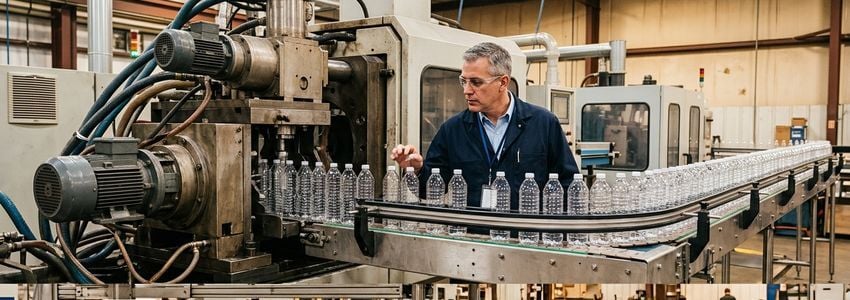
Stretch blow molding, including two-stage and one-stage systems, is the standard process for producing PET bottles used in beverage and food packaging. These machines can range from $100,000 for entry-level systems to several million dollars for high-speed rotary lines used by large beverage bottlers. Because of their strong resale market and widespread industry use, they are among the easier blow molding assets to finance.
Rotary and Multi-Station Blow Molding Systems
High-output rotary systems handle continuous, high-volume production runs and represent the largest capital outlay in the category, often exceeding $1 million. Lenders typically require more detailed financial documentation for transactions at this size, but financing remains available through equipment finance companies and larger banks.
Auxiliary and Support Equipment
Mold cooling systems, trim presses, leak testers, conveyors, and material handling equipment can be financed alongside the primary blow molding machine or as a separate facility. Many manufacturers bundle auxiliary equipment into a single financing transaction to simplify documentation and create one predictable monthly payment.
By the Numbers
Blow Molding Equipment Financing - Key Statistics
$75K-$1M+
Typical equipment cost range lenders finance
36-84
Months available for repayment terms
2-5 Days
Typical funding timeline with alternative lenders
100%
Of equipment cost can often be financed
Key Benefits of Blow Molding Machine Financing
Manufacturers who finance blow molding equipment rather than paying cash outright gain several practical advantages that go beyond simply spreading out payments.
- Preserves working capital: Cash stays available for resin purchases, tooling, labor, and unexpected production needs instead of being tied up in a single asset.
- Builds business credit: On-time payments reported to commercial credit bureaus strengthen your business credit profile for future financing needs.
- Matches payments to useful life: Loan or lease terms can be structured to align with the 7 to 15 year useful life typical of blow molding machines.
- Enables faster capacity growth: Financing lets you add production capacity immediately in response to a new contract rather than waiting months to accumulate cash reserves.
- Predictable budgeting: Fixed monthly payments make it easy to forecast costs without the surprises that come with variable-rate credit lines.
Ready to Finance Your Blow Molding Machine?
Get fast, flexible financing from the #1 business lender in the U.S. No obligation - apply in minutes and get a decision quickly.
Apply Now →How Blow Molding Machine Financing Works
Understanding the step-by-step process helps you move quickly once you identify the right machine and vendor.
Quick Guide
How Blow Molding Machine Financing Works - At a Glance
Provide basic business details, credit information, and specifics on the machine you want to finance.
The lender evaluates credit, business financials, and the equipment. Smaller transactions are often reviewed within 24-48 hours.
You receive a loan or lease agreement outlining rate, term, monthly payment, and any end-of-term options.
The lender pays the equipment vendor directly. The machine is delivered, installed, and commissioned.
Monthly payments typically begin within 30 days of funding, often once the machine is running production.
Lenders distinguish between new and used equipment when structuring financing. New machines typically qualify for higher advance rates, sometimes up to 100% of the purchase price, while used equipment usually requires an appraisal or dealer invoice and sees advance rates of 80-90% of fair market value. Most lenders will finance blow molding machines up to 12-15 years old, provided maintenance records and condition documentation support the valuation.
Rates, Terms, and What to Expect
Interest rates and terms for blow molding machine financing vary based on several factors. Understanding the typical ranges helps you evaluate offers intelligently and negotiate from a position of knowledge rather than accepting the first quote you receive.
Interest Rates
Blow molding equipment financing rates generally run from 5% to 25% APR depending on the applicant's credit score, years in business, revenue, and the type and age of the machine. Strong borrowers with established manufacturing operations, credit scores above 680, and multi-year revenue histories qualify for rates at the lower end of that range. Newer businesses or those with credit challenges typically pay more, but financing remains accessible through alternative lending channels built for exactly this situation.
Loan Terms
Terms for blow molding equipment financing typically run from 36 to 84 months. Shorter terms carry higher monthly payments but reduce total interest paid over the life of the loan. Longer terms lower the monthly payment while increasing total financing cost. Many manufacturers target 60-month terms as a middle ground that keeps payments manageable without stretching the obligation well beyond the machine's most productive years.
Down Payments
Conventional bank equipment loans may require a down payment of 10-20%, while many equipment finance companies and alternative lenders offer 0% down programs for qualified borrowers on new equipment. Leases typically require the equivalent of 1-3 months of payments upfront rather than a traditional down payment structure.
Collateral
In most blow molding equipment transactions, the financed machine itself serves as the primary collateral through a UCC-1 filing. Some lenders, particularly on larger transactions or for businesses with thinner credit files, may require additional collateral or a personal guarantee from the business owner.
How to Qualify for Blow Molding Machine Financing
Lenders evaluate blow molding financing applications using a mix of financial and business factors. Understanding what matters most helps you position your application for the strongest possible approval.
Credit Score
Personal credit scores in the 620-680 range are typically the minimum threshold for mainstream equipment lenders. Scores above 700 unlock meaningfully better rates and terms. Business credit scores through Dun and Bradstreet, Experian Business, and Equifax Business are also reviewed when available and can strengthen an otherwise average application.
Time in Business
Most equipment lenders want to see at least 1-2 years of operating history. Certain specialty programs will work with businesses operating for as little as 6 months when the owner brings strong personal credit and relevant plastics industry experience to the table.
Revenue and Cash Flow
Lenders need confidence that your business generates enough consistent revenue to service the new debt. Most require annual revenue of at least $150,000-$300,000 for blow molding equipment transactions, though requirements vary by lender and loan size. Bank statements covering 3-6 months of activity are the most common documentation requested during underwriting.
Equipment Details
You will need to provide details about the specific machine you want to finance: make, model, year, station count or output rate, condition, purchase price, and vendor information. For used equipment, an appraisal or dealer invoice helps the lender establish fair market value quickly.
Financial Statements
For transactions above $250,000, most lenders will request 2 years of business tax returns and year-to-date profit and loss statements. Smaller transactions are frequently approved on a simplified documentation basis using bank statements alone, which speeds up the process considerably for lower-cost machines.
Who Blow Molding Financing Is Best For
Blow molding machine financing fits a wide range of manufacturers, though the best structure depends on your specific situation.
Established Custom Molders Adding Capacity
Contract manufacturers with several years of operating history and a new customer contract in hand are typically the strongest candidates. Stable cash flow and a proven track record allow these businesses to access the most competitive rates and terms.
Beverage and Packaging Companies Scaling Production
Companies moving from co-packing arrangements to in-house production often need a stretch blow molding line to control quality and reduce per-unit costs. Financing allows this transition without a disruptive capital outlay.
Startups Entering Contract Manufacturing
Entrepreneurs with relevant industry experience and strong personal credit can often secure financing for used equipment even without an extensive operating history, particularly when a signed customer contract supports the application.
Manufacturers Replacing Aging or Failed Equipment
When a machine breaks down unexpectedly, fast-turnaround financing prevents a production line from sitting idle and protects customer relationships that depend on consistent delivery schedules.
Pro Tip: Blow molding equipment is highly self-liquidating - a properly utilized machine running consistent production runs generates revenue that can cover its monthly payment within a handful of production cycles on a typical packaging contract.
Comparing Your Financing Options
Manufacturers have several distinct paths to financing blow molding equipment. Each has different qualification requirements, timelines, and costs.
| Financing Option | Typical Rate Range | Approval Timeline | Best For |
|---|---|---|---|
| Traditional Bank Loan | 5-9% APR | 30-90 days | Established manufacturers, strong financials |
| SBA Equipment Loan | Prime + 1-3% | 60-90 days | Longer terms, lower down payment needs |
| Equipment Finance Company | 7-18% APR | 24-72 hours | Speed, flexible qualification |
| Alternative Business Lender | 10-25% APR | 1-3 days | Time-sensitive purchases, credit challenges |
| Manufacturer/Dealer Financing | Varies widely | 1-2 weeks | Convenience, but compare rates carefully |
Traditional bank loans offer the lowest rates but come with the most stringent qualification requirements and the longest timelines. The SBA 7(a) loan program can also be used for equipment purchases and offers competitive government-backed rates, though the approval process takes longer than most manufacturers can wait when a production opportunity is time-sensitive. Equipment finance companies and alternative lenders bridge that gap with faster decisions built around the equipment's value and the business's cash flow.
How Crestmont Capital Helps Manufacturers
Crestmont Capital specializes in equipment financing for manufacturers across the country, including blow molding, extrusion, and plastics processing operations. Our team understands the operational realities of running a molding line - resin cost swings, tooling investment, and production uptime pressure - and structures financing that fits the business rather than forcing the business into a generic lending box.
We offer both term financing and equipment leasing for blow molding machines, whether you are purchasing new equipment from an OEM or acquiring a used line from another manufacturer. Financing amounts from $50,000 to several million dollars are available with terms structured to match the useful life of the equipment.
Most applicants receive a decision within 24 hours of submitting a completed application. We work with businesses across the credit spectrum, including manufacturers with limited operating history or past credit challenges, and we are not limited to only the strongest applicants on paper.
Our Advantage: Crestmont Capital is rated the #1 business lender in the U.S. We offer flexible terms, fast approvals, and dedicated manufacturing finance specialists who understand blow molding operations and can structure financing that fits your production goals.
Manufacturers working with Crestmont can also access working capital loans to bridge cash flow gaps between equipment installation and first production revenue, or a business line of credit to manage day-to-day expenses like resin purchases and payroll while a new machine ramps up. For businesses that have questions about the paperwork lenders file against financed equipment, our UCC filing guide explains what these filings mean in practice.
Get Approved for Manufacturing Equipment Financing
Crestmont Capital works with manufacturers at every stage, from startups to established plants. Apply today and get a fast decision.
Get Your Quote →Real-World Scenarios
Scenario 1: New Beverage Contract Requires Additional Capacity
A regional co-packer lands a multi-year contract to bottle a new sports drink brand. The contract requires a dedicated stretch blow molding line priced at $320,000. Rather than draining cash reserves, the owner finances the machine over 60 months. The predictable monthly payment is built into the project's per-unit cost model, and the machine is installed and running within four weeks of application.
Scenario 2: Upgrading from Manual to Automated Systems
A container manufacturer in the Midwest needs to replace two aging single-station extrusion blow molding machines with one automated multi-station system to meet tightening customer quality specifications. The $650,000 upgrade is financed over 72 months, and the labor savings from automation help offset the monthly payment while improving part consistency.
Scenario 3: Startup Entering Custom Bottle Manufacturing
An entrepreneur with 15 years of plastics industry experience launches a custom bottle manufacturing business. With strong personal credit and a signed letter of intent from a regional cosmetics brand, they secure financing for a used injection blow molding machine and matching tooling through a lender specializing in manufacturing equipment. Production begins within 45 days of the business launch.
Scenario 4: Emergency Equipment Replacement
A packaging company's primary extrusion blow molding machine suffers a catastrophic failure. The repair estimate exceeds the value of continuing to run the aging unit. The company secures same-day approval on financing for a replacement machine and has it ordered within 48 hours, preventing a costly production shutdown and protecting a key customer relationship. According to Forbes research on small business resilience, the ability to access fast capital is consistently cited as a top factor separating businesses that recover quickly from equipment failures from those that lose customers over extended downtime.
Scenario 5: Diversifying into Industrial Parts
A packaging-focused molder wants to diversify into automotive blow molded components, such as ducting and fluid reservoirs, to reduce reliance on a single industry. Financing a specialized machine configured for engineering-grade resins allows the shop to enter the new market without disrupting existing packaging production lines.
Scenario 6: Multi-Machine Facility Expansion
A growing plastics processor opens a second production facility and finances four blow molding machines, installation infrastructure, and mold cooling systems through a combination of equipment loans and a capital equipment financing facility. The structured approach allows machines to be added independently as the new facility's order volume grows.
How to Get Started
Get a firm quote from the vendor or dealer, including model, year, condition, and price. This speeds up underwriting significantly.
Complete our quick application at offers.crestmontcapital.com/apply-now. It takes just a few minutes and you can upload documents directly.
A Crestmont Capital advisor will review your application, discuss your production goals, and match you with the right financing structure.
Once approved, funds are released to the vendor. Your machine is ordered, delivered, and installed as quickly as the vendor can deliver.
Conclusion
Blow molding machine financing is the most practical path for most manufacturers to acquire the equipment they need to grow, replace aging machines, or respond to new customer contracts. With options ranging from traditional bank loans to fast-turnaround alternative lending, there is a financing structure suited to nearly every business situation, whether you are a startup entering contract manufacturing or an established plant scaling production. The key is choosing the right structure for your ownership goals and cash flow position, working with a lender who understands plastics manufacturing, and moving quickly when the right opportunity arises. Crestmont Capital is ready to help you finance your next blow molding machine with competitive terms and fast decisions. Apply today and get your production moving forward.
Frequently Asked Questions
Disclaimer: The information provided in this article is for general educational purposes only and is not financial, legal, or tax advice. Funding terms, qualifications, and product availability may vary and are subject to change without notice. Crestmont Capital does not guarantee approval, rates, or specific outcomes. For personalized information about your business funding options, contact our team directly.








