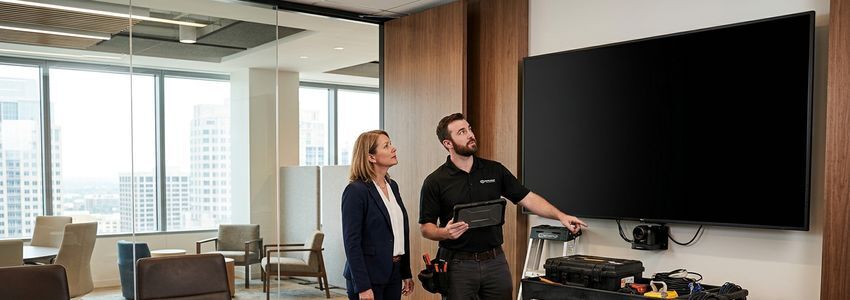
Every corporate headquarters, hospital system, school district, hotel chain, house of worship, and government agency that wants to look and sound professional eventually runs into the same problem: the AV equipment they need costs far more than a single check can comfortably cover. AV integration equipment financing solves that problem by letting a business spread the cost of a full audio-visual build-out over time, instead of draining cash reserves or delaying a project the organization actually needs today.
AV integration is different from simply buying a projector or a soundbar off a shelf. It is the design, procurement, and installation of a complete system, video walls, conferencing hardware, control processors, digital signage networks, distributed audio, and the cabling and programming that ties it all together into something a non-technical employee can operate with the touch of a button. Projects like this routinely run from the low five figures for a single conference room to seven figures for a corporate campus or a hotel renovation, which is exactly why financing has become the default way most businesses fund AV integration work rather than the exception.
In This Article
- What Is AV Integration Equipment Financing?
- Types of AV Integration Equipment You Can Finance
- Key Benefits of Financing
- How It Works
- Loan vs. Lease: Which Is Right for You?
- How Much Can You Borrow and Who Qualifies
- Industries That Rely on AV Integration
- How Crestmont Capital Helps
- Real-World Scenarios
- Comparing Your Financing Options
- Tips to Improve Your Approval Odds
- Frequently Asked Questions
- Next Steps
What Is AV Integration Equipment Financing?
AV integration equipment financing is a business funding solution that allows a company to acquire a complete audio-visual system, hardware, cabling, control equipment, and often the installation labor bundled into the financed amount, and repay it through fixed monthly payments over a set term. Instead of writing one large check to an integrator before a project starts, the business pays a manageable monthly amount while using the finished system immediately.
The term "AV integration" refers to the process of combining individual audio and video components, displays, speakers, microphones, cameras, control processors, and network switches, into a single, unified system that behaves as one seamless experience for the end user. A well-integrated conference room, for example, lets an employee walk in, tap one button on a touch panel, and instantly have the display, camera, microphone, and video conferencing software all working together. Financing this kind of build-out means a business does not have to choose between having modern AV capability and preserving working capital for payroll, inventory, or other operating needs.
Most AV integration financing is structured as either an equipment loan, where the business owns the system from day one and simply repays the lender over time, or an equipment lease, where the business makes payments for use of the system and has options at the end of the term to purchase, return, or upgrade the equipment. Both structures accomplish the same underlying goal: converting a large capital expense into a predictable operating cost that fits inside a monthly budget.
Key Stat: According to the U.S. Small Business Administration, the average SBA 7(a) loan in fiscal year 2024 was approximately $443,097, a figure that lines up closely with the cost of a mid-size corporate AV integration project, including conference rooms, digital signage, and a boardroom video wall.
Types of AV Integration Equipment You Can Finance
AV integration financing is not limited to a single piece of equipment. Most lenders, including Crestmont Capital, will finance the full scope of a project, hardware, cabling, mounting infrastructure, and labor, as a single package. Common categories include:
- Conference room and huddle room systems: displays, cameras, microphones, speakers, and touch-panel control systems for video conferencing
- Video walls and large-format displays: LED walls, LCD video wall arrays, and interactive displays for lobbies, command centers, and boardrooms
- Digital signage networks: media players, mounted displays, and content management software distributed across multiple locations
- Distributed audio systems: ceiling speakers, amplifiers, and zone controllers for restaurants, retail spaces, and multi-room facilities
- Control and automation systems: centralized processors that tie lighting, shades, audio, and video into a single interface
- Broadcast and streaming equipment: cameras, switchers, and encoders for houses of worship, corporate town halls, and training facilities
- Network infrastructure supporting AV: switches, cabling, and rack equipment required to run modern AV-over-IP systems
- Installation labor and programming: many lenders will roll the integrator's labor and system programming costs into the total financed amount
Because AV integration projects almost always combine multiple categories at once, most financing is structured around the total project invoice from the integrator rather than itemized equipment lists. This is one of the biggest advantages of financing over a traditional equipment loan for a single machine: the entire scope of work, hardware and labor together, can be wrapped into one predictable payment.
Key Benefits of Financing AV Integration Equipment
- Preserve working capital: keep cash available for payroll, inventory, and day-to-day operations instead of tying it up in a single large purchase
- Get the complete system now: avoid a phased, incomplete rollout that leaves some rooms or locations without modern AV capability
- Predictable monthly budgeting: fixed payments make it easy to forecast cash flow rather than absorbing one large hit to the balance sheet
- Match payments to the equipment's useful life: AV systems typically remain useful for 5 to 7 years, and financing terms can be structured to match that timeline
- Potential tax advantages: financed equipment may qualify for accelerated depreciation treatment; a tax professional can confirm what applies to your specific situation
- Faster project approval: many organizations find it easier to get a monthly operating expense approved internally than a single large capital expenditure
- Flexibility to upgrade: leasing structures in particular make it easier to refresh technology at the end of a term rather than being stuck with aging equipment
Ready to Upgrade Your AV Systems?
Get pre-qualified for AV integration equipment financing in minutes. No obligation, no impact to your credit score to check your options.
Apply Now →How AV Integration Equipment Financing Works
The financing process for an AV integration project generally follows the same core steps regardless of lender, though timelines and documentation requirements can vary based on project size.
- Get a project quote from your AV integrator. Most lenders finance based on a formal proposal or invoice from the integrator that itemizes hardware, materials, and labor.
- Submit a financing application. This typically includes basic business information, time in business, and recent bank statements. Larger projects may require financial statements or tax returns.
- Receive underwriting decision. Smaller projects (under roughly $100,000) can often be approved within 24 to 48 hours. Larger, multi-phase projects may take one to two weeks for full underwriting.
- Review and sign financing documents. Terms, rate, and payment schedule are finalized and the equipment schedule or purchase order is confirmed with the integrator.
- Funding is released. The lender pays the integrator directly, or in some structures reimburses the business, and the installation project begins or continues.
- Begin fixed monthly payments. Payments start once the system is delivered or, in some structures, once installation is substantially complete.
Terms for AV integration financing commonly range from 24 to 84 months, depending on project size and the expected useful life of the equipment. Larger, infrastructure-heavy projects, such as a full building AV-over-IP rollout, often qualify for the longer end of that range since the underlying equipment has a longer service life.
AV Integration Loan vs. Lease: Which Is Right for You?
Businesses financing an AV integration project generally choose between two structures: an equipment loan or an equipment lease. Each has real tradeoffs depending on how long the business expects to use the system and how it wants the expense to appear on its books.
| Feature | Equipment Loan | Equipment Lease |
|---|---|---|
| Ownership | You own the system from day one | Lender owns it; you have purchase/return/upgrade options at end of term |
| Upfront Cost | Often requires a down payment | Frequently $0 down |
| Best For | Businesses planning to keep the system for its full useful life | Businesses that expect to upgrade technology every 3 to 5 years |
| End of Term | Loan is paid off, no further action needed | Choose to buy out, return, or refresh equipment |
| Monthly Payment | Typically higher due to ownership | Often lower, spreading cost further |
Organizations that view their AV system as long-term infrastructure, such as a permanent boardroom or a broadcast studio, tend to prefer a loan structure so the system is fully owned once payments are complete. Businesses that operate in fast-changing environments, corporate offices adapting to hybrid work, hospitality brands refreshing guest-facing technology, often prefer a lease so they can refresh hardware before it becomes outdated.

How Much Can You Borrow and Who Qualifies?
Financing amounts for AV integration projects generally range from as little as $10,000 for a single conference room to several million dollars for a full corporate campus or hotel-wide rollout. Most lenders base the approved amount on the total project invoice from the integrator rather than a percentage of business revenue, which means the financing amount scales directly with the scope of the AV build-out.
Typical qualification requirements include:
- At least 1 to 2 years in business (though some lenders work with newer businesses backed by strong personal credit)
- Personal credit score of approximately 600 or higher for standard rates; businesses with lower scores may still qualify through alternative financing structures
- Minimum monthly or annual revenue thresholds that vary by lender and project size
- A formal quote or invoice from a licensed AV integrator detailing the scope of work
- Recent business bank statements, typically 3 to 6 months
Larger organizations, hospital systems, school districts, and multi-location hospitality brands, often qualify for more favorable terms due to established credit history and predictable revenue, while smaller businesses and newer companies can still access financing through structures designed around cash flow rather than time in business alone.
Industries That Rely on AV Integration
AV integration is not limited to any single sector. Some of the industries that most frequently finance AV build-outs include:
- Corporate offices: conference rooms, huddle spaces, and town hall broadcast systems supporting hybrid work
- Hospitality: hotel meeting spaces, ballrooms, and guest-facing digital signage
- Healthcare: telemedicine suites, digital wayfinding, and patient education displays
- Education: lecture capture systems, interactive classroom displays, and campus-wide digital signage
- Houses of worship: broadcast and streaming systems, distributed audio, and overflow room video
- Government and municipal buildings: council chambers, courtrooms, and emergency operations centers
- Retail: digital signage networks and in-store video walls for brand experiences
- Entertainment venues: sports bars, event centers, and restaurants investing in large-format displays
The common thread across every one of these industries is the same: AV technology has moved from a nice-to-have amenity to a baseline expectation, and the businesses that finance the upgrade instead of delaying it are the ones that keep pace with client and employee expectations.
By the Numbers
AV Integration Financing - Key Statistics
73%
Full approval rate for equipment loans among small businesses that applied, per the Federal Reserve's Small Business Credit Survey
$443K
Average SBA 7(a) loan size in fiscal year 2024, in line with mid-size AV integration project budgets
24-84
Typical financing term range, in months, for AV integration equipment and installation
5-7 Yrs
Typical useful life of a commercial AV integration system before a technology refresh is needed
How Crestmont Capital Helps
Crestmont Capital works with businesses across every industry to structure financing around the realities of an AV integration project, not a rigid, one-size-fits-all equipment loan. Because AV build-outs almost always combine hardware, cabling, and labor into a single integrator invoice, Crestmont structures financing around the full project cost rather than requiring separate approvals for each line item.
For businesses that are financing AV integration as part of a broader technology upgrade, Crestmont's guide to financing technology upgrades covers how to sequence multiple projects, such as network infrastructure alongside a new conference room build-out, without overextending cash flow. Businesses evaluating a company-wide technology refresh may also find Crestmont's overview of financing new technology purchases useful for comparing loan and lease structures side by side.
Crestmont also finances the underlying computer and network equipment that supports modern AV-over-IP systems, as well as the broader telecommunications infrastructure many businesses upgrade at the same time as their AV systems. For technology-driven companies looking at financing beyond a single project, Crestmont's guide to business loans for technology companies outlines additional funding structures available. Whatever the scope, businesses can also explore general equipment leasing options to compare against a traditional loan structure before committing to a project.
Real-World Scenarios
Scenario 1: Corporate Headquarters Conference Room Refresh
A 200-employee professional services firm needed to upgrade eight conference rooms to support hybrid meetings after most staff shifted to a three-day office schedule. The integrator's quote for cameras, displays, microphones, and touch-panel control systems came to $340,000. Rather than pull that amount from reserves earmarked for a planned office expansion, the firm financed the project over 60 months, keeping capital available for the expansion while getting every room operational within six weeks.
Scenario 2: Hotel Ballroom and Meeting Space Upgrade
A 220-room independent hotel needed to replace aging projectors and sound systems across its ballroom and four breakout rooms ahead of a major conference booking. The $185,000 project was financed over 48 months, allowing the hotel to win the conference contract, which required modern AV capability as a condition of the booking, without disrupting cash flow during its slower season.
Scenario 3: House of Worship Broadcast System
A growing congregation wanted to add a livestream and overflow-room video system to accommodate attendance that had outgrown its main sanctuary. The $95,000 project, cameras, switchers, streaming encoders, and a second display system for an overflow room, was financed over 36 months using donation-based revenue projections, letting the congregation reach members who could not fit in the building.
Scenario 4: Multi-Location Retail Digital Signage Rollout
A regional retail chain with 14 locations wanted to install synchronized digital signage for promotions and wayfinding across every store. The $410,000 rollout, covering displays, media players, and centralized content management software, was financed over 60 months, letting the chain launch simultaneously across all locations instead of a slow, store-by-store rollout that would have delayed the marketing campaign it was built to support.
Get Your AV Project Off the Ground
Fast, flexible financing from the #1 rated business lender in the U.S. Get a decision in as little as 24 hours.
Apply Now →Comparing Your Financing Options
| Financing Type | Typical Term | Best For |
|---|---|---|
| Equipment Loan | 24-84 months | Businesses that want to own the system long-term |
| Equipment Lease | 24-60 months | Businesses expecting frequent technology refreshes |
| SBA 7(a) Loan | Up to 10 years for equipment | Established businesses with strong financials seeking the lowest rates |
| Working Capital Loan | 6-24 months | Smaller projects or businesses needing faster funding |
Tips to Improve Your Approval Odds
- Get a detailed, itemized quote from your AV integrator before applying, lenders move faster with a clear scope of work
- Have recent bank statements ready, most lenders want the last 3 to 6 months on hand
- Know your exact project timeline so financing can be structured to release funds when the integrator needs them
- Consider a lease if cash flow is tight, lower monthly payments can make approval easier for newer businesses
- Bundle related projects when it makes sense, financing network upgrades alongside AV equipment can sometimes secure better overall terms
Frequently Asked Questions
What is AV integration equipment financing?
AV integration equipment financing is a funding option that lets a business acquire a complete audio-visual system, hardware, cabling, and often installation labor, and repay the cost through fixed monthly payments instead of a single upfront purchase.
What can be included in an AV integration financing package?
Most lenders will finance the full project scope: displays, cameras, microphones, speakers, control processors, cabling, network switches, and the integrator's installation and programming labor, all bundled into a single financed amount.
How much does an AV integration project typically cost?
Costs vary widely by scope. A single conference room upgrade may cost $10,000 to $50,000, while a full corporate campus or hotel-wide rollout can run into the hundreds of thousands or low millions of dollars.
Is it better to lease or finance AV integration equipment?
A loan makes sense if you plan to keep the system for its full useful life and want to own it outright. A lease often makes more sense if you expect to refresh the technology every 3 to 5 years, since it usually carries a lower monthly payment.
How long does approval take for AV integration financing?
Smaller projects, generally under $100,000, are often approved within 24 to 48 hours. Larger, multi-phase projects may take one to two weeks for full underwriting review.
What credit score do I need to qualify?
A personal credit score of approximately 600 or higher typically qualifies for standard rates. Businesses with lower scores may still be able to secure financing through alternative structures, though terms may differ.
Do I need to already be working with an AV integrator to apply?
Most lenders require a formal quote or invoice from your integrator before finalizing terms, but you can often start the application and get pre-qualified before that quote is finished.
Can startups or newer businesses qualify for AV integration financing?
Yes, in many cases. While longer time in business often improves terms, lenders also evaluate personal credit, cash flow, and the strength of the integrator's proposal, which can help newer businesses qualify.
What is the typical repayment term for AV integration equipment?
Terms most commonly range from 24 to 84 months, depending on the size of the project and the expected useful life of the equipment being financed.
Can I finance labor and installation, not just hardware?
Yes. Most AV integration financing is structured around the integrator's full project invoice, which typically includes hardware, cabling, mounting, and labor together as one financed amount.
Are there tax benefits to financing AV integration equipment?
Financed equipment may qualify for depreciation or other tax treatment depending on how it is structured. Consult a qualified tax professional to understand what applies to your specific business and equipment purchase.
What happens at the end of an AV equipment lease?
You typically have three options at the end of a lease term: purchase the equipment at its remaining value, return the equipment, or upgrade to newer technology under a new agreement.
Can financing cover a multi-location AV rollout?
Yes. Businesses with multiple locations can often finance a synchronized rollout, such as digital signage or conference room systems across every site, as a single project rather than financing each location separately.
How is AV integration financing different from a general business loan?
AV integration financing is typically secured by the equipment itself and structured around a specific project invoice, which often makes it easier to qualify for and can carry more favorable terms than an unsecured general-purpose business loan.
How do I get started with AV integration equipment financing?
Start by getting a detailed quote from your AV integrator, then submit a financing application with basic business information and recent bank statements. Most businesses can get pre-qualified within minutes.
Next Steps
Request a detailed proposal from your AV integrator covering hardware, labor, and timeline.
Submit a quick application to see what financing you qualify for, with no impact to your credit score.
Compare loan and lease terms to find the structure that fits your project and cash flow.
Once approved, funds are released to your integrator so installation can begin or continue without delay.
Don't Let Budget Delay Your AV Project
Crestmont Capital helps businesses of every size fund complete AV integration projects. Apply in minutes and get a decision fast.
Apply Now →Conclusion
Av integration equipment financing gives businesses of every size, from a single corporate conference room to a multi-location retail signage rollout, a way to get modern AV capability in place today without derailing cash flow. Whether the right fit is a loan, a lease, or an SBA-backed structure, the goal is the same: match the payment schedule to how long you plan to use the system and get the project built without unnecessary delay.
If your business is planning an AV integration project of any size, talk to Crestmont Capital about structuring financing around your integrator's proposal so you can move forward with confidence.
Sources: U.S. Small Business Administration, U.S. Census Bureau Annual Business Survey, and Forbes Technology Council.
Disclaimer: The information provided in this article is for general educational purposes only and is not financial, legal, or tax advice. Funding terms, qualifications, and product availability may vary and are subject to change without notice. Crestmont Capital does not guarantee approval, rates, or specific outcomes. For personalized information about your business funding options, contact our team directly.