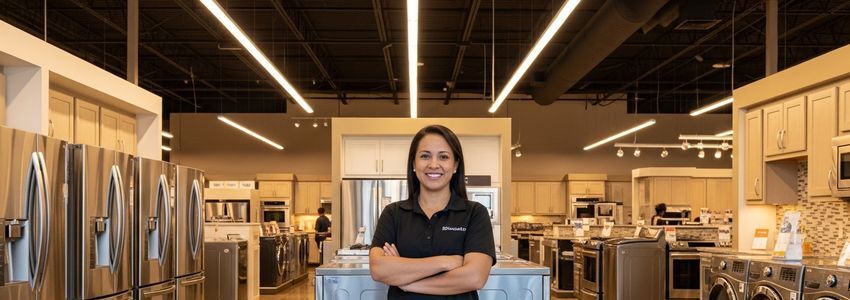
Running an appliance store is one of the most capital-intensive retail businesses in the country. From stocking showrooms with refrigerators, ranges, washers, and dishwashers to maintaining delivery fleets, warehouse infrastructure, and trained installation crews, the financial demands never stop. Whether you own a single-location independent shop or a regional appliance chain, access to the right financing can be the difference between keeping your shelves stocked and watching customers walk out the door empty-handed.
Appliance store business loans give retailers the working capital needed to purchase inventory in volume, invest in showroom upgrades, expand delivery operations, bridge seasonal cash flow gaps, and hire the staff needed during peak selling seasons like Memorial Day and Black Friday weekends. This complete guide covers every financing option available to appliance retailers, what lenders look for, how much you can borrow, and exactly how to get approved.
In This Article
- What Are Appliance Store Business Loans?
- Why Appliance Retailers Need Financing
- Types of Appliance Store Business Loans
- How Much Can Appliance Stores Borrow?
- Qualification Requirements
- How the Loan Process Works
- How Crestmont Capital Helps
- Real-World Scenarios
- Comparing Loan Options
- Frequently Asked Questions
- How to Get Started
What Are Appliance Store Business Loans?
Appliance store business loans are financing products specifically used by appliance retailers to fund the operational and growth needs of their businesses. These loans differ from consumer loans in that approval decisions are based on business financials - revenue, cash flow, time in business, and credit history - rather than personal spending alone.
The appliance retail industry operates on tight margins, high inventory costs, and seasonal demand cycles. According to data from the U.S. Census Bureau, the household appliance and electronics retail sector generates well over $100 billion in annual sales. Yet despite strong overall market demand, many independent appliance dealers struggle to access sufficient working capital to fully capitalize on peak demand periods and growth opportunities.
Business loans for appliance stores can be used for virtually any operational purpose: buying inventory before a major holiday weekend, financing a delivery vehicle, upgrading your showroom, covering payroll during a slow summer month, or expanding to a second location. The right loan type depends on your specific need, your financial profile, and how quickly you need the money.
Industry Insight: The appliance retail sector is highly seasonal. Memorial Day, Labor Day, and Black Friday collectively drive a disproportionate share of annual appliance sales. Retailers who have access to financing before these windows consistently outperform those who rely on cash flow alone.
Why Appliance Retailers Need Financing
Unlike soft goods retailers where inventory can be reordered quickly and stored cheaply, appliance retail requires significant upfront capital for products that are heavy, expensive, and slow to turn. Here are the primary financial challenges that drive appliance store owners to seek business financing:
Inventory Carrying Costs
A competitive appliance showroom needs floor models across every major category. A mid-tier refrigerator costs $700 to $1,800 wholesale. A washer-dryer pair runs $600 to $1,400. A dishwasher adds another $350 to $900. Stocking a showroom with 30 to 50 floor models across categories requires $40,000 to $150,000 in inventory investment before a single unit is sold. Add warehouse stock to meet demand during peak weekends and that number climbs significantly.
Supplier Payment Terms
Most appliance manufacturers and distributors require payment within 30 to 60 days. If you sell on consumer credit or installment plans, your customer payments may extend over 12 to 24 months. That mismatch between when you pay suppliers and when you collect from customers creates a persistent cash flow gap that financing can bridge.
Seasonal Demand Peaks
Appliance retailers must position inventory for Memorial Day, Labor Day, and Black Friday six to eight weeks before each event. That means laying out capital for inventory that will not fully turn until after the sales event. Without financing, many dealers miss sales during peak weekends because they simply do not have enough stock on hand.
Delivery and Installation Infrastructure
White-glove delivery and installation is a key differentiator for independent appliance retailers competing against big-box chains. Maintaining a two-person delivery crew and one or two dedicated trucks adds $80,000 to $150,000 in annual operating costs. Equipment financing or working capital loans help spread these costs across the business revenue base.
Technology and Showroom Investment
Consumers today research appliances extensively online before visiting stores. To compete effectively, independent dealers need modern point-of-sale systems, connected display technology, digital pricing tools, and showrooms that demonstrate connected home capabilities. These investments require capital that most appliance dealers cannot fund from monthly cash flow alone.
Types of Appliance Store Business Loans
Appliance store owners have access to a broad range of financing products. Understanding the differences helps you select the loan that best fits your specific need, timeline, and financial profile.
Working Capital Loans
Working capital loans are lump-sum term loans designed to cover day-to-day operational expenses - inventory purchases, payroll, supplier payments, and short-term cash flow gaps. Most unsecured working capital loans range from $10,000 to $500,000 with terms from 6 to 36 months. They typically fund within 24 to 72 hours from alternative lenders, making them ideal for time-sensitive inventory purchases.
Business Line of Credit
A business line of credit is a revolving credit facility that lets you borrow up to an approved limit, repay it as cash flow allows, and borrow again. Unlike a term loan, you only pay interest on what you actually use. For appliance retailers dealing with seasonal inventory swings and unpredictable supplier payment cycles, a line of credit is often the most valuable financial tool available. Lines typically range from $25,000 to $250,000.
Inventory Financing
Inventory financing uses your appliance stock as collateral, allowing lenders to advance 50% to 80% of your inventory value. This is especially powerful for appliance dealers with significant warehouse stock. As you sell inventory and repay the advance, you free up credit to purchase new stock. Inventory financing often has more flexible approval criteria than unsecured loans because the lender has a tangible asset backing the loan. Explore the Crestmont inventory financing program to learn more.
Equipment Financing
Appliance stores need more than just the products they sell. Delivery trucks, forklifts, warehouse shelving, point-of-sale terminals, and installation tools are all essential operational equipment. Equipment financing allows you to purchase these assets with the equipment itself serving as collateral. Interest rates on equipment loans are generally lower than unsecured loans, and repayment terms typically match the useful life of the equipment - 3 to 7 years for vehicles and technology.
SBA Loans
The U.S. Small Business Administration offers loan guarantee programs that reduce lender risk and enable longer repayment terms and lower interest rates. SBA 7(a) loans can provide up to $5 million for working capital, inventory, equipment, and expansion. SBA 504 loans are designed specifically for major fixed assets like real estate and heavy equipment. The tradeoff is time: SBA loans typically take 30 to 90 days to close. Visit SBA.gov to learn more about current programs and requirements.
Merchant Cash Advance
A merchant cash advance (MCA) provides a lump sum of capital in exchange for a percentage of your future credit card and debit card sales. Repayment happens automatically and flexes with your daily revenue. MCAs can fund in 24 to 48 hours and are accessible even for business owners with less-than-perfect credit. They are best used for short-term needs when speed of funding is critical, as effective costs are higher than traditional loans.
Revenue-Based Financing
Revenue-based financing provides capital in exchange for a fixed percentage of your monthly revenue until a predetermined total is repaid. Unlike MCAs that collect daily, revenue-based financing typically settles monthly, making it easier to forecast cash flow. This option works well for established appliance stores with consistent monthly revenue.
Traditional Term Loans
Bank term loans offer the best rates and longest terms for qualified borrowers, but require strong credit, significant documentation, and often take 2 to 4 weeks to close. For appliance retailers with 2+ years of operating history, strong credit (680+), and established bank relationships, a traditional term loan is often the most cost-effective financing option for large capital investments like location expansions or major equipment purchases.
Ready to Stock Up and Scale Your Appliance Store?
Get fast, flexible financing built for appliance retailers. Apply in minutes and get a decision in as little as 24 hours.
Apply Now →How Much Can Appliance Stores Borrow?
Loan amounts for appliance store businesses vary based on your revenue, credit history, time in business, and the specific loan type. Here is a practical overview of what retailers at different stages typically qualify for:
| Business Stage | Annual Revenue | Typical Loan Range | Best Options |
|---|---|---|---|
| Startup (under 1 year) | Under $300K | $10K - $50K | MCA, microloans |
| Early stage (1-2 years) | $300K - $750K | $25K - $150K | Working capital, line of credit |
| Established (2-5 years) | $750K - $3M | $100K - $500K | Term loans, inventory financing |
| Mature retailer (5+ years) | $3M+ | $500K - $5M+ | SBA loans, bank financing |
As a general benchmark, most alternative lenders will approve an unsecured loan equal to 8% to 15% of your annual gross revenue. With collateral - inventory or equipment - that ceiling rises significantly. SBA loans can fund up to $5 million for the most qualified applicants.
Qualification Requirements
Understanding what lenders look for before you apply helps you prepare a stronger application and choose the right lender for your current financial profile.
Time in Business
Traditional banks and SBA lenders typically require at least 2 years of operating history. Alternative and online lenders often work with businesses as new as 6 months. The newer your business, the more your application will lean on personal credit and projected revenue rather than established business financials.
Annual Revenue
Most lenders require a minimum of $100,000 to $150,000 in annual revenue to qualify for a meaningful loan amount. Higher revenue unlocks access to larger loan amounts and better rates. Appliance stores processing $500,000 or more annually in sales are well-positioned for mid-range working capital loans.
Credit Score
SBA loans and bank term loans typically require a personal credit score of 650 to 700 or above. Alternative lenders often work with scores as low as 550. For secured products like inventory financing and equipment loans, credit requirements are somewhat more flexible because the lender has a hard asset as collateral.
Cash Flow and Bank Statements
Lenders want to see consistent monthly deposits, positive average daily balances, and no patterns of overdrafts or NSF fees. Bring 3 to 6 months of business bank statements to any application. Strong, consistent cash flow is often more important to alternative lenders than a perfect credit score.
Debt Service Coverage Ratio (DSCR)
The DSCR measures your ability to repay debt from operating income. Most traditional lenders require a minimum DSCR of 1.25, meaning your operating income is at least 25% greater than your total debt obligations. If your DSCR is below 1.0, you may struggle to qualify for bank-level financing until you reduce existing debt or grow revenue.
Pro Tip: Before applying, pull your business credit reports from Dun and Bradstreet, Experian Business, and Equifax Business. Errors are common and can cost you approval or a favorable rate. Dispute inaccuracies 30 to 60 days before you plan to apply.
How the Appliance Store Loan Process Works
Quick Guide
How Appliance Store Financing Works - At a Glance
Determine how much you need, why you need it, and how quickly. Match your need to the right loan type.
Collect 3-6 months of bank statements, tax returns, P&L statement, and business license.
Complete an application online or with a financing advisor. Most applications take 10-20 minutes.
Compare total cost of capital, repayment terms, fees, and any collateral requirements before signing.
Receive funds in 24-72 hours (alternative lenders) and put them to work in your business immediately.
How Crestmont Capital Helps Appliance Store Owners
Crestmont Capital specializes in financing solutions for small and mid-size businesses, including appliance retailers. As the number one rated business lender in the U.S., we understand the unique capital demands of the appliance retail industry - from seasonal inventory cycles to the high cost of delivery infrastructure.
Our small business financing programs are designed to be fast, flexible, and transparent. Unlike traditional banks that often take weeks to process applications and require extensive collateral, Crestmont Capital delivers decisions within 24 hours on most applications and funds approved loans within days.
We offer appliance store owners access to the full spectrum of business financing products: working capital loans, equipment financing, business lines of credit, inventory financing, SBA loan assistance, and merchant cash advances. Our advisors work with you to understand your specific business situation and recommend the option that best fits your needs and financial profile.
For appliance retailers exploring expansion options, our commercial financing solutions include larger-scale financing for second locations, warehouse buildouts, and fleet expansion. Whatever stage your business is in, Crestmont Capital has a program designed to support your growth.
Key Benefit: Crestmont Capital's appliance retail financing programs are designed for businesses at every stage - from single-location independent dealers to regional chains with multiple locations. Whether you need $25,000 for a seasonal inventory push or $500,000 to open a second showroom, our team can help structure the right financing solution.

Real-World Scenarios: How Appliance Retailers Use Financing
Abstract financing concepts become clearer with real examples. Here are six scenarios that represent how appliance store owners actually use business loans.
Scenario 1: Memorial Day Inventory Build
An independent appliance dealer in the Southeast generates $1.2 million in annual sales. Memorial Day weekend consistently produces 12% of annual revenue - but only if the showroom and warehouse are fully stocked six weeks in advance. The problem: supplier invoices come due before customer payments clear. A $90,000 working capital loan, drawn 45 days before the holiday weekend, allows the dealer to place full inventory orders. The loan repays over 6 months from strong post-holiday revenue. Net result: $140,000 in Memorial Day sales versus $75,000 in prior years when inventory was limited.
Scenario 2: Delivery Fleet Expansion
A Midwest appliance dealer has won several commercial contracts with apartment complexes and property management companies. Fulfilling these orders requires same-day or next-day delivery that their single truck cannot handle. A $75,000 equipment loan finances a second commercial delivery van with installation racking. The monthly payment is $1,450 for 60 months. The new delivery capacity generates $180,000 in additional commercial revenue in year one, delivering a strong return on the financing investment.
Scenario 3: Showroom Technology Upgrade
A California appliance retailer notices that conversion rates have declined as customers increasingly research smart home integration before visiting showrooms. They invest $45,000 funded through a working capital loan in connected appliance displays, interactive demonstration stations, and updated POS technology. Within six months, average transaction values increase 18% as customers who visit the renovated showroom show higher purchase intent and upgrade rates.
Scenario 4: Opening a Second Location
A successful appliance store owner in Texas has operated a profitable single location for seven years. Market research shows an underserved trade area 30 miles away. Total second-location startup costs are estimated at $280,000 including leasehold improvements, initial inventory, fixtures, equipment, and a 3-month working capital reserve. An SBA 7(a) loan at competitive rates provides the capital over a 10-year term with manageable monthly payments. The second location reaches profitability in month 14.
Scenario 5: Supplier Relationship Discount
A supplier offers a 7% early-payment discount if invoices are paid within 10 days instead of the standard 45-day net terms. On a $200,000 annual supplier spend, that is a $14,000 annual saving. The appliance dealer uses a business line of credit to pay invoices within the discount window, then repays the line over 45 days as sales come in. The net saving after line of credit interest costs is approximately $10,500 per year - a meaningful contribution to the bottom line.
Scenario 6: Cash Flow Bridge During Slow Season
Summer is traditionally slow for appliance retail in northern markets. A Wisconsin appliance dealer experiences a $35,000 monthly revenue decline from June through August. Rather than cutting staff and losing trained employees needed for the fall surge, they use a $50,000 line of credit to cover payroll and operating costs during the slow months. The line is fully repaid by October from strong fall revenue. Employee retention enables better customer service during peak season, contributing to the dealer's highest-ever holiday quarter.
Your Appliance Store Growth Starts Here
Whether you need inventory capital, equipment financing, or working capital to bridge the slow season - Crestmont Capital has a solution for your appliance store.
Get Funded Today →Comparing Appliance Store Loan Options
No single loan type is best for all appliance retailers. The right option depends on your specific need, timeline, and financial profile. Here is a side-by-side comparison of the most relevant options:
| Loan Type | Loan Amount | Time to Fund | Best Use Case | Min. Credit Score |
|---|---|---|---|---|
| Working Capital Loan | $10K - $500K | 24-72 hours | Inventory, payroll, cash flow | 550+ |
| Line of Credit | $25K - $250K | 1-5 days | Seasonal needs, supplier payments | 580+ |
| Equipment Financing | $5K - $1M+ | 2-7 days | Delivery trucks, POS systems | 550+ |
| Inventory Financing | Up to 80% of inventory value | 3-10 days | Bulk inventory purchase | 560+ |
| SBA 7(a) Loan | Up to $5M | 30-90 days | Expansion, major investment | 650+ |
| Merchant Cash Advance | $5K - $500K | 24-48 hours | Emergency needs, fast capital | 500+ |
For most established appliance retailers, the optimal financing strategy combines two products: a term loan or equipment loan for large capital investments, and a business line of credit for ongoing working capital flexibility. This approach gives you both predictability for major expenses and agility for day-to-day operational needs.
By the Numbers
Appliance Store Financing - Key Statistics
$100B+
Annual U.S. appliance retail market size
24 hrs
Fastest funding time through Crestmont Capital
80%
Maximum advance rate on inventory financing
$5M
Maximum SBA 7(a) loan for appliance retailers
Tips to Improve Your Approval Odds
A few strategic steps before applying can meaningfully improve your approval odds and the quality of terms you receive.
Separate your business and personal finances. Open a dedicated business checking account if you have not already. Lenders need to see clean business bank statements. Commingled personal and business funds make underwriting harder and can trigger red flags even for financially healthy businesses.
Build your business credit profile. Apply for a business credit card, use it for regular purchases, and pay it monthly. Establish vendor trade lines with suppliers who report to Dun and Bradstreet or Experian Business. A strong business credit profile reduces dependence on personal credit scores over time.
Keep 3 months of operating expenses in reserve. Lenders look at your average daily bank balance as a signal of financial health. Businesses that consistently maintain 2 to 3 months of expenses in reserve present as lower risk and often receive better loan offers.
Document your use of funds clearly. Lenders approve specific, credible requests faster than vague ones. "I need $75,000 to purchase inventory for Memorial Day weekend and repay over 6 months" is more compelling than "I need capital for growth." Being specific demonstrates planning and increases lender confidence.
Consider timing your application strategically. According to Forbes Advisor, applying for business loans during strong revenue periods produces better outcomes than applying during slow periods, even if your need is greatest during slow months. If possible, apply during your strongest revenue months.
Work with a specialist in retail financing. Lenders who understand appliance retail - the seasonal nature of sales, the high inventory carrying costs, the white-glove delivery model - will evaluate your application with appropriate context rather than penalizing you for seasonal revenue dips. According to CNBC Select, working with lenders who specialize in your industry consistently produces better outcomes for small business borrowers.
You can also find free financing guidance through the SBA local assistance network, including Small Business Development Centers that help business owners prepare loan applications at no cost.
Frequently Asked Questions
What are appliance store business loans?
Appliance store business loans are financing products used by appliance retailers to fund operational and growth needs such as inventory purchases, showroom upgrades, delivery equipment, payroll, and expansion. These loans are based on business financials rather than personal spending and are available from banks, alternative lenders, and the SBA.
How much can an appliance store borrow?
Loan amounts depend on your revenue, credit history, and loan type. Newer stores may qualify for $10,000 to $75,000. Established retailers can access $100,000 to $500,000. SBA loans can provide up to $5 million for the most qualified applicants.
What is the fastest way to get funding for my appliance store?
Merchant cash advances and working capital loans from alternative lenders are the fastest options, often funding within 24 to 48 hours of approval. Crestmont Capital can typically provide decisions within 24 hours and fund approved loans within 1 to 3 business days.
Can I get an appliance store loan with bad credit?
Yes. Alternative lenders work with credit scores as low as 550. Secured options like inventory financing and equipment loans are more accessible with lower credit because the lender has collateral. MCAs approve based primarily on daily revenue. Expect higher rates and shorter terms with scores below 620.
What documents do I need to apply?
Most lenders require 3 to 6 months of business bank statements and basic business information. For larger loans, you will also need business and personal tax returns, a profit and loss statement, a balance sheet, and potentially financial projections.
What is inventory financing and how does it work for appliance dealers?
Inventory financing is a loan or credit line secured by your appliance stock. Lenders advance 50% to 80% of inventory value. As you sell inventory and repay the advance, credit becomes available again. It is particularly useful for stocking up before major sales seasons like Memorial Day or Black Friday.
How does a business line of credit help appliance retailers?
A business line of credit gives appliance retailers revolving access to capital. You draw what you need, repay it, and draw again. It is ideal for managing seasonal inventory swings, covering supplier payments before customer receipts clear, and handling unexpected expenses without disrupting cash flow.
Can I use a business loan to finance delivery vehicles?
Yes. Equipment financing is specifically designed for purchasing business vehicles including delivery trucks. The vehicle serves as collateral, often resulting in better rates than unsecured loans. Terms typically range from 36 to 72 months.
Are SBA loans available for appliance retailers?
Yes. Appliance stores are eligible for SBA 7(a) loans up to $5 million and SBA 504 loans for major fixed assets. The application process takes 30 to 90 days and requires significant documentation, making them best for planned capital needs rather than urgent financing.
What credit score do I need?
SBA and bank loans typically require 650 to 700+. Alternative lenders often accept 550 to 620. MCAs may work with scores as low as 500. The higher your score, the better the rates and terms you will receive.
Do appliance store loans require collateral?
Not always. Many alternative lenders offer unsecured working capital loans based on revenue and cash flow. Secured options like inventory and equipment financing offer better rates. SBA loans over $25,000 typically require collateral when available.
How can I finance opening a second appliance store location?
Typical second-location costs include leasehold improvements, initial inventory, fixtures, equipment, and working capital reserves. SBA 7(a) loans and commercial term loans are well-suited for this type of expansion. Crestmont Capital has financed many appliance retailer expansions across the country.
What is the minimum time in business to qualify?
Traditional banks require 2 years. Alternative lenders often work with businesses as young as 6 months. Building 12+ months of revenue history opens access to substantially better financing options and lower effective costs.
How do I choose between a term loan and a line of credit?
Use a term loan for large, one-time capital needs with a specific purpose such as a showroom renovation or vehicle purchase. Use a line of credit for ongoing, variable capital needs like managing seasonal inventory swings. Many appliance retailers benefit from having both simultaneously.
What happens if I miss a payment on my business loan?
Missing a payment typically triggers a late fee. Continued delinquency can result in default, credit damage, and collateral recovery for secured loans. Contact your lender proactively if you anticipate cash flow problems. Most lenders prefer to restructure repayment rather than pursue default proceedings.
How to Get Started
Complete our quick application at offers.crestmontcapital.com/apply-now - takes just a few minutes and requires no commitment.
A Crestmont Capital advisor will review your appliance store's specific needs and match you with the right financing option for your situation.
Receive your funds and put them to work - often within 1 to 3 business days of approval through Crestmont Capital.
Conclusion
Appliance store business loans are a critical tool for independent appliance retailers competing in a demanding, capital-intensive market. Whether you need working capital to stock up before a major holiday weekend, equipment financing for a new delivery truck, or a line of credit to bridge seasonal cash flow gaps, there is a financing solution designed to fit your needs and financial profile.
The key is understanding which loan type fits your specific situation - and working with a lender who understands the appliance retail industry. Explore your options through the SBA loan programs Crestmont Capital supports, or apply directly for working capital and equipment financing today. Take the first step toward securing the capital your appliance store needs to grow on your terms.
Disclaimer: The information provided in this article is for general educational purposes only and is not financial, legal, or tax advice. Funding terms, qualifications, and product availability may vary and are subject to change without notice. Crestmont Capital does not guarantee approval, rates, or specific outcomes. For personalized information about your business funding options, contact our team directly.