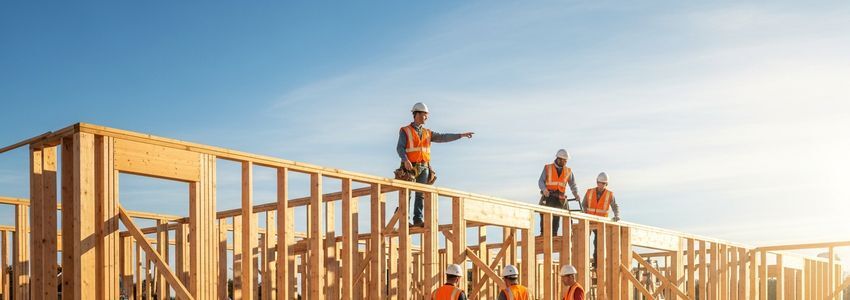
Framing contractors are the backbone of residential and commercial construction. You raise the skeleton of every building - the walls, floors, roofs, and structural systems that everything else depends on. But running a framing business takes serious capital: lumber costs have been volatile, crews are expensive to maintain, and the gap between project start and final payment can stretch for months. That is where framing contractor business loans come in.
Whether you need working capital to cover payroll between jobs, equipment financing for nail guns and forklifts, or a line of credit to bid on larger commercial projects, understanding your financing options can be the difference between growing your business and watching opportunities pass you by.
This guide covers everything framing contractors need to know about business loans - from the types of financing available to how to qualify, what to watch out for, and how to put capital to work strategically.
- Why Framing Contractors Need Financing
- Types of Business Loans for Framing Contractors
- Working Capital and Cash Flow Financing
- Equipment Financing for Framing Tools
- SBA Loans for Framing Contractors
- How to Qualify for a Framing Contractor Loan
- How to Apply: Step-by-Step
- Using Capital Strategically
- Framing Business Loan Overview
- Frequently Asked Questions
- Next Steps
Why Framing Contractors Need Financing
Framing is one of the most capital-intensive trades in construction. Before a single nail is driven, a framing crew needs lumber, hardware, scaffolding, power tools, fuel, and labor - all paid out of pocket, often weeks or months before the general contractor cuts a check.
The U.S. Census Bureau consistently tracks residential construction starts at over a million units per year, creating enormous demand for framing services. But that demand comes with serious cash flow challenges.
Here are the most common financial pressures framing contractors face:
- Lumber and material costs: Framing lumber accounts for a large share of project costs - and prices can swing dramatically. According to the Small Business Administration, managing material cost volatility is one of the top challenges for construction contractors.
- Payroll gaps: Skilled framers are in high demand. Keeping a reliable crew means paying wages consistently even when project payments are delayed.
- Seasonal slowdowns: In many markets, new construction slows in winter. Maintaining capacity during slow periods requires reserves or access to credit.
- Scaling to larger projects: Landing a multi-unit development or commercial framing contract often requires more crew, more equipment, and more materials than your current cash flow can support.
- Equipment wear and replacement: Framing work is hard on tools. Nail guns, saws, compressors, scaffolding, and forklifts all require ongoing maintenance and eventual replacement.
- Bidding requirements: Some general contractors and developers require proof of bonding, insurance, or financial capacity before awarding a framing subcontract.
Access to the right financing does more than solve immediate cash flow problems. It gives framing contractors the ability to bid aggressively, hire ahead of projects, and negotiate better pricing with lumber yards and material suppliers. In a competitive market, that financial flexibility is a genuine competitive advantage.
Ready to Grow Your Framing Business?
Get funding designed for contractors - fast approvals, flexible terms, no red tape.
Apply Now - Takes 5 MinutesTypes of Business Loans for Framing Contractors
Not all business loans are the same, and the best option for your framing company depends on what you need the money for, how quickly you need it, and what your financial profile looks like. Here is a breakdown of the main loan types available to framing contractors.
Term Loans
A term loan is the classic business loan - you borrow a lump sum and repay it over a fixed period with regular installments. Term loans are well-suited for larger one-time investments: buying a used forklift, expanding your shop, or funding a major hiring push ahead of a large project.
Term loans from traditional banks typically offer the lowest interest rates but require strong credit, two-plus years in business, and substantial documentation. Online lenders and alternative lenders can approve framing contractors faster - sometimes within 24-48 hours - with more flexible requirements, though rates are usually higher.
Best for: Equipment purchases, business expansion, hiring crews for new contracts
Loan amounts: $10,000 to $500,000+ depending on lender and qualifications
Terms: 1-5 years for short-term lenders; up to 10 years for banks and SBA
Learn more about small business loans for contractors at Crestmont Capital.
Business Lines of Credit
A business line of credit works like a credit card for your business - you get approved for a maximum credit limit, draw from it as needed, and only pay interest on what you use. When you repay, the funds become available again.
For framing contractors, a line of credit is often the most practical financing tool. You can draw on it to cover materials at the start of a job, repay it when the GC pays you, and have it ready again for the next project. It smooths out the peaks and valleys of construction cash flow without forcing you to take on a large lump-sum loan.
Best for: Ongoing working capital, bridging payment gaps, covering materials and labor between project payments
Credit limits: $10,000 to $250,000 for most contractors
Terms: Revolving; typically renewed annually
Explore business lines of credit designed for contractors.
Equipment Financing
Equipment financing lets you purchase or lease tools, machinery, and vehicles using the equipment itself as collateral. Because the lender has a security interest in the equipment, these loans often have better rates and more accessible qualification requirements than unsecured loans.
For framing contractors, equipment financing works for items like:
- Pneumatic framing nailers and compressors
- Scaffolding systems
- Miter saws, table saws, and circular saws
- Forklifts and telehandlers
- Work trucks and trailers
- Generators and power distribution equipment
See equipment financing options at Crestmont Capital.
Short-Term Business Loans
Short-term loans provide fast access to capital - sometimes same-day or next-day funding - with repayment over 3-18 months. They are ideal for urgent needs: a material supplier who needs payment to release a lumber order, an unexpected equipment repair, or covering payroll when a payment is delayed.
Short-term loans carry higher interest rates than traditional term loans, but for contractors who can repay quickly once a project payment arrives, the cost can be worth the flexibility and speed.
Explore short-term business loans for quick capital access.
Invoice Financing
If you have outstanding invoices from general contractors or developers, invoice financing lets you borrow against those receivables immediately - typically getting 70-90% of the invoice value upfront. When your customer pays, you receive the remainder minus the lender's fee.
This is particularly useful for framing contractors who regularly work with large GCs or developers that have 30-60 day payment terms. Rather than waiting for payment, you can access that capital now and keep operations moving.
Merchant Cash Advances
A merchant cash advance (MCA) provides a lump sum in exchange for a percentage of your future revenues. While MCAs are fast and accessible even with lower credit scores, they are typically the most expensive form of financing. They can be a last resort for contractors with immediate needs who cannot qualify for other options, but should be approached carefully.
Working Capital and Cash Flow Financing
Cash flow management is perhaps the single biggest financial challenge for framing contractors. The construction industry's payment structure - where subs are often the last to get paid in a payment chain that starts with the property owner - creates persistent cash flow pressure.
Understanding how working capital financing works can help you manage this pressure proactively rather than reactively.
The Framing Cash Flow Cycle
A typical framing project follows this cash flow pattern:
- Bid and award - You commit to a job price and schedule
- Mobilization - You buy materials, hire or assign crew, set up equipment
- Work in progress - You are paying labor and overhead daily
- Draw request - You submit an invoice to the GC, often monthly
- Payment processing - GC processes your draw and pays, often 20-45 days later
- Retainage holdback - GC typically holds 5-10% until final completion
On a 60-day project, you might not receive full payment until 90-120 days after you started buying materials. A working capital loan or line of credit fills that gap.
How Much Working Capital Do Framing Contractors Need?
Financial advisors typically recommend that construction contractors maintain enough working capital to cover 2-3 months of operating expenses. For a framing company with $50,000/month in labor and materials costs, that means $100,000-$150,000 in accessible capital.
Most framing contractors do not have that sitting in a bank account - which is exactly why lines of credit and working capital loans are so valuable. You pay interest only when you draw on the credit, keeping costs manageable while having the capacity available when you need it.
Equipment Financing for Framing Tools and Vehicles
Framing contractors rely on specific equipment that is both expensive and essential. Equipment financing allows you to acquire what you need without depleting working capital or cash reserves.
Why Finance Instead of Buy Outright?
Even if you have the cash to buy equipment outright, financing often makes more sense from a business strategy perspective:
- Preserve cash flow: Tying up $40,000 in a forklift purchase leaves you with less capital for materials, payroll, and opportunities.
- Tax advantages: Equipment financing payments may be deductible as business expenses. Consult a tax advisor for details specific to your situation.
- Technology refresh: Financing with a shorter term lets you upgrade to newer equipment when the loan ends rather than being stuck with aging tools.
- Build credit: Successfully repaying equipment loans builds your business credit profile, making future financing easier and cheaper.
Equipment Loan vs. Equipment Lease
With an equipment loan, you own the equipment outright after repayment - the lender holds a lien until then. With a lease, you pay to use the equipment over a term and either return it, renew, or purchase at the end.
For framing equipment that has long useful life - like scaffolding, forklifts, and work trucks - buying via a loan typically makes more financial sense. For rapidly evolving technology or equipment you need only seasonally, a lease may be preferable.
Need Equipment for Your Next Framing Project?
Crestmont Capital offers equipment financing with fast approvals and flexible terms for contractors.
Get Equipment FinancingSBA Loans for Framing Contractors
The Small Business Administration does not lend money directly to contractors - instead, it guarantees loans made by approved lenders, reducing the lender's risk and enabling better terms for borrowers. SBA loan programs are among the most favorable financing options available to small construction businesses.
SBA 7(a) Loans
The SBA 7(a) is the most popular SBA program. It can be used for working capital, equipment, real estate, and business acquisitions. For framing contractors, the 7(a) is well-suited for:
- Large equipment purchases or fleet expansion
- Working capital for scaling operations
- Purchasing a competitor's book of business
- Refinancing existing high-interest debt
Loan amounts: Up to $5 million
Terms: Up to 10 years for working capital; up to 25 years for real estate
Rates: Variable, based on prime rate plus a spread - typically among the lowest available to small businesses
SBA 7(a) loans require strong credit (typically 680+), two-plus years in business, and a demonstrated ability to repay. The application process takes longer than alternative lenders - often 60-90 days - but the favorable terms are often worth the wait for well-qualified contractors.
Learn more about SBA loan programs at Crestmont Capital.
SBA 504 Loans
The SBA 504 program is designed specifically for major fixed asset purchases - commercial real estate or large equipment. If you are looking to purchase your own yard, storage facility, or significant equipment, the 504 can offer very long terms and fixed interest rates.
SBA Microloans
For newer framing businesses or smaller capital needs (up to $50,000), SBA microloans are available through nonprofit intermediary lenders. These are a good option for contractors who are just starting out and building their financial track record.
How to Qualify for a Framing Contractor Business Loan
Lenders evaluate framing contractor loan applications using several key criteria. Understanding what they look for helps you prepare a stronger application and choose the right lender for your situation.
Credit Score
Your personal credit score plays a significant role, especially for newer businesses. General thresholds:
- 720+: Excellent - qualifies for best rates and terms from banks and SBA
- 680-719: Good - qualifies for most products including SBA loans
- 640-679: Fair - may qualify for online lenders and some bank products
- 580-639: Below average - primarily alternative and short-term lenders
- Below 580: Difficult - consider MCAs or secured products; focus on rebuilding credit
Business credit scores (Dun & Bradstreet PAYDEX, Experian Business) also factor in for established companies. Building a strong business credit profile is valuable for long-term financing access.
Time in Business
Most lenders want to see at least 1-2 years in business. Under one year, options are more limited but not impossible - some alternative lenders work with newer contractors, and SBA microloans are available for startups.
Annual Revenue
Lenders look at your annual revenue to assess capacity to repay. Most lenders have minimum revenue thresholds, and loan amounts are typically tied to a multiple of monthly revenue. A framing company with $500,000 in annual revenue can generally access more capital than one at $150,000.
Cash Flow and Debt Service Coverage
Lenders analyze whether your business generates enough cash flow to service the new debt. The debt service coverage ratio (DSCR) - your net operating income divided by total debt obligations - should generally be 1.25 or higher to qualify for traditional loans.
Project Backlog and Contracts
Unlike retail or service businesses with steady daily revenue, framing contractors often have lumpy income tied to project cycles. Having signed contracts in your backlog - documentation of work you are committed to perform - significantly strengthens your loan application. Lenders see a $300,000 framing contract as evidence of future revenue.
Collateral
Equipment, vehicles, real estate, and accounts receivable can all serve as collateral. Secured loans (with collateral) typically carry lower rates than unsecured loans. For new businesses without established credit, offering collateral can be the key to qualifying.
How to Apply: Step-by-Step Guide for Framing Contractors
Applying for a business loan as a framing contractor does not need to be overwhelming. Here is a straightforward process to follow:
Step 1: Know What You Need
Before approaching any lender, get clear on: How much do you need? What is it for? How quickly do you need it? How will you repay it? Having clear answers to these questions helps you choose the right product and communicate effectively with lenders.
Step 2: Check Your Credit
Pull your personal credit report (free at AnnualCreditReport.com) and review it for errors. Dispute any inaccuracies. If your score has room for improvement, even a month or two of focused effort (paying down balances, ensuring on-time payments) can make a meaningful difference.
Step 3: Gather Your Documents
Standard documentation for a contractor loan application typically includes:
- Business and personal tax returns (2-3 years)
- Business bank statements (3-6 months)
- Profit and loss statement
- Balance sheet
- Current accounts receivable aging report
- List of current contracts/backlog
- Business license and contractor's license
- Proof of insurance and bonding
- Business plan (for larger loans or SBA applications)
Step 4: Compare Lenders
Do not apply to the first lender you find. Compare banks, credit unions, online lenders, and SBA-approved lenders. Look at interest rates, fees, loan terms, funding speed, and customer reviews. Forbes Advisor and similar resources provide useful comparisons of lender options.
Step 5: Submit Your Application
Complete the application carefully. Inconsistencies between your application and supporting documents are a common reason for delays or denials. Make sure your revenue figures, business age, and other details match your tax returns and bank statements.
Step 6: Review Your Offer
Before signing, read every term. Understand the interest rate (and whether it is fixed or variable), all fees (origination, prepayment, late payment), the repayment schedule, and what happens if you miss a payment. Do not hesitate to ask questions or negotiate terms.
Start Your Application Today
Crestmont Capital makes it easy for framing contractors to access the funding they need. Apply in minutes and get a decision fast.
Apply Now
Using Capital Strategically to Grow Your Framing Business
Getting approved for financing is only half the equation. How you deploy that capital determines whether a loan is a smart investment or a burden. Here are the highest-impact ways framing contractors use business financing to grow.
Bidding on Larger Contracts
The most transformative use of business financing is often the simplest: having the financial capacity to say yes to bigger projects. A $2 million multi-family framing subcontract that could triple your annual revenue requires proving you can mobilize a larger crew and cover materials during the project cycle. A term loan or line of credit gives you that capacity.
Similar strategies have been used by concrete, plumbing, and electrical contractors to scale significantly - you can read more in our guide to concrete contractor business loans.
Building a Reliable Crew
Skilled framers are in high demand. The best workers often have their pick of contractors to work for, and they choose stability. Having the financial cushion to keep crews employed between projects - rather than laying off workers after each job - builds loyalty and reduces the costly cycle of constant recruiting and training.
Buying Materials in Bulk
Lumber yards and material suppliers offer meaningful discounts for volume purchases. With a line of credit, you can buy materials for multiple upcoming projects at once, locking in better pricing and ensuring supply. Given lumber price volatility, the ability to buy ahead at favorable prices can be a significant profitability advantage.
Investing in Better Equipment
Newer, better equipment makes your crews more productive and your bids more competitive. A forklift speeds up framing dramatically compared to hand-carrying materials. Better nail guns and tools reduce fatigue and rework. Equipment financing lets you upgrade without draining cash reserves.
Expanding to New Markets
Many framing contractors start residential and have the skills to move into commercial or multi-family work - but those markets require larger crews, more equipment, and sometimes different licensing. Business financing bridges the gap between your current capacity and the larger opportunity.
Framing Contractor Loan Quick Reference
Framing Contractor Financing at a Glance
Loan Type Comparison for Framing Contractors
| Loan Type | Best For | Speed | Typical Rate |
|---|---|---|---|
| Term Loan | Equipment, expansion | 1-5 days (online) | 7-30% APR |
| Line of Credit | Cash flow, materials | 1-3 days | 8-25% APR |
| Equipment Financing | Tools, trucks, lifts | 1-3 days | 5-20% APR |
| SBA 7(a) | Large needs, best rates | 30-90 days | Prime + 2.75-4.75% |
| Short-Term Loan | Urgent needs | Same day - 2 days | 20-80% APR |
Avoiding Common Financing Mistakes
Many framing contractors make financing decisions under pressure - when cash is tight and a project is stalling. That urgency leads to costly mistakes. Here are the most common pitfalls to avoid:
Borrowing Too Much (or Too Little)
Borrowing more than you need creates unnecessary debt and interest expense. Borrowing too little means you run short mid-project and have to scramble for additional financing at worse terms. Do a realistic project-by-project cash flow analysis before determining your loan amount.
Ignoring the Total Cost of Capital
Comparing loans by monthly payment alone is misleading. A lower monthly payment on a longer term loan can mean paying far more in total interest. Always calculate the total repayment amount and the APR (annual percentage rate) to compare options fairly.
Not Reading the Fine Print
Prepayment penalties, factor rates vs. interest rates, automatic renewal clauses, and personal guarantee requirements are buried in loan documents. Take the time to read every document or have an advisor review key terms before signing.
Using Short-Term Financing for Long-Term Needs
Funding a five-year equipment purchase with a 12-month short-term loan creates a mismatch between your cash flows and your debt obligations. Match the loan term to the useful life of what you are financing.
Waiting Until You Are in Crisis
Lenders want to lend to businesses that are growing and profitable. Applying for a line of credit when you have three months of strong revenue behind you will get you better terms than applying when payroll is overdue and you are desperate. Build relationships with lenders before you need them.
Building Business Credit as a Framing Contractor
Strong business credit opens doors to better rates and higher limits over time. Here is how to build it deliberately:
- Establish a formal business entity: An LLC or corporation with its own EIN, bank account, and address establishes your business as a separate financial identity.
- Open a business bank account: All business income and expenses should flow through a dedicated business account. This creates the financial history lenders look for.
- Get a business credit card: Use it for business expenses and pay it off monthly. This builds your business credit profile with the major bureaus.
- Register with D&B: Dun & Bradstreet maintains one of the major business credit bureaus. Register your business and monitor your PAYDEX score.
- Pay suppliers early or on time: Trade references from lumber yards and material suppliers who report payment history can boost your business credit score.
- Start small and scale: A small equipment loan repaid perfectly builds more credit history than a large loan you struggle with.
Frequently Asked Questions
Can I get a business loan as a framing contractor with bad credit?
Yes, options exist for framing contractors with lower credit scores. Alternative lenders, merchant cash advances, and invoice financing typically have lower credit requirements than banks. However, expect higher interest rates. A score below 580 significantly limits options - consider building credit for 6-12 months before applying if possible.
How much can a framing contractor borrow?
Loan amounts vary widely based on your revenue, credit, and the lender. Short-term loans may offer $10,000-$150,000. Lines of credit typically range from $10,000-$250,000 for most contractors. SBA loans can go up to $5 million. Generally, lenders offer 10-15% of annual revenue for working capital loans.
How fast can I get funding as a framing contractor?
Alternative and online lenders can fund as fast as the same day or next business day for short-term loans and some lines of credit. Bank term loans typically take 1-3 weeks. SBA loans require 30-90 days. The trade-off is generally that faster funding comes with higher rates.
Do I need collateral to get a framing contractor loan?
Not always. Many short-term loans and lines of credit are unsecured, relying on your credit and cash flow rather than specific collateral. Equipment loans use the equipment as collateral. SBA loans require collateral for amounts over $25,000 when available. Secured loans typically offer better rates than unsecured alternatives.
What documents do I need to apply for a framing contractor business loan?
Typically: 2-3 years of business and personal tax returns, 3-6 months of business bank statements, profit and loss statement, balance sheet, business license, contractor's license, and proof of insurance. For larger loans, a business plan and project backlog documentation strengthen your application.
Can I use a business loan to buy a framing truck or trailer?
Yes. Both equipment loans and term loans can be used to purchase work trucks, trailers, and other vehicles. Equipment financing with the vehicle as collateral typically offers the best rates. Make sure the vehicle title is in the business name and keep business and personal use separate for accounting purposes.
What is the difference between a business line of credit and a term loan for framing contractors?
A term loan gives you a lump sum upfront that you repay on a fixed schedule - best for one-time large purchases. A line of credit lets you draw and repay repeatedly up to your credit limit - best for ongoing cash flow management. Many contractors maintain both: a term loan for equipment and a line of credit for working capital.
Can a framing contractor get an SBA loan?
Yes, framing contractors are eligible for SBA loans. The SBA 7(a) is the most common option. Requirements include 680+ credit, 2+ years in business, and demonstrated ability to repay. The process takes longer than alternative lenders but offers significantly better rates and terms for qualified contractors.
How do framing contractors use loans to manage seasonal slowdowns?
A business line of credit is ideal for managing seasonal cash flow. Draw on it during slow winter months to cover payroll and overhead, then repay when spring project payments arrive. Some contractors also use short-term loans to bridge specific slow periods or take on off-season work like interior framing or remodel projects.
Will applying for a business loan hurt my credit score?
A hard credit inquiry (which most formal loan applications trigger) typically reduces your personal credit score by 2-5 points temporarily. If you apply to multiple lenders within a short period (14-30 days), credit bureaus typically treat these as a single inquiry for scoring purposes. Check if a lender offers prequalification with a soft pull before formally applying.
What interest rates can framing contractors expect on business loans?
Rates vary widely. SBA loans: prime rate plus 2.75-4.75% (currently 10-12% range). Bank term loans: 7-18% APR. Online/alternative lenders: 15-40% APR. Equipment financing: 5-20% APR. Short-term loans: 20-80% APR. Your credit score, time in business, and loan type are the primary factors determining your rate.
Can a new framing contractor with less than one year in business get a loan?
Options are limited but available. SBA microloans (up to $50,000) are available to startups. Some alternative lenders work with businesses under one year old. Secured options like equipment financing and invoice financing are more accessible for newer businesses. Building 6-12 months of documented revenue strengthens applications significantly.
What is invoice financing and how does it work for framing contractors?
Invoice financing allows you to borrow against outstanding invoices immediately rather than waiting 30-60 days for payment. The lender advances 70-90% of the invoice value, holds the remaining amount in reserve, then releases it (minus fees) when your customer pays. It is ideal for framing contractors with large GC customers who have long payment terms.
How can I improve my chances of getting approved for a framing contractor loan?
Key factors: maintain a credit score above 680, keep business and personal finances separate, document your revenue consistently in a dedicated business bank account, build a backlog of signed contracts, pay existing obligations on time, and apply when your business is in good financial shape rather than in crisis. Having a clear plan for how you will use and repay the funds also helps.
What happens if I cannot repay my framing contractor business loan?
Consequences depend on loan type. For secured loans (equipment, real estate), the lender can repossess collateral. For loans with personal guarantees (most SBA loans and many bank loans), your personal assets may be at risk. Defaulting damages your personal and business credit for years and may result in legal action. If you are struggling, contact your lender proactively - many will work out modified payment plans before resorting to collections.
Next Steps: Securing Financing for Your Framing Business
Ready to move forward? Here is your action plan:
- Check your credit scores - Pull both personal and business credit reports and address any errors
- Gather your financial documents - Tax returns, bank statements, P&L, and contract backlog
- Define your need - Decide exactly how much you need and what it is for
- Compare lender types - Match your timeline, credit profile, and use case to the right loan type
- Apply with Crestmont Capital - Get a fast decision with no hidden fees or surprises
- Put capital to work - Execute your plan and track results against your projections
Framing contractors who understand and leverage business financing effectively have a significant competitive advantage. Whether you are bridging a cash flow gap, funding your next equipment upgrade, or positioning to land larger commercial contracts, the right financing partner can make the difference.
Crestmont Capital specializes in working with contractors across all trades. Our team understands the unique cash flow cycles, seasonality, and project-based nature of your business - and we structure financing to fit how you actually work, not how a spreadsheet model thinks you should work.
Explore all your options at Crestmont Capital small business loans or apply directly below.
Get Funded Today - Apply in 5 Minutes
Fast approvals, flexible terms, and financing designed for contractors. Apply now and get a decision quickly.
Apply Now at Crestmont CapitalDisclaimer: The information provided in this article is for general educational purposes only and is not financial, legal, or tax advice. Funding terms, qualifications, and product availability may vary and are subject to change without notice. Crestmont Capital does not guarantee approval, rates, or specific outcomes. For personalized information about your business funding options, contact our team directly.