
 (800) 949-0401
Using Equipment Financing to Improve Safety Standards
Workplace safety is not optional. Federal and state regulations require businesses to maintain compliant equipment, protective gear, and operational systems that protect employees and the public. For many growing companies, the upfront cost of upgrading safety equipment can feel like an impossible barrier. That is where equipment financing for safety equipment becomes a critical business tool. Instead of draining reserves or delaying necessary upgrades, you can spread costs over manageable monthly payments while putting safer, compliant equipment to work immediately.
This guide breaks down exactly how equipment financing helps businesses of every size improve workplace safety standards, meet OSHA requirements, reduce liability exposure, and protect the people who keep operations running every day.
In This Article
- Why Safety Equipment Upgrades Cannot Wait
- How Equipment Financing Works for Safety Purchases
- Types of Safety Equipment You Can Finance
- Industries That Benefit Most
- Financing and OSHA Compliance
- How Crestmont Capital Helps
- Real-World Scenarios
- How to Qualify
- How to Get Started
- Frequently Asked Questions
Why Safety Equipment Upgrades Cannot Wait
The data on workplace injuries is sobering. According to the U.S. Bureau of Labor Statistics, private industry employers reported approximately 2.6 million nonfatal workplace injuries and illnesses in 2023 alone. Each incident carries real costs: workers compensation claims, lost productivity, regulatory fines, increased insurance premiums, and potential litigation. Beyond the financial toll, a preventable injury damages employee morale and erodes the trust that keeps skilled workers on the job.
The challenge for small and mid-sized businesses is simple math. A single piece of modern safety equipment - whether an advanced ventilation system, a fall-protection array, fire suppression hardware, or industrial-grade protective gear - can cost tens of thousands of dollars. When capital is tied up in payroll, inventory, and growth initiatives, a large upfront safety expenditure may feel impossible even when leadership knows it is necessary.
Waiting is not a neutral choice. OSHA can impose civil penalties of up to $16,131 per serious violation and up to $161,323 for willful or repeated violations as of 2024 federal adjustments. A single inspection that reveals outdated or noncompliant equipment can result in fines that dwarf the cost of the financing that could have prevented the issue in the first place. More importantly, a serious injury can result in costs that no business can easily absorb.
Key Insight: According to the National Safety Council, the average cost of a workplace injury in the United States exceeds $44,000 when accounting for wage losses, medical expenses, and administrative expenses. Financing a $30,000 safety upgrade at manageable monthly payments is significantly less costly than absorbing one preventable injury.
How Equipment Financing Works for Safety Purchases
Equipment financing is a form of secured lending where the equipment itself serves as collateral for the loan. Unlike working capital loans or lines of credit, equipment financing is purpose-built for purchasing physical assets. Lenders are generally more willing to offer favorable terms because the collateral is tangible and retains value. The result is that businesses often qualify for equipment financing even when their credit profile would limit access to other loan types.
The mechanics are straightforward. You identify the safety equipment you need, apply for financing, receive approval, and the lender pays the vendor directly. You then make fixed monthly payments over a term that typically ranges from 12 to 84 months. The equipment goes to work immediately, generating productivity and safety improvements while you pay over time.
There are two primary structures to understand. With equipment loans, you own the equipment outright once you make the final payment, and you may build equity throughout the loan term. With equipment leasing, you make payments for the right to use the equipment over a defined period, with options at the end to purchase, renew, or return. For safety equipment that has a long useful life and consistent value, an equipment loan often makes the most sense. For technology-based safety systems that may become outdated, leasing preserves flexibility.
To learn more about how these two approaches compare, read our detailed guide on equipment leasing and when it outperforms a traditional loan structure.
Finance Your Safety Equipment Today
Get fast, flexible equipment financing to upgrade your workplace safety systems. No obligation - apply in minutes.
Apply NowTypes of Safety Equipment You Can Finance
One of the most common misconceptions is that equipment financing only applies to large machinery or vehicles. In reality, virtually any tangible piece of safety-related equipment qualifies. Here is a breakdown of what businesses are financing through programs like those offered at Crestmont Capital.
Personal Protective Equipment (PPE) Systems and Storage
While individual PPE items are often too small to finance individually, businesses frequently finance PPE dispensing stations, centralized storage systems, automated inventory tracking equipment for safety supplies, and bulk procurement packages. Manufacturing plants, construction firms, and chemical processing facilities regularly finance comprehensive PPE infrastructure upgrades.
Fall Protection Systems
For industries where working at height is routine - construction, warehousing, utilities, telecommunications - fall protection equipment represents one of the most significant safety investments. This includes anchor systems, lifeline equipment, self-retracting lifelines, safety nets, guardrail systems, and specialized harness storage units. A full fall protection installation for a mid-sized warehouse can easily reach $50,000 to $150,000, making financing a practical necessity for most operators.
Fire Suppression and Detection Systems
Commercial fire suppression systems, industrial sprinkler arrays, advanced smoke detection networks, and fire suppression equipment for manufacturing processes represent high-value safety investments that lend themselves well to equipment financing. These systems often have long useful lives and provide immediate protection upon installation.
Industrial Ventilation and Air Quality Systems
Proper ventilation is critical in manufacturing, chemical processing, automotive repair, painting, and agricultural operations. Industrial HVAC systems, dust collection units, fume extraction systems, and air filtration equipment protect workers from respiratory hazards. These systems range from $10,000 for basic units to several hundred thousand dollars for full facility-wide installations.
Safety Monitoring and Sensor Technology
Modern workplaces increasingly rely on sensor networks, gas detection systems, noise monitoring equipment, ergonomic assessment tools, and machine safety guards. These technology-based safety systems often benefit from leasing arrangements given their tendency to evolve rapidly, though financing works equally well for established categories.
Emergency Response Equipment
AEDs (automated external defibrillators), first aid stations, emergency eyewash stations, emergency shower systems, and spill containment equipment all qualify for equipment financing. Organizations such as healthcare facilities, industrial plants, and school systems routinely finance large-scale emergency preparedness infrastructure.
Ergonomic and Lifting Equipment
Forklifts, pallet jacks, scissor lifts, dock levelers, and ergonomic workstation equipment reduce musculoskeletal injuries, which account for more than 30% of all workplace injuries according to OSHA data. Financing this category of equipment is particularly common in warehousing, logistics, and manufacturing.
By the Numbers
Workplace Safety and Equipment Financing - Key Statistics
2.6M
Workplace injuries reported in 2023 (BLS)
$44K+
Average cost of a single workplace injury
$161K
Max OSHA fine for willful violations (2024)
84 Mo
Maximum equipment financing terms available
Industries That Benefit Most from Safety Equipment Financing
While every industry has safety obligations, certain sectors face particularly high costs and regulatory complexity when it comes to maintaining compliant equipment. These industries have the most to gain from financing safety purchases strategically.
Construction and Contracting
Construction consistently ranks among the most hazardous industries in the United States. OSHA's "Fatal Four" - falls, struck-by incidents, electrocutions, and caught-in/between accidents - account for the majority of construction fatalities. Preventing these incidents requires substantial investment in fall protection, scaffolding systems, electrical safety equipment, and heavy equipment with modern safety features. General contractors and subcontractors regularly use equipment financing to fund these critical systems without disrupting project cash flow.
Manufacturing
Manufacturing facilities contend with machine guarding requirements, chemical exposure protocols, noise protection standards, and fire suppression mandates. A mid-size manufacturing operation may need to finance machine guards, updated ventilation systems, chemical storage cabinets, and emergency shower installations simultaneously. Equipment financing allows manufacturers to address multiple safety categories in a single financing arrangement.
Healthcare and Veterinary Practices
Healthcare facilities face unique safety challenges including radiation protection, sharps disposal systems, sterile processing equipment, and patient handling systems that prevent staff injuries. These specialized systems often require significant capital investment. Financing allows healthcare operators to deploy the most effective safety technology without compromising clinical investment budgets.
Agriculture and Food Processing
Agricultural operations have substantial safety obligations around machinery, chemical storage, respiratory protection, and heat illness prevention. Food processing facilities must meet strict OSHA standards around slip-and-fall prevention, sanitation equipment, and cold storage systems. Equipment financing enables farms and processors to stay current with evolving safety requirements.
Transportation and Logistics
Warehouses, distribution centers, and fleet operators rely on heavy lifting equipment, dock systems, and vehicle safety technology to protect workers. Financing forklift fleets, dock leveling systems, and telematics safety technology helps logistics companies maintain safe operations while managing capital efficiently.
Pro Tip: When financing safety equipment, ask your lender about bundling multiple items into a single financing package. Instead of separate applications for a ventilation upgrade, fall protection system, and emergency stations, consolidating into one agreement simplifies payments and often improves terms.
Financing Safety Upgrades for OSHA Compliance
OSHA standards are not static. The agency regularly updates requirements across dozens of industries, and businesses that fall behind on compliance face escalating risks. The U.S. Small Business Administration provides guidance on safety obligations for small businesses, emphasizing that proactive compliance is far less costly than reactive penalty remediation.
Equipment financing is uniquely suited to compliance-driven spending because the need is often non-discretionary. When an inspection reveals that machinery guards are inadequate, that a ventilation system fails current air quality standards, or that fall protection equipment is outdated, business owners cannot simply defer the upgrade. The equipment must be replaced or updated to avoid ongoing citations. Financing allows businesses to act immediately without waiting for capital to accumulate.
There is also an insurance dimension. Many commercial insurance providers offer premium reductions for documented safety upgrades. A business that finances a new fire suppression system may recoup a portion of the financing cost through reduced annual premiums. Similarly, some insurers require specific safety equipment as a condition of coverage, making financing not just beneficial but essential for maintaining the coverage the business needs.
According to a report from Forbes, companies with robust safety programs reduce workers compensation costs by an average of 20 to 40 percent, providing a measurable financial return on safety investments that can effectively offset financing costs over time.
Need to Meet a Compliance Deadline?
Crestmont Capital offers fast approvals and flexible terms so you can address safety upgrades before your next inspection. Apply today.
Get Pre-QualifiedHow Crestmont Capital Helps Businesses Finance Safety Equipment
Crestmont Capital specializes in equipment financing for businesses across every major industry. Our lending team understands that safety equipment purchases often arise from urgent compliance needs, industry standards changes, or post-incident corrective action plans. We structure financing solutions that move quickly, with terms designed to align payments with the operational benefit the equipment provides.
Our equipment financing programs support purchases ranging from $10,000 to several million dollars, with terms from 12 to 84 months. We work with a broad network of lenders and have relationships with specialized equipment finance companies that focus on safety and compliance-driven purchases. This means we can often secure approvals for clients who might not qualify through a traditional bank, particularly when the equipment serves a documented safety function.
The application process is designed for busy business owners. Most equipment financing applications require basic business financial documentation - recent bank statements, a few months of business tax returns, and basic business identification. For purchases under $150,000, many clients receive credit decisions within 24 to 48 hours. Larger transactions require more complete underwriting but still move significantly faster than traditional bank loan processes.
Beyond standard equipment loans, Crestmont Capital can also connect qualifying businesses with SBA loan programs that may offer longer terms and favorable rates for safety-related capital improvements, particularly for businesses that have been operating for at least two years and meet SBA size standards.
For businesses that have experienced credit challenges in the past, we also have programs designed for borrowers with imperfect credit. Our guide on equipment financing with bad credit explains how businesses can still access equipment capital even when traditional lenders have said no.
Real-World Scenarios: How Businesses Use Safety Equipment Financing
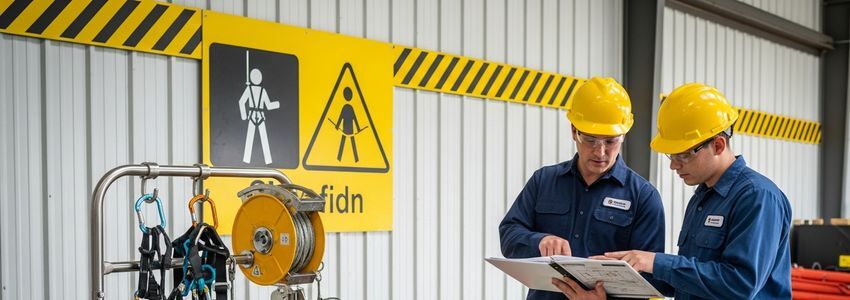
Understanding how financing works in practice helps business owners apply these concepts to their own situations. Here are six realistic scenarios based on common patterns we see across industries.
Scenario 1: Construction Company Faces Fall Protection Citation
A general contractor with 45 employees receives an OSHA citation after an inspection reveals inadequate fall protection on a commercial roofing project. The required corrective action includes new anchor systems, self-retracting lifelines for all crew members, and harness storage equipment. Total cost: $68,000. Rather than pulling cash from operating reserves during peak construction season, the company finances the full amount over 48 months. Monthly payments of approximately $1,600 are covered by the labor savings from reduced workers compensation claims within the first year.
Scenario 2: Food Processing Plant Upgrades Ventilation
A regional food processing facility receives notice from their commercial insurer that the existing ventilation system does not meet current coverage requirements for chemical processing areas. The required upgrade, including a full industrial HVAC and fume extraction system, is quoted at $120,000. The facility uses equipment financing over 60 months. Combined with an insurance premium reduction of $8,000 annually, the net cost of the upgrade is significantly lower than the sticker price suggests.
Scenario 3: Manufacturing Plant Implements Machine Guarding
A metal fabrication shop with aging CNC equipment needs to install updated machine guards across its production floor following an industry safety audit. The total investment is $45,000 for custom guards, emergency stop systems, and lockout/tagout stations. Equipment financing over 36 months allows the shop to complete the full installation immediately rather than phasing it in over 18 months and accepting interim compliance risk.
Scenario 4: Healthcare Facility Funds Patient Handling Equipment
A skilled nursing facility experiences a spike in staff back injuries related to patient transfers. A licensed ergonomics consultant recommends a full deployment of ceiling lift systems throughout the facility at a total cost of $280,000. Equipment financing over 84 months reduces the monthly payment impact to a level the facility can absorb within its operating budget, and the reduction in workers compensation claims delivers measurable ROI within the first two years.
Scenario 5: Agricultural Operation Modernizes Chemical Storage
A large-scale greenhouse operation needs to bring its chemical storage facilities into compliance with updated state environmental and workplace safety regulations. New hazardous material storage cabinets, secondary containment systems, and chemical safety monitoring equipment total $52,000. Equipment financing allows the operation to complete the compliance project before the regulatory deadline without disrupting seasonal planting investment.
Scenario 6: Auto Repair Shop Installs Exhaust Extraction System
An automotive service center is expanding from 6 to 12 bays and must install a full vehicle exhaust extraction system to meet occupational health standards for the new configuration. The system, including ceiling-mounted extraction rails and a central filtration unit, costs $38,000. Equipment financing over 48 months allows the shop to complete the expansion and the required safety infrastructure simultaneously without a major cash outlay at opening.
Important Context: In virtually every scenario above, the cost of financing the safety equipment is substantially lower than the cost of a single OSHA fine, workers compensation claim, or injury-related lawsuit. Equipment financing for safety is not just a capital management strategy - it is a direct risk mitigation tool.
How to Qualify for Equipment Financing for Safety Equipment
Qualifying for equipment financing is generally more accessible than many business owners expect. Because the equipment serves as collateral, lenders face lower default risk than with unsecured loans. This allows financing companies to work with a broader range of credit profiles.
Here are the key factors lenders evaluate for safety equipment financing applications:
Time in Business: Most equipment lenders prefer to see at least 12 months of operating history. Some programs accept startups or businesses under one year in operation, though terms may reflect the higher risk profile.
Business Revenue: Lenders want to see that monthly revenue is sufficient to service the proposed payment comfortably. A general benchmark is that your equipment payment should not exceed 10 to 15 percent of average monthly revenue for most lenders, though this varies by program.
Credit Profile: Personal credit scores above 650 are generally preferred for equipment financing, though many lenders work with scores in the 580 to 649 range with appropriate collateral, down payments, or co-signers. Business credit history, if established, is also considered.
Equipment Type and Age: Safety equipment that has a long useful life and clear market value is most favorable. Standard categories like fire suppression systems, fall protection hardware, industrial HVAC, and medical lift systems are well understood by equipment lenders. Highly specialized or custom equipment may require additional documentation.
Down Payment: Many equipment financing programs offer 0 to 10 percent down on qualifying purchases. For borrowers with credit challenges, a larger down payment can improve approval odds and reduce interest costs.
The small business financing options at Crestmont Capital span multiple lender relationships, which means we can often match borrowers with programs appropriate for their specific profile. If you are unsure whether you qualify, our team can conduct a soft assessment before you commit to a formal application.
According to research from Reuters, small business equipment lending has remained relatively stable even in periods of economic uncertainty because equipment serves as tangible, recoverable collateral. This structural advantage means equipment financing approval rates often outperform those for unsecured business loans by a significant margin.
Ready to Protect Your Team and Your Business?
Crestmont Capital makes it simple to finance safety equipment with fast approvals, flexible terms, and no hidden fees. Start your application today.
Apply NowHow to Get Started
Review your current equipment against OSHA standards, insurance requirements, and your own safety audit findings. Create a prioritized list of what needs to be upgraded or installed.
Contact two to three equipment vendors to get written quotes for the safety equipment you need. Having concrete pricing makes the financing application faster and more precise.
Complete the Crestmont Capital application at offers.crestmontcapital.com/apply-now. The process takes just a few minutes. Our team will review your application and contact you within one business day.
Once approved, funds are disbursed directly to your equipment vendor. Your safety upgrade goes into service immediately while you repay over manageable monthly installments.
Frequently Asked Questions
Conclusion: Safety Equipment Financing Is a Sound Business Decision
Workplace safety is not just a moral obligation - it is a financial one. The costs of a preventable workplace injury, an OSHA citation, or an insurance claim far exceed the cost of financing the equipment that would have prevented the problem. Equipment financing for safety equipment gives businesses of every size the ability to act immediately, protect employees, satisfy regulators, and manage cash flow responsibly at the same time.
Whether you are facing a compliance deadline, responding to an inspection, or proactively upgrading aging safety systems, equipment financing provides a practical path forward. Crestmont Capital works with businesses across every industry to structure equipment financing solutions that make safety investments accessible without straining operational capital.
If you are ready to improve your workplace safety standards through equipment financing, our team is ready to help you move forward. Apply today and receive a credit decision within one business day for most applications.
Disclaimer: The information provided in this article is for general educational purposes only and is not financial, legal, or tax advice. Funding terms, qualifications, and product availability may vary and are subject to change without notice. Crestmont Capital does not guarantee approval, rates, or specific outcomes. For personalized information about your business funding options, contact our team directly.








