
Owning a UFC GYM franchise combines the global power of one of the world's most recognized sports brands with the booming demand for mixed martial arts and functional fitness training. With more than 150 locations across the United States and an expanding international footprint, UFC GYM has become a serious contender in the boutique fitness franchise space. But understanding the full scope of startup costs, equipment investments, and ongoing operational expenses is essential before signing a franchise agreement.
Whether you are a seasoned gym operator looking to diversify your portfolio or a first-time business owner drawn to the UFC brand, this guide covers everything you need to know about UFC GYM franchise financing, including how much it costs to open a location, what lenders look for, and how to structure your funding strategy for long-term success.
UFC GYM Franchise Overview and Brand Strength
UFC GYM was founded in 2009 as a joint venture between the Ultimate Fighting Championship and New Evolution Ventures (NeV). The concept was straightforward but powerful: bring the world-class training methods of UFC fighters to everyday members. The result was a full-service gym brand with mixed martial arts at its core, offering everything from MMA classes and kickboxing to traditional strength training, group fitness, and youth programs.
The brand benefits enormously from the UFC's dominance in professional combat sports. The UFC has grown into a multi-billion dollar entertainment property with more than 700 million fans globally, according to data compiled by the organization. That brand recognition translates directly to consumer trust and member acquisition at the gym level - a competitive edge few other fitness franchises can match.
UFC GYM franchises typically offer several membership tiers and a broad class schedule that appeals to both serious martial arts practitioners and general fitness enthusiasts. Locations range from smaller TITLE Boxing-style facilities to full-size gyms spanning 15,000 to 25,000 square feet. This range creates flexibility for franchisees with different capital levels and market conditions, but it also means that the financing requirements vary significantly depending on the specific format chosen.
Key Insight
UFC GYM is listed in Entrepreneur Magazine's Franchise 500 and is recognized as a registered SBA franchise, meaning qualified borrowers can access SBA-guaranteed loan programs to finance their investment with lower down payments and longer repayment terms.
The fitness industry broadly has been resilient even through economic cycles. The U.S. health and fitness club market generates over $35 billion annually, according to the International Health, Racquet and Sportsclub Association (IHRSA). Martial arts instruction and mixed martial arts-themed fitness have seen particularly strong growth, driven by younger demographics who view fitness as an experience rather than a chore. UFC GYM is well-positioned to capture this trend.
UFC GYM Franchise Cost Breakdown
Understanding the full UFC GYM franchise cost is the foundation of your financing strategy. The total investment required varies based on the size of your location, local real estate market, build-out requirements, and how much equipment you need. Here is a detailed breakdown based on publicly available Franchise Disclosure Document (FDD) data and industry sources.
Initial Franchise Fee
The UFC GYM initial franchise fee is approximately $40,000 to $50,000. This fee grants you the right to use the UFC GYM brand, trademarks, training systems, and ongoing support resources. It is paid upfront and does not cover build-out, equipment, or working capital.
Real Estate and Build-Out Costs
The largest component of your startup investment is typically the physical space. UFC GYM locations require significant square footage to accommodate the combination of MMA training floors, mat areas, weight rooms, cardio equipment, locker rooms, and group fitness studios. Depending on your market:
- Leasehold improvements and build-out: $150,000 to $600,000+
- First and last month's rent plus security deposit: $30,000 to $120,000
- Architectural and permit fees: $10,000 to $50,000
Major metro markets with high construction costs will land at the upper end of these ranges. Smaller secondary markets may see more favorable build-out costs.
Equipment and Fixtures
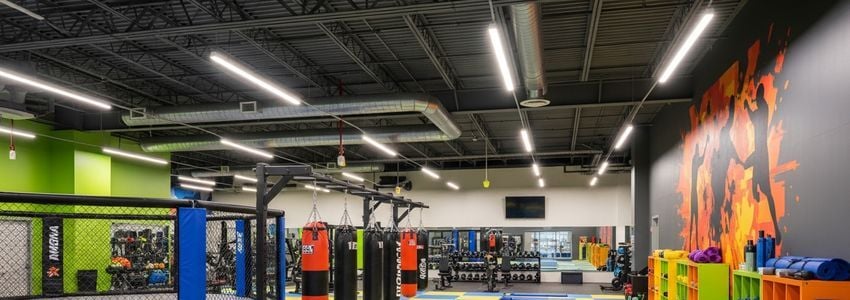
UFC GYM locations require a specific equipment package that reflects the brand's training philosophy. This includes heavy bags, speed bags, MMA cages or rings, grappling mats, cardio equipment, free weights, functional training stations, and specialized UFC-branded gear. Total equipment costs typically range from $150,000 to $400,000 depending on the gym format and size.
Technology and Systems
Point-of-sale systems, membership management software, security cameras, sound systems, and digital signage are all standard requirements. Budget $20,000 to $60,000 for technology and systems setup.
Working Capital and Opening Inventory
Lenders and the franchisor both require that you demonstrate access to sufficient working capital to operate through the pre-profitability phase. UFC GYM's FDD typically recommends having three to six months of operating expenses as liquid reserves. Working capital needs are generally estimated at $75,000 to $200,000.
Total Estimated UFC GYM Franchise Cost
| Investment Category | Low Estimate | High Estimate |
|---|---|---|
| Franchise Fee | $40,000 | $50,000 |
| Real Estate / Build-Out | $190,000 | $770,000 |
| Equipment and Fixtures | $150,000 | $400,000 |
| Technology and Systems | $20,000 | $60,000 |
| Working Capital | $75,000 | $200,000 |
| Additional Opening Costs | $25,000 | $80,000 |
| Total Estimated Investment | $500,000 | $1,560,000 |
These estimates align with typical full-service fitness franchise investments. Most UFC GYM franchisees find that a total investment in the $600,000 to $1,000,000 range is realistic for a mid-sized market location.
Ready to Finance Your UFC GYM Franchise?
Get pre-qualified today and discover your financing options. Decisions in as little as 24 hours.
Apply Now - Free, No ObligationFinancing Options for UFC GYM Franchisees
Most UFC GYM franchise investors use a combination of financing products to fund their total investment. No single loan type covers every aspect of the startup costs, so understanding how different financing tools work together is essential to building an efficient capital structure.
Traditional Bank Loans
Conventional commercial bank loans offer competitive interest rates and longer repayment terms for qualified borrowers. Banks typically lend 60% to 75% of the total project cost for franchise investments, requiring the borrower to inject 25% to 40% from personal savings or other sources. Requirements generally include a personal credit score of 700 or higher, significant collateral, and demonstrated net worth.
For a UFC GYM investment, traditional bank loans work well for financing the real estate build-out or for established operators adding a new location to an existing portfolio. However, first-time franchisees often find it challenging to meet bank underwriting standards without a proven fitness industry track record.
SBA Loans
Small Business Administration loans are among the most popular financing tools for franchise investments, and UFC GYM's registration in the SBA Franchise Registry makes this pathway particularly accessible. SBA loans offer government-backed guarantees that reduce lender risk, enabling borrowers who don't fully qualify for conventional loans to secure competitive financing. We cover SBA options in detail in the next section.
Alternative and Online Lenders
Alternative lenders like Crestmont Capital specialize in franchise financing and can often approve deals that traditional banks decline. These lenders evaluate the strength of the franchise concept, the borrower's management experience, and overall business fundamentals rather than relying exclusively on personal credit scores. Small business loans from alternative lenders typically fund faster, with approvals in days rather than weeks.
ROBS (Rollover for Business Startups)
If you have retirement savings in a 401(k) or IRA, you may be able to use those funds to finance your UFC GYM franchise through a ROBS arrangement. This strategy allows you to invest pre-tax retirement dollars into a new business without triggering early withdrawal penalties. ROBS can be a powerful way to fund part or all of your equity injection requirement, but it requires careful setup by a qualified ERISA attorney or ROBS specialist.
Business Line of Credit
A business line of credit provides flexible revolving access to capital that works well for managing the variable cash flow challenges that come with gym ownership - particularly during pre-opening and the first year of operations when membership revenue is ramping up. Lines of credit can supplement term loan financing without replacing it.
Equipment Financing
Given that fitness equipment represents a major component of UFC GYM startup costs, equipment financing is a natural fit. This product uses the equipment itself as collateral, often allowing 80% to 100% of equipment costs to be financed with relatively straightforward approval criteria. Equipment loans typically carry terms of 3 to 7 years.
SBA Loans for UFC GYM Franchise
The Small Business Administration's loan programs are designed specifically to support small business owners who might not qualify for conventional financing. For UFC GYM franchise investors, SBA loans offer an exceptional combination of lower down payments, longer repayment terms, and competitive interest rates.
SBA 7(a) Loan Program
The SBA 7(a) loan is the most commonly used SBA program for franchise financing. Loan amounts can go up to $5 million, and repayment terms can extend up to 10 years for working capital or up to 25 years for real estate. Interest rates are variable and tied to the prime rate plus a lender spread, making them highly competitive compared to conventional business loans.
Key features of the SBA 7(a) for UFC GYM:
- Maximum loan amount: $5 million
- Down payment requirement: Typically 10% to 20%
- Repayment terms: Up to 10 years (up to 25 for real estate)
- Interest rates: Variable, currently 10.5% to 12% for most borrowers
- Collateral: Required, business assets plus personal guarantee typically sufficient
Because UFC GYM is registered in the SBA Franchise Registry, lenders do not need to conduct additional due diligence on the franchise agreement - which speeds up the approval process significantly. Visit sba.gov for a complete overview of SBA loan programs.
SBA 504 Loan Program
The SBA 504 program is specifically designed for major fixed asset purchases including real estate and long-lived equipment. If you plan to purchase rather than lease your gym facility, a 504 loan can finance up to 90% of the property cost at a fixed rate. The program requires a 10% down payment from the borrower, with 40% financed through a Certified Development Company (CDC) and 50% from a traditional bank lender.
Pro Tip: SBA Franchise Registry
When applying for an SBA loan, always confirm that your franchise brand is listed in the SBA Franchise Registry at sba.gov. Registered franchises are pre-vetted, which dramatically reduces lender review time and can cut weeks off your loan approval timeline.
Equipment Financing for Fitness Franchises
Fitness franchise equipment represents a large and very specific capital need. UFC GYM locations require everything from heavy bags and grappling mats to commercial-grade cardio machines, free weight systems, and UFC-branded retail merchandise fixtures. Financing this equipment separately from the rest of your project can simplify your capital stack and in some cases reduce your overall cost of capital.
How Equipment Financing Works
Equipment loans are secured by the specific equipment being financed, which means approval criteria are generally less stringent than for unsecured loans. Lenders will evaluate the useful life of the equipment, your credit profile, and your business plan, but they do not typically require real estate collateral. Most equipment loans for fitness businesses offer:
- Financing amounts: $25,000 to $5 million+
- Terms: 3 to 7 years
- Down payments: 0% to 20% depending on credit strength
- Approval timeline: 1 to 5 business days for amounts under $500,000
Equipment Leasing vs. Financing
Some UFC GYM franchisees choose to lease their fitness equipment rather than finance a purchase. Leasing preserves cash flow and may offer certain accounting advantages, but you do not build equity in the assets and typically pay more over the full lease term. For branded MMA equipment with strong resale value, an outright purchase financed through an equipment loan is often the more cost-effective long-term choice.
Get Your UFC GYM Equipment Financed
Finance 100% of your MMA and fitness equipment. Fast approvals, competitive rates.
Apply for Equipment FinancingLender Qualification Requirements
Whether you pursue an SBA loan, conventional bank financing, or an alternative lender for your UFC GYM franchise, lenders evaluate your application using several key criteria. Understanding what lenders look for will help you prepare a stronger application and improve your chances of approval.
Personal Credit Score
For SBA loans, most lenders look for a personal credit score of at least 680, though the strongest offers go to borrowers with 700 or above. Alternative lenders may work with scores as low as 600 to 620, though lower scores typically mean higher interest rates. If your score needs improvement, focus on paying down revolving balances and resolving any derogatory items before applying.
Liquid Capital and Equity Injection
Lenders want to see that you have personal skin in the game. The SBA requires a minimum 10% equity injection for franchise loans, but most lenders prefer to see 20% to 30% of total project costs funded from the borrower's own resources. For a $750,000 UFC GYM project, that means having $150,000 to $225,000 available from personal savings, retirement accounts (via ROBS), or other liquid sources.
Net Worth
Lenders typically want to see a personal net worth equal to or greater than the loan amount being requested. This provides an additional layer of security. Business assets, real estate equity, retirement accounts, and other investments all count toward your net worth calculation.
Franchise Experience and Management Background
Lenders evaluate your ability to operate a gym or fitness business successfully. Prior experience in the fitness industry, franchise management, or business ownership in general strengthens your application. UFC GYM's franchisor also provides training programs and support that lenders view positively as a risk mitigation factor.
Business Plan
A well-prepared business plan that includes financial projections, market analysis, and a clear description of your target demographic is essential for franchise loan applications. Lenders want to understand your competitive landscape, expected membership ramp-up timeline, and break-even projections.
What Lenders Look For - Quick Summary
- Personal credit score: 680+ (700+ preferred)
- Cash injection: 10% to 30% of total project cost
- Net worth: Equal to or exceeding loan amount
- Business plan with 3-year financial projections
- Management experience in fitness or franchise operations
- Clean personal financial history (no recent bankruptcies or judgments)
If your profile does not meet all of these criteria, bad credit business loan options may still be available to you through alternative lenders who take a more holistic view of creditworthiness.
How to Apply for a UFC GYM Franchise Loan
The loan application process for a franchise investment is more involved than applying for a personal loan or credit card, but following a systematic approach will make it manageable. Here is a step-by-step roadmap.
Step 1: Complete Due Diligence on the Franchise
Before approaching any lender, you should fully understand what you are buying. Review the UFC GYM Franchise Disclosure Document (FDD) carefully - ideally with the help of a franchise attorney. Pay particular attention to Item 7 (estimated initial investment), Item 19 (financial performance representations), Item 20 (existing franchisees), and Item 21 (financial statements of the franchisor).
Speaking with existing UFC GYM franchisees is also invaluable. They can provide honest assessments of the actual costs, support quality, and earning potential that you will not find anywhere else.
Step 2: Build Your Financial Profile
Lenders will request extensive financial documentation including personal tax returns for the past 2 to 3 years, a personal financial statement showing assets and liabilities, bank statements for the past 3 to 6 months, and proof of equity injection funds.
Step 3: Prepare a Business Plan and Financial Projections
Your business plan should cover your market analysis, target member profile, competitive landscape, pricing strategy, staffing plan, and 3-year financial projections including monthly revenue, expenses, and cash flow. According to Reuters coverage of the fitness industry, post-pandemic recovery has driven gym membership demand back above pre-pandemic levels, providing a strong market backdrop for new franchise investments.
Step 4: Identify Your Lender
Consider working with an SBA Preferred Lender Program (PLP) lender for faster SBA loan processing. These lenders have been delegated authority by the SBA to approve loans without additional SBA review, cutting weeks off the process. Alternatively, working with a specialty franchise lender or an alternative lender like Crestmont Capital can offer faster approvals and more flexible underwriting.
Step 5: Submit Your Application
Once you have selected a lender, submit your completed application package. Be responsive to any requests for additional documentation and maintain regular communication with your loan officer. Fast business loans from alternative lenders can sometimes fund within 24 to 48 hours, while SBA loans typically take 30 to 90 days to close.
Start Your UFC GYM Franchise Loan Application Today
Crestmont Capital specializes in franchise financing. Get a decision in as little as 24 hours.
Apply NowUFC GYM Financial Projections and ROI
Prospective UFC GYM franchisees naturally want to know what kind of return on investment they can expect. While specific figures depend on your market, location, and operational execution, understanding the general economics of gym ownership helps you evaluate whether this investment makes financial sense.
Revenue Model
UFC GYM locations generate revenue through several streams:
- Membership fees: The core revenue driver; monthly dues range from $30 to $80+ depending on membership tier
- Class fees and personal training: Premium revenue from specialized MMA instruction and one-on-one coaching
- Youth programs: Children's martial arts classes typically command premium per-class pricing
- Merchandise and supplements: UFC-branded merchandise, apparel, and nutrition products
- Day passes and short-term memberships: Ancillary revenue from non-member visitors
Revenue Ramp-Up Timeline
Most gym franchises experience a 12- to 24-month ramp-up period before reaching stabilized membership levels. Pre-sales are critical - the most successful UFC GYM franchisees actively sell memberships in the months before opening to ensure a strong launch-day base. Industry benchmarks suggest targeting 500 to 800 members for a mid-sized full-service UFC GYM location to reach break-even.
Gross Margin and Profitability
Fitness clubs typically achieve gross margins of 50% to 65% after instructor and staff costs. Net operating margins for established franchise locations average 15% to 25%, according to fitness industry research. A UFC GYM with $1.2 million in annual revenue could generate $180,000 to $300,000 in net operating income - providing a reasonable return on a $750,000 investment.
Ongoing Fees
Beyond your startup costs, UFC GYM franchisees pay ongoing royalty fees and marketing contributions that reduce operating income. These typically include a royalty fee of 6% to 7% of gross sales and marketing fund contributions of 1% to 2% of gross sales. Factoring these fees into your projections is essential.
Related Resource
If you are exploring other fitness franchise investments alongside UFC GYM, our guide on Whataburger Franchise Loans and The UPS Store Franchise Loans provide detailed financing breakdowns across multiple franchise categories.
UFC GYM Franchise Financing at a Glance
UFC GYM Franchise: Key Numbers
$500K
Minimum Total Investment
$40-50K
Initial Franchise Fee
6-7%
Ongoing Royalty Fee
10%
Min SBA Down Payment
$5M
Max SBA 7(a) Amount
150+
U.S. Locations
Sources: UFC GYM FDD, SBA.gov, Crestmont Capital research
Comparing UFC GYM to Other Fitness Franchise Investments
The fitness franchise landscape is crowded, and UFC GYM competes against a range of well-established brands. Understanding how UFC GYM's investment profile stacks up can help you make a more informed decision about whether it is the right franchise for your financial goals and background.
Planet Fitness represents the low-cost end of the fitness franchise spectrum with a total investment in the $1 million to $4.6 million range for a full-size location. Anytime Fitness falls in the $78,000 to $513,000 range for its smaller format. Orangetheory and F45 Training occupy the boutique fitness segment with investments typically in the $250,000 to $750,000 range.
UFC GYM's investment range of $500,000 to $1.56 million positions it solidly in the middle tier of fitness franchise investments. The key differentiator is brand power: the UFC is one of the most recognized sports and entertainment brands in the world, with the marketing muscle to drive ongoing consumer awareness that boutique independent gyms simply cannot match.
Forbes has noted in its franchise coverage that brand-affiliated gyms often outperform independent fitness businesses in member retention and new member acquisition, particularly in competitive urban markets where consumers have many options.
Common Financing Mistakes to Avoid
First-time franchise investors often make financing mistakes that complicate their launch or create long-term cash flow problems. Here are the most common pitfalls and how to avoid them.
Underestimating Working Capital Needs
The most common mistake is not having enough cash reserved for operating expenses during the ramp-up period. Membership revenue takes time to build, but rent, payroll, utilities, and loan payments start on day one. Ensure you have at least 6 months of operating expenses accessible beyond what you need for build-out and equipment.
Relying on a Single Financing Source
Waiting until you have one lender's approval before approaching others creates unnecessary risk. Apply to multiple lenders simultaneously to improve your odds and create negotiating leverage on terms. This is particularly important for SBA loans, which can be unpredictable in their approval timelines.
Neglecting to Shop Interest Rates
Even a 1% difference in interest rate on a $750,000 loan amounts to thousands of dollars over a 10-year term. Get quotes from at least 3 to 5 lenders before committing to any financing offer.
Expert Insight
According to CNBC's small business coverage, franchise businesses have consistently higher 5-year survival rates than independent businesses - a data point that resonates positively with lenders evaluating franchise loan applications.
UFC GYM Franchise Support and Training
One factor that directly impacts your financing prospects is the quality of the franchisor's support infrastructure. Lenders view strong franchisor support as a risk mitigation factor. UFC GYM provides franchisees with a comprehensive onboarding program that includes initial training at UFC GYM headquarters, on-site support during the pre-opening and opening phases, access to UFC's marketing materials and national brand campaigns, proprietary member management systems and POS platforms, and ongoing regional field support visits.
This level of institutional support helps justify the franchise fee and royalty payments - and it demonstrates to lenders that you are not starting from scratch, but rather launching a proven business concept with an experienced partner.
Refinancing and Growth Financing
Once your UFC GYM franchise is operational and generating stable revenue, new financing opportunities open up. Established gym owners can access more attractive loan terms than first-time franchisees because they have documented business performance to show lenders.
Growth scenarios to consider include multi-unit expansion by adding a second or third UFC GYM location using the equity and operating history from your first unit, equipment upgrades as fitness technology evolves, and refinancing to replace higher-cost startup financing with more favorable terms as your business matures.
Working with a lender who understands franchise businesses and can grow with you over time is a significant strategic advantage. See our companion guide on Club Pilates franchise financing for another example of how fitness franchise owners structure growth financing.
The Role of Personal Credit in UFC GYM Franchise Financing
Your personal credit score plays a larger role in franchise lending than in some other business financing contexts. This is because most franchise investments are relatively new businesses without an established track record, so lenders lean heavily on the owner's personal financial history as a proxy for business creditworthiness.
If your credit score is below 680, take steps to improve it before applying. Strategies include paying down credit card balances to below 30% of limits, disputing any errors on your credit report, avoiding new credit inquiries, and keeping all existing accounts current. Even modest improvements in your score can unlock better interest rates that save tens of thousands of dollars over the life of your loan.
Bloomberg has covered the increasing scrutiny lenders apply to personal credit profiles in franchise financing decisions, noting that the post-pandemic lending environment has reset underwriting standards at many banks to more conservative benchmarks.
For those with challenged credit histories, bad credit business loan programs exist that evaluate applications holistically, looking at business plan quality, market opportunity, and your equity injection level rather than relying solely on a credit score.
Frequently Asked Questions About UFC GYM Franchise Loans
What is the total cost to open a UFC GYM franchise?
The total investment to open a UFC GYM franchise ranges from approximately $500,000 to $1,560,000, depending on location size, market, build-out complexity, and equipment package. Most mid-size market locations fall between $600,000 and $1,000,000 total.
Can I get an SBA loan for a UFC GYM franchise?
Yes. UFC GYM is registered in the SBA Franchise Registry, which makes SBA 7(a) and 504 loans available for qualified borrowers. SBA loans offer lower down payments (as low as 10%) and longer repayment terms than conventional business loans.
How much cash do I need to open a UFC GYM?
Most lenders require 10% to 30% of total project costs as a cash injection. For a $750,000 project, that means $75,000 to $225,000 in liquid personal capital. Having additional working capital reserves of 3 to 6 months of operating expenses is also important.
What credit score do I need for a UFC GYM franchise loan?
For SBA and conventional bank loans, most lenders prefer a personal credit score of 680 or higher. Alternative lenders may approve borrowers with scores as low as 600 to 620. A higher score typically results in better interest rates and loan terms.
How long does it take to get a franchise loan approved?
Alternative lender approvals can come in as little as 24 to 72 hours. SBA loan approvals typically take 30 to 90 days from application to closing. Having all your documentation prepared in advance significantly speeds up the process.
What are UFC GYM's ongoing franchise fees?
UFC GYM franchisees pay a royalty fee of approximately 6% to 7% of gross sales plus marketing fund contributions of 1% to 2% of gross sales. These fees should be factored into your financial projections when evaluating the investment.
Can I finance UFC GYM equipment separately from the rest of the investment?
Yes. Equipment financing is a common approach that allows you to use the equipment as collateral. This can fund 80% to 100% of equipment costs separately from your main franchise loan, simplifying your overall capital structure.
Does UFC GYM offer any in-house financing to franchisees?
UFC GYM does not typically provide direct financing to franchisees, but the franchisor may have preferred lending relationships or be able to refer you to lenders familiar with their franchise system. Most franchisees arrange financing independently through SBA lenders, banks, or alternative lenders.
What is a ROBS arrangement and can I use it for UFC GYM?
A ROBS (Rollover for Business Startups) allows you to invest retirement account funds (401k, IRA) into a new business without triggering early withdrawal penalties. It can be used to fund your equity injection requirement for a UFC GYM franchise. This strategy requires legal and financial expertise to implement correctly.
How long is the UFC GYM franchise agreement?
UFC GYM franchise agreements are typically 10-year terms with renewal options. This long-term commitment aligns well with the amortization schedules of SBA loans and long-term equipment financing, which typically run 7 to 10 years.
What documents do I need to apply for a UFC GYM franchise loan?
Common required documents include 2 to 3 years of personal tax returns, a personal financial statement, recent bank statements, a business plan with financial projections, the signed franchise agreement or letter of intent, and proof of any equity injection funds.
Is a personal guarantee required for a UFC GYM franchise loan?
Yes, in nearly all cases. SBA loans require personal guarantees from any owner with 20% or more equity in the business. Conventional bank loans and alternative lender financing also typically require personal guarantees. This means your personal assets are at risk if the business fails to repay.
Can I get approved for a UFC GYM franchise loan with bad credit?
It is more challenging but not impossible. Alternative lenders are more flexible about credit scores than banks, and some programs specifically serve borrowers with scores in the 550 to 640 range. Having a larger down payment, strong personal net worth, and relevant industry experience can help offset a lower credit score.
How profitable is a UFC GYM franchise?
Profitability varies significantly based on location, market size, member count, and operational efficiency. Industry benchmarks suggest that established fitness franchise locations with strong membership bases can generate net operating margins of 15% to 25%. Review UFC GYM's Item 19 in the FDD for the franchisor's own financial performance representations.
What is the difference between a franchise fee and royalty fees?
The franchise fee is a one-time upfront payment for the right to open a UFC GYM location covering initial training, brand use, and system access. Royalty fees are ongoing percentage-of-revenue payments made throughout the life of the franchise agreement in exchange for continued brand use, support, and system access.
Disclaimer: The information provided in this article is for general educational purposes only and does not constitute financial, legal, or investment advice. Franchise investment costs and loan terms vary widely based on individual circumstances, lender criteria, and market conditions. Always consult with qualified financial, legal, and franchise professionals before making any investment decision. Crestmont Capital makes no guarantees regarding loan approval or business outcomes.