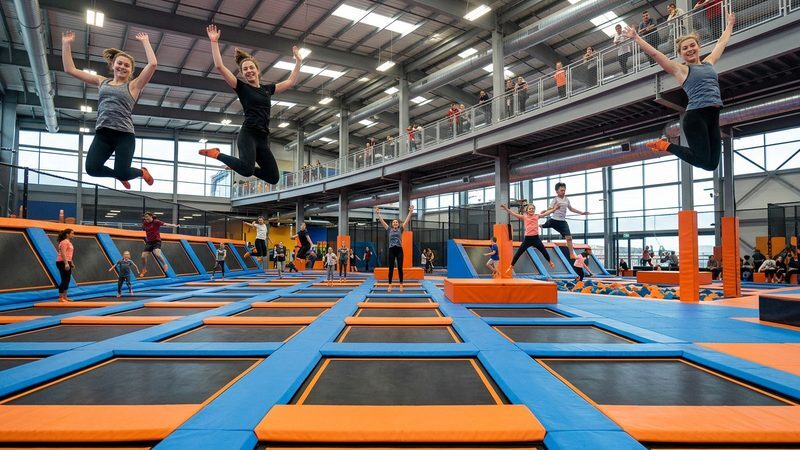
Opening or expanding a trampoline park takes serious capital, and the equipment alone is usually the single largest line item in the budget. Trampoline park equipment financing gives owners a practical way to acquire courts, safety systems, and attractions without draining working capital in one lump sum. In this guide, we break down exactly how trampoline park equipment financing works, what it covers, who qualifies, and how to structure funding that protects your cash flow from day one.
In This Article
What Is Trampoline Park Equipment Financing?
Trampoline park equipment financing is a form of business funding designed specifically to cover the purchase or lease of the physical equipment a trampoline park needs to operate. That includes trampoline courts, angled wall trampolines, foam pits, airbags, dodgeball courts, ninja warrior courses, climbing walls, safety padding, netting, and the point-of-sale and waiver systems that keep the facility running.
Instead of paying the full invoice price up front, a lender or financing company provides the capital to acquire the equipment. You repay the amount over a fixed term, usually in monthly installments. In most structures, the equipment itself serves as collateral, which is why approval is often faster and qualification more flexible than with an unsecured bank loan.
For a business model where trampoline park equipment cost routinely lands between several hundred thousand dollars and well over a million for a full build-out, spreading that cost across three to seven years can be the difference between opening on schedule and never opening at all.
The structure is widely used across the family entertainment center industry, from single-location independent parks to multi-unit operators refreshing aging courts. It applies equally to new construction, used equipment purchases, and major equipment replacements at existing facilities.
Key Benefits of Financing Trampoline Park Equipment
There is a reason nearly every capital-intensive entertainment venue uses some form of equipment funding. Here are the advantages that matter most to trampoline park owners.
- Preserve working capital. A trampoline park needs cash for payroll, insurance, marketing, and rent long before the first customer jumps. Financing keeps your cash reserve intact for those operating costs instead of locking it into steel and springs.
- Fixed, predictable payments. Monthly installments make budgeting straightforward. You know exactly what leaves the account each month, which matters when revenue is seasonal.
- Faster path to opening. Waiting to save the full trampoline park equipment cost can delay a launch by years. Financing compresses that timeline into weeks.
- Revenue starts paying for the equipment immediately. A financed court starts generating admissions, party bookings, and concessions revenue while you are still paying it off. The asset effectively funds its own payment.
- Flexible structures. Loans, leases, deferred payment schedules, and seasonal payment plans can all be shaped around how a trampoline park actually earns money, including slower summer months in some markets.
- Easier qualification than unsecured debt. Because the equipment secures the funding, lenders focus more on the asset and your revenue plan than on perfect credit or years of operating history.
- Upgrade without a second cash crisis. Courts wear out. Foam compacts. Safety standards evolve. Financing makes mid-life equipment refreshes a planned expense instead of an emergency.
Key Stat: According to the U.S. Small Business Administration, miscalculating startup costs is one of the most common reasons new businesses run out of cash. Equipment financing directly addresses the largest cost category for venue-based entertainment businesses.
How Trampoline Park Equipment Financing Works
The mechanics are simpler than most owners expect. Here is the process from application to installation.
Step 1: Build Your Equipment List and Get Quotes
Start with a detailed equipment package from your manufacturer or installer. Lenders want itemized quotes showing exactly what is being purchased, from court frames and springs to padding, netting, foam, and electronic systems. A clean quote package speeds up underwriting significantly.
Step 2: Apply With a Financing Provider
Submit an application with basic business information, the equipment quote, and recent bank statements. For established parks, expect to provide a few months of revenue history. For new builds, lenders weigh the business plan, your industry experience, and personal credit more heavily.
Step 3: Review Terms and Choose a Structure
Approval typically comes back with a term length, monthly payment, and structure options. Terms for trampoline park equipment commonly run 36 to 84 months. You choose between owning the equipment at the end through a loan-style structure or leasing with a purchase option.
Step 4: Funding Goes Directly to the Vendor
In most deals, the financing company pays the equipment manufacturer or installer directly. You never handle the full lump sum, which keeps the transaction clean and fast.
Step 5: Make Payments While the Equipment Earns
Once installed, the equipment starts producing revenue immediately. Monthly payments come out of operating cash flow, and at the end of the term you either own the equipment outright or exercise a purchase option, depending on the structure.
What Equipment Can You Finance?
Almost everything bolted, sprung, padded, or plugged in inside a trampoline park qualifies. The most commonly financed items include:
- Main court trampolines - the interconnected jump surfaces that form the core of the park
- Angled wall trampolines - wall-to-floor transition trampolines for advanced jumpers
- Foam pits and airbag systems - landing zones for tricks, flips, and training areas
- Dodgeball and sport courts - dedicated enclosed courts with their own trampoline beds
- Ninja warrior and obstacle courses - frames, obstacles, and safety flooring
- Climbing walls and vertical attractions - auto-belay systems, wall panels, and harnesses
- Safety padding and netting - frame pads, column wraps, and barrier netting throughout the facility
- Waiver and point-of-sale systems - check-in kiosks, RFID wristband systems, and POS hardware
- Party room fixtures and arcade equipment - secondary revenue equipment that rounds out the facility
Soft costs are sometimes eligible too. Depending on the lender, installation, shipping, and even initial safety certification can be rolled into the financed amount, which matters when installation alone runs six figures on a large build.
Building or Upgrading a Trampoline Park?
Get the equipment you need now and pay over time. Fast approvals from the #1 business lender in the U.S.
Apply Now →How Much Does Trampoline Park Equipment Cost?
Trampoline park equipment cost is the starting point for every financing conversation, and it surprises most first-time operators. While every build is different, the major cost categories are consistent across the industry.
Core Court Systems
The main jump court is the heart of the park and usually the largest single equipment expense. Court systems are typically priced by square footage of jumping surface, and a mid-size park's main court alone can run into the hundreds of thousands of dollars once frames, beds, springs, and padding are included. Angled wall sections and performance trampolines add to that base figure.
Safety Systems
Safety padding, netting, column wraps, and barrier systems are non-negotiable and typically represent a meaningful share of the total package. Insurance carriers and industry standards drive much of this cost, and cutting corners here creates liability exposure that dwarfs any savings.
Attraction Add-Ons
Foam pits, airbag landing systems, dodgeball courts, ninja courses, climbing walls, and battle beams each carry their own price tags, from tens of thousands for a single attraction to six figures for a full ninja course installation. Most parks phase these in over time, which is where staged equipment financing becomes useful.
Technology and Operations Equipment
Waiver kiosks, RFID wristband systems, point-of-sale hardware, security cameras, and party room fixtures are smaller line items individually but add up quickly across a full facility. These are usually eligible for the same financing package as the courts themselves.
Soft Costs
Shipping and professional installation are frequently overlooked in early budgets. Freight for steel court structures is substantial, and manufacturer-certified installation on a large park can reach six figures. Both can often be rolled into equipment financing when they appear on the vendor invoice.
The practical takeaway: budget the full installed cost, not the equipment sticker price, and bring that complete quote to your financing application. A realistic installed figure is what lenders want to see, and it prevents the mid-build funding gaps that stall openings.
Who Qualifies for Trampoline Park Equipment Financing?
Qualification is more accessible than most owners assume, but lenders do look at a consistent set of factors.
Established Parks
Operating facilities with at least six to twelve months of revenue history are the strongest candidates. Lenders review monthly revenue, time in business, and credit. Parks using financing for expansion attractions or replacement equipment often qualify for the best terms because the equipment purchase is backed by proven cash flow.
New Builds and Startups
First-time operators can qualify as well, though underwriting leans harder on personal credit, industry experience, and the quality of the business plan. A background in family entertainment, fitness, or franchise operations helps considerably. Some lenders ask for a larger down payment from startups, typically 10 to 30 percent of the equipment cost.
Credit Considerations
Because the equipment secures the funding, credit standards are more forgiving than with unsecured loans. Many programs work with owners in the 600 to 650 credit range, and some specialized programs go lower. Stronger credit simply means better rates and lower upfront costs. Owners rebuilding credit can also look at bad credit equipment financing options designed for exactly that situation.
What Lenders Typically Ask For
- Itemized equipment quote from the manufacturer or installer
- Three to six months of business bank statements (existing operations)
- Business plan with revenue projections (new builds)
- Basic ownership and entity information
- Personal credit authorization for all significant owners
Financing vs. Leasing vs. Paying Cash
Three paths exist for acquiring trampoline park equipment, and each fits a different situation.
| Factor | Equipment Loan | Equipment Lease | Paying Cash |
|---|---|---|---|
| Upfront cost | Low (0-20% down typical) | Lowest (often first payment only) | Full invoice price immediately |
| Ownership | You own it from day one | Purchase option at term end | Immediate ownership |
| Monthly payment | Fixed | Fixed, often lower than a loan | None |
| Cash flow impact | Predictable, spread out | Predictable, spread out | Severe one-time drain |
| Best for | Long-term assets you will keep 7+ years | Equipment you may upgrade on a cycle | Owners with excess reserves beyond operating needs |
Most trampoline park owners land on a loan or a lease-with-purchase structure. Courts and safety systems are long-lived assets, so ownership usually makes sense. Operators who refresh attractions aggressively every few years sometimes prefer leasing for the built-in upgrade path. You can compare both structures on our equipment financing and equipment leasing pages.
How Crestmont Capital Helps Trampoline Park Owners
Crestmont Capital has funded equipment purchases for entertainment venues, fitness facilities, and family attractions across the country, and trampoline parks fit squarely inside that wheelhouse. The approach is built around speed and flexibility rather than the rigid checklists that stall deals at traditional banks.
Here is what working with Crestmont looks like in practice:
- Fast decisions. Applications are reviewed in hours, not weeks. Most qualified applicants receive a decision the same day they apply.
- Structures matched to your revenue. Seasonal payment schedules, deferred starts, and terms from 24 to 84 months let you match payments to how a trampoline park actually earns.
- New builds welcome. Startup operators can access startup equipment financing programs built specifically for first-time venue launches.
- Full-package funding. Courts, safety systems, ninja courses, climbing walls, POS systems, and installation costs can all be combined into a single financing package instead of juggling multiple vendors and loans.
- Working capital alongside equipment. Many owners pair equipment funding with a business line of credit to cover marketing and payroll through the ramp-up period.
By the Numbers
Trampoline Park Equipment Financing - Key Figures
3-7 yrs
Typical financing term range for trampoline park equipment
10-30%
Common down payment range for startup operators
33M+
Small businesses operating in the U.S., per the SBA
Same day
Typical Crestmont Capital decision speed on qualified applications
Talk to a Funding Specialist
Tell us about your park and your equipment list. We will show you the payment options that fit your budget.
Apply Now →Real-World Scenarios: How Owners Use Equipment Financing
Abstract terms only go so far. These scenarios reflect the most common ways trampoline park equipment financing plays out in practice.
Scenario 1: The First-Time Park Build
A former gymnastics facility manager finds a 28,000-square-foot warehouse in a growing suburb. The equipment package from the manufacturer totals just over $900,000 installed. Paying cash would consume nearly her entire capital raise, leaving almost nothing for six months of payroll and marketing. She finances the full equipment package over 72 months with 15 percent down, keeping roughly $400,000 liquid for operating costs. The park opens on schedule and the monthly payment is covered by week-two birthday party bookings alone.
Scenario 2: The Aging Court Replacement
An established park hitting year six notices court performance dropping and maintenance calls increasing. Replacement trampoline beds, springs, and padding for the main court run about $180,000. Rather than defer the work and risk injuries or bad reviews, the owner finances the replacement over 48 months. Revenue never dips, the park advertises a full court refresh, and party bookings actually rise the following quarter.
Scenario 3: Adding a Ninja Course to Lift Weekday Traffic
A park with strong weekend traffic but weak weekday attendance decides to add a ninja warrior course targeting after-school programs and fitness classes. The attraction costs $140,000 installed. A 60-month equipment loan adds a manageable fixed payment, and the new school group contracts it attracts cover the payment several times over within the first year.
Scenario 4: The Multi-Unit Operator Standardizing Equipment
A regional operator running four parks wants consistent courts, POS systems, and waiver kiosks across all locations. A single financing package covering all four sites simplifies the vendor relationship into one monthly payment and one term, and the standardized equipment cuts maintenance training costs across the group.
Scenario 5: The Credit-Rebuild Owner
An owner whose first business closed during the pandemic is ready to try again with a leaner trampoline park concept. Traditional banks decline the application. Through a bad credit equipment financing program, he secures the core court package with a slightly higher down payment, opens the park, and refinances to better terms two years later with operating history on the books.
Scenario 6: The Franchise Refit
A franchise owner is required by the brand to upgrade to the latest court design and safety padding standard within 18 months. Equipment financing lets her meet the franchise deadline on a predictable payment schedule instead of diverting the marketing budget that keeps the location competitive.
Frequently Asked Questions
Get Your Equipment Quote Funded
Already have a manufacturer quote? Turn it into a monthly payment plan today. No obligation to apply.
Apply Now →Next Steps: Getting Funded
Request a full package quote from your manufacturer or installer covering equipment, shipping, and installation.
Submit the short application with your quote and recent bank statements. No lengthy paperwork.
Compare term lengths, down payment levels, and structures to find the payment that fits your cash flow.
Funding goes directly to your vendor, installation gets scheduled, and your park starts earning.
Conclusion
A trampoline park lives and dies by the quality of its equipment, and the quality of that equipment should never be limited by how much cash happens to be in the bank on a given day. Trampoline park equipment financing turns the largest startup or upgrade cost into a predictable monthly expense, preserves the working capital your park needs to actually operate, and gets courts, courses, and attractions installed on your timeline instead of your savings account's timeline.
Whether you are building your first park, replacing an aging court, or adding the attraction that fills your slowest weekday hours, the right funding structure makes the equipment pay for itself while it earns. Crestmont Capital has helped venue owners across the country do exactly that, and the application takes minutes. If equipment cost is the one thing standing between you and a bigger, better park, it is a solvable problem.
For related reading, see our guide on financing equipment upgrades without cash flow strain, or explore small business financing options for the rest of your operation. Industry data from sources like Census.gov and small business trend coverage from CNBC and Forbes can also help you benchmark your plans against the broader market.
Disclaimer: The information provided in this article is for general educational purposes only and is not financial, legal, or tax advice. Funding terms, qualifications, and product availability may vary and are subject to change without notice. Crestmont Capital does not guarantee approval, rates, or specific outcomes. For personalized information about your business funding options, contact our team directly.