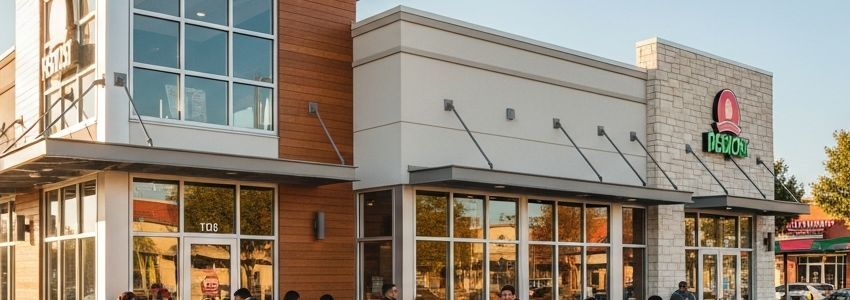
Opening a Taco John's franchise is a genuine opportunity to own a piece of one of the most beloved regional fast-food brands in America. But like any restaurant franchise, securing the right financing is the critical first step that separates aspiring owners from operating ones. This guide covers everything you need to know about Taco John's franchise costs, financing options, qualification requirements, and how to put yourself in the best possible position to get funded.
What Is Taco John's Franchise?
Taco John's is a fast-food Mexican-inspired restaurant chain founded in 1969 in Cheyenne, Wyoming. Known for its signature Potato Oles and a bold, Tex-Mex-inflected menu, the brand has grown into a regional powerhouse with over 400 locations across 23 states, primarily in the Midwest and Mountain West.
Unlike the coastal-dominant chains, Taco John's holds deeply loyal customer bases in markets like Wyoming, Minnesota, Wisconsin, Iowa, South Dakota, and Nebraska. For franchise investors, this regional concentration is actually a competitive advantage: less saturation, loyal repeat customers, and room to grow in underserved markets.
The franchise model is structured around:
- Traditional freestanding restaurant locations
- End-cap and inline strip mall locations
- Non-traditional locations (travel centers, airports, colleges)
- Drive-through models
According to Forbes, fast-food franchises with proven brand equity in defined regional markets consistently outperform startup restaurant concepts when it comes to loan approval rates and early profitability timelines. Taco John's fits this profile well.
The brand is owned by The Resolute Restaurant Group and has been on a strategic growth trajectory over the past several years, investing in digital ordering platforms, menu modernization, and new restaurant design formats. For investors looking at a regional brand with national infrastructure support, Taco John's deserves serious consideration.
Lenders often view established regional fast-food brands favorably because they benefit from both name recognition and lower competition density. SBA lenders in particular appreciate proven franchise systems with documented unit economics and multi-year operating histories. Taco John's checks these boxes.
Taco John's Franchise Costs and Requirements
Before you can apply for financing, you need a clear picture of what you are actually trying to fund. Taco John's franchise costs vary based on location type, real estate, and build-out scope, but here are the core numbers every prospective franchisee should know.
Initial Investment Breakdown
Taco John's Franchise Investment Overview
Estimates based on Taco John's FDD and industry averages. Actual costs vary by location and market.
Detailed Cost Categories
Here is a more granular look at where your investment dollars go when opening a Taco John's location:
| Cost Category | Estimated Range |
|---|---|
| Franchise Fee | $25,000 |
| Real Estate / Leasehold Improvements | $150,000 - $550,000 |
| Equipment and Fixtures | $120,000 - $280,000 |
| Signage | $15,000 - $40,000 |
| Initial Inventory | $10,000 - $25,000 |
| Training and Pre-Opening Costs | $20,000 - $45,000 |
| Technology / POS Systems | $15,000 - $35,000 |
| Working Capital Reserve (3 months) | $50,000 - $100,000 |
| Total Estimated Investment | $450,000 - $1,200,000 |
Note that these figures are estimates based on publicly available FDD data and industry benchmarks. Your specific costs will depend on your territory, the type of location, whether you are building from scratch or converting an existing space, and current construction and equipment market conditions.
Franchisee Financial Requirements
Taco John's has established baseline financial requirements for franchise candidates:
- Minimum Net Worth: $500,000
- Minimum Liquid Capital: $150,000
- Restaurant or business management experience: Strongly preferred
- Commitment to active involvement in day-to-day operations (absentee ownership is not accepted)
These thresholds exist to protect the franchisor's brand and ensure franchisees have the financial cushion to weather the first 12 to 18 months of operations, which are typically the highest-risk period for any new franchise unit.
Ready to explore your Taco John's franchise financing options?
Crestmont Capital helps franchise candidates get matched with the right lenders fast. No obligation - just answers.
Apply for Franchise FinancingTypes of Financing Available for Taco John's Franchise Owners
There is no single financing product that works for every franchise owner. The right mix depends on your credit profile, equity, timeline, and risk tolerance. Here is a breakdown of the most commonly used tools for funding a Taco John's franchise.
1. SBA 7(a) Loans
The SBA 7(a) loan is the most widely used financing vehicle for franchise startups in the United States. These are government-backed loans issued by approved lenders, with the SBA guaranteeing a portion of the loan in case of default. This guarantee lowers the risk for lenders, which translates into better terms for borrowers.
Key features of SBA 7(a) loans for franchise financing:
- Loan amounts up to $5 million
- Repayment terms up to 10 years for working capital; up to 25 years for real estate
- Interest rates tied to Prime Rate (typically Prime + 2.75% to 4.75%)
- Down payment typically 10% to 20%
- Can cover franchise fee, build-out, equipment, working capital
For Taco John's specifically, the SBA maintains a Franchise Registry that helps lenders quickly identify approved franchise systems. Being on this list speeds up the review process and can improve approval odds. To learn more about how SBA loans apply to your specific situation, visit our guide to SBA loans for business owners.
2. SBA 504 Loans
If your Taco John's investment involves purchasing or constructing real estate or acquiring major fixed assets, an SBA 504 loan may be the better structure. These loans are designed specifically for long-term, fixed-asset financing and come with below-market interest rates for the SBA-guaranteed portion.
- Typically structured as 50% conventional lender / 40% SBA / 10% borrower equity
- Fixed interest rate on the SBA portion
- Best suited for real estate acquisition and major construction
- Loan amounts can exceed $5 million for eligible projects
3. Conventional Bank Loans
Traditional bank loans remain an option, particularly for franchisees with strong personal credit, substantial collateral, and existing banking relationships. Conventional loans typically require:
- 700+ credit score
- 20% to 30% down payment
- Solid collateral (real estate, equipment)
- Business plan with detailed financial projections
The tradeoff is that banks often have stricter underwriting criteria than SBA-backed lenders. However, for highly qualified borrowers, conventional loans can offer faster processing and fewer documentation requirements.
4. Equipment Financing
Restaurant equipment is a major cost center for any Taco John's franchise - commercial fryers, refrigeration units, drive-through technology, POS systems, and prep stations are just the beginning. Equipment financing allows you to fund these purchases using the equipment itself as collateral, which typically results in lower rates and faster approvals.
Benefits of equipment financing for franchise operators:
- Preserves working capital for operations and staffing
- Equipment serves as its own collateral
- Faster approval compared to SBA loans (often 3-7 days)
- Tax benefits through Section 179 deductions
- Flexible terms from 24 to 84 months
5. Business Lines of Credit
A revolving business line of credit functions like a business credit card with a much higher limit and lower interest rate. It is ideal for managing the variable cash flow demands of a restaurant franchise - covering payroll gaps during slow seasons, restocking inventory, funding local marketing, and handling unexpected equipment repairs without disrupting operations.
Lines of credit for established franchise operators typically range from $25,000 to $500,000+ depending on revenue and creditworthiness. You only pay interest on what you draw, making this a cost-efficient safety net when used strategically.
6. Alternative Term Loans
For franchise candidates who need faster funding or do not fully qualify for SBA loans, alternative lenders offer term loans with streamlined applications, minimal documentation, and approval timelines as short as 24 to 48 hours. The tradeoff is typically higher interest rates compared to SBA products.
Alternative loans work well for:
- Bridge financing during SBA processing
- Supplementing a primary SBA loan with additional working capital
- Franchise owners with credit scores in the 600 to 680 range
- Funding urgency scenarios (lease deadlines, equipment opportunities)
Crestmont Capital's network includes both SBA-preferred lenders and best-in-class alternative lenders. You can learn more about your options on our small business loans page.
7. ROBS (Rollover for Business Startups)
Some franchise investors leverage retirement savings to fund their franchise without triggering early withdrawal penalties or taxes. This strategy - known as ROBS - involves setting up a C-corporation, creating a 401(k) plan, and using those funds to purchase stock in the new business. While complex, ROBS is a legitimate and increasingly popular strategy for franchise financing. It requires careful legal and tax guidance to implement correctly.
Many successful Taco John's franchise owners do not rely on a single funding source. A common approach is to combine an SBA 7(a) loan for the primary build-out and working capital with a separate equipment financing line for kitchen assets. This "stacking" approach optimizes terms for each asset category and can reduce overall interest costs.
How to Qualify for a Taco John's Franchise Loan
Qualifying for franchise financing involves demonstrating to lenders that you have the financial capacity, business acumen, and operational readiness to make your Taco John's location succeed. Here is what lenders look at and how to prepare.

Franchise investors who prepare thoroughly before applying consistently achieve better loan terms and faster approvals.
Credit Profile
Your personal credit score is one of the first data points lenders evaluate. Most SBA lenders prefer a score of 680 or higher. Alternative lenders may work with scores as low as 600. If your score needs work, focus on:
- Paying down revolving credit balances to below 30% utilization
- Disputing any inaccuracies on your credit report
- Avoiding new credit applications in the 6 months before you apply for franchise financing
A CNBC analysis of small business lending trends found that credit preparation before applying for business loans is one of the top factors separating approved from declined applications.
Collateral
Lenders generally want to see collateral that can be liquidated to recover losses in a default scenario. For franchise loans, acceptable collateral typically includes:
- Real estate (commercial or personal property)
- Business equipment and fixtures
- Cash or cash equivalents
- Investment accounts
SBA loans generally do not require full collateralization - lenders are required to take collateral where available but will not decline a loan solely due to insufficient collateral if other factors are strong.
Business Plan and Financial Projections
A well-constructed business plan is essential for any franchise loan application. Your plan should include:
- Executive summary with overview of your Taco John's investment
- Market analysis for your target territory
- Three-year financial projections (income statement, cash flow, balance sheet)
- Management team bios highlighting restaurant or franchise experience
- Capital deployment schedule showing how loan proceeds will be used
Franchise Approval Status
Most lenders want to see a signed franchise agreement or at least a Letter of Intent from Taco John's before funding. If you are still in the exploration phase, you can start the pre-qualification process with lenders, but full approval is typically contingent on franchisor approval.
Operator Experience
Taco John's and most franchise lenders view operational experience as a significant positive. If you have prior restaurant management, food service, or franchise ownership experience, highlight this prominently. Multi-unit franchise operators are particularly attractive to lenders because they have a proven track record of managing franchise systems at scale.
Industry Experience Alternatives
If you lack direct restaurant experience, lenders and franchisors may accept:
- General business management or ownership experience
- Commitment to complete Taco John's full training program
- A strong management team with restaurant operations experience
- A partnership with a more experienced operating partner
Not sure if you qualify? Let us check for you.
Crestmont Capital reviews your full financial profile and matches you with lenders who are likely to approve your specific situation - before you formally apply anywhere.
Get Pre-Qualified TodayHow Crestmont Capital Helps Taco John's Franchise Candidates
Navigating franchise financing alone is time-consuming and often frustrating. Most franchise candidates do not know which lenders specialize in quick-service restaurant brands, what documentation packages are required, or how to structure their loan request to maximize approval odds. That is exactly where Crestmont Capital adds value.
As one of the country's top-rated business lenders, Crestmont Capital specializes in working with franchise owners at every stage of their journey - from pre-approval to funding and beyond. Our approach is different in a few key ways:
Lender Network Access
Crestmont Capital maintains active relationships with SBA-preferred lenders, conventional banks, equipment finance companies, and alternative lenders who understand the franchise business model. Rather than sending your application to a single lender and waiting weeks, we match your profile with multiple lenders simultaneously, creating competitive tension that typically results in better rates and terms for you.
Application Support
The paperwork involved in an SBA franchise loan application can be overwhelming. Our team helps you compile and organize the documentation package lenders need, reviews your business plan for completeness, and prepares you for the underwriting questions lenders typically ask. This preparation reduces delays and increases first-submission approval rates.
Deal Structuring
Sometimes the right answer is not a single loan product but a combination of financing tools structured to minimize cost while meeting your total capital needs. Our team helps you think through the full capital stack - primary loan, equipment financing, working capital line - and structures a financing plan that serves your business long-term, not just your immediate needs.
Speed
Franchise opportunities do not wait. When you have a location secured and a lease deadline approaching, you need funding certainty fast. Crestmont Capital's streamlined process can deliver SBA pre-approval letters within days and, for certain alternative loan products, can fund in as few as 3 to 7 business days. Learn more about our capabilities on the fast business loans page.
Bad Credit Solutions
If your credit history has challenges - past delinquencies, a prior bankruptcy, or limited credit depth - Crestmont Capital does not automatically close the door. Our bad credit business loan specialists work to find lenders who evaluate your complete financial picture, not just a three-digit number. We have helped franchise candidates with scores in the 580 to 650 range secure viable financing when other lenders said no.
Real-World Financing Scenarios
Abstract financing information is useful, but real-world examples help put the numbers in context. Here are five illustrative scenarios representing the range of Taco John's franchise financing situations our team regularly encounters.
Scenario 1: The First-Time Franchisee, Strong Credit
Maria is a 44-year-old logistics manager with $220,000 in savings, a 730 credit score, and no prior franchise experience. She has been approved by Taco John's for a territory in Sioux Falls, South Dakota, and the total project cost is $680,000.
Financing approach: SBA 7(a) loan for $560,000 (80% of project cost) with $120,000 equity injection from personal savings. Equipment financing for $85,000 of kitchen assets funded separately at lower rates. Total monthly debt service approximately $6,200 with an 84-month term on the SBA note.
Outcome: Full funding secured within 55 days of application. Maria's strong credit profile and clean financial history made this a straightforward SBA transaction.
Scenario 2: The Multi-Unit Operator Expanding
Derek already owns two Taco John's locations in Nebraska and is approved for a third. His existing locations generate strong revenue, and he wants to move quickly on a new site before a competitor takes the lease.
Financing approach: Because his existing units generate positive cash flow, Derek qualifies for an expedited SBA 7(a) with an accelerated approval track. Existing equipment in one location is used as supplemental collateral to speed up approval. Funding target: $820,000 total, closed in 38 days.
Outcome: Multi-unit operators with demonstrated track records consistently receive preferential treatment from franchise lenders. Derek's expansion loan came in at a better rate than his original loans because of his operational history.
Scenario 3: The Career Changer with Retirement Savings
James, 52, is a retiring military officer with $380,000 in a 401(k) and a strong desire to own his own business. His liquid cash outside retirement accounts is only $65,000, which is below Taco John's liquid capital minimum of $150,000.
Financing approach: James worked with a ROBS specialist to access $150,000 from his retirement savings to meet the equity injection requirement without early withdrawal penalties. This was combined with an SBA 7(a) loan for the balance of the project. His military leadership background and strong personal credit (760 score) made him an attractive borrower.
Outcome: Funded and operational within 90 days. James now owns a thriving location in Rapid City, South Dakota.
Scenario 4: The Operator with Credit Challenges
Tamika has restaurant management experience and a signed Taco John's franchise agreement, but her credit score is 612 due to medical debt from three years ago. Traditional banks have declined her applications.
Financing approach: Crestmont Capital's team identified an alternative lender with experience funding QSR franchise operators with non-prime credit. The loan was structured at a higher interest rate with a shorter term but provided the working capital Tamika needed. She was also set up with an equipment financing line for kitchen assets at a competitive rate, since equipment financing relies more on asset value than credit score.
Outcome: Partial funding achieved. Tamika is operating her location while actively paying down her medical debt to refinance into a lower-rate SBA product within 18 to 24 months.
Scenario 5: The Conversion Buyer
Kevin found an existing Taco John's location for sale from a retiring franchise owner. The purchase price for the business is $425,000, including all equipment and the franchise transfer fee. Kevin has $80,000 liquid and strong credit (710 score).
Financing approach: SBA 7(a) loan structured as a business acquisition loan. The existing revenue history of the location made this an attractive deal for lenders. Kevin's down payment was 15% of the purchase price ($63,750), with the balance financed over 10 years.
Outcome: Acquisition funded and closed in 47 days. Kevin stepped into an operating business with existing staff, an established customer base, and immediate cash flow from day one. For more information about small business financing strategies for acquisition scenarios, visit our resource center.
Frequently Asked Questions About Taco John's Franchise Loans
How much does it cost to open a Taco John's franchise?
Can I get an SBA loan to finance a Taco John's franchise?
What credit score do I need to finance a Taco John's franchise?
How much net worth do I need to become a Taco John's franchisee?
What types of loans are available for Taco John's franchise financing?
Does Taco John's offer in-house financing to franchisees?
How long does it take to get approved for a Taco John's franchise loan?
What can franchise loan funds be used for?
Can I use a business line of credit for Taco John's franchise expenses?
What is the royalty fee for a Taco John's franchise?
Can I finance a Taco John's franchise with bad credit?
What is equipment financing and how does it apply to a Taco John's franchise?
How much down payment do I need for a Taco John's franchise loan?
Are there Taco John's franchise opportunities in my state?
How does Crestmont Capital help with Taco John's franchise financing?
Next Steps to Get Your Taco John's Franchise Funded
Your Franchise Financing Action Plan
- Contact Taco John's Franchising - Request their Franchise Disclosure Document (FDD) and begin the candidate evaluation process with their development team.
- Pull your credit reports - Review all three bureaus (Experian, Equifax, TransUnion) and address any errors or derogatory items before applying for financing.
- Assess your liquid assets - Confirm you meet the $150,000 liquid capital minimum. If using retirement savings, consult a ROBS specialist early.
- Draft your business plan - Include your target market analysis, management team overview, and financial projections for years 1-3.
- Gather financial documents - Collect two years of personal and business tax returns, recent bank statements, a personal financial statement, and any existing business financial records.
- Apply with Crestmont Capital - Submit your application and let our team match you with the right lender for your unique profile. No obligation - just answers.
- Review loan offers - Compare terms, rates, and repayment schedules across multiple offers before committing.
- Close and build - Once funded, execute your build-out plan and prepare for a successful opening day.
The SBA's Franchise Registry lists franchise brands with pre-reviewed agreements, which can significantly speed up the loan approval process. Taco John's participation in this registry is worth confirming with your SBA lender before applying. Additionally, a recent AP News analysis on restaurant franchise investment highlighted that QSR brands with strong brand recognition and a defined regional presence consistently outperform expectations for investors in secondary and tertiary markets - exactly where Taco John's is strongest.
Conclusion
Taco John's represents a genuine opportunity for franchise investors who want brand recognition, operational infrastructure, and a loyal regional customer base without the ultra-competitive market saturation that plagues larger national chains. The investment is meaningful - typically $450,000 to $1.2 million total - but the financing tools available through SBA programs, equipment financing, and alternative lenders make it accessible to a wide range of qualified candidates.
The key to success is preparation: understand your total capital needs, get your credit and financial documentation in order, and work with an experienced financing partner who knows the franchise lending landscape. Crestmont Capital has helped hundreds of franchise investors find the right funding structure, and our team is ready to do the same for you.
Whether you are exploring your first Taco John's location or looking to expand an existing portfolio, the right financing strategy starts with a conversation. Apply today and get a clear picture of your options - typically within 24 hours of application submission.
Start Your Taco John's Franchise Financing Today
Crestmont Capital is rated #1 in the U.S. for small business lending. Apply in minutes and receive your funding options within 24 hours.
Apply Now - It's FreeNo hard credit pull. No obligation. Decisions typically within 24 hours.
Disclaimer: The information provided in this article is for general educational purposes only and is not financial, legal, or tax advice. Funding terms, qualifications, and product availability may vary and are subject to change without notice. Crestmont Capital does not guarantee approval, rates, or specific outcomes. For personalized information about your business funding options, contact our team directly.