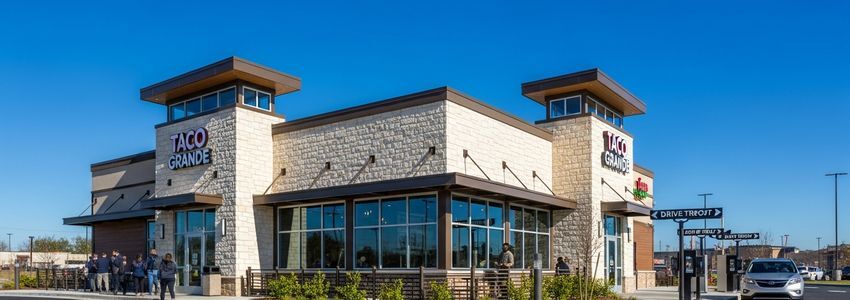
Taco franchise business loans give entrepreneurs the capital they need to secure a franchise territory, build out a location, purchase equipment, and launch operations. Taco concepts are among the most popular and fastest-growing segments in the fast food and fast casual space — from nationally recognized brands to regional favorites — and securing the right financing can mean the difference between moving forward and missing out on a prime opportunity.
In This Article
- What Are Taco Franchise Business Loans?
- How Much Does a Taco Franchise Cost?
- Types of Financing for Taco Franchise Owners
- How Taco Franchise Financing Works
- Key Benefits of Franchise Financing
- Taco Franchise Financing at a Glance
- Who Qualifies for Taco Franchise Business Loans?
- Comparing Franchise Loan Options
- How Crestmont Capital Helps
- Real-World Scenarios
- FAQ
- How to Get Started
What Are Taco Franchise Business Loans?
Taco franchise business loans are financing products specifically used to fund the costs associated with acquiring, building, or expanding a taco franchise unit. Whether you are opening your first Taco Bell, Del Taco, Fuzzy's Taco Shop, Taco John's, or an independent taco concept, lenders evaluate your franchise agreement, financial profile, and business plan to determine how much capital you qualify for.
Unlike a general small business loan, franchise financing takes into account the brand's franchise disclosure document (FDD), your territory rights, the brand's historical performance, and your own management experience. The franchise model is actually viewed favorably by many lenders because it comes with a proven system, established brand recognition, and documented unit economics — which reduces the perceived risk compared to a new independent startup.
These loans can cover a wide range of startup and operating costs, including franchise fees, construction and build-out, kitchen equipment, signage, initial inventory, working capital, and technology systems. The amount you borrow and the structure of the loan will depend on the specific franchise concept you choose and your personal financial strength.
Key Stat: According to the International Franchise Association, the U.S. franchise sector generates over $800 billion in economic output annually, with quick-service restaurant (QSR) franchises — including taco concepts — representing the largest segment by unit count.
How Much Does a Taco Franchise Cost?
The total investment required to open a taco franchise varies considerably depending on the brand, the size of the location, real estate costs in your market, and whether you are building from the ground up or converting an existing space. Most mid-level taco franchise brands fall in a total investment range of $300,000 to $1.5 million per unit, though premium brands or large locations can exceed $2 million.
Here is a breakdown of the major cost categories most taco franchise owners encounter:
- Franchise Fee: The upfront fee paid to the franchisor to secure your territory and license. This typically ranges from $25,000 to $75,000 depending on the brand.
- Build-Out and Construction: Leasehold improvements, flooring, plumbing, electrical, and interior design. Costs range widely based on location condition and brand standards — typically $150,000 to $600,000.
- Kitchen Equipment: Commercial grills, fryers, refrigeration units, prep tables, POS systems, and other food service equipment. Budget $75,000 to $250,000.
- Signage and Branding: Exterior signage, menu boards, and branded materials per franchise standards. Typically $15,000 to $50,000.
- Initial Inventory: Food, packaging, supplies, and cleaning materials for opening operations. Usually $10,000 to $30,000.
- Working Capital: Cash reserves to cover payroll, utilities, marketing, and operational expenses during the ramp-up period. Most franchisors recommend 3 to 6 months of operating expenses.
- Real Estate / Lease Deposits: Security deposits, first/last month's rent, and potential tenant improvement allowances.
- Training and Opening Costs: Travel, accommodation for training, and pre-opening marketing campaigns.
When you total these line items, most taco franchise owners require between $400,000 and $1.2 million in total capital — and lenders expect franchisees to provide 20 to 30 percent as a down payment or equity injection, meaning loan amounts typically range from $300,000 to $900,000 or more.
Ready to Finance Your Taco Franchise?
Get fast, flexible financing from Crestmont Capital. No obligation — apply in minutes and get a decision quickly.
Apply Now →Types of Financing for Taco Franchise Owners
Not every lender offers the same products, and not every loan type is the right fit for every franchise situation. Understanding your options helps you choose the financing that aligns with your goals, timeline, and financial profile.
SBA 7(a) Loans
The SBA 7(a) loan program is the most commonly used financing tool for franchise acquisitions and startups. It offers loan amounts up to $5 million with repayment terms up to 10 years for working capital and 25 years for real estate. The SBA guaranty reduces lender risk, which often makes approval more attainable for franchisees who have strong personal credit and relevant experience but limited collateral.
Many major taco franchise brands are on the SBA's approved franchise registry, which simplifies the underwriting process. When a brand is pre-approved, lenders do not need to conduct a separate review of the FDD, which can shorten your timeline to funding.
SBA 504 Loans
If your franchise investment involves a real estate purchase — such as buying the land or building — the SBA 504 program provides long-term, fixed-rate financing at highly competitive rates. The 504 structure typically requires a 10 percent down payment from the borrower, with 40 percent provided by a Certified Development Company and 50 percent from a traditional lender.
Equipment Financing
Commercial kitchen equipment for a taco franchise represents a substantial line item. Equipment financing allows you to secure this capital with the equipment itself serving as collateral, which means you typically do not need to pledge additional assets. Terms often range from 3 to 7 years, and rates are competitive when your credit profile is strong. This option can be combined with other loan types to structure your total capital stack efficiently.
Business Term Loans
Conventional term loans from banks or alternative lenders provide lump-sum capital repaid over a defined period. For franchisees with strong financial profiles — at least 2 years of relevant operating history, solid personal credit, and a robust business plan — term loans can close faster than SBA products and may come with fewer requirements around collateral valuation and appraisals.
Business Lines of Credit
A business line of credit is ideal for ongoing operational needs — covering payroll gaps, restocking inventory, handling unexpected equipment repairs, or funding a local marketing push. Rather than taking a large lump sum, you draw funds as needed and only pay interest on what you use. This is a highly flexible tool that many franchise owners maintain alongside their primary term loan.
Franchise-Specific Lending Programs
Some lenders have dedicated franchise lending divisions with streamlined processes for well-known brands. If you are opening a Taco Bell, Taco John's, Del Taco, or another national concept, ask your SBA lender whether your brand qualifies for a preferred lender program. These programs often mean faster approvals and reduced documentation requirements.
Working Capital Loans
The ramp-up period for a new taco franchise unit — typically 3 to 12 months — can be cash-flow negative as you build your customer base. Working capital loans provide the bridge funding needed to cover operating expenses while revenue is still building. This can prevent you from pulling down your personal reserves or missing payroll during a temporary cash flow gap.
How Taco Franchise Financing Works
The process of securing financing for a taco franchise follows a structured path from application to funding. Understanding each phase helps you prepare the right documents and set realistic expectations around timeline.
Step 1: Confirm Your Franchise Agreement — Lenders will want to see a signed or draft franchise agreement before they begin underwriting. If you are early in the process, a letter of intent or FDD review will help lenders evaluate the brand's financial health and unit economics.
Step 2: Prepare Your Financial Profile — Gather your last 2 to 3 years of personal and business tax returns, 3 to 6 months of bank statements, a personal financial statement, and a current credit report. Your personal FICO score should generally be 650 or above for SBA loans, with 700+ giving you access to the most competitive rates.
Step 3: Build Your Business Plan — Most lenders — especially for SBA loans — require a detailed business plan that includes market analysis, competition overview, revenue projections, and a clear breakdown of how loan proceeds will be used. Many franchise brands provide templated business plans that you can customize for your local market.
Step 4: Submit Your Application — Work with a lender experienced in franchise financing. They will guide you through the application, help you avoid common documentation errors, and advocate for your approval. Crestmont Capital has experience working with franchise owners across a wide range of restaurant concepts.
Step 5: Underwriting and Approval — The lender evaluates your personal financials, business plan, franchise agreement, collateral, and the brand's track record. For SBA loans, underwriting typically takes 2 to 6 weeks. For conventional term loans or alternative lending, timelines can be significantly shorter.
Step 6: Closing and Funding — Once approved, you sign final documents, and funds are disbursed. For construction projects, lenders may disburse funds in draw schedules tied to construction milestones rather than as a single lump sum.
Key Benefits of Franchise Financing
Financing your taco franchise rather than paying all costs out of pocket preserves your personal liquidity and creates leverage for faster growth. Here are the most significant benefits franchise owners experience:
- Preserve Cash Reserves: Keeping personal funds available allows you to weather unexpected expenses or slower-than-projected ramp periods without financial stress.
- Access to Larger Opportunities: Financing allows you to pursue prime locations that require significant build-out investment — locations that generate higher long-term revenue than smaller alternatives.
- Scale Faster: If you plan to become a multi-unit operator, establishing a strong lending relationship early makes it easier to finance your second and third units.
- Build Business Credit: Properly serviced business loans help establish and strengthen your business credit profile, improving terms on future borrowing.
- Tax Efficiency: Business loan interest may be deductible as a business expense (consult a qualified tax professional for guidance specific to your situation).
- Fixed Repayment Predictability: Term loans with fixed monthly payments make financial planning straightforward, allowing you to project cash flow confidently.
By the Numbers
Taco Franchise Financing — Key Statistics
$800B+
Annual U.S. franchise economic output (IFA)
$300K-$1.5M
Typical total investment range per taco franchise unit
10-25 Yrs
Typical SBA loan repayment terms for franchise financing
$5M
Maximum SBA 7(a) loan amount for franchise expansion
Who Qualifies for Taco Franchise Business Loans?
Lender requirements vary by product type, loan size, and institution, but most franchise lenders evaluate applicants across several common dimensions. Understanding these criteria helps you determine your readiness and identify areas to strengthen before applying.
Credit Score
For SBA loans, most lenders require a personal FICO score of at least 650 to 680, with scores above 700 receiving the most favorable rates and terms. Alternative lenders may work with scores as low as 600, but at higher interest rates. If your credit score needs improvement, focus on paying down revolving balances and resolving any derogatory marks before applying.
Relevant Experience
Lenders want to know you have the management or operational experience to run a food service business successfully. This does not necessarily mean you have owned a restaurant before — management experience in any service-oriented business, particularly in high-volume environments, is viewed favorably. Many franchisors require demonstrable management experience as well.
Net Worth and Liquidity
Most taco franchise brands require franchisees to have a net worth of $300,000 to $500,000 and liquid capital (cash, savings, retirement accounts accessible without penalty) of $100,000 to $250,000 or more. Lenders look at similar benchmarks. The equity injection you contribute is typically 20 to 30 percent of the total project cost.
Business Plan Quality
A well-prepared business plan with realistic revenue projections backed by the franchisor's average unit volumes (AUV) and local market analysis significantly improves your approval odds. Include your site selection rationale, competitive analysis, staffing plan, and a 3-year financial projection.
Franchise Brand Strength
Lenders are more comfortable financing established brands with a strong track record. Taco concepts with hundreds or thousands of operating units and documented FDD Item 19 financial performance data are viewed more favorably than emerging concepts. However, many lenders — including SBA-preferred lenders — will finance newer franchise systems if the franchisor has strong support systems and you have a compelling business plan.
See Your Taco Franchise Financing Options
Crestmont Capital works with franchise owners across the country. Apply today and get a funding decision fast.
Apply Now →
Comparing Taco Franchise Loan Options
Different financing products are suited to different situations. The table below compares the major loan types available to taco franchise owners across key dimensions:
| Loan Type | Best For | Loan Amount | Terms | Speed |
|---|---|---|---|---|
| SBA 7(a) | Full franchise startup, multi-purpose | Up to $5M | 10-25 years | 3-8 weeks |
| SBA 504 | Real estate or major fixed assets | Up to $5.5M | 10-25 years | 6-10 weeks |
| Equipment Financing | Kitchen equipment, POS systems | $25K-$500K+ | 3-7 years | 1-2 weeks |
| Business Term Loan | Established operators, growth capital | $50K-$2M | 1-10 years | 1-4 weeks |
| Line of Credit | Ongoing working capital, operations | $25K-$500K | Revolving | 1-2 weeks |
| Working Capital Loan | Ramp-up costs, seasonal cash flow | $10K-$500K | 3-24 months | 1-5 days |
How Crestmont Capital Helps Taco Franchise Owners
Crestmont Capital is a direct business lender rated #1 in the country, with a track record of helping franchise owners across the restaurant and food service industries secure the capital they need to launch, grow, and succeed. We work directly with borrowers — no brokers, no middlemen — which means faster decisions, lower costs, and a more transparent financing experience.
We offer a full range of financing products that franchise owners commonly use, including SBA loans, equipment financing, business lines of credit, and working capital loans. Our advisors understand the unique requirements of franchise financing — FDD review, franchisor approval processes, construction draw management, and multi-unit structures — and can guide you through every step.
If you are exploring your first taco franchise unit or planning to expand an existing multi-unit operation, Crestmont Capital has the products, expertise, and speed to help you move forward. You can start the process in minutes by completing our online application at offers.crestmontcapital.com/apply-now.
Pro Tip: Many franchise owners use a combination of financing products — for example, an SBA 7(a) loan for the build-out and franchise fee, equipment financing for the kitchen, and a line of credit for working capital. This structure optimizes rates and repayment terms across different expense categories.
Real-World Scenarios
Understanding how franchise financing works in practice helps you visualize the path forward for your specific situation. Here are six scenarios that illustrate how taco franchise owners across different stages use business loans.
Scenario 1 — First-Time Franchisee, Regional Brand: A former restaurant manager with strong savings and a 730 FICO score signs a franchise agreement with a regional taco chain. Total project cost is $650,000. She uses an SBA 7(a) loan for $520,000 (80 percent of project cost) with a 10-year term, contributing $130,000 as her equity injection. Monthly payments are manageable, and she reaches break-even within 9 months.
Scenario 2 — Multi-Unit Expansion: An existing Taco John's franchisee with two profitable units wants to open a third. His current units have 3 years of tax returns showing strong cash flow. He secures a $750,000 business term loan based on his operating history and combined collateral. Funding closes in 18 days — faster than an SBA loan but at a slightly higher rate, which he views as worthwhile given the prime lease opportunity.
Scenario 3 — Equipment Replacement Mid-Operation: A Fuzzy's Taco Shop franchisee needs to replace two commercial fryers and a refrigeration unit after a major equipment failure. Total cost: $95,000. She secures equipment financing in under a week, keeping operations running without disrupting cash flow or drawing down working capital.
Scenario 4 — Ramp-Up Working Capital: A new Del Taco franchisee opens his first location and finds revenue is 15 percent below projections in months 2 and 3. He draws $40,000 from a business line of credit to cover payroll and utilities during the slow period, paying it back once revenue stabilizes in month 5.
Scenario 5 — SBA 504 Real Estate Purchase: A franchisee with three profitable units identifies an opportunity to purchase the building that houses her highest-volume location. The $1.2 million purchase is financed via SBA 504 with $120,000 down (10 percent), $480,000 through a CDC, and $600,000 from a bank lender. She locks in long-term fixed rates, eliminating rent escalation risk.
Scenario 6 — Startup With Conversion: An entrepreneur acquires a closed fast food location and converts it to a new taco franchise concept. The existing infrastructure reduces build-out costs significantly. He uses an SBA 7(a) loan of $350,000 with a 10 percent equity contribution, leveraging the reduced project cost to preserve personal capital for a second unit within 18 months.
Frequently Asked Questions
What credit score do I need to finance a taco franchise?
Most SBA-backed franchise loans require a minimum personal FICO score of 650 to 680. Scores above 700 typically qualify for the most competitive rates and terms. Alternative lenders may work with scores as low as 600, but expect higher interest rates and shorter terms. It is worth improving your credit score before applying if possible, as even a modest increase can translate to meaningful savings over the life of a large loan.
How much cash do I need to open a taco franchise?
Most lenders and franchisors require a cash equity injection of 20 to 30 percent of the total project cost. For a franchise with a $700,000 total investment, you would typically need $140,000 to $210,000 in liquid capital as your down payment. Additionally, most brands require franchisees to have a minimum net worth in the range of $300,000 to $500,000 and recommend keeping additional cash reserves for the ramp-up period.
Can I use an SBA loan to open a taco franchise?
Yes. SBA loans are one of the most popular and accessible tools for franchise financing. The SBA 7(a) program allows loan amounts up to $5 million with repayment terms up to 10 years for working capital and 25 years for real estate. Many established taco franchise brands are registered on the SBA's approved franchise registry, which simplifies and accelerates the approval process for SBA-preferred lenders.
How long does it take to get a franchise business loan?
Timeline varies significantly by loan type. SBA loans typically take 3 to 8 weeks from application to funding, depending on lender workload and documentation completeness. Conventional term loans from banks may take 2 to 4 weeks. Equipment financing often closes in 5 to 10 business days. Alternative lenders and working capital products can fund in as little as 24 to 72 hours. Having your documentation organized and complete before applying is the single most effective way to speed up your timeline.
Do I need restaurant experience to get a taco franchise loan?
While direct restaurant experience is a plus, most lenders are primarily evaluating your management competence, financial strength, and the quality of your business plan. Experience managing teams, operating high-volume service businesses, or running any type of small business can satisfy a lender's experience requirement. The franchise model itself mitigates some of the experience gap since you receive training, systems, and ongoing support from the franchisor. Some brands have their own experience requirements separate from lender requirements.
Can I finance multiple taco franchise units at once?
Yes, but it is more complex. Multi-unit financing requires lenders to evaluate the aggregate project cost, your ability to manage multiple locations simultaneously, and your cash flow across all units. Some lenders structure a separate loan per unit, while others offer an umbrella facility. SBA loans can be stacked across multiple units up to the $5 million total limit per borrower. Having an experienced franchise lending advisor is especially important when pursuing multi-unit financing.
What documents do I need to apply for a taco franchise loan?
Standard documents include: personal and business tax returns (2 to 3 years), 3 to 6 months of personal and business bank statements, a personal financial statement, your franchise agreement or letter of intent, a business plan with financial projections, a signed franchise disclosure document (FDD), and a cost breakdown of your project. Some lenders also require a resume outlining your relevant experience and a site evaluation or letter of intent from the landlord for your chosen location.
What interest rates should I expect on taco franchise loans?
Rates vary by loan type, your credit profile, and market conditions. SBA 7(a) loans are typically priced at the prime rate plus 2.25 to 2.75 percent, which translates to roughly 10 to 12 percent in a mid-rate environment. Equipment financing rates range from 6 to 15 percent depending on your credit and the equipment type. Conventional term loans and lines of credit sit in a similar range. Working capital products and merchant cash advances carry higher effective rates and are better suited to short-term needs than long-term franchise investment.
What is the difference between a franchise fee and the total investment?
The franchise fee is a single upfront payment to the franchisor that grants you the right to operate under their brand within a defined territory. It is one component of the total investment, which also includes build-out costs, equipment, signage, initial inventory, working capital, real estate deposits, training, and other pre-opening expenses. The total investment is the complete amount of capital you need to get your location fully operational. Most lenders finance a substantial portion of the total investment, not just the franchise fee.
Can I get a taco franchise loan with bad credit?
It is possible but challenging. If your personal credit score is below 650, you may still qualify through alternative lenders or by bringing in a co-borrower with strong credit. Some lenders will also consider strong business performance history — existing profitable units — as a compensating factor. Improving your credit score before applying is strongly advisable since even moving from 620 to 680 can open significantly better financing options and save tens of thousands in interest over the life of a large loan.
How do I choose between SBA and conventional financing?
SBA loans are generally better for borrowers who have limited collateral, want longer repayment terms to lower monthly payments, or are opening their first franchise unit. Conventional loans are typically faster to close and have fewer documentation requirements, making them attractive to established operators with strong cash flow and collateral. Many franchise owners use SBA for their first unit and then transition to conventional financing as their track record grows.
Do lenders require collateral for franchise loans?
Most traditional and SBA lenders require collateral to the extent it is available, which may include the business assets (equipment, tenant improvements, inventory), personal real estate, and for SBA loans, the SBA guaranty itself reduces collateral requirements compared to conventional lending. Equipment loans use the financed equipment as collateral. Some alternative and online lenders offer unsecured products, but typically at higher rates and for smaller amounts. A personal guarantee is standard across most loan types for small business and franchise borrowers.
How do royalty fees affect my loan qualification?
Ongoing royalty fees — typically 4 to 8 percent of gross sales paid to the franchisor — reduce your net operating income and therefore your debt service coverage ratio (DSCR). Lenders account for royalties, advertising fund contributions, and other brand fees when calculating whether your projected cash flow can support loan repayments. Make sure your financial projections and business plan accurately reflect all ongoing franchise costs so lenders can evaluate your true cash flow position.
What is the best way to prepare for a franchise loan application?
The best preparation involves three parallel tracks: financial readiness (clean tax returns, strong DSCR projections, adequate liquidity), documentation completeness (organized 2 to 3 years of returns, bank statements, personal financial statement, business plan), and franchise readiness (signed FDD, signed or near-signed franchise agreement, confirmed site or strong site candidates). The closer you are to having all three areas locked in before approaching lenders, the faster and smoother your process will be.
Can I refinance a taco franchise loan after opening?
Yes. Once your franchise unit has 12 to 24 months of operating history and documented profitability, you may qualify to refinance your existing loan at better terms — lower rate, longer term, or a larger facility for expansion. SBA loans have prepayment penalties for refinancing within the first 3 years, so review your existing loan documents before pursuing a refinance. Conventional loans may also have prepayment provisions to check. Crestmont Capital can review your current loan structure and advise whether refinancing makes financial sense for your situation.
How to Get Started
Complete our quick application at offers.crestmontcapital.com/apply-now — it takes just a few minutes and there is no obligation.
A Crestmont Capital advisor will review your franchise opportunity, discuss your goals, and match you with the financing products that fit your situation.
Once approved and funded, you can move forward with your franchise agreement, build-out, and grand opening — putting your taco franchise business loans to work.
Conclusion
Taco franchise business loans give driven entrepreneurs the financial leverage to turn a franchise opportunity into a profitable, operating business. From SBA 7(a) loans and equipment financing to business lines of credit and working capital products, the right loan structure ensures you have adequate capital for every phase — from signing your franchise agreement to opening day and beyond.
The taco category continues to be one of the strongest performers in the restaurant franchise space, with proven demand, loyal customer bases, and strong unit economics across multiple brands. Whether you are evaluating your first location or planning a multi-unit expansion, the key is pairing the right financing product with a thorough business plan and a lender who understands the franchise model.
Crestmont Capital is here to help you navigate every step. Apply today and let our franchise financing specialists guide you toward the capital that makes your taco franchise ownership goals a reality.
Ready to Open Your Taco Franchise?
Apply for taco franchise business loans today. Fast decisions, flexible terms, and expert franchise financing support from Crestmont Capital.
Apply Now →Disclaimer: The information provided in this article is for general educational purposes only and is not financial, legal, or tax advice. Funding terms, qualifications, and product availability may vary and are subject to change without notice. Crestmont Capital does not guarantee approval, rates, or specific outcomes. For personalized information about your business funding options, contact our team directly.