
 (800) 949-0401
Soap Making Equipment Financing: The Complete Guide for Business Owners
Soap making equipment financing gives artisan and commercial soap producers a way to acquire mixers, molds, curing racks, cutters, packaging lines, and lye-handling systems without paying the full cost upfront. Whether a business is scaling from a home kitchen operation to a licensed commercial facility or upgrading aging equipment, financing spreads the cost over time while preserving working capital for ingredients, labor, and marketing.
This guide covers everything a soap business owner needs to know: how financing works, what equipment qualifies, typical costs, qualification requirements, and how to choose between financing, leasing, and paying cash.
In This Article
What Is Soap Making Equipment Financing?
Soap making equipment financing is a type of commercial equipment loan or lease designed specifically to help soap manufacturers acquire the machinery and tools they need to produce, cure, cut, and package soap at scale. Instead of paying cash upfront for a stick blender battery, an industrial mixer, a loaf mold system, or an automated cutting table, a soap business owner makes fixed monthly payments over a set term while using the equipment to generate revenue.
This type of financing is not limited to giant factories. It covers everything from a small-batch artisan operation buying its first commercial-grade lye mixing station to an established soap company investing in a fully automated extrusion and stamping line. Lenders that specialize in equipment financing, like Crestmont Capital, structure these loans around the value and useful life of the equipment itself, which often makes approval more accessible than a general unsecured business loan.
The soap and personal care manufacturing industry has grown steadily as consumer demand for natural, handmade, and specialty soap products increases. That growth means more soap makers need reliable access to capital equipment: mixers, curing racks, molds, cutting equipment, wrapping and labeling machines, and quality control tools. Equipment financing is the bridge between demand for a business's products and the physical capacity to produce them.
Key Benefits of Financing Soap Making Equipment
- Preserve cash flow. Instead of draining savings or a line of credit on a single large purchase, financing spreads the cost across manageable monthly payments, leaving cash available for raw materials, packaging, and payroll.
- Access newer, more efficient equipment. Financing makes it realistic to buy equipment that increases batch size, reduces labor hours, or improves consistency, rather than settling for used or outdated machinery because of budget constraints.
- Predictable budgeting. Fixed monthly payments make it easier to forecast expenses and plan production schedules around known costs.
- Potential tax advantages. Many businesses can deduct equipment costs or financing payments as ordinary business expenses; a tax professional can confirm specifics for a given situation.
- Faster scaling. When a soap business lands a large wholesale order or retail placement, financing allows it to add production capacity quickly instead of waiting months to save enough cash.
- Equipment serves as its own collateral. Because the machinery itself typically secures the loan, soap makers may qualify without pledging other business or personal assets.
Key Stat: According to the U.S. Census Bureau's Annual Survey of Manufactures, small manufacturing establishments (fewer than 20 employees) account for a substantial share of soap, cleaning compound, and toilet preparation manufacturers nationwide, underscoring how many soap businesses operate at a scale where equipment financing plays a critical role in growth.
Ready to Upgrade Your Soap Production Line?
Get fast, flexible equipment financing from the #1 business lender in the U.S. No obligation, apply in minutes.
Apply Now →How Soap Making Equipment Financing Works
The process is similar to other forms of commercial equipment financing, but it helps to understand each step before applying.
1. Identify the equipment. Get a quote or invoice from the equipment vendor for the mixer, mold system, cutter, curing rack, or full production line the business needs.
2. Apply with a lender. Submit a business equipment financing application, typically including basic business information, time in business, revenue, and the equipment quote.
3. Underwriting review. The lender evaluates the business's revenue history, credit profile, and the value of the equipment being financed. Because the equipment secures the loan, approval decisions can often be made within one to two business days.
4. Approval and terms. If approved, the lender presents a term sheet with the loan or lease amount, interest rate or factor rate, monthly payment, and term length, commonly ranging from 24 to 72 months depending on the equipment's useful life.
5. Funding. Once the agreement is signed, the lender pays the equipment vendor directly or reimburses the business, and the soap maker takes delivery of the equipment.
6. Repayment. The business makes fixed monthly payments over the agreed term. At the end of a lease term, some agreements include a buyout option to own the equipment outright for a nominal fee.
Types of Soap Making Equipment You Can Finance
Soap production spans a wide range of equipment depending on batch size and method (cold process, hot process, melt and pour, or extrusion). Commonly financed equipment includes:
- Industrial mixers and stick blenders for combining oils, lye solution, and additives at commercial volume
- Lye mixing and handling stations with proper ventilation and safety containment
- Soap molds and loaf log systems, including silicone, wood, and stainless steel molds
- Curing racks and shelving systems for large-batch drying and curing
- Bar cutters and slicers, from manual wire cutters to automated multi-bar cutting tables
- Extrusion and stamping equipment for uniform bar shapes at high volume
- Melt and pour tanks and dispensing systems for clear or glycerin soap production
- Packaging and labeling machines, including shrink wrap tunnels and label applicators
- Scales and quality control instruments for consistent batch measurement
- Commercial ventilation and HVAC systems required for lye handling and fragrance work areas
Quick Guide
How Soap Making Equipment Financing Works, At a Glance
Request pricing from your equipment vendor for the mixer, mold, or production line.
Submit basic business details, revenue history, and the equipment quote.
Underwriting reviews the business and equipment value, often within 1-2 business days.
The vendor is paid directly, equipment ships, and monthly payments begin.
How Much Does Soap Making Equipment Cost?
Equipment costs for soap production vary enormously based on batch size and automation level. A small commercial operation might spend a few thousand dollars on an upgraded mixer and cutting table, while a larger facility investing in an automated extrusion and stamping line, conveyor packaging system, and industrial curing room can spend well into six figures.
General cost ranges soap makers commonly encounter:
- Commercial mixers and blenders: roughly $500 to $8,000 depending on capacity
- Mold systems and loaf log cutters: roughly $1,000 to $15,000
- Curing racks and shelving: roughly $500 to $5,000
- Automated bar cutters: roughly $5,000 to $40,000
- Extrusion and stamping lines: roughly $50,000 to $250,000+
- Packaging and labeling systems: roughly $10,000 to $75,000
These figures are general estimates for planning purposes. Actual pricing depends on the manufacturer, capacity, automation level, and whether equipment is new or used. Always confirm exact pricing directly with equipment vendors before applying for financing.
Who Qualifies for Soap Making Equipment Financing?
Equipment financing tends to be more accessible than unsecured business loans because the equipment itself acts as collateral. Typical qualification factors include:
- Time in business: Many lenders work with businesses that have at least 6-12 months of operating history, though newer businesses may still qualify with a strong equipment quote and personal credit profile.
- Revenue: Lenders want to see consistent monthly revenue that supports the proposed payment amount.
- Credit profile: Both personal and business credit may be reviewed. Because the equipment secures the financing, approval standards are often more flexible than for unsecured products.
- Equipment type and value: New equipment from established manufacturers is generally easier to finance than highly specialized or custom-built machinery.
- Down payment: Some financing structures require 10-20% down, while others offer 100% financing depending on the applicant's profile and the equipment's resale value.
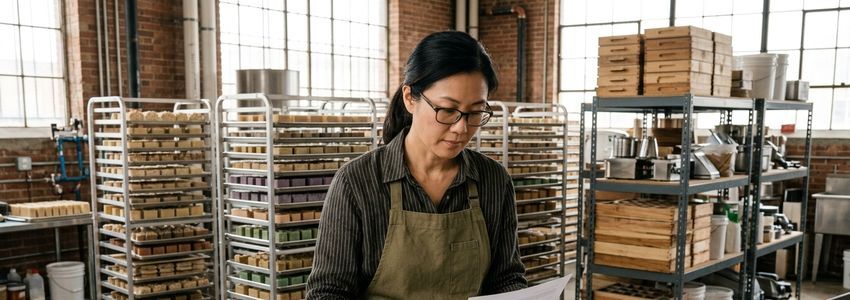
Soap businesses ranging from home-based Etsy sellers transitioning to licensed commercial kitchens, to established manufacturers supplying regional retailers, have all successfully used equipment financing to scale production without depleting cash reserves.
Financing vs. Leasing vs. Buying Outright
Soap business owners generally choose between three paths when acquiring production equipment. Each has tradeoffs worth understanding before committing.
| Factor | Equipment Financing | Equipment Leasing | Buying Outright |
|---|---|---|---|
| Upfront cost | Low to none | Low to none | Full purchase price |
| Ownership at end of term | Yes, once paid off | Depends on buyout option | Immediate |
| Best for | Equipment used long-term | Equipment that may need upgrading soon | Businesses with strong cash reserves |
| Impact on cash flow | Minimal, fixed payments | Minimal, often lower monthly payment | Significant, one-time expense |
For most growing soap businesses, financing strikes the right balance: it builds equity in equipment that will be used for years while keeping monthly costs predictable. Leasing can make sense for equipment that changes rapidly or that a business wants to test before committing long-term.
How Crestmont Capital Helps Soap Makers
Crestmont Capital works with soap manufacturers and other specialty producers to structure equipment financing around the realities of a growing production business, not a rigid one-size-fits-all template. Applications are reviewed quickly, terms are structured to match the useful life of the equipment, and funding can often move fast enough to meet a vendor's lead time.
For soap businesses considering a full production upgrade rather than a single machine, Crestmont's manufacturing equipment financing programs are built for exactly this kind of investment, covering everything from mixers to full packaging lines. Businesses that need flexibility on ownership terms can also explore equipment leasing options.
Soap makers looking to stretch budget further by financing pre-owned machinery from auctions or retiring manufacturers can look at used equipment financing, which can significantly lower the entry cost for a first commercial-grade line. And for businesses that need working capital alongside equipment (to cover ingredients, packaging inventory, or a hiring push), Crestmont's broader small business financing options can complement an equipment purchase.
Soap producers researching related manufacturing equipment financing may also find it useful to review Crestmont's guide to cosmetics manufacturing equipment financing, which covers many of the same regulatory and production considerations that apply to soap and personal care products, as well as the guide to vitamin and supplement manufacturing equipment financing for businesses expanding into adjacent product lines.
Scale Your Soap Business With the Right Equipment
See what financing options you qualify for today. Fast approvals, flexible terms, no obligation.
Apply Now →Real-World Scenarios
Scenario 1: The Etsy seller scaling to wholesale. A home-based soap maker selling on Etsy lands her first wholesale order from a regional boutique chain. She needs an industrial mixer and curing rack system to meet volume, but doesn't want to drain her savings. Equipment financing lets her acquire a $12,000 commercial mixing and curing setup with a manageable monthly payment, funded by the new wholesale revenue.
Scenario 2: The commercial kitchen upgrading to automation. An established soap company producing 500 bars a week manually decides to invest in an automated bar cutter and extrusion line to hit 5,000 bars a week for a new retail contract. At roughly $85,000, the investment is too large to pay in cash without disrupting operations, so the business finances the equipment over 60 months.
Scenario 3: The specialty producer adding a product line. A soap manufacturer wants to add a melt-and-pour glycerin soap line alongside its existing cold-process products to reach a different customer segment. Financing the melt tanks and molds separately from the core mixer investment lets the business test the new product line without overextending its budget.
Pro Tip: Request an itemized equipment quote from your vendor before applying. A detailed quote with make, model, and price speeds up underwriting and often results in a faster approval decision.
Common Mistakes to Avoid
- Underestimating total cost of ownership. Factor in installation, ventilation upgrades, and training time, not just the sticker price of the machine.
- Financing more capacity than needed. Match equipment scale to realistic near-term demand rather than aspirational volume that may take years to reach.
- Skipping vendor comparison. Get quotes from multiple equipment suppliers before applying; the equipment cost directly affects the financing terms.
- Ignoring maintenance and service contracts. Some financed equipment requires ongoing service agreements that should be budgeted separately from the loan payment.
- Waiting too long to apply. Equipment lead times can run weeks or months; starting the financing process early avoids production delays.
Frequently Asked Questions
Get Financing for Your Soap Production Equipment
Apply in minutes and see what you qualify for, with no obligation and no impact on your credit to check.
Apply Now →Next Steps
Contact vendors for detailed pricing on the mixers, molds, or production line you need.
Have recent bank statements and revenue figures ready to speed up underwriting.
Submit your application with Crestmont Capital to get a fast, no-obligation decision.
Once funded, your equipment ships and your production capacity grows immediately.
Conclusion
Soap making equipment financing gives soap manufacturers, from home-based artisans to established commercial producers, a practical way to acquire the mixers, molds, curing racks, cutters, and packaging equipment needed to grow without depleting cash reserves. Whether the goal is meeting a new wholesale order, adding a product line, or automating a manual process, financing structures the investment around predictable monthly payments while equipment starts generating revenue immediately.
Soap business owners who take time to compare equipment vendors, understand qualification requirements, and choose the right financing structure position themselves to scale sustainably. Crestmont Capital works with soap makers at every stage to structure financing that fits the realities of a growing production business.
Disclaimer: The information provided in this article is for general educational purposes only and is not financial, legal, or tax advice. Funding terms, qualifications, and product availability may vary and are subject to change without notice. Crestmont Capital does not guarantee approval, rates, or specific outcomes. For personalized information about your business funding options, contact our team directly.








