
 (800) 949-0401
Using Loans to Upgrade Restaurant POS and Technology Systems
Running a modern restaurant means more than great food and service. Technology now plays a central role in everything from taking orders to managing inventory, processing payments, and engaging customers. Yet many restaurant owners hold back on upgrading their systems because the upfront cost feels too high. Restaurant technology loans offer a practical path to modernizing your operations without depleting your cash reserves. Whether you need a new point-of-sale system, a reservation platform, kitchen display screens, or an integrated payroll solution, the right financing can make it happen now rather than years from now.
- Why Technology Upgrades Matter for Restaurants
- What Technology Can You Finance?
- Types of Loans for Restaurant Technology
- How Much Does Restaurant Technology Cost?
- How to Qualify for Restaurant Technology Loans
- How to Apply for Restaurant Technology Financing
- Calculating the ROI on Your Technology Investment
- Tips for Getting the Best Terms
- Frequently Asked Questions
- Next Steps
Why Technology Upgrades Matter for Restaurants
The restaurant industry has changed dramatically in recent years. Customers now expect fast, accurate service, digital menus, online ordering, loyalty programs, and contactless payment options. Operators who fail to invest in modern systems often find themselves losing ground to competitors who provide a smoother experience.
According to the National Restaurant Association, over 50% of restaurant operators say technology investments directly improved their revenue over the last two years. Yet many small and mid-size operators delay upgrades because they worry about the cost. That delay has real consequences: slower table turns, higher error rates, and inefficient labor scheduling can cost a restaurant thousands of dollars per month.
Beyond the customer experience, technology upgrades also help on the back end. Advanced POS systems integrate with accounting software, giving you real-time data on food costs, labor ratios, and profit margins. Kitchen display systems (KDS) reduce ticket times and miscommunication between front-of-house and back-of-house staff. Inventory management software helps reduce food waste, which is one of the largest controllable costs in the restaurant business.
The bottom line: investing in restaurant technology is not an optional luxury. It is a strategic move that delivers measurable returns. And restaurant technology loans make that investment accessible without forcing you to choose between upgrading your systems and keeping enough cash on hand to run daily operations.
Crestmont Capital offers fast, flexible financing for restaurant POS systems, software, and tech upgrades. Get funded in as little as 24 hours.
Apply NowWhat Technology Can You Finance?
Restaurant technology spans a wide range of systems, software, and hardware. Most lenders who offer restaurant technology loans will consider funding any purchase that contributes to your operations or revenue-generating capacity. Here is a breakdown of what you can typically finance:
Point-of-Sale (POS) Systems
The POS system is the operational hub of most restaurants. Modern cloud-based POS platforms go far beyond taking orders. They track sales data in real time, manage employee schedules, process loyalty points, integrate with delivery apps, and generate detailed reports. Popular platforms like Toast, Square for Restaurants, Lightspeed, and Revel cost anywhere from $1,500 for a basic setup to $20,000 or more for a full multi-terminal, multi-location system.
Online Ordering Platforms
Building or integrating a direct online ordering system reduces dependence on third-party delivery platforms that charge commissions of 15 to 30 percent. A direct ordering solution typically costs $5,000 to $15,000 to set up, plus ongoing monthly fees. The payback period is often quite short when you factor in the savings from reducing third-party commission fees.
Kitchen Display Systems (KDS)
Kitchen display screens replace paper tickets and streamline communication between servers and cooks. A single KDS unit costs $500 to $1,500, and most full-service restaurants need two to four units. Integration with your POS is essential and typically included in the installation.
Inventory Management Software
Platforms like MarketMan, BlueCart, or Restaurant365 help track food costs, generate purchase orders automatically, and reduce waste. Licensing fees range from $200 to $800 per month, and many systems require an upfront setup investment.
Reservation and Waitlist Management
Digital reservation systems such as OpenTable, Resy, or Yelp Guest Manager replace paper reservation books and reduce no-shows through automated confirmations and reminders. These systems typically cost $200 to $800 per month, with some platforms charging a setup fee or per-cover fee.
Payroll and Scheduling Software
Labor is the largest cost for most restaurants. Workforce management tools like HotSchedules, 7Shifts, or Homebase help managers build efficient schedules, track overtime, and stay compliant with labor laws. These tools usually run $50 to $400 per month depending on headcount.
Customer Loyalty and CRM Platforms
Loyalty programs drive repeat visits and increase average check size. Platforms like Paytronix, Punchh, or Stamp Me can be financed as part of a broader technology upgrade. Setup costs range from $500 to $5,000, with monthly fees of $100 to $600.
Digital Menu Boards and Kiosks
Self-order kiosks can significantly reduce labor costs during peak periods while also increasing average check sizes by 15 to 20 percent through upsell prompts. A single kiosk typically costs $3,000 to $8,000, and digital menu board installations run $1,500 to $5,000 per display.
Types of Loans for Restaurant Technology
Not every financing product is the right fit for every technology purchase. Understanding your options helps you choose the loan that delivers the best balance of speed, cost, and flexibility.
Equipment Financing
If the technology you are purchasing qualifies as equipment (POS hardware, kiosks, kitchen display screens, digital menu boards), equipment financing is often the most cost-effective option. The hardware itself serves as collateral, which typically results in lower interest rates and longer repayment terms. Learn more about the equipment financing options available through Crestmont Capital.
Equipment loans typically offer:
- Loan amounts from $5,000 to $500,000 or more
- Repayment terms of 24 to 84 months
- Interest rates from 6% to 25% depending on credit and time in business
- Funding in 1 to 5 business days
Small Business Term Loans
A traditional term loan provides a lump sum that you repay over a fixed period with regular installments. Term loans are flexible enough to cover both hardware and software, installation costs, and staff training. For restaurant technology upgrades in the $20,000 to $150,000 range, a term loan is often the most practical option. Explore small business financing through Crestmont Capital to find the right fit.
Business Line of Credit
A business line of credit works differently from a term loan. You draw funds as needed, pay interest only on what you use, and replenish your available credit as you repay. Lines of credit are well-suited for phased technology rollouts or ongoing software subscription costs. They give you maximum flexibility when you are not sure of the total cost upfront.
SBA 7(a) Loans
For larger technology investments in the $100,000 to $500,000 range, an SBA 7(a) loan can offer competitive interest rates and long repayment terms. SBA loans require more documentation and take longer to close (typically 30 to 90 days), but the cost of capital is generally lower than alternative lending options.
Working Capital Loans
If you need to cover the cost of a technology upgrade without tying up capital for hardware specifically, a working capital loan provides fast, unsecured funding. These loans are based primarily on your business revenue and bank statements, making them accessible even if you have limited collateral. They are best for smaller purchases in the $5,000 to $50,000 range.
Restaurant Technology Loan: Decision Framework
| Purchase Type | Best Loan Type | Typical Range | Speed |
|---|---|---|---|
| POS Hardware + Installation | Equipment Financing | $5K - $75K | 1-3 days |
| Full Tech Stack Upgrade | Term Loan | $25K - $250K | 1-5 days |
| Phased Rollout | Line of Credit | $10K - $150K | 1-5 days |
| Software Subscriptions | Working Capital | $5K - $50K | Same day to 2 days |
| Large Multi-Location Upgrade | SBA 7(a) Loan | $100K - $500K+ | 30-90 days |
How Much Does Restaurant Technology Cost?
The total cost of a restaurant technology upgrade depends heavily on the size of your operation, the systems you are replacing, and the platforms you choose. Here are typical budget ranges for common upgrade scenarios:
Small Cafe or Quick-Service Restaurant (Under 30 Seats)
A basic upgrade covering a cloud-based POS system, integrated online ordering, and a customer loyalty program typically runs $5,000 to $20,000. Hardware costs (terminals, card readers, receipt printers) account for roughly half of this, with software setup and training making up the rest.
Mid-Size Full-Service Restaurant (30 to 100 Seats)
A more comprehensive upgrade covering a full POS system, kitchen display screens, reservation management, inventory software, and digital menu boards typically costs $20,000 to $75,000. Labor for installation and staff training adds to the total.
Large Restaurant or Multi-Location Operation
For larger operations or restaurant groups, a complete technology overhaul covering enterprise-level POS, centralized reporting, loyalty programs, and back-office integration can easily reach $75,000 to $250,000 or more. Multi-location deployments benefit from economies of scale but require careful project management.
When budgeting for a technology upgrade, remember to include:
- Hardware purchase or lease costs
- Software licensing and setup fees
- Installation and cabling work
- Staff training time (and any lost productivity during transition)
- Data migration from older systems
- Ongoing monthly software subscription fees
Our team can help you map out the right financing amount for your restaurant technology project. No obligation consultation available.
Apply NowHow to Qualify for Restaurant Technology Loans
Qualifying for restaurant technology loans follows the same general criteria as most small business financing. Lenders evaluate your ability to repay the loan based on your business performance, credit profile, and financial stability. Here is what most lenders look for:
Time in Business
Most lenders require a minimum of 6 to 12 months in business for working capital loans, and 1 to 2 years for larger term loans or equipment financing. SBA loans typically require 2 or more years of operating history.
Annual Revenue
Revenue requirements vary by lender and loan size. Alternative lenders may approve loans for restaurants generating $120,000 or more annually. Traditional banks and SBA lenders typically want to see $300,000 or more in annual revenue for larger loans.
Credit Score
Your personal credit score plays a meaningful role in most restaurant technology loan approvals. Equipment loans and term loans from traditional lenders generally require a score of 650 or higher. Alternative lenders may work with scores as low as 550 to 600, though at higher interest rates. Review our guide on business credit scores to understand how lenders evaluate your profile.
Cash Flow
Lenders want to see that your restaurant generates enough monthly cash flow to cover the new loan payment comfortably. Most lenders use a Debt Service Coverage Ratio (DSCR) of 1.25 or higher, meaning your monthly cash flow should be at least 25% more than your monthly debt obligations.
Business Bank Statements
Expect to provide three to six months of business bank statements. Lenders look at average daily balances, consistency of deposits, and any signs of cash flow stress like negative balances or returned payments.
How to Apply for Restaurant Technology Financing
Applying for restaurant technology loans is a straightforward process, especially when you work with an alternative lender or financing specialist. Here is what the typical process looks like:
Step 1: Define your project and budget. Create a detailed list of the technology systems you want to purchase, including hardware, software, installation, and training costs. Get quotes from vendors so you know the total project cost before applying.
Step 2: Check your credit. Pull your personal credit report and review your business credit profile. Address any errors before applying to maximize your chances of approval at the best rate.
Step 3: Gather your documents. Prepare your last two years of business tax returns, three to six months of bank statements, a voided business check, and basic business information (entity type, EIN, years in business).
Step 4: Submit your application. With many lenders, you can complete an initial application online in 10 to 15 minutes. At Crestmont Capital, our process is designed to be fast and straightforward for restaurant operators. Visit our commercial financing page to learn more.
Step 5: Review your offers. Once approved, you will receive one or more financing offers. Compare the total cost, repayment term, monthly payment amount, and any fees before accepting. Our guide on types of business loans can help you understand what you are being offered.
Step 6: Receive funding and begin your upgrade. Once you accept an offer, funding is typically deposited to your business bank account within 1 to 5 business days. You can then pay your technology vendor directly.
Calculating the ROI on Your Technology Investment
Before committing to a restaurant technology loan, it is worth doing a rough return on investment (ROI) calculation. The goal is to ensure that the financial benefit of the upgrade exceeds the cost of the loan over a reasonable timeframe.
Revenue Gains
Consider how the technology upgrade will increase revenue. A modern online ordering system that captures just five additional orders per day at an average ticket of $25 generates $4,563 in additional monthly revenue (assuming 365 days divided by 12 months). A kiosk that increases average check size by 15% on 80 daily transactions at $18 per transaction adds $648 per month. These numbers add up quickly.
Cost Reductions
Look at cost savings as well. An inventory management system that reduces food waste by 3% on $40,000 in monthly food purchases saves $1,200 per month. Better scheduling software that reduces overtime hours by 10% on a $25,000 monthly labor budget saves $2,500 per month. Combined, these two systems alone could justify a $50,000 technology loan.
According to Forbes, restaurant operators who invest in integrated technology platforms typically see payback periods of 12 to 24 months. When you factor in the full life of the systems (often 5 to 7 years), the ROI is substantial.
Competitive Advantage
Do not underestimate the value of competitive positioning. In markets where neighboring restaurants already offer mobile ordering, contactless payment, and personalized loyalty programs, staying behind on technology is not a neutral decision. It is a gradual competitive disadvantage that compounds over time.
For more guidance on measuring financial returns from a business loan, see our overview of small business cash flow management.
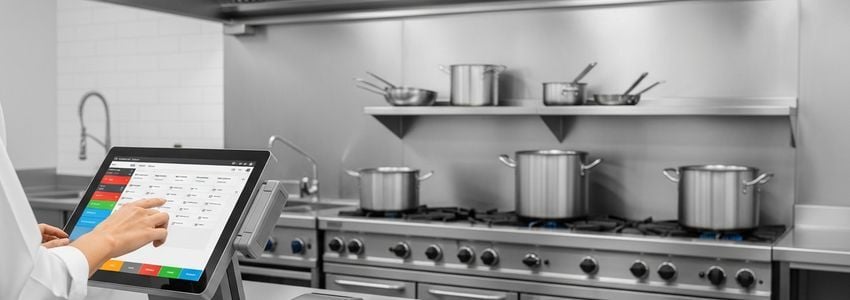
Modern POS and technology upgrades can transform restaurant operations and increase profitability.
Tips for Getting the Best Terms on Restaurant Technology Loans
A few strategic moves before and during the application process can make a meaningful difference in the rates and terms you receive.
Improve Your Credit Score Before Applying
Even a modest improvement in your credit score (10 to 20 points) can shift you into a better rate tier. Pay down any existing credit card balances, dispute errors on your report, and avoid applying for new credit in the 60 days before your loan application.
Show Strong Bank Deposits
Lenders heavily weight your bank statement history. If possible, time your application during a period when your deposits are strong and consistent. Seasonal restaurants should apply during or shortly after their peak season when their financials look most favorable.
Get Multiple Quotes
Do not accept the first offer you receive. Getting quotes from two or three lenders allows you to compare rates, terms, and fees. Even a 2% difference in interest rate on a $50,000 loan over 36 months saves over $1,700 in total interest.
Consider Vendor Financing
Some major POS vendors offer their own financing programs or have lending partners. Toast Capital, for example, offers working capital advances to Toast customers. These programs can be convenient, but compare the total cost against what an independent lender offers before committing.
Bundle Your Purchase
If you are planning multiple technology upgrades (POS, KDS, online ordering, and inventory management), financing them together as a single project often yields better terms than applying for multiple smaller loans separately.
The SBA's lending resources provide additional guidance on finding the right loan type for your business needs, including equipment and technology financing programs.
Crestmont Capital works with restaurant operators of all sizes. Apply today and get a decision in as little as a few hours.
Apply NowAccording to CNBC, restaurant technology spending has grown by an average of 12% annually since 2020, driven by rising labor costs and increased demand for digital ordering. Operators who invest now position themselves to capture that growth while spreading the cost over time through strategic financing.
Bloomberg research also highlights that the restaurant sector ranks among the top five industries for equipment and technology loan demand, with approval rates from alternative lenders consistently above 60% for established operators. (Bloomberg)
Frequently Asked Questions
What is a restaurant technology loan?
A restaurant technology loan is a form of small business financing used to purchase, lease, or upgrade technology systems for a restaurant. This includes POS systems, online ordering platforms, kitchen display screens, inventory management software, scheduling tools, and other digital infrastructure that supports restaurant operations.
Can I use a business loan to buy a POS system?
Yes. POS systems and related hardware are eligible purchases for equipment financing loans, term loans, working capital loans, and business lines of credit. Equipment financing is often the most cost-effective option for hardware purchases since the equipment itself serves as collateral, which typically results in lower rates.
How much can I borrow for a restaurant technology upgrade?
Loan amounts range widely depending on the lender and your qualifications. Alternative lenders may offer $5,000 to $250,000, while SBA loans and traditional bank loans can go higher. Most small to mid-size restaurant technology projects fall in the $10,000 to $75,000 range, which is well within reach for most established operators.
What credit score do I need for a restaurant technology loan?
Most traditional lenders require a personal credit score of 650 or higher. Alternative lenders may approve loans with scores as low as 550, though at higher interest rates. Improving your score before applying can significantly impact both approval odds and the rate you receive.
How fast can I get funded for a restaurant technology loan?
Alternative lenders and online lenders can often fund restaurant technology loans within 24 to 72 hours of approval. Equipment financing typically takes 1 to 5 business days. SBA loans take 30 to 90 days. If you need fast funding for a technology upgrade, an alternative lender is generally the quickest path.
Can I finance both hardware and software with the same loan?
Yes. Term loans and working capital loans can be used for both hardware and software purchases. Equipment financing is more often used for tangible hardware. If your upgrade includes both components, a term loan or line of credit gives you the most flexibility to cover the full scope of the project.
Do I need to put up collateral for a restaurant technology loan?
For equipment financing, the equipment itself serves as collateral. Working capital loans and lines of credit are typically unsecured, meaning you do not need to pledge specific assets. Larger term loans from traditional lenders or the SBA may require collateral in the form of business assets or a personal guarantee.
Are there tax benefits to financing restaurant technology?
Yes. Under Section 179 of the U.S. tax code, businesses can deduct the full purchase price of qualifying equipment and software in the year it is placed in service, rather than depreciating it over multiple years. In 2024, the deduction limit was $1.22 million. This can significantly reduce the net cost of your technology upgrade. Consult a tax professional for guidance specific to your situation.
What if my restaurant has been open less than a year?
Newer restaurants face more limited options but are not without resources. Some lenders offer startup-friendly financing starting at 6 months in business. Equipment financing with strong personal credit is often more accessible for newer businesses than unsecured working capital loans. Microloans from community lenders or the SBA Microloan program are also worth exploring for early-stage operators.
How do I choose between leasing and buying restaurant technology?
Leasing typically requires lower monthly payments and can be easier to qualify for, but you do not own the equipment at the end of the lease unless you exercise a buyout option. Buying through a loan costs more per month but builds equity and offers tax benefits. For rapidly evolving technology like POS systems, some operators prefer leasing because it makes it easier to upgrade when newer platforms emerge.
Can I use a restaurant technology loan for multiple locations?
Yes. Multi-location restaurant operators can apply for a single loan to cover technology upgrades across multiple sites. Larger loan amounts for multi-location projects often qualify for better rates, and centralizing the financing simplifies repayment and accounting.
What documents are required for a restaurant technology loan application?
Most lenders require: two to three years of business tax returns, three to six months of business bank statements, a completed application form, a copy of your business license, a voided business check, and basic information about the technology you plan to purchase. Some lenders also request profit and loss statements or balance sheets.
Will financing restaurant technology hurt my cash flow?
When structured properly, a restaurant technology loan should improve your cash flow over time by increasing revenue and reducing costs more than the monthly loan payment. The key is to choose the right loan term. A longer repayment period results in lower monthly payments, making the immediate cash flow impact more manageable even if total interest is slightly higher.
Is restaurant technology financing the same as restaurant equipment financing?
They overlap significantly but are not identical. Restaurant equipment financing traditionally refers to loans for commercial kitchen equipment (ovens, refrigerators, dishwashers). Technology financing covers digital systems like POS, software, kiosks, and display screens. In practice, many lenders use both terms interchangeably, and the same loan products are usually available for both categories.
How does my restaurant's revenue affect my loan amount?
Most lenders base your maximum loan amount on a percentage of your annual revenue, typically 10% to 20% for unsecured working capital loans and up to 50% or more for secured equipment loans. A restaurant generating $500,000 annually could typically qualify for $50,000 to $250,000 depending on the loan type and the lender's criteria.








