
 (800) 949-0401
Quilting Business Equipment Financing: The Complete Guide for Business Owners
Quilting has grown from a beloved American craft tradition into a genuine small business opportunity, with longarm quilting studios, quilt shops, and custom sewing operations popping up in nearly every community. But turning a quilting hobby into a full-time or side business almost always runs into the same obstacle: the equipment is expensive. A commercial longarm machine alone can run anywhere from a few thousand dollars to well over $25,000, and that is before fabric cutters, computerized pattern systems, embroidery attachments, and studio furniture are factored in. Quilting equipment financing gives business owners a way to acquire that equipment now and pay for it over time out of the revenue it generates, rather than draining savings or maxing out a personal credit card. This guide walks through exactly how quilting business equipment financing works, which financing products make sense for different stages of a quilting business, and how to qualify.
In This Article
What Is Quilting Equipment Financing?
Quilting equipment financing is a type of business funding used specifically to purchase or lease the machinery and tools a quilting or sewing business needs to operate and grow. Instead of paying the full purchase price of a longarm quilting machine, computerized embroidery system, industrial sewing machine, or fabric cutting table out of pocket, a business owner borrows the funds and repays them in fixed installments over an agreed term, typically two to seven years depending on the equipment's useful life.
In most cases, the equipment itself serves as collateral for the loan. That structure benefits both sides: the lender has security in the form of a tangible, resellable asset, and the borrower often qualifies more easily and at better terms than they would with an unsecured loan. This is the same basic model used across manufacturing, medical, and construction industries, and it applies just as well to a quilt shop financing a new Handi Quilter system or a home-based longarm quilter upgrading from a domestic machine to a professional frame.
Financing is not limited to brand-new equipment. Many lenders, including Crestmont Capital's equipment financing programs, will fund used or refurbished machines as well, which matters a great deal in an industry where used longarm machines routinely sell for a fraction of their original price and still have years of productive life left.
Key Benefits of Financing Your Quilting Business Equipment
For most quilting business owners, financing is not a last resort. It is a deliberate strategy for preserving cash and scaling faster than a cash-only approach would allow.
- Preserve working capital. Fabric, batting, thread, and packaging still need to be purchased every month. Tying up $15,000 or $20,000 in a single equipment purchase can leave a quilting business without the cash to keep the lights on while it waits for the new machine to start generating revenue.
- Predictable monthly payments. A fixed-rate equipment loan or lease turns a large, unpredictable expense into a known monthly line item that is easy to build into pricing and cash flow projections.
- Faster revenue generation. A longarm machine or embroidery system only earns money once it is running. Financing lets a shop put equipment into service immediately instead of saving for months or years to pay cash.
- Access to newer, more capable technology. Computerized quilting systems with pattern libraries and automated stitching regulate stitch quality and speed up turnaround time on customer quilts, which directly increases how many jobs a business can complete per month.
- Potential tax benefits. Business equipment purchases and lease payments are often deductible business expenses; a tax professional can confirm how this applies to a specific situation.
- Keeps personal credit cards untouched. Financing built for business equipment keeps large purchases off personal cards, protecting personal credit utilization and keeping business and personal finances cleanly separated.
Industry Snapshot: The U.S. quilting industry generates an estimated $4.5 billion annually, and the vast majority of quilt shops nationwide, more than 9 in 10, are single-owner small businesses. For an industry this dependent on independent operators, equipment financing plays an outsized role in whether a shop can compete on turnaround time and service quality.
Ready to Upgrade Your Quilting Studio?
Get fast, flexible financing from the #1 business lender in the U.S. No obligation, apply in minutes.
Apply Now →How Quilting Equipment Financing Works
The process is more straightforward than most first-time applicants expect, and it typically follows the same four steps regardless of whether the equipment is a $4,000 sewing machine or a $28,000 automated longarm system.
- Choose the equipment and get a quote. Most lenders want a vendor quote or invoice showing the make, model, and price of the equipment being financed. This can come from a longarm dealer, a quilt shop wholesaler, or a private seller for used equipment.
- Submit a business financing application. This usually includes basic business information, time in business, monthly or annual revenue, and a look at recent business bank statements. Newer or home-based businesses can still qualify; the requirements are typically lighter than what a traditional bank would ask for.
- Receive an approval and review terms. A lender will present the loan or lease amount, term length, payment amount, and any down payment requirement. Terms commonly range from 24 to 84 months depending on the equipment type and loan size.
- Equipment is purchased and funds are disbursed. Once terms are accepted, the lender pays the vendor directly (or reimburses the borrower for equipment already purchased, in some cases), and the borrower begins making scheduled payments.
Because the equipment secures the loan, approval decisions can often be made within one to two business days, and funding can be completed in under a week, which matters when a dealer's financing promotion or a used-equipment listing will not stay available indefinitely.
Equipment You Can Finance
Quilting and sewing businesses rely on a wide range of equipment, and most of it qualifies for financing. Common categories include:
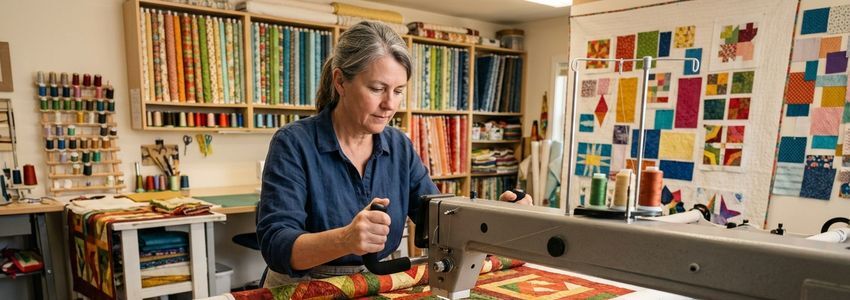
- Longarm quilting machines and frames. From entry-level frame systems to fully automated computerized longarms with robotic stitching, this is usually the single largest equipment investment a quilting business makes.
- Computerized quilting and pattern automation systems. Add-on systems that allow a longarm to stitch complex, repeatable pattern designs automatically, dramatically increasing throughput for custom quilt jobs.
- Industrial and semi-industrial sewing machines. Heavy-duty machines built for piecing, binding, and production sewing at a volume domestic machines cannot handle. See our dedicated guide on industrial sewing machine financing for more detail on this category.
- Fabric cutting equipment. Rotary fabric cutters, die-cutting systems, and automated cutting tables that speed up kit-cutting for pattern shops and production quilters.
- Embroidery machines and multi-needle systems. Many quilt shops and sewing studios add embroidery services as a second revenue stream; our guide to embroidery machine financing covers this equipment category specifically.
- Studio furniture and storage systems. Fabric bolts racking, cutting tables, pressing stations, and design walls that support daily production workflow.
- Point-of-sale and inventory systems. For quilt shops selling fabric and notions at retail, POS hardware and inventory management software are commonly bundled into an equipment financing package.
Financing Options Compared
Not every quilting business needs the same type of financing. The right choice depends on whether the goal is a single large equipment purchase, ongoing working capital, or a combination of both.
| Financing Type | Best For | Typical Term | Collateral |
|---|---|---|---|
| Equipment Financing | Buying a longarm machine, embroidery system, or industrial sewing machine outright | 24 - 84 months | The equipment itself |
| Equipment Leasing | Businesses that want to upgrade equipment every few years or minimize upfront cost | 24 - 60 months | Leased equipment (return, buy out, or upgrade at end of term) |
| Business Line of Credit | Ongoing fabric and notions inventory, seasonal cash flow gaps, small repairs | Revolving, draw as needed | Often unsecured |
| SBA Loans | Larger, established shops financing a major buildout plus multiple pieces of equipment | Up to 10 years for equipment, up to 25 for real estate | Often required for larger amounts |
| Working Capital Loan | General operating expenses alongside an equipment purchase | 3 - 24 months | Typically unsecured |
For a single, well-defined equipment purchase like a longarm machine or an embroidery system, equipment financing or leasing is almost always the most cost-effective route because the rate reflects the strength of the collateral rather than the business's overall credit profile alone. A business line of credit or working capital loan complements that by covering the fabric, thread, and notions inventory a shop needs to actually put the new equipment to work.
Who This Financing Is Best For
Quilting equipment financing serves a wide range of business owners, from brand-new home-based operations to established retail quilt shops:
- Home-based longarm quilters ready to move from a domestic sewing machine to a dedicated longarm frame to take on customer quilting jobs.
- Quilt shop owners adding or replacing sales-floor equipment, embroidery services, or fabric-cutting stations to grow revenue per customer visit.
- Mobile and studio-based quilters who need reliable, production-grade machines to meet growing customer demand and reduce turnaround time.
- Sewing and alterations businesses expanding into quilting services as an additional revenue line.
- Established production quilting operations fulfilling wholesale or bulk orders for pattern designers, boutiques, or online retailers, where multiple machines running simultaneously directly increases output.
Key Stat: Serious hobbyist quilters spend an estimated $3,200 per year on supplies and equipment, and roughly two-thirds of quilters say they prefer buying from local, independent shops over big-box retailers or online marketplaces. That loyalty is a real competitive advantage for small quilting businesses that can invest in the equipment needed to deliver fast, high-quality service.
How Crestmont Capital Helps Quilting Business Owners
Crestmont Capital works with small business owners across the crafting, sewing, and textile trades to structure financing that fits how a quilting business actually operates, including seasonal demand swings around the holidays and quilt show season. Rather than a rigid, one-size-fits-all loan product, Crestmont looks at the whole picture: the equipment being purchased, current revenue, and how quickly that equipment is expected to start paying for itself.
For a longarm machine, embroidery system, or industrial sewing setup, equipment financing and equipment leasing options are structured around the useful life of the equipment, so payment terms stay realistic. For shops that also need working capital for fabric and notions inventory alongside a new machine, a business line of credit or unsecured working capital loan can run in parallel with an equipment loan. Larger, more established operations planning a significant expansion, such as adding a retail storefront alongside production services, may be better served by an SBA loan, which Crestmont can help structure and navigate.
The application process is built for busy shop owners: a short online application, minimal paperwork for smaller equipment amounts, and decisions that typically come back within one to two business days.
By the Numbers
The Quilting Industry - Key Statistics
$4.5B
Estimated annual size of the U.S. quilting industry
94%
Of U.S. quilt shops are single-owner small businesses
$28K
Approximate cost of a top-tier automated longarm system
9-11M
Active quilters in the United States
Let's Talk About Your Studio's Next Machine
Crestmont Capital structures financing around how your quilting business actually makes money. Get a fast, no-obligation quote today.
Get Started →Real-World Scenarios
Seeing how quilting equipment financing plays out in practice makes it easier to picture how it might apply to a specific business.
Scenario 1: The Home Longarm Upgrade
Maria has been quilting customer tops on a mid-range domestic machine for two years, working nights and weekends around a full-time job. Demand has grown to the point where she is turning away work. She finances a $9,500 semi-automated longarm frame with a 48-month equipment loan. The new machine lets her complete a queen-size quilt in under two hours instead of most of a day, and within four months her customer queue and monthly revenue both roughly double.
Scenario 2: The Quilt Shop Adding Embroidery
A retail quilt shop with steady foot traffic wants to add a commercial embroidery service to increase revenue per square foot without expanding the storefront. The owner finances a multi-needle embroidery system through an equipment loan while using an existing business line of credit to stock additional thread and stabilizer inventory. The embroidery service becomes profitable within its first two months and brings in new walk-in customers who had not previously shopped at the store.
Scenario 3: The Production Quilting Business
A husband-and-wife team runs a production quilting operation fulfilling wholesale orders for a regional pattern designer. To keep up with a new, larger contract, they need a second computerized longarm system running in parallel with their existing machine. They finance the $22,000 system with a 60-month equipment loan, structured so the new machine's added output covers the monthly payment within the first quarter.
Scenario 4: The Mobile Quilting Service
An entrepreneur offering mobile quilting classes and small-batch custom work at craft fairs needs a portable, heavy-duty sewing setup plus a fabric cutting station that breaks down for transport. She finances the full equipment package as a single loan rather than three separate purchases, simplifying her bookkeeping and keeping one predictable monthly payment instead of juggling multiple vendor payment plans.
Next Steps: Applying for Quilting Equipment Financing
Quick Guide
How to Apply, Step by Step
Contact your longarm dealer or equipment supplier for a written price quote on the machine or system you want.
Pull together 3-6 months of business bank statements and a rough sense of monthly revenue.
Complete a short online application with Crestmont Capital, including the equipment quote.
Review your approval, sign your agreement, and your equipment purchase moves forward, often within days.
According to the U.S. Small Business Administration, equipment-secured loans consistently see higher approval rates than general unsecured business loans, in large part because the equipment itself reduces the lender's risk. That is good news for quilting business owners, since almost every major purchase in this trade, from a longarm frame to an embroidery system, is exactly the kind of asset-backed equipment lenders are comfortable financing.
Turn Your Quilting Skills Into a Growing Business
Apply in minutes and see what financing options are available for your next piece of equipment.
Apply Now →Frequently Asked Questions
Conclusion
Quilting equipment financing exists because good equipment is expensive and cash flow rarely lines up perfectly with a major purchase. Whether the goal is a first longarm machine, a computerized embroidery system for a growing quilt shop, or a second production machine to keep up with wholesale demand, matching the right financing product to the purchase makes it possible to grow without draining the working capital a business needs to run day to day. For most quilting businesses, equipment financing or leasing on the machine itself, paired with a line of credit for ongoing inventory needs, covers the full picture. The sooner the right equipment is in place and running, the sooner it starts paying for itself.
Disclaimer: The information provided in this article is for general educational purposes only and is not financial, legal, or tax advice. Funding terms, qualifications, and product availability may vary and are subject to change without notice. Crestmont Capital does not guarantee approval, rates, or specific outcomes. For personalized information about your business funding options, contact our team directly.








