Opening a franchise can be a life-changing investment, offering the chance to own a business with a proven model and established brand recognition. Pizza Factory, with its beloved "hometown pizzeria" feel and loyal customer base, represents a fantastic opportunity for aspiring entrepreneurs. But before you can start serving up their famous thin-crust pizzas and fresh salad bar, you need to secure the necessary capital. This comprehensive guide will walk you through every aspect of obtaining a Pizza Factory franchise loan, from understanding the initial costs to exploring your best financing options with Crestmont Capital.
Navigating the world of franchise financing can seem complex, but it doesn't have to be. We'll break down the investment requirements, explain how to qualify for a loan, and detail specific funding solutions like SBA loans and equipment financing that are perfectly suited for a new Pizza Factory location. Let's get started on the path to funding your franchise dream.
In This Article
- What Is Pizza Factory?
- Pizza Factory Franchise Costs and Investment Requirements
- Financing Options for Pizza Factory Franchisees
- How to Qualify for a Pizza Factory Franchise Loan
- SBA Loans for Pizza Factory Franchises
- Equipment Financing for Pizza Factory Operators
- How Crestmont Capital Helps Pizza Factory Franchisees
- Real-World Scenarios: Financing Your Pizza Factory Franchise
- Frequently Asked Questions
- Next Steps: Apply for Pizza Factory Franchise Financing
- Conclusion
- Disclaimer
What Is Pizza Factory?
Before diving into the financials, it's essential to understand the brand you're investing in. Pizza Factory is more than just a pizza chain; it's a community institution built on quality, family, and a nostalgic "hometown" atmosphere. Founded in 1979 in Oakhurst, California, by Danny and Carol Wheeler, Pizza Factory was built on the principle of providing a family-friendly gathering place where communities could come together over great food.
The concept quickly gained popularity, and franchising began in 1985. Today, there are over 100 Pizza Factory locations, primarily concentrated in the western United States. The brand has cultivated a fiercely loyal following by staying true to its roots while adapting to modern tastes.
The "Awesome" Concept and Menu
Pizza Factory's brand promise is simple: "We Toss'em, They're Awesome." This speaks to their commitment to fresh, hand-tossed pizzas made with high-quality ingredients. The core of their menu includes:
- Hand-Tossed Pizzas: Famous for their crispy, thin crust, but also offering other crust varieties.
- Fresh Salad Bar: A signature offering that sets them apart from many competitors, allowing customers to build their own fresh salads.
- Pastas and Sandwiches: A variety of hot pastas, calzones, and oven-baked sandwiches broaden the menu's appeal.
- Appetizers and Sides: Classic offerings like breadsticks, wings, and more round out the dining experience.
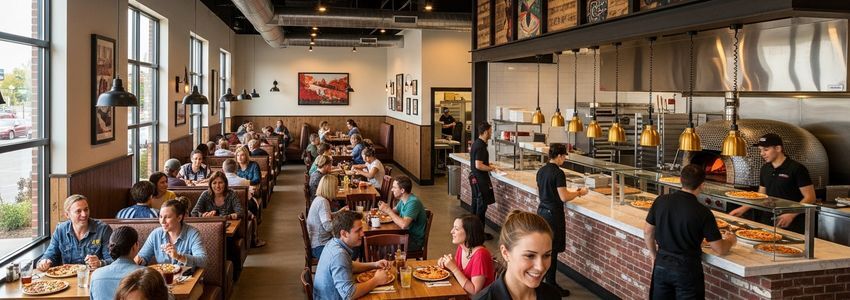
The restaurant environment is designed to be a community hub. Many locations feature party rooms for birthdays and events, and some even have arcades, making them a go-to destination for families, sports teams, and local organizations. This community-centric approach is a cornerstone of their business model and a significant driver of repeat business.
Why Pizza Factory is an Attractive Franchise Opportunity
Investing in a Pizza Factory franchise offers several distinct advantages for entrepreneurs, particularly those looking to become pillars of their local community.
- Established Brand Recognition: With over 40 years of history, Pizza Factory is a well-known and respected name, especially in its core markets. This reduces the risk and marketing burden associated with starting a new restaurant from scratch.
- Proven Business Model: The company provides a comprehensive system for operations, marketing, and management. Franchisees receive extensive training and ongoing support to ensure they are set up for success.
- Community Focus: The brand's emphasis on community involvement allows owners to build deep, meaningful connections in their towns. This not only drives business but also provides a great sense of personal fulfillment.
- SBA Approval: Pizza Factory is listed on the SBA Franchise Directory. This is a crucial advantage, as it means the Small Business Administration has already vetted the franchise's business model and legal documents. This significantly streamlines the process for obtaining SBA loans for franchise businesses, one of the most popular financing routes.
- Strong Industry Performance: The pizza industry is remarkably resilient. According to industry reports, the U.S. pizza market is valued at over $50 billion and continues to grow. It's a segment that performs well in various economic climates, making it a relatively stable investment.
Key Insight: Pizza Factory's inclusion in the SBA Franchise Directory is a major green flag for lenders. It demonstrates a stable, credible business model and can expedite the approval process for government-backed loans like the SBA 7(a).
By choosing Pizza Factory, you're not just buying a restaurant; you're investing in a legacy brand with a clear identity, a loyal customer base, and a robust support system designed to help you thrive.
Pizza Factory Franchise Costs and Investment Requirements
Understanding the full financial picture is the first critical step in your journey to becoming a Pizza Factory franchisee. The total investment can vary significantly based on factors like location, restaurant size, and whether you're building a new store or converting an existing one. Here’s a detailed breakdown of the typical costs associated with opening a Pizza Factory franchise.
Initial Investment Breakdown
The estimated total initial investment to open a Pizza Factory ranges from approximately $200,000 to $500,000. This is a broad range, so let's break down the individual components that contribute to this total cost. The following table provides estimated ranges for each key expense category.
| Expense Category | Estimated Cost Range | Description |
|---|---|---|
| Initial Franchise Fee | $20,000 - $30,000 | A one-time fee paid to Pizza Factory for the right to use their brand, trademarks, and operating system. It also covers initial training and support. |
| Real Estate & Leasehold Improvements | $50,000 - $200,000+ | This is often the largest variable. Costs include security deposits, and construction/renovation to build out the space to Pizza Factory's specifications (plumbing, electrical, HVAC, flooring, etc.). |
| Kitchen Equipment & Fixtures | $75,000 - $150,000 | Includes all necessary kitchen equipment like pizza ovens, mixers, walk-in coolers, prep tables, salad bar, POS system, and smallwares. |
| Furniture, Decor, & Signage | $20,000 - $50,000 | Covers dining room tables, chairs, booths, interior decor package, and exterior signage that adheres to brand standards. |
| Initial Inventory & Supplies | $5,000 - $10,000 | The first order of food, beverages, paper goods, and cleaning supplies needed to open your doors. |
| Grand Opening Marketing | $5,000 - $15,000 | Funds allocated for marketing and advertising efforts to create buzz and drive traffic during your first few months of operation. |
| Professional Fees & Permits | $5,000 - $15,000 | Costs for legal counsel to review franchise documents, accounting services, business licenses, and health permits. |
| Additional Funds (Working Capital) | $20,000 - $50,000 | Crucial funds to cover operating expenses (payroll, rent, utilities, royalties) for the first 3-6 months before the business becomes self-sustaining. |
Ongoing Fees
Beyond the initial investment, franchisees are responsible for ongoing fees that support the brand and provide you with continued services. These are typically calculated as a percentage of your gross sales:
- Royalty Fee: 5% of gross sales. This fee covers the ongoing right to use the Pizza Factory brand, as well as access to their operational support, R&D for new menu items, and corporate guidance.
- Marketing/Advertising Fee: Typically 1-2% of gross sales. This contributes to a national or regional advertising fund that promotes the Pizza Factory brand as a whole, benefiting all franchisees.
Franchisee Financial Requirements
To ensure their franchisees are financially stable and capable of launching successfully, Pizza Factory, like most franchisors, has minimum financial requirements for candidates. While these can vary, prospective owners should generally meet the following criteria:
- Minimum Liquid Capital: Approximately $100,000. This refers to cash or assets that can be quickly converted to cash. It demonstrates you have the funds for a down payment on a loan and the necessary working capital to weather the initial startup phase.
- Minimum Net Worth: Approximately $250,000 - $300,000. Net worth is the value of your assets (cash, stocks, real estate) minus your liabilities (mortgages, loans, credit card debt). Lenders and franchisors see a strong net worth as a sign of financial responsibility and a safety net for the business.
Meeting these requirements is the first step toward qualification. The next is securing the right financing to cover the rest of the investment. This is where a strategic approach to finding a pizza franchise business loan becomes paramount.
Understand Your Pizza Factory Costs?
Now let's get you funded. Crestmont Capital offers specialized financing for franchisees. Apply in minutes to see your options.
Apply Now →Financing Options for Pizza Factory Franchisees
With a clear understanding of the costs, the next step is to explore how to fund your investment. Very few franchisees pay for the entire startup cost out of pocket. Instead, they leverage smart financing to preserve their personal capital and get their business off the ground. There are several excellent financing avenues available, each with its own set of benefits and requirements.
1. SBA Loans
SBA loans are often considered the gold standard for franchise financing. Backed by the U.S. Small Business Administration, these loans reduce the risk for lenders, making them more willing to offer favorable terms. For a Pizza Factory franchise, an SBA loan is an ideal choice because the brand is already on the SBA Franchise Directory.
- Best for: Covering a majority of the total startup costs, including the franchise fee, build-out, equipment, and working capital.
- Pros: Long repayment terms (up to 25 years), low down payments (as little as 10%), and competitive interest rates.
- Cons: Can have a lengthy application process and strict documentation requirements.
2. Equipment Financing
A significant portion of your startup cost will be for kitchen equipment. Equipment financing is a specialized loan product designed specifically for this purpose. The equipment you are purchasing-pizza ovens, mixers, refrigeration units-serves as the collateral for the loan.
- Best for: Purchasing all new kitchen and dining room equipment without tying up working capital.
- Pros: Often requires no additional collateral, can finance up to 100% of the equipment cost, fast approval times, and potential tax benefits under Section 179.
- Cons: Can only be used for equipment purchases; not suitable for other startup costs like the franchise fee or build-out.
3. Conventional Bank Loans
A traditional term loan from a bank or credit union is another common option. These loans provide a lump sum of capital that you repay over a set period with fixed interest rates. However, they can be more difficult to qualify for than SBA loans, especially for a new business without an established revenue history.
- Best for: Entrepreneurs with excellent credit, a substantial down payment, and a strong relationship with a local bank.
- Pros: Potentially lower interest rates for highly qualified borrowers, established process.
- Cons: Higher down payment requirements (typically 20-30%), shorter repayment terms, and a more rigid qualification process.
4. Business Lines of Credit
A business line of credit provides access to a revolving pool of funds that you can draw from as needed. You only pay interest on the amount you use. This is an excellent tool for managing cash flow and covering unexpected expenses during the startup phase and beyond.
- Best for: Managing ongoing working capital needs, short-term expenses, and having a financial safety net.
- Pros: Flexible access to cash, only pay for what you use, can be reused as you pay it back.
- Cons: May have variable interest rates and is not designed to cover the entire initial investment.
5. Alternative & Online Lenders (like Crestmont Capital)
Alternative lenders like Crestmont Capital often provide a more flexible and faster path to funding than traditional banks. We specialize in small business loans and franchise financing, offering a range of products including SBA loans, equipment financing, and working capital loans with a streamlined online application process.
- Best for: Franchisees who need funding quickly, value a simplified application process, or may not meet the strict criteria of a traditional bank.
- Pros: Fast application and funding times, higher approval rates, and more flexible qualification criteria.
- Cons: Interest rates may sometimes be higher than a traditional bank loan for some products, depending on the borrower's profile.
6. Rollovers as Business Startups (ROBS)
The ROBS strategy allows you to use your eligible retirement funds (like a 401(k) or IRA) to finance your business without paying early withdrawal penalties or taxes. This is a complex process that involves creating a C corporation and a new 401(k) plan for your business.
- Best for: Entrepreneurs with a substantial amount of money in a retirement account who want to make a large down payment or fund the business debt-free.
- Pros: Allows you to invest in your own business, debt-free financing.
- Cons: It's a complex legal and financial process that requires professional guidance. It also puts your retirement savings at risk if the business fails.
For most Pizza Factory franchisees, a combination of these options works best. For example, you might use an SBA 7(a) loan to cover the bulk of the startup costs and supplement it with an equipment financing agreement for the kitchen package. A business line of credit can then be secured for ongoing operational flexibility.

How to Qualify for a Pizza Factory Franchise Loan
Securing a loan is a competitive process. Lenders need to be confident in your ability to repay the debt and successfully run your franchise. To put your best foot forward, you need to prepare a comprehensive loan application package that addresses what lenders call the "Five C's of Credit."
1. Character (Credit History)
This is a measure of your financial reliability and integrity. Lenders will closely examine your personal and business credit history.
- Personal Credit Score: This is one of the most important factors. For the best loan terms, you should aim for a personal credit score of 680 or higher. A score above 720 will put you in a very strong position. If your score is lower, there may still be options available, but you can expect higher interest rates.
- Credit Report: Lenders will look for a history of on-time payments, a healthy credit utilization ratio (ideally below 30%), and no recent bankruptcies, foreclosures, or major delinquencies. It's wise to pull your credit report from all three major bureaus (Equifax, Experian, TransUnion) before applying to check for errors.
2. Capacity (Cash Flow)
Capacity refers to your ability to generate enough cash flow to cover your operational expenses and make your loan payments. Since a new franchise has no operating history, lenders will assess this based on detailed financial projections.
- Financial Projections: Your business plan must include at least three years of projected financial statements: a profit and loss (P&L) statement, a cash flow statement, and a balance sheet. These should be realistic and well-researched, ideally based on data from Pizza Factory's Franchise Disclosure Document (FDD) and your local market analysis.
- Personal Financials: Lenders will also look at your personal income and debt-to-income ratio to ensure you have financial stability outside of the business.
3. Capital (Down Payment)
Lenders want to see that you have "skin in the game." Your personal investment in the project, known as a down payment or equity injection, demonstrates your commitment and reduces the lender's risk.
- Typical Down Payment: For an SBA loan, the minimum down payment is typically 10%. For conventional loans, it's often 20-30%. This capital should come from your personal savings, not from another loan.
- Source of Funds: Be prepared to document the source of your down payment. This shows lenders that the funds are legitimate and not borrowed.
4. Collateral (Assets)
Collateral is an asset that you pledge to the lender to secure the loan. If you default on the loan, the lender can seize the collateral to recoup their losses.
- Types of Collateral: For a business loan, collateral can include the business assets being purchased (like equipment and real estate). Lenders may also require you to pledge personal assets, such as your home (if you have equity in it) or investment accounts.
- SBA Requirement: The SBA generally requires that a loan be collateralized to the maximum extent possible. However, a loan will not be declined solely due to a lack of collateral if all other factors are strong.
5. Conditions (The Business Plan & Market)
This refers to the overall conditions of your business, the local market, and the economy. Your business plan is the primary tool for demonstrating this.
- A Comprehensive Business Plan: This is your roadmap to success and a critical part of any loan application. It must include:
- Executive Summary: A concise overview of your entire plan.
- Company Description: Details about your specific Pizza Factory location.
- Market Analysis: Research on your local demographics, competition, and target customers.
- Management Team: Bios of you and any key personnel, highlighting relevant experience (especially in restaurant or retail management).
- Marketing & Sales Strategy: How you plan to attract and retain customers.
- Financial Projections: As mentioned above, detailed and realistic projections.
- Industry Strength: As noted by publications like Forbes, the franchise industry, particularly in the quick-service restaurant (QSR) sector, has shown remarkable resilience and growth, which is a positive condition for lenders.
SBA Loans for Pizza Factory Franchises
The U.S. Small Business Administration (SBA) loan program is one of the most powerful tools available to aspiring franchisees. These loans are not made by the SBA itself; instead, the SBA provides a government guarantee on a portion of the loan made by an approved lender, like Crestmont Capital. This guarantee significantly reduces the lender's risk, encouraging them to provide financing to small businesses that might not otherwise qualify for a conventional loan.
As a brand listed on the SBA Franchise Directory, Pizza Factory is a prime candidate for this type of financing. This pre-approval means the SBA has already reviewed and accepted Pizza Factory's franchise agreement and FDD, which can save weeks in the underwriting process.
SBA 7(a) Loan Program: The Workhorse of Franchise Financing
The SBA 7(a) loan is the most common and versatile SBA loan program. It can be used for a wide variety of business purposes, making it perfect for funding a new Pizza Factory from the ground up.
- Loan Amounts: Up to $5 million.
- Use of Funds:
- Franchise fees
- Real estate purchase or leasehold improvements
- Equipment, machinery, and fixtures
- Inventory and supplies
- Working capital
- Refinancing existing business debt
- Repayment Terms: The long repayment terms are a major advantage, improving monthly cash flow.
- Up to 10 years for working capital and equipment.
- Up to 25 years for real estate.
- Interest Rates: Rates are variable and are tied to the Prime Rate, plus a spread determined by the lender. The SBA sets maximums for these spreads, ensuring the rates remain competitive.
- Down Payment: Typically requires a 10-20% down payment, which is lower than most conventional loans.
Pro Tip: When applying for an SBA 7(a) loan, work with an SBA-preferred lender. These lenders have the authority to make final credit decisions without waiting for separate SBA approval, drastically speeding up the timeline from application to funding.
SBA 504 Loan Program: For Major Asset Purchases
If your business plan involves purchasing the building for your Pizza Factory, the SBA 504 loan program is an excellent option. It's specifically designed for financing major fixed assets like real estate and long-term equipment.
The 504 loan has a unique structure:
- 50% of the project cost is financed by a conventional lender (like a bank).
- 40% is financed by a Certified Development Company (CDC) with a 100% SBA-guaranteed debenture.
- 10% is the down payment from the borrower.
This structure often results in a blended interest rate that is lower than a single conventional loan, with repayment terms of up to 25 years.
The Application Process for an SBA Loan
While often perceived as paperwork-heavy, the process is manageable with the right guidance. Here's what to expect:
- Gather Documentation: You'll need a comprehensive package, including your business plan, 3 years of personal and business (if applicable) tax returns, personal financial statements, franchise agreement, and detailed projections.
- Find an SBA-Approved Lender: Partner with a lender like Crestmont Capital that has deep experience with SBA loans and franchise financing.
- Complete the Application: Your lender will guide you through completing the necessary SBA forms (like Form 1919 and Form 413) and their own internal application.
- Underwriting and Approval: The lender will analyze your entire package. If they are a preferred lender, they can approve the loan in-house. Otherwise, the package goes to the SBA for final review.
- Closing and Funding: Once approved, you'll sign the loan documents, and the funds will be disbursed according to a schedule, often directly to vendors for things like equipment and construction.
An SBA loan is a powerful tool that can make your dream of owning a Pizza Factory a reality by providing the comprehensive, long-term, and affordable capital you need to launch successfully.
Equipment Financing for Pizza Factory Operators
A Pizza Factory franchise is an equipment-intensive business. From the massive deck ovens that produce the perfect crispy crust to the walk-in coolers that keep ingredients fresh, your kitchen is the heart of your operation. This is why equipment financing is such a vital and popular funding solution for restaurant franchisees.
Equipment financing is a type of loan or lease used specifically to purchase business equipment. The key feature is that the equipment being purchased serves as its own collateral. This makes it easier to qualify for than some other types of loans and protects your other business and personal assets.
What Equipment Can You Finance?
Virtually every piece of equipment needed to run your Pizza Factory can be covered under an equipment financing agreement. This includes, but is not limited to:
- Pizza Ovens: Deck ovens, conveyor ovens, or brick ovens.
- Dough Equipment: Commercial mixers, dough sheeters, and proofing cabinets.
- Refrigeration: Walk-in coolers and freezers, reach-in refrigerators, pizza prep tables with refrigerated compartments.
- Salad Bar: The refrigerated salad bar unit itself, along with all containers and utensils.
- Cooking Line Equipment: Fryers, ranges, and hoods.
- Sinks and Dishwashing: 3-compartment sinks, commercial dishwashers, and grease traps.
- Point-of-Sale (POS) System: Terminals, cash drawers, receipt printers, and kitchen display systems.
- Dining Room Furnishings: Tables, chairs, booths, and decor.
- Smallwares: All the pots, pans, pizza peels, cutting boards, and utensils needed for daily operations.
Benefits of Equipment Financing for Your Pizza Factory
- Preserves Working Capital: Instead of spending a massive lump sum of cash ($75,000 - $150,000+) on equipment, you can preserve that capital for other critical needs like payroll, marketing, and rent during your crucial first few months. Cash flow is king for a new business, and equipment financing protects it.
- 100% Financing: Many equipment financing agreements can cover the full cost of the equipment, including taxes, shipping, and installation fees. This means you may be able to acquire all your necessary equipment with zero cash out of pocket.
- Fast Funding: Compared to SBA or conventional loans, equipment financing is incredibly fast. Applications are often simpler, and funding can happen in a matter of days, which is critical when you're on a tight timeline to open. Crestmont Capital is known for providing fast business loans for exactly these situations.
- Fixed, Predictable Payments: Equipment loans typically have fixed interest rates and a set term (e.g., 3-7 years). This makes budgeting easy, as you'll have a consistent monthly payment that won't change.
- Potential Tax Advantages: Section 179 of the IRS tax code allows businesses to deduct the full purchase price of qualifying equipment from their gross income in the year it was purchased and put into service. This can provide a significant tax benefit. (Always consult with a tax professional to understand how this applies to your specific situation).
How Does It Work?
The process is straightforward:
- Get a Quote: You'll work with your suppliers to get a detailed quote for the entire equipment package you need.
- Apply for Financing: You'll submit a simple application to a lender like Crestmont Capital, along with the equipment quote.
- Approval and Documentation: The lender will review your application and credit. Upon approval, you'll receive loan documents to sign.
- Funding: The lender typically pays the equipment vendor directly. The equipment is then delivered and installed at your Pizza Factory location, and your repayment term begins.
By leveraging equipment financing, you can outfit your restaurant with top-of-the-line, brand-new equipment without depleting your vital cash reserves, setting your Pizza Factory up for operational excellence from day one.
How Crestmont Capital Helps Pizza Factory Franchisees
Choosing the right financing partner is just as important as choosing the right franchise. At Crestmont Capital, we're not just a lender; we're a strategic partner dedicated to the success of small business owners and franchisees. We understand the unique challenges and opportunities that come with opening a franchise like Pizza Factory, and we've built our services to meet those specific needs.
Expertise in Franchise Financing
Franchise financing is a specialized field. Unlike a generic business loan, it requires an understanding of the franchise model, the Franchise Disclosure Document (FDD), and the relationship between the franchisor and franchisee. Our team has extensive experience working with hundreds of franchise brands, including those in the competitive QSR space. We know what it takes to get a franchise loan approved because we do it every day. We understand Pizza Factory's model and its status on the SBA Directory, allowing us to navigate the process efficiently on your behalf.
A Full Suite of Loan Products
We recognize that a one-size-fits-all approach doesn't work. A successful financing strategy for a Pizza Factory often involves a combination of funding types. Crestmont Capital offers a comprehensive portfolio of loan products, allowing us to create a customized financing package tailored to your exact needs.
- SBA 7(a) Loans: We are a proficient facilitator of SBA loans, guiding you through the documentation and application process to secure the best long-term financing.
- Equipment Financing: We offer fast, flexible equipment financing to help you get your kitchen up and running without draining your cash.
- Working Capital Loans: Need a quick injection of cash to cover payroll or a grand opening marketing blitz? Our working capital loans provide fast access to the funds you need to keep your business running smoothly.
- Business Lines of Credit: We can help you establish a line of credit to provide an ongoing financial safety net for your new franchise.
Speed and Efficiency
In the world of business, time is money. Delays in funding can mean missing out on a prime real estate location or pushing back your grand opening. Traditional banks can take months to approve a loan. At Crestmont Capital, we leverage technology and a streamlined process to provide answers and funding much faster.
- Simple Online Application: Our application takes just minutes to complete.
- Minimal Paperwork: We've simplified the documentation requirements to get you to a decision faster.
- Dedicated Loan Specialists: You'll be assigned a dedicated specialist who will be your single point of contact, answering your questions and keeping you informed every step of the way.
A Partner Invested in Your Success
Our goal is to build long-term relationships. We succeed when you succeed. We take the time to understand your vision for your Pizza Factory franchise, review your business plan, and provide honest, transparent advice on the best financing strategy. We're here to help you not just open your doors, but to thrive and potentially grow into a multi-unit operator in the future. As a top-rated business lender, we have a proven track record of helping entrepreneurs across the country achieve their goals, a trend also highlighted by business media like CNBC which often covers the growing role of alternative finance in small business growth.
By the Numbers
Pizza Factory Franchise - Key Statistics
$200k - $500k
Total Initial Investment
5%
Ongoing Royalty Fee
100+
Locations Nationwide
SBA Approved
Listed on SBA Franchise Directory
Partner with the Franchise Financing Experts
Crestmont Capital simplifies the funding process so you can focus on what matters: building your business.
Get Started Today →Real-World Scenarios: Financing Your Pizza Factory Franchise
To make these financing concepts more concrete, let's explore a few hypothetical but realistic scenarios of how different types of franchisees might approach funding their Pizza Factory location.
Scenario 1: The First-Time Entrepreneur
Profile: Sarah is a former restaurant manager with 10 years of experience in the food service industry. She has a strong credit score of 740, has saved up $50,000 (her liquid capital), and has a net worth of $280,000, which includes the equity in her home.
Project Cost: Sarah has found a great location in a growing suburban strip mall. The total estimated project cost, including the franchise fee, build-out, equipment, and working capital, is $380,000.
Financing Strategy:
- Loan Type: SBA 7(a) Loan. This is the perfect fit for Sarah. It allows her to finance the majority of the project with one loan, and her strong management experience and good credit make her an excellent candidate.
- Loan Breakdown:
- Total Project Cost: $380,000
- Sarah's Down Payment (Equity Injection): $38,000 (10%)
- SBA 7(a) Loan Amount: $342,000
- Use of Funds: The $342,000 loan, combined with her remaining $12,000 in savings, will cover the entire project. The loan is structured with a 10-year term for the equipment and working capital portions and a 25-year term for the leasehold improvements, resulting in an affordable monthly payment that fits her financial projections.
- Outcome: Sarah successfully secures the SBA loan through Crestmont Capital. The long-term financing keeps her monthly payments manageable, allowing her to focus on a successful grand opening and building her customer base.
Scenario 2: The Multi-Unit Operator
Profile: Mark already owns two successful sandwich shop franchises and is looking to diversify his portfolio by opening a Pizza Factory. He has a strong business credit history, significant cash flow from his existing businesses, and a net worth of over $1.5 million.
Project Cost: Mark is opening his second Pizza Factory. The location needs a full equipment package, but the build-out is less extensive. The total cost for equipment is $120,000.
Financing Strategy:
- Loan Type: Equipment Financing Agreement and a Business Line of Credit. Mark doesn't need an SBA loan for the entire project, as he has the capital for the franchise fee and build-out. He wants to preserve his cash for future opportunities.
- Financing Breakdown:
- Equipment Financing: Mark applies for a $120,000 equipment loan. Because of his strong business credit, he is approved for 100% financing with a 5-year term and a competitive fixed interest rate. The process is fast, taking less than a week from application to funding.
- Business Line of Credit: To ensure he has flexibility, Mark also secures a $75,000 revolving line of credit. He doesn't draw on it immediately but has it available for marketing pushes, inventory fluctuations, or unexpected repairs.
- Outcome: Mark outfits his new location with brand-new equipment without touching his investment capital. The line of credit gives him peace of mind and the operational agility to manage multiple locations effectively.
Scenario 3: The Career Changer with Significant Savings
Profile: David has worked in corporate tech for 20 years and has a substantial 401(k) balance of $600,000. He's tired of the corporate world and wants to own a community-focused business. His credit is excellent, but he wants to minimize his debt load.
Project Cost: The total investment for David's chosen location is $450,000.
Financing Strategy:
- Funding Mix: Rollovers as Business Startups (ROBS) combined with a smaller conventional loan.
- Financing Breakdown:
- ROBS: David works with a specialized firm to structure a ROBS plan. He rolls over $250,000 from his 401(k) into his new business's C Corporation. This money is used as a significant equity injection, covering the franchise fee, initial working capital, and a large portion of the build-out. This is a tax-free and penalty-free transaction.
- Conventional Loan: With such a large down payment (over 50% of the project cost), David is a very attractive candidate for a conventional bank loan. He easily secures a $200,000 loan with a favorable interest rate and a 7-year term to cover the remaining costs.
- Outcome: David starts his business with significantly less debt than he would have with a traditional 90% LTV loan. This results in much lower monthly payments and less financial pressure in the early years, allowing his business to become profitable more quickly.
Frequently Asked Questions
1. What is Pizza Factory and why is it a good franchise choice?
Pizza Factory is a well-established restaurant franchise founded in 1979, known for its "hometown pizzeria" atmosphere, hand-tossed pizzas, and fresh salad bars. It's a strong choice because it has over 40 years of brand recognition, a proven business model, a community-focused identity that builds customer loyalty, and is listed on the SBA Franchise Directory, which simplifies the process of securing government-backed financing.
2. What is the total cost to open a Pizza Factory franchise?
The total initial investment for a Pizza Factory franchise typically ranges from $200,000 to $500,000. This range includes the initial franchise fee (around $20,000-$30,000), real estate and build-out costs, all kitchen and dining room equipment, initial inventory, grand opening marketing, and crucial working capital for the first several months of operation.
3. What are the main ways to finance a Pizza Factory franchise?
The most common financing methods include SBA 7(a) loans (ideal for covering most startup costs), equipment financing (specifically for kitchen and POS systems), conventional bank loans, and business lines of credit for working capital. Some franchisees also use Rollovers as Business Startups (ROBS) to invest their retirement funds. Often, a combination of these methods is the most effective strategy.
4. What are the minimum requirements to qualify for a franchise loan?
Lenders typically look for a strong personal credit score (ideally 680+), a solid business plan with realistic financial projections, relevant management or industry experience, and a cash down payment (equity injection) of at least 10-20% of the total project cost. Pizza Factory also has its own financial requirements, usually around $100,000 in liquid capital and a $250,000+ net worth.
5. Why are SBA loans a good option for Pizza Factory?
SBA loans are excellent for Pizza Factory because the brand is pre-vetted and listed on the SBA Franchise Directory, which streamlines the loan process. These loans offer high borrowing limits (up to $5 million), long repayment terms (up to 25 years), and low down payment requirements (as low as 10%). This makes them one of the most affordable and comprehensive financing solutions available.
6. How does equipment financing work for a pizzeria?
Equipment financing allows you to purchase all necessary kitchen and dining equipment-like ovens, mixers, coolers, and POS systems-with a dedicated loan. The equipment itself serves as the collateral, so you often don't need to pledge other assets. This method preserves your cash for other startup costs and can offer tax advantages. The process is typically very fast, with funding in a few days.
7. How long does it take to get a franchise loan approved and funded?
The timeline varies by loan type. Equipment financing can be very fast, often funded within 2-5 business days. An SBA 7(a) loan is a more involved process and typically takes 30 to 90 days from application to funding, depending on the complexity of the deal and the efficiency of the lender. Working with an experienced lender like Crestmont Capital can help expedite this timeline.
8. Can I get a Pizza Factory franchise loan with bad credit?
It is more challenging but not necessarily impossible. A low credit score (below 640) will likely disqualify you from traditional bank loans and SBA loans. However, some alternative lenders may have options, though they will come with higher interest rates and less favorable terms. It's often better to take time to improve your credit score before applying for a major franchise loan.
9. How much of a down payment do I need?
The required down payment, or equity injection, depends on the loan type. For an SBA 7(a) loan, you will typically need a minimum of 10% of the total project cost. For a conventional bank loan, the requirement is often higher, usually between 20% and 30%. Lenders require this to ensure you are personally invested in the success of the business.
10. How much can I borrow for my Pizza Factory franchise?
The loan amount will depend on your qualifications and the total project cost. SBA 7(a) loans can go up to $5 million, which is more than enough to cover the full startup cost of a Pizza Factory. The final amount you are approved for will be based on your business plan, financial projections, credit history, and the value of any available collateral.
11. What is working capital and why is it included in the loan?
Working capital is the money used to cover day-to-day operating expenses before your business starts generating a consistent positive cash flow. This includes funds for payroll, rent, utilities, marketing, and inventory. Lenders, especially the SBA, insist on including 3-6 months of working capital in the startup loan to ensure your business has the financial runway it needs to survive the critical initial period.
12. Can I get financing to open multiple Pizza Factory locations?
Yes. Once you have successfully opened and operated your first location for a period of time (usually 1-2 years), lenders will be very open to financing your expansion. Your proven track record with the brand will make you a much stronger candidate for subsequent loans. Many lenders offer specific loan products designed for multi-unit franchise growth.
13. What makes Crestmont Capital different from a bank?
Crestmont Capital specializes in franchise and small business financing, offering a more streamlined, flexible, and faster process than many traditional banks. We offer a wider range of loan products under one roof, allowing us to create a custom financing package for your needs. Our focus is on saying "yes" and finding solutions, with dedicated specialists to guide you through the entire process.
14. What is the typical timeline for applying with Crestmont Capital?
Our process is designed for speed. You can complete our initial online application in minutes. A financing specialist will then contact you, usually within a few hours, to discuss your project and required documents. For simpler products like equipment financing, funding can occur in as little as 24-48 hours. For more complex loans like an SBA loan, we work to expedite the process as much as possible, aiming for a much faster turnaround than the industry average.
15. What's the very first step I should take to get financing?
The first step is to get pre-qualified. This will give you a clear understanding of how much you can borrow and what loan options are available to you. You can start by completing the quick online application at Crestmont Capital. This requires no commitment and will allow one of our franchise financing experts to review your profile and provide a clear path forward.
Next Steps: Apply for Pizza Factory Franchise Financing
You've done the research and understand the incredible opportunity that a Pizza Factory franchise presents. Now it's time to take action. Securing your financing is the most critical next step. At Crestmont Capital, we've simplified the process to get you from application to funding as quickly and smoothly as possible. Here’s how to get started:
Submit Your Application
Complete our simple, secure online application in just a few minutes. It's fast, easy, and there's no obligation. This initial step gives us the basic information we need to start exploring the best financing options for your specific situation.
Consult with a Specialist
Once we receive your application, a dedicated franchise financing specialist will reach out to you. They will discuss your project in detail, answer all your questions, and walk you through the necessary documentation, such as your business plan and financial statements.
Receive Your Offers & Get Funded
Our team will work diligently to underwrite your file and secure the best possible loan offers. We'll present you with clear, transparent terms. Once you accept an offer and complete the final paperwork, we'll move to close the loan and disburse the funds so you can start building your Pizza Factory empire.
Don't Wait to Fund Your Dream
The path to owning your own Pizza Factory starts now. Take the first step by applying with Crestmont Capital today.
Apply in Minutes →Conclusion
Investing in a Pizza Factory franchise is an opportunity to own a beloved community brand with a history of success and a bright future. While the initial investment may seem substantial, a wide array of excellent financing options are available to help you turn your entrepreneurial dream into a reality. From the comprehensive coverage of an SBA 7(a) loan to the speed and specificity of equipment financing, there is a solution perfectly tailored to your needs.
The key to a successful launch is preparation and partnership. By developing a strong business plan, understanding the qualification requirements, and working with a financing expert who specializes in the franchise industry, you can navigate the process with confidence. At Crestmont Capital, we are committed to being that partner. We provide the expertise, the diverse loan products, and the streamlined process necessary to get you funded quickly and efficiently, so you can focus on what you do best: bringing awesome pizza and a sense of community to your hometown.
Disclaimer
Disclaimer: The information provided in this article is for general educational purposes only and is not financial, legal, or tax advice. Funding terms, qualifications, and product availability may vary and are subject to change without notice. Crestmont Capital does not guarantee approval, rates, or specific outcomes. For personalized information about your business funding options, contact our team directly.