Earthmoving contractors know the machine well. A motor scraper cuts, loads, hauls, and spreads soil in a single pass, which makes it one of the most productive tools ever built for moving large volumes of earth. It is also one of the most expensive machines on a job site. A new motor scraper can cost well over $1 million, and even well-maintained used units routinely sell for several hundred thousand dollars.
Motor scraper financing gives contractors, mining operations, land developers, and site preparation companies a practical way to put this machine to work without draining cash reserves. Instead of tying up capital in a single purchase, you spread the cost over fixed monthly payments while the machine generates revenue on active jobs.
This guide covers everything business owners need to know about financing a motor scraper: how the process works, which machines qualify, what new and used units cost, how loans compare to leases, what lenders look for, and how to get funded quickly so you can mobilize on your next project.
In This Article
- What Is Motor Scraper Financing?
- Key Benefits of Financing a Motor Scraper
- How Motor Scraper Financing Works
- Types of Motor Scrapers You Can Finance
- Motor Scraper Costs: New vs. Used
- Financing Options: Loans vs. Leases
- Who Qualifies for Motor Scraper Financing?
- Financing vs. Renting vs. Paying Cash
- How Crestmont Capital Helps
- Real-World Scenarios
- Frequently Asked Questions
- How to Get Started
What Is Motor Scraper Financing?
Motor scraper financing is a form of equipment financing that lets a business acquire a motor scraper by paying for it over time instead of in a single lump sum. A lender provides the capital to purchase the machine, and you repay that capital plus interest through fixed monthly payments over an agreed term. In most structures, the motor scraper itself serves as the collateral, which is why equipment financing is often easier to qualify for than unsecured borrowing.
The term covers several related products. An equipment loan gives you ownership from day one with the machine titled in your company's name once the loan is repaid. An equipment lease lets you use the machine for a set period in exchange for monthly payments, with options to purchase, renew, or return it at the end of the term. Some buyers also use an equipment line of credit to move quickly when the right unit appears at auction or through a dealer.
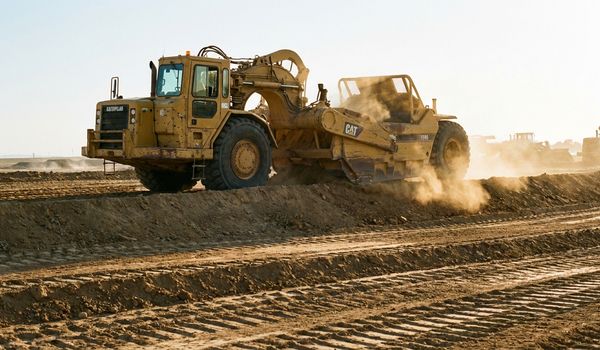
A quick note on the machine itself, since lenders and dealers sometimes use different names. The motor scraper, known technically as a wheel tractor-scraper, combines a tractor unit with a towed bowl that has a cutting edge along its front bottom lip. As the machine moves forward, the cutting edge slices soil into the bowl. Once loaded, the operator closes the bowl, hauls the material at speed, then spreads it in a controlled layer at the fill area. Loading, hauling, and spreading in one machine is what makes the motor scraper so efficient on jobs that involve moving thousands of cubic yards of earth.
Motor scrapers show up anywhere mass earthmoving happens: subdivision and commercial site preparation, highway and road construction, mining and aggregate operations, landfill cell construction, reservoir and pond excavation, and large-scale agricultural land leveling. If your business moves dirt in volume, a motor scraper is often the lowest cost-per-yard way to do it.
Key Benefits of Financing a Motor Scraper
Paying cash for a machine that can cost seven figures is rarely the smartest use of capital, even when the money is available. Financing delivers several advantages that matter to a growing earthmoving business.
- Preserve working capital. Cash stays available for payroll, fuel, insurance, materials, and bonding capacity instead of sitting inside a depreciating asset.
- Fixed, predictable payments. Monthly payments stay constant over the term, which makes job costing and bid pricing far more accurate.
- Revenue from day one. The machine starts earning on active jobs immediately, so the equipment can effectively pay for itself out of production.
- Up to 100% financing. Qualified buyers can often finance the full purchase price, and sometimes soft costs like delivery and setup, with little or no money down.
- Build business credit. Consistent on-time payments strengthen your company's credit profile, which improves terms on future fleet purchases.
- Scale the fleet faster. Financing lets you add a second or third machine when the workload justifies it, rather than waiting years to accumulate cash.
- Flexible end-of-term options. Lease structures let you return, renew, or purchase the machine, which keeps your fleet strategy open as technology and workloads change.
For most contractors, the decision is not whether a motor scraper will pay for itself. On the right workload, few machines match its cost per cubic yard. The real question is how to acquire it without constraining the rest of the business, and that is exactly the problem financing solves.
Key Stat: Total U.S. construction spending has been running at an annual rate above $2 trillion, according to the U.S. Census Bureau's construction spending report. Contractors with the right earthmoving equipment are positioned to capture a growing share of that work.
Need a Motor Scraper on Your Next Job?
Get fast, flexible equipment financing from the #1 business lender in the U.S. No obligation, apply in minutes.
Apply Now →How Motor Scraper Financing Works
The process is more straightforward than most buyers expect, especially compared to traditional bank lending. Here is how a typical motor scraper financing transaction moves from application to funding.
Step 1: Identify the machine. You find the motor scraper you want, whether that is a new unit from a dealer, a used machine from a private seller, or a lot at an equipment auction. The lender will want the year, make, model, hours, serial number, and purchase price. A dealer invoice or seller quote is the standard document.
Step 2: Submit an application. A short application covers your business entity, time in business, annual revenue, and credit authorization. Established lenders like Crestmont Capital keep this step to minutes rather than the multi-week document chase that banks are known for.
Step 3: Credit review and approval. The lender evaluates your business credit, personal credit of the owners, time in business, cash flow, and the machine itself. Because the motor scraper secures the transaction, approvals are possible across a wide range of credit profiles. Decisions typically arrive within 24 to 48 hours.
Step 4: Review terms and sign documents. You receive a proposal with the financed amount, rate, term length, and monthly payment. After any adjustments, you sign the agreement electronically.
Step 5: Funding and delivery. The lender pays the dealer or seller directly. You take delivery of the machine and put it to work. For auction purchases, funding can often be coordinated with the auction house's release timeline.
Step 6: Repayment. You make fixed monthly payments for the term of the agreement. On a loan, you own the machine free and clear at the end. On a lease, you exercise your purchase option, renew, or return the unit depending on the structure you chose.
Types of Motor Scrapers You Can Finance
Lenders generally finance any motor scraper with a verifiable serial number and a clear title, regardless of configuration. Understanding the main types helps you match the machine to the work before you apply.
| Scraper Type | How It Loads | Best For | Typical Bowl Capacity |
|---|---|---|---|
| Single-engine open bowl | Powered bowl with push-pull loading or dozer assist | General site prep, highway work, shorter hauls | 14-24 cubic yards |
| Tandem (twin-engine) | Engines on both tractor and scraper for self-loading power | Heavy cuts, long hauls, mining and mass excavation | 24-44 cubic yards |
| Elevating scraper | Elevator flights lift material into the bowl without push assistance | Fine grading, topsoil, windrow material, solo operation | 11-25 cubic yards |
| Auger scraper | Rotating auger lifts and aerates material as it loads | Sticky soils, landfills, material blending | 25-38 cubic yards |
| Pull-type scraper | Towed behind an agricultural or construction tractor | Farm land leveling, smaller site jobs, lower budgets | 9-28 cubic yards |
Single-engine open bowl scrapers are the most common configuration on general construction sites. Machines in the Caterpillar 621 class, along with comparable models from other manufacturers, handle the bulk of subdivision and highway work. They load fastest with a push dozer, but modern push-pull arrangements let pairs of scrapers load each other.
Tandem or twin-engine scrapers add a second engine on the scraper unit itself. The extra power lets them self-load in most materials and maintain speed on steep grades and long hauls. They are the standard choice for mining, mass excavation, and large highway projects where production volume dominates the economics.
Elevating scrapers replace the push-loading system with a powered elevator that lifts material into the bowl. They load alone without a push dozer, which makes them efficient for smaller crews and finish grading. They work best in loose, granular, or windrowed material.
Auger scrapers use a rotating auger in the bowl that aerates and lifts material as it loads. The mixing action handles sticky and wet soils that would plug a conventional bowl, which is why they are popular with landfill operators and sites with heavy clay.
Pull-type scrapers are towed behind a high-horsepower tractor. They cost a fraction of a self-propelled unit and are the entry point for agricultural land leveling and smaller site jobs. Many contractors finance a pull-type scraper together with the tractor that pulls it.
On the brand side, Caterpillar dominates the self-propelled market with the 620 and 630 series families, while John Deere, Komatsu, Case, and Bell serve various segments. K-Tec and Ashland lead the pull-type category. Lenders care far more about the machine's condition, hours, and verifiable value than the badge on the hood, so financing is available across all major manufacturers.
Motor Scraper Costs: New vs. Used
Pricing depends on size, configuration, hours, condition, and market demand, but the ranges below reflect what buyers typically encounter in the current market.
| Machine Category | New (Typical Range) | Used (Typical Range) | Notes |
|---|---|---|---|
| Single-engine open bowl (e.g., Cat 621 class) | $700,000 - $1,000,000 | $150,000 - $600,000 | Price varies heavily with hours, tires, and bowl condition |
| Tandem twin-engine (e.g., Cat 627/637 class) | $1,000,000 - $1,500,000+ | $250,000 - $800,000 | Highest production class; strong resale market |
| Elevating scraper (e.g., Cat 623 class) | $800,000 - $1,200,000 | $100,000 - $500,000 | Elevator chain and flight wear affects used pricing |
| Pull-type scraper (e.g., K-Tec, Ashland) | $80,000 - $300,000 | $30,000 - $150,000 | Entry-level option; often financed alongside a tractor |
Several factors move a specific machine within these ranges. Hour count is the single biggest driver for used units, since major component life on engines, transmissions, and drivetrains is tracked in hours. Tire condition matters more than most buyers expect, because a full set of scraper tires can cost tens of thousands of dollars. Bowl cutting edges, elevator chains on elevating models, and documented service history all shift pricing in both directions.
Market timing also plays a role. When infrastructure spending is strong, used earthmoving equipment values firm up and auction prices climb. Financing protects you either way: when prices are high, financing preserves the cash you need to compete, and when the market softens, financing lets you move quickly on undervalued machines without liquidating other assets.
Pro Tip: A well-maintained used motor scraper with documented service history often delivers the best return on investment. Financing is available for both new and used machines, so you can choose the unit that fits the work instead of the unit that fits your cash on hand.
By the Numbers
Motor Scraper Financing - Key Figures
$2T+
Annual U.S. construction spending pace driving earthmoving demand (U.S. Census Bureau)
$1M+
Typical price range for a new large motor scraper, making financing the standard path to ownership
24-48 hrs
Typical credit decision window when you apply with Crestmont Capital
Up to 100%
Of the machine cost that can be financed for qualified buyers, preserving working capital
Motor Scraper Financing Options: Loans vs. Leases
Three structures account for nearly every motor scraper transaction. The right choice depends on how long you plan to run the machine, how you want the payments to behave, and how the purchase fits your broader fleet strategy.
| Feature | Equipment Loan | Finance Lease | Operating Lease |
|---|---|---|---|
| Ownership at term end | Yes, title transfers to you | Usually, via $1 or fixed-price buyout | No, machine is returned or purchased at fair market value |
| Monthly payment | Higher (full cost amortized) | Moderate | Lowest (you pay for use, not full value) |
| Typical term | 36-84 months | 36-72 months | 24-60 months |
| Best for | Long-term fleet assets you plan to run for years | Ownership with lower payments and a planned buyout | Short-term projects or frequent fleet upgrades |
| Equity building | Builds equity with every payment | Equity captured at buyout | No equity; purely an expense |
Equipment loans are the default for contractors buying a machine they intend to run for a decade or more. You build equity with every payment, and at the end of the term you own a productive asset outright. Loans also give you full control over modifications, hour accumulation, and eventual resale.
Finance leases lower the monthly payment by pushing part of the cost into an end-of-term buyout, often structured as a $1 or 10% purchase option. You get most of the economics of ownership with payments that behave more like a rental. Contractors who want ownership but need to protect monthly cash flow often land here.
Operating leases work like a long-term rental with the lowest payments of the three. They make sense when a project has a defined end date, when you want to upgrade machines every few years, or when keeping the obligation off the balance sheet matters for bonding or banking relationships.
Government-backed programs are another path worth knowing about. The U.S. Small Business Administration's loan programs, including the SBA 7(a) loan, can be used for heavy equipment purchases. SBA loans offer long terms and competitive rates, but the application process is slower and documentation-heavy compared to direct equipment financing, which is why most contractors use them selectively.
Who Qualifies for Motor Scraper Financing?
Because the machine secures the transaction, motor scraper financing is accessible to a wider range of businesses than most owners assume. Lenders weigh several factors together rather than applying a single cutoff.
Credit profile. A credit score of 650 or higher typically unlocks the best rates and terms. Scores between 600 and 650 are routinely approved with adjusted terms. Below 600, approvals are still possible, particularly when time in business, revenue, and down payment strengthen the file. Specialized programs exist for bad credit equipment financing when credit is the weak point in an otherwise solid business.
Time in business. Two or more years of operating history is the conventional benchmark for the strongest terms. Newer businesses are considered regularly, especially when the owners bring industry experience, signed contracts, or a larger down payment to the table.
Revenue and cash flow. Lenders want to see that monthly revenue comfortably covers the new payment alongside existing obligations. Recent bank statements are the standard way to demonstrate this, and strong deposits can offset weaker credit in many programs.
The machine itself. Age, hours, condition, and marketability of the specific motor scraper affect approval and terms. A late-model, low-hour unit from a major manufacturer supports higher advance rates than a 25-year-old machine with unknown history, simply because the collateral is easier to value and resell.
Documentation. A typical file includes the application, three to six months of business bank statements, the purchase quote or invoice for the machine, and basic entity documents. Larger transactions may call for tax returns or financial statements. Compared to bank underwriting, the package is light, and specialized lenders move from complete file to decision in one to two business days.
Financing vs. Renting vs. Paying Cash
Every acquisition method has a place. The mistake is using the wrong one for your situation.
Renting makes sense for genuinely short-term needs: a single project measured in weeks, a machine down for major repairs, or a chance to evaluate a model before committing. Rental rates on scrapers run high precisely because the rental company absorbs ownership costs and utilization risk. Rent the same machine for more than a few months a year and the math usually flips against you.
Paying cash eliminates interest cost entirely, which is its only real advantage. The disadvantages are substantial: a seven-figure withdrawal concentrates risk in one asset, drains the reserves that cover payroll and fuel through slow pay cycles, and can shrink the working capital that backs your bonding capacity. Contractors who pay cash for iron sometimes find themselves unable to bid the bigger work the machine was bought to chase.
Financing occupies the middle ground and wins for most established businesses. You keep cash reserves intact, match the machine's cost to the revenue it produces, and lock in fixed payments that make job costing predictable. The interest paid over the term is typically small compared to the margin a productive scraper generates, and the machine builds equity or delivers ownership value depending on the structure you choose.
A useful rule of thumb: if the machine will work consistently for years, buy it with financing. If the need disappears when a specific project ends, rent or use an operating lease. If you are sitting on cash with no better use and the machine is priced right, cash can work, but walk through the opportunity cost with your accountant first.
How Crestmont Capital Helps
Crestmont Capital is the #1 rated business lender in the United States, and equipment financing is one of our core strengths. We finance motor scrapers and heavy earthmoving equipment for contractors, developers, mining operations, and site work companies across the country.
Our equipment financing programs cover new and used machines with terms from 24 to 84 months, and our used equipment financing options are built for the auction and private-party purchases where contractors find their best values. If a lease structure fits your situation better, our equipment leasing programs offer finance and operating lease options with flexible end-of-term choices.
Speed is where we separate from banks and captive finance arms. Applications take minutes, decisions typically come back within 24 to 48 hours, and funding can be coordinated directly with your dealer, auction house, or private seller. When a well-priced machine hits the market, that speed is often the difference between owning it and watching a competitor load it onto their lowboy.
If you are comparing options across the broader category, our guides to heavy equipment financing and construction equipment financing cover the fundamentals that apply to any machine purchase, from excavators to articulated trucks.
Put Your Earthmoving Fleet to Work
Crestmont Capital finances new and used motor scrapers with terms built around your cash flow. Get a decision fast.
Get Financing →Real-World Scenarios: How Businesses Use Motor Scraper Financing
Abstract benefits only go so far. Here is how financing a motor scraper plays out in the situations our clients actually face.
Scenario 1: The site prep contractor who landed a subdivision job. A five-person site preparation company wins a contract to move 400,000 cubic yards for a new residential subdivision. Their dozer-and-truck spread cannot hit the schedule. They finance a used tandem motor scraper with 4,200 hours for $385,000, put 10% down, and take a $7,400 monthly payment. The machine moves enough yardage to replace two truck-and-loader cycles, the job finishes six weeks early, and the efficiency bonus alone covers more than half the annual payments.
Scenario 2: The road builder scaling for a DOT contract. A regional road construction company needs three additional scrapers to bid a state highway widening. Buying outright would consume their entire equipment budget and strain bonding capacity. They finance two new single-engine units and one low-hour used tandem through a mix of loans and a finance lease, keeping payments aligned with the DOT payment schedule. They win the bid, mobilize on time, and the financed fleet becomes the core of their earthmoving division for the next decade.
Scenario 3: The landfill operator with sticky soils. A private landfill needs daily cover moved but keeps plugging conventional bowls with wet clay. An auger scraper solves the problem, but a new unit runs $1.1 million. They structure a 72-month equipment loan with 15% down, folding delivery and a set of spare cutting edges into the financed amount. Daily cover productivity doubles, and the machine's specialized capability lets them take on a neighboring county's contract as well.
Scenario 4: The agricultural contractor leveling fields. A family operation that laser-levels irrigated farmland wants to move from a single pull-type setup to a two-crew operation. They finance two new K-Tec pull-type scrapers and a used high-horsepower tractor in a single package under $400,000. The second crew doubles billable acreage in the first season, and the structured payments fit the seasonal cash flow of farm work.
Scenario 5: The mining contractor replacing rental iron. An aggregate producer has been renting a scraper for seven months a year at $28,000 per month. Their controller runs the numbers: financing a late-model used unit costs $9,800 per month on a five-year term, and at the end they own a machine with years of life left. The switch saves more than $130,000 in the first two years alone, and the machine's availability is no longer at the mercy of the rental fleet.
Industry Note: Earthmoving utilization rates tend to track infrastructure and site development activity. Contractors who finance during strong backlogs lock in capacity before competitors can mobilize, which is often the difference between winning and losing a bid.
Frequently Asked Questions
What is motor scraper financing? +
Motor scraper financing is a type of equipment financing that lets your business acquire a motor scraper by paying for it over time through fixed monthly payments, rather than paying the full purchase price upfront. The machine typically serves as collateral for the transaction, which keeps qualification accessible and rates competitive.
How does motor scraper financing work? +
You find the machine you want, submit a short application with basic business information, and the lender reviews your credit, cash flow, time in business, and the machine's details. Once approved, you sign documents, the lender pays the seller directly, and you take delivery. You then make fixed monthly payments for the agreed term.
What credit score do I need to finance a motor scraper? +
A score of 650 or higher generally qualifies for the best rates and terms. Scores between 600 and 650 are routinely approved with adjusted terms, and approvals below 600 are possible when other factors like revenue, time in business, and down payment strengthen the application. Specialized programs exist for borrowers with challenged credit.
How much does a motor scraper cost? +
New self-propelled motor scrapers typically range from about $700,000 for single-engine models to $1.5 million or more for large tandem machines. Used units span a wide range from under $100,000 for older high-hour machines to $800,000 for late-model low-hour units. Pull-type scrapers run roughly $80,000 to $300,000 new.
Can I finance a used motor scraper? +
Yes. Used equipment financing is one of the most common ways contractors acquire motor scrapers, and it covers dealer purchases, private-party sales, and auction buys. Lenders evaluate the machine's age, hours, condition, and marketability, and late-model low-hour units often qualify for terms similar to new equipment.
What is the difference between a motor scraper loan and a lease? +
With a loan, you own the machine and build equity with every payment, taking full ownership when the term ends. With a lease, you pay for the use of the machine over a set term and then choose to purchase it, renew the lease, or return it. Finance leases with a $1 or fixed buyout behave much like ownership, while operating leases work more like long-term rentals with lower payments.
How long are motor scraper financing terms? +
Most terms run between 36 and 84 months depending on the machine's age, price, and your preferences. Newer machines support longer terms, while older used units usually carry shorter terms. Longer terms lower the monthly payment but increase total interest paid over the life of the agreement.
Do I need a down payment to finance a motor scraper? +
Not always. Qualified buyers can often finance up to 100% of the purchase price with no money down. Buyers with newer businesses, weaker credit, or older machines may be asked for 10% to 20% down to strengthen the file. A larger down payment almost always improves the rate and terms offered.
Can I finance multiple motor scrapers at once? +
Yes. Fleet financing packages let you acquire several machines in a single transaction or on a coordinated schedule. This is common for contractors scaling up for a large project, and it often produces better overall terms than financing each machine separately.
What documents do I need to apply? +
A standard package includes the completed application, three to six months of business bank statements, and the purchase quote or invoice for the machine with its year, make, model, hours, and serial number. Larger transactions may also request tax returns or financial statements, but most decisions are made on the light package.
How fast can I get approved for motor scraper financing? +
Specialized equipment lenders typically deliver a credit decision within 24 to 48 hours of receiving a complete application. Funding can follow within a few days of signing, which is dramatically faster than the multi-week timelines common with traditional bank loans or government-backed programs.
Can a business with limited operating history qualify? +
Yes, though the terms adjust. Businesses under two years old are considered regularly, especially when the owners have verifiable industry experience, signed contracts that support the new payment, or the ability to make a larger down payment. The machine's value as collateral works in your favor.
Can I get motor scraper financing with bad credit? +
Yes. Because the machine secures the transaction, lenders can approve borrowers with credit scores that would fail an unsecured loan application. Expect adjusted terms such as a higher rate, a larger down payment, or a shorter term. Strong recent revenue and bank balances help offset credit weaknesses significantly.
Should I rent, lease, or buy a motor scraper? +
Rent when the need is genuinely short term, such as a single project lasting weeks. Buy with financing when the machine will work consistently for years, since ownership delivers the lowest long-term cost per hour. Choose an operating lease when you want the lowest payment, plan to upgrade frequently, or need the machine only for a defined project window.
What types of motor scrapers can be financed? +
Essentially any configuration with a verifiable serial number and clear title: single-engine open bowl scrapers, tandem twin-engine machines, elevating scrapers, auger scrapers, and pull-type scrapers, across all major manufacturers including Caterpillar, John Deere, Komatsu, Case, Bell, K-Tec, and Ashland. New and used units both qualify.
Ready to Bid Bigger Earthmoving Jobs?
Apply online in minutes and get matched with the right motor scraper financing option for your business.
Apply Now →How to Get Started
Complete our quick application at offers.crestmontcapital.com/apply-now - it takes just a few minutes.
A Crestmont Capital advisor will review your needs and match you with the right motor scraper financing option.
Receive your funds and put your machine to work, often within days of approval.
Conclusion
A motor scraper is one of the most productive earthmoving investments a business can make, and one of the largest. Financing turns that seven-figure hurdle into a manageable monthly payment matched to the revenue the machine produces, while keeping your working capital available for everything else a growing operation demands.
The right structure depends on how long you will run the machine, how you want payments to behave, and where your business is headed. Equipment loans build ownership, finance leases balance payment and ownership, and operating leases deliver maximum flexibility. What matters most is working with a lender that understands heavy equipment and moves at the speed your business requires.
Small businesses continue to drive a massive share of American construction activity, and access to capital remains one of the most common constraints on their growth, as outlets like CNBC's small business coverage regularly report. Motor scraper financing removes that constraint for the machine at the heart of your earthmoving operation. When you are ready, Crestmont Capital can have an answer back to you within 24 to 48 hours, so the machine you need ends up on your job site instead of someone else's.
Disclaimer: The information provided in this article is for general educational purposes only and is not financial, legal, or tax advice. Funding terms, qualifications, and product availability may vary and are subject to change without notice. Crestmont Capital does not guarantee approval, rates, or specific outcomes. For personalized information about your business funding options, contact our team directly.

Allan Garfinkle
Allan Garfinkle is the Chief Revenue Officer at Crestmont Capital, where he has spent more than a decade leading revenue strategy, business development, and operational growth. With 28 years of experience building and advising startups and small businesses, Allan has helped more than 10,000 business owners navigate financing decisions, growth opportunities, and changing economic conditions. He earned a Bachelor of Science in Economics and an MBA with a concentration in Finance from Northeastern University, as well as a Juris Doctor from New England Law, where his studies focused on contracts and business law. His writing draws on extensive practical experience in small-business lending, equipment financing, business credit, and commercial finance.