The mobile mechanic business has moved from a niche convenience to a serious segment of the American auto repair industry. Instead of towing a vehicle to a shop and waiting days for an appointment, customers now expect a certified technician to show up in their driveway, office parking lot, or job site with a fully equipped service van. That shift in expectations is showing up clearly in the data: search demand for mobile mechanic services keeps climbing, independent operators are entering the market at a steady pace, and the broader auto repair industry continues to grow on the back of an aging national vehicle fleet.
This report collects the most important mobile mechanic business statistics for 2026 in one place. Whether you are a technician thinking about going out on your own, an investor evaluating the space, or an existing operator benchmarking your numbers against the industry, the data below will give you a realistic picture of market size, earnings potential, startup costs, customer behavior, and where the industry is heading next.
In This Article
- What Is a Mobile Mechanic Business?
- The Mobile Mechanic Industry at a Glance
- Market Size and Growth Statistics
- What Is Driving Demand
- Revenue and Earnings Statistics
- Startup and Operating Cost Statistics
- Mobile Mechanic vs. Traditional Repair Shop
- Customer Behavior and Booking Trends
- Technology Trends Reshaping the Industry
- Challenges and Barriers
- Financing a Mobile Mechanic Business
- Real-World Scenarios
- Next Steps
- Frequently Asked Questions
What Is a Mobile Mechanic Business?
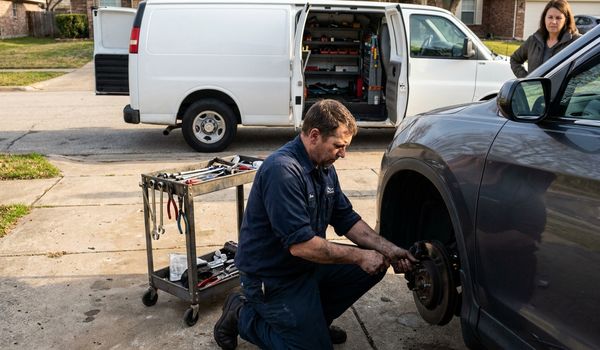
A mobile mechanic business is an auto repair operation that performs maintenance and repair work at the customer's location instead of a fixed shop. The mechanic operates out of a service van or truck fitted with tools, diagnostic equipment, air compressors, jacks, and often a small inventory of common parts. Services typically include brake jobs, battery replacement, alternator and starter swaps, oil changes, diagnostics, belt and hose work, suspension repairs, and pre-purchase inspections. Jobs that require a lift, heavy alignment racks, or transmission rebuilds usually still go to a traditional shop.
The model flips the economics of auto repair. Without a service bay lease, waiting room, or large front-office staff, a mobile operator carries far lower overhead than a brick-and-mortar shop. In exchange, the mechanic accepts constraints: one job at a time, travel between appointments, weather exposure, and a ceiling on the complexity of work that can be done curbside. The data in this report shows why hundreds of thousands of technicians and entrepreneurs are deciding that trade is worth it, and why the mobile mechanic industry has become one of the more accessible entry points into automotive business ownership.
The Mobile Mechanic Industry at a Glance
Before digging into individual data points, here is a snapshot of the key numbers defining the mobile mechanic business in 2026:
By the Numbers
Mobile Mechanic Business Statistics, 2026 Snapshot
$81.7B
Estimated U.S. auto repair and maintenance market in 2026, the parent industry for mobile mechanics
12.6 yrs
Average age of vehicles on U.S. roads, a record high that keeps repair demand elevated
285M+
Registered vehicles in the United States, the service base for the repair industry
$75-$150
Typical hourly labor rate range charged by mobile mechanics in 2026
$15K-$60K
Typical startup cost range for a mobile mechanic business, versus $250K+ for a traditional shop
60-70%
Share of common shop repairs that can be completed at the customer's location
Figures compiled from U.S. Census Bureau industry data, trade association reporting, and operator surveys. Ranges reflect variation by market, specialization, and business structure.
Mobile Mechanic Market Size and Growth Statistics
The mobile mechanic business sits inside the broader U.S. automotive repair and maintenance market, which industry estimates place at roughly $81.7 billion in 2026, up from about $78 billion in 2024. The sector has grown at an average rate of 2.5 to 3.5 percent annually over the past five years, and mobile service is widely considered the fastest-growing format within it. While no government agency tracks mobile mechanics as a separate industry code, operator surveys and franchise disclosures suggest mobile and on-demand repair formats are growing at roughly two to three times the rate of fixed-location shops, driven by convenience demand and low barriers to entry.
The structural foundation of the market is the vehicle fleet itself. The United States has more than 285 million registered vehicles, and the average vehicle on the road is now 12.6 years old, the oldest fleet average ever recorded. Older vehicles need more frequent repairs: industry data shows annual repair and maintenance spending rises sharply once a vehicle passes the six-year mark, and the sweet spot for independent repair spending is vehicles between six and fourteen years old. With new vehicle prices still elevated and owners holding cars longer, that sweet spot now covers a larger share of the fleet than at any point in the past two decades.
On the supply side, the industry remains highly fragmented. The U.S. has roughly 230,000 to 240,000 auto repair and maintenance establishments, the vast majority of them small independent businesses. Fragmentation matters for mobile operators because there is no dominant national brand locking up the market. A solo mobile mechanic competes primarily with local independents and dealership service departments, not with a national mobile chain. That competitive structure, combined with startup costs far below a fixed shop, explains why mobile mechanic business formation has accelerated since 2020 and shows no sign of slowing in 2026.
What Is Driving Demand for Mobile Mechanics
Several measurable trends are pushing customers toward on-site repair instead of the traditional drop-off model:
- Time scarcity. Surveys of vehicle owners consistently show that the biggest complaint about auto repair is not price but inconvenience: arranging rides, sitting in waiting rooms, and losing a car for a full day. Mobile service eliminates the logistics problem entirely, which is why customer satisfaction scores for on-site repair run well above the industry average.
- An aging fleet. With the average vehicle at 12.6 years old, breakdowns and wear-and-tear repairs are rising. Brake jobs, alternators, starters, and suspension work are exactly the mid-complexity jobs mobile mechanics handle best.
- Remote and hybrid work. Roughly a quarter of the U.S. workforce now works from home at least part of the week. A car sitting in a home driveway all day is the ideal candidate for mobile service, and booking data from mobile platforms shows weekday residential appointments have grown every year since 2020.
- Fleet and commercial demand. Delivery vans, contractor trucks, rideshare vehicles, and small commercial fleets lose money every hour they sit in a shop. On-site fleet maintenance has become a reliable contract revenue stream for mobile operators, often representing 30 to 50 percent of revenue for established businesses.
- Digital booking habits. Consumers now book everything from haircuts to home cleaning through apps. Auto repair was one of the last local services to move online, and mobile mechanics, with no front counter and no waiting room, adapted fastest.
Key Takeaway
Demand for mobile repair is not a fad riding on one trend. It is stacked on top of at least four independent, measurable shifts: an aging fleet, changing work patterns, digital booking habits, and commercial fleet economics. Demand drivers that diverse tend to persist.
Ready to Launch or Expand Your Mobile Mechanic Business?
Crestmont Capital finances service vehicles, tools, and diagnostic equipment for automotive businesses. Approvals in as fast as 24 hours.
Apply Now - It Takes 2 MinutesRevenue and Earnings Statistics for Mobile Mechanics
Revenue potential is the statistic most prospective owners care about, and the range is wide because the business scales with hours worked, service mix, and local pricing. Here is what the data shows for 2026:
Solo operators. A full-time solo mobile mechanic typically completes three to six jobs per day, with an average ticket between $150 and $450 depending on service mix. At four jobs per day averaging $250, working five days a week, gross revenue lands around $250,000 per year. More conservative schedules produce $120,000 to $180,000. Because labor is the primary input, gross margins on labor-only work routinely exceed 80 percent before vehicle and overhead costs.
Hourly rates. Mobile mechanic labor rates in 2026 generally run $75 to $150 per hour, with metro markets like Los Angeles, Seattle, Miami, and the New York suburbs at the top of the range. Many operators have moved away from quoting hourly rates entirely, instead using flat-rate menu pricing for common jobs, which customers prefer for its certainty and which rewards efficient mechanics with effective rates above $150 per hour.
Owner earnings. After fuel, insurance, parts markup swings, software, payment processing, and vehicle costs, a well-run solo operation typically nets the owner $70,000 to $120,000 per year. Operators who add fleet contracts, hire a second technician, or specialize in higher-ticket work such as European vehicles or diesel pickups report net incomes above $150,000. Compared with employed technician pay, which averages in the mid-$50,000s nationally, ownership roughly doubles earnings for a competent, fully booked mechanic.
Parts markup. Mobile mechanics typically mark up parts 25 to 50 percent over wholesale cost, adding $30 to $80 of margin to an average job. Some operators let customers supply their own parts to close hesitant buyers, but most treat parts margin as a core revenue line and decline customer-supplied parts for liability and warranty reasons.
Startup and Operating Cost Statistics
The single most-cited advantage of the mobile model is the cost of entry. Where opening a traditional two-bay repair shop typically requires $250,000 or more once you count the lease deposit, lifts, air systems, signage, and initial inventory, a mobile mechanic business can launch for a fraction of that:
- Service vehicle: $8,000 to $45,000. A reliable used cargo van or pickup sits at the low end; a new or late-model van with professional upfitting sits at the high end.
- Tools and equipment: $5,000 to $15,000 for a professional starter set, including jacks, stands, impact tools, hand tools, a compressor, and fluid handling equipment. Technicians leaving a shop job often already own much of this.
- Diagnostics: $1,500 to $6,000 for a professional-grade scan tool with broad make coverage, plus annual software subscriptions of $500 to $1,500.
- Licensing, insurance, and setup: $2,000 to $6,000 for business registration, liability insurance, garage keeper or bailee coverage where required, and a commercial auto policy.
- Marketing and software: $1,000 to $5,000 for a website, booking software, local search setup, and initial advertising.
All-in, most operators launch for $15,000 to $60,000, with the vehicle decision accounting for most of the spread. Operating costs are correspondingly lean: no rent, minimal utilities, and no front-desk payroll. Typical monthly operating expense for a solo operator runs $1,500 to $3,500, dominated by fuel, insurance, software subscriptions, and marketing. That lean cost structure is why mobile mechanic businesses commonly reach break-even within six to twelve months, far faster than fixed shops, and why the failure rate in the first two years runs well below the small business average.
Financing Note
The vehicle and tool package is the one startup cost most new owners cannot pay from savings. Because these are tangible business assets, they are exactly the kind of purchase equipment financing is designed for, often with the vehicle itself serving as collateral.
Mobile Mechanic vs. Traditional Repair Shop: The Numbers
The following comparison summarizes how the two models stack up on the metrics that matter most to a prospective owner:
| Metric | Mobile Mechanic | Traditional Shop |
|---|---|---|
| Typical startup cost | $15,000 - $60,000 | $250,000+ |
| Monthly overhead | $1,500 - $3,500 | $15,000 - $40,000 |
| Break-even timeline | 6 - 12 months | 2 - 4 years |
| Gross margin on labor | 80%+ | 50 - 65% |
| Jobs per day (per tech) | 3 - 6 | 6 - 10 |
| Share of repairs serviceable | 60 - 70% of common jobs | Nearly 100% |
| Customer convenience | Highest (on-site) | Drop-off required |
The pattern in the data is consistent: the mobile model trades job throughput for margin and cost structure. A shop can push more cars through per day, but it pays heavily for the privilege in rent, staffing, and equipment. A mobile operator completes fewer jobs but keeps far more of every dollar. For a first-time owner without outside capital, the mobile model is statistically the lower-risk entry point into the same $80 billion industry.
Customer Behavior and Booking Trends
Understanding who books mobile repair, and how, separates well-marketed operators from struggling ones. The 2026 customer data shows a clear profile:
Who books. The core mobile mechanic customer is a 30-to-55-year-old vehicle owner with a household income above the local median, a car between six and twelve years old, and limited free time. Two segments punch above their weight: parents with young children, for whom a shop visit with kids in tow is genuinely difficult, and remote workers whose vehicles sit at home all day. A third high-value segment is small fleet managers responsible for two to twenty vehicles.
How they book. More than 70 percent of mobile repair customers now initiate contact online, primarily through Google search and Google Business Profile listings. The phrase patterns are telling: searches containing "near me" and "at my home" have grown every year for a decade. Online booking with instant or same-day quoting converts at two to three times the rate of phone-only operators, which is why booking software has become a standard operating cost rather than a luxury.
What they book. The ten most requested mobile services in 2026 are battery replacement, brake pads and rotors, oil and filter changes, starter replacement, alternator replacement, diagnostic inspections, pre-purchase inspections, spark plug service, serpentine belt replacement, and tire rotation. Notice what is absent: every job on that list is a one-to-three-hour task requiring no lift. Operators who build their marketing around this top-ten list match their offer to actual demand instead of leading with services mobile customers rarely request.
What they pay. The average mobile repair ticket in 2026 runs $225 to $350 nationally, roughly in line with independent shop pricing once the shop's shop-supply and disposal fees are included. Customers consistently report in surveys that they would pay a 10 to 15 percent premium for on-site service, yet mobile pricing rarely needs to test that ceiling because the operator's cost structure already supports competitive rates.
Technology Trends Reshaping the Mobile Mechanic Industry
Technology is doing two things at once for this industry: making vehicles harder to repair, and making small operators easier to run. Both forces show up clearly in the 2026 data.
Diagnostic capability has democratized. A decade ago, meaningful diagnostics required shop-grade equipment costing five figures. Today, a $2,000 to $5,000 professional scan tool covers the majority of makes, and cloud-based service information subscriptions put factory repair procedures on a tablet. This is the single biggest enabler of the mobile model: the diagnostic work that once anchored customers to a shop now travels in the van.
Vehicle complexity is rising. Advanced driver assistance systems, hybrid drivetrains, and over-the-air software locks are pushing some repairs back toward dealerships. Industry surveys show independent shops now turn away a measurable share of late-model work involving ADAS calibration. Mobile mechanics feel this at the margin, but the core mobile job list, brakes, batteries, starters, alternators, suspension, fluids, remains squarely serviceable on-site. The data suggests the practical mobile service menu will hold near its current 60 to 70 percent of common repairs through the decade.
Business software is the quiet force multiplier. Solo operators now run scheduling, quoting, invoicing, payment processing, parts ordering, and customer follow-up from a phone. Operators using integrated shop-management apps report meaningfully higher revenue per working day than paper-and-phone operators, primarily through faster quoting, higher booking conversion, and automated review requests that compound local search rankings.
Electric vehicles are a tailwind, not a threat, for now. EVs still represent a single-digit share of the U.S. fleet, and their maintenance profile, tires, suspension, brakes (which last longer but still wear), 12-volt batteries, and cabin filters, is mostly mobile-friendly. Mobile operators who complete EV certification training report little current revenue impact but expect differentiation to matter by the end of the decade.
Upgrade Your Service Van or Diagnostic Equipment
Crestmont Capital offers fast equipment financing built for automotive businesses. Keep your cash reserve intact and let the equipment pay for itself.
Explore Equipment FinancingChallenges and Barriers in the Mobile Mechanic Business
The statistics above explain why the model attracts new entrants. These numbers explain why some operators fail. Honest treatment of the challenges is part of any complete statistical picture:
- Capacity ceiling. A solo mobile mechanic physically completes three to six jobs per day, and travel time between appointments caps utilization. Revenue growth beyond roughly $250,000 per year almost always requires hiring, and hiring reliable technicians is the industry's number one operational complaint.
- Weather exposure. Rain, snow, and extreme heat cancel or degrade on-site work. Operators in northern climates report 5 to 15 lost or compromised working days per year, and plan their service mix, such as pre-purchase inspections at dealerships or under covered parking, around it.
- Job scope limits. Transmission rebuilds, engine swaps, alignments, and anything requiring a lift must be declined or referred. Operators estimate they turn away 20 to 30 percent of inbound requests, which is why referral relationships with fixed shops matter.
- Zoning and permitting. Some municipalities restrict automotive work in residential driveways or street parking. Compliance research is a genuine pre-launch task, and a small share of operators report being forced to adjust their service area after local enforcement contact.
- Physical toll. Working curbside without a lift is harder on the body than shop work. Burnout and injury risk are real retention issues in operator surveys, and they feed directly into the hiring ceiling described above.
None of these barriers overturns the model's economics. They do define its shape: the businesses that succeed are the ones that plan for weather, build referral channels for out-of-scope work, verify local rules before launch, and treat hiring as a deliberate second-stage decision rather than an improvised one.
Financing a Mobile Mechanic Business
Because startup costs concentrate in two tangible assets, the service vehicle and the tool package, mobile mechanic businesses are unusually well suited to asset-based financing. The financed van and equipment serve as their own collateral, which keeps approval requirements accessible even for first-time business owners. Here is how the financing landscape breaks down in 2026:
Equipment financing covers the van, upfitting, lift alternatives such as heavy-duty jacks, diagnostic tools, and tool storage systems. Terms typically run 24 to 72 months with the equipment securing the loan, and approvals can come through in as little as one business day. Crestmont Capital's equipment financing programs are built for exactly this kind of purchase, including used vehicles and tools bought from private sellers.
Working capital covers what equipment financing does not: initial marketing, insurance deposits, software subscriptions, parts inventory, and the cash buffer that carries a new business to break-even. An unsecured working capital loan or a business line of credit gives a new operator that runway without tying up the assets needed to do the work.
Vehicle-specific programs matter because the service vehicle is both transportation and the shop floor. Operators expanding from a pickup-and-trailer setup to a dedicated service van, or adding a second vehicle for a hired technician, often use business vehicle financing to keep personal and business assets cleanly separated.
Operators who want the full picture of borrowing options for this specific business model should review our companion guide on mobile mechanic business loans, and shop owners weighing the fixed-location route can compare against the numbers in our auto repair shop financing guide.
Planning Tip
Finance the depreciating, revenue-producing assets (the van and tools) and preserve cash for marketing and operating runway. New operators who do the opposite, paying cash for the van and going to market broke, are the ones who stall in the first six months.
Real-World Scenarios: How the Numbers Play Out
Statistics become decisions when you apply them. Here are four representative scenarios drawn from the data patterns above:
Scenario 1: The shop technician going independent. A dealership technician in Dallas leaves a $62,000 job, buys a $14,000 used cargo van, and spends $6,000 completing his tool set. Total launch cost: about $24,000, financed over 48 months at roughly $600 per month. He books three jobs per day at a $260 average ticket within four months, grossing about $165,000 in year one and netting roughly $85,000 after all costs. His income rises about 37 percent while his hours drop.
Scenario 2: The side-hustle validator. A mechanic in Columbus keeps his shop job and works Saturdays and two weekday evenings, completing five to seven jobs per week. Annual gross of roughly $55,000 on a $9,000 startup spend, mostly tools he already owned plus a used pickup. The part-time data validates full-time demand in his zip codes before he commits, and his launch risk drops to nearly zero.
Scenario 3: The fleet contract pivot. A two-year-old solo operation in Atlanta signs a contract to maintain a 14-vehicle courier fleet at $95 per vehicle per month plus repair work. The contract adds about $16,000 in base annual revenue and roughly $25,000 in repair tickets, and, critically, fills weekday schedule gaps. Fleet work rises to 40 percent of revenue and smooths the seasonal dips that consumer-only operators report.
Scenario 4: The second-van expansion. An established Phoenix operator grossing $230,000 solo finances a second upfitted van at $38,000 and hires a technician at $58,000 plus commission. The second unit adds about $140,000 in year-one revenue against roughly $80,000 in combined payroll and vehicle costs. The operator's net rises, but so does complexity: scheduling, quality control, and parts logistics become daily management work rather than occasional annoyances.
Next Steps for Aspiring Mobile Mechanics
Validate your local demand. Count the mobile mechanics already ranking in your zip codes, read their reviews, and note their booked-out lead times. Fully booked competitors are proof of demand, not a reason to stay out.
Verify zoning and licensing. Confirm your municipality allows on-site automotive work, register the business, and price liability and commercial auto insurance before spending on anything else.
Build your startup budget from the cost data above. Vehicle, tools, diagnostics, insurance, software, and marketing, in that order of size. Identify which line items you will finance and which you will pay from savings.
Set up booking and payments before launch. Online booking, instant quoting, and card-on-file payment are the difference between the conversion rates in the customer data section and the rates phone-only operators settle for.
Secure financing early. An approval in hand before you shop for the van keeps you from overpaying or losing a good vehicle to a faster buyer. A two-minute application is enough to know your number.
Get Your Mobile Mechanic Business Funded Today
Join the thousands of automotive business owners who launched with Crestmont Capital. Fast approvals, flexible terms, no hidden fees.
Get Funded in 24 HoursFrequently Asked Questions
How big is the mobile mechanic industry in 2026? +
Mobile mechanics operate within the roughly $81.7 billion U.S. auto repair and maintenance market. No agency tracks mobile operators as a separate industry code, but franchise disclosures and operator surveys indicate on-site repair formats are growing at two to three times the rate of fixed shops, making mobile the fastest-growing service format in the industry.
How much does it cost to start a mobile mechanic business? +
Most operators launch for $15,000 to $60,000. The vehicle is the biggest variable, running from about $8,000 for a reliable used van to $45,000 for a new professionally upfitted one. Tools add $5,000 to $15,000, diagnostics $1,500 to $6,000, and licensing, insurance, and marketing another $3,000 to $11,000. Compare that with $250,000 or more to open a traditional two-bay shop.
How much do mobile mechanics make per year? +
A fully booked solo operator typically grosses $120,000 to $250,000 per year and nets $70,000 to $120,000 after vehicle costs, insurance, fuel, software, and parts swings. Operators with fleet contracts, a second technician, or a high-ticket specialization report net incomes above $150,000. By comparison, employed automotive technicians average in the mid-$50,000s nationally.
What do mobile mechanics charge per hour? +
Posted labor rates generally run $75 to $150 per hour, with major metro markets at the top of the range. Many operators have shifted to flat-rate menu pricing for common jobs, which customers prefer for its certainty and which rewards efficient mechanics with effective hourly rates above $150.
What repairs can a mobile mechanic actually do? +
Industry estimates put 60 to 70 percent of common shop repairs within mobile reach: brakes, batteries, starters, alternators, oil service, belts, hoses, spark plugs, suspension components, diagnostics, and pre-purchase inspections. Jobs requiring a lift or specialized shop equipment, such as transmission rebuilds, engine swaps, and alignments, stay with fixed shops.
Is the mobile mechanic business growing? +
Yes. The parent auto repair industry grows 2.5 to 3.5 percent annually, and mobile formats are outpacing it by a factor of two to three. The growth rests on durable drivers: a record 12.6-year average vehicle age, persistent high new-car prices keeping owners in older vehicles longer, remote work patterns, and consumer preference for app-booked on-site service.
How long does it take a mobile mechanic business to break even? +
With monthly operating costs of $1,500 to $3,500 and average tickets of $225 to $350, most solo operators cover costs within six to twelve months of launch. Operators who start part-time while keeping a shop job often reach break-even almost immediately because their fixed costs stay near zero.
Do mobile mechanics make more than shop mechanics? +
Owner-operators who stay booked typically double employed technician pay, netting $70,000 to $120,000 versus the mid-$50,000s employment average. The trade is income volatility: a shop paycheck is guaranteed, while mobile income depends on booking flow, weather, and local competition. The data favors ownership for mechanics who can market themselves.
What are the biggest challenges mobile mechanics face? +
Operator surveys point to five recurring issues: the solo capacity ceiling of three to six jobs per day, weather-related lost days (5 to 15 per year in northern climates), turning away 20 to 30 percent of requests that need a lift, municipal zoning restrictions on residential repair work, and the physical toll of curbside work without a lift.
Can you finance a mobile mechanic van and tools? +
Yes, and the asset-heavy startup cost structure makes this business a natural fit for equipment financing. The van, upfitting, and tool package serve as their own collateral, terms commonly run 24 to 72 months, and approvals can arrive in as little as one business day. Working capital loans and lines of credit cover the non-equipment costs like marketing, insurance, and parts inventory.
What services do mobile customers request most? +
The top ten requested mobile services in 2026 are battery replacement, brake pads and rotors, oil and filter changes, starter replacement, alternator replacement, diagnostic inspections, pre-purchase inspections, spark plug service, serpentine belt replacement, and tire rotation. Every job on that list is a one-to-three-hour task requiring no lift, which is exactly why the mobile model works.
Who is the typical mobile mechanic customer? +
The core customer is a 30-to-55-year-old vehicle owner with above-median household income, a six-to-twelve-year-old vehicle, and limited free time. Parents with young children and remote workers over-index heavily, and small fleet managers with two to twenty vehicles represent the highest-value recurring segment. More than 70 percent of customers now initiate contact online.
Will electric vehicles hurt the mobile mechanic business? +
Not in the current decade's data. EVs remain a single-digit share of the U.S. fleet, and their maintenance needs, tires, suspension, brakes, 12-volt batteries, and filters, are largely mobile-friendly. Rising ADAS complexity pushes some late-model work toward dealerships, but the core mobile job list is expected to stay serviceable on-site through the decade.
How many jobs can a mobile mechanic do in a day? +
Three to six jobs per day is the realistic range, with travel time between appointments the main constraint. At an average ticket of $150 to $450, that daily capacity translates directly into the $120,000 to $250,000 annual gross revenue range for solo operators. Tight route clustering and next-day scheduling are the two levers that push operators toward the top of the range.
Do I need special licenses or permits to run a mobile mechanic business? +
Requirements vary by state and municipality. At minimum you need a standard business license, liability insurance, and a commercial auto policy. Some states require automotive repair dealer registration, and some cities restrict automotive work in residential driveways or on public streets. Verifying local rules before launch is a genuine startup task, and a small share of operators report having to adjust their service area after enforcement contact.
The Bottom Line on Mobile Mechanic Business Statistics
The 2026 data tells a consistent story. The mobile mechanic business model pairs the lowest entry cost in the repair industry, $15,000 to $60,000 against a quarter million for a fixed shop, with gross margins above 80 percent on labor, break-even timelines under a year, and owner earnings that roughly double employed technician pay. Demand rests on four independent, measurable trends rather than one fragile fad, and the $81.7 billion parent industry continues to grow on the back of the oldest vehicle fleet in American history.
The model's constraints are equally clear in the numbers: a daily capacity ceiling, weather exposure, and a service menu covering 60 to 70 percent of common repairs. Operators who plan around those constraints, finance their vehicle and tools deliberately instead of draining savings, and build fleet contracts alongside consumer bookings are the ones compounding in this industry. If you are ready to run your own numbers, start with our guide to financing options for mobile mechanic businesses, or go straight to a two-minute application and see exactly what your startup package would cost per month.
Sources and further reading: U.S. Census Bureau Economic Census, SBA Business Guide, and Forbes Advisor Small Business. Industry figures compiled from Census data, trade association reporting, and operator surveys; ranges reflect variation by market and business structure.
Disclaimer: The information provided in this article is for general educational purposes only and is not financial, legal, or tax advice. Funding terms, qualifications, and product availability may vary and are subject to change without notice. Crestmont Capital does not guarantee approval, rates, or specific outcomes. For personalized information about your business funding options, contact our team directly.

Allan Garfinkle
Allan Garfinkle is the Chief Revenue Officer at Crestmont Capital, where he has spent more than a decade leading revenue strategy, business development, and operational growth. With 28 years of experience building and advising startups and small businesses, Allan has helped more than 10,000 business owners navigate financing decisions, growth opportunities, and changing economic conditions. He earned a Bachelor of Science in Economics and an MBA with a concentration in Finance from Northeastern University, as well as a Juris Doctor from New England Law, where his studies focused on contracts and business law. His writing draws on extensive practical experience in small-business lending, equipment financing, business credit, and commercial finance.