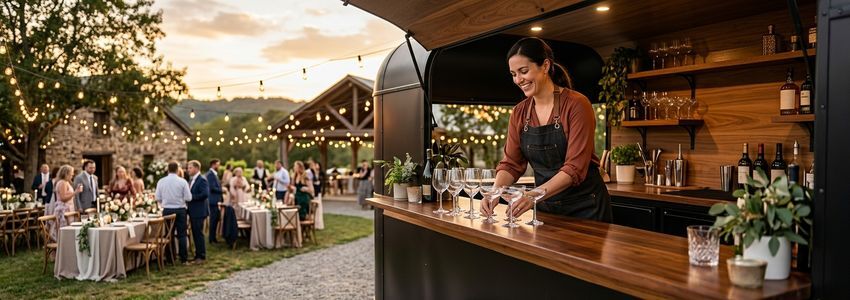
Weddings, corporate parties, and private events increasingly want a bar experience that comes to them, and a well-built mobile bar trailer is the single biggest asset standing between an entrepreneur and that business. Mobile bar trailer financing gives event and catering business owners a way to purchase a new or custom-built bar trailer, complete with refrigeration, tap systems, and branded finishes, without paying tens of thousands of dollars in cash upfront. Instead of draining savings or maxing out a credit card, financing spreads the cost of the trailer into a predictable monthly payment that can be covered by a handful of booked events.
In This Article
What Is Mobile Bar Trailer Financing?
Mobile bar trailer financing is a funding arrangement that lets a business owner purchase a mobile bar trailer, whether a ready-to-use unit, a professionally built custom trailer, or a converted horse or cargo trailer, while spreading the cost over a fixed monthly payment schedule instead of paying the full price in a lump sum.
Prices for mobile bar trailers vary enormously depending on size and finish level. A basic ready-to-use trailer with a bar counter and fridge can run $6,000 to $18,000, while a mid-tier custom build with multi-tap systems, premium finishes, and branded exteriors typically lands between $75,000 and $130,000. High-end signature builds with generators, advanced audiovisual systems, and heavy custom fabrication can push past $150,000. Very few new operators can pay that out of pocket without financing, which is why equipment financing has become the standard path into this business.
Because the trailer itself typically serves as collateral, mobile bar trailer financing is usually easier to qualify for and comes with more competitive terms than an unsecured personal loan of the same size. The lender has a tangible, resellable asset backing the transaction, which reduces their risk and often speeds up approval.
Key Stat: According to U.S. Census Bureau Statistics of U.S. Businesses data, there were roughly 39,100 licensed drinking-place establishments operating in the United States as of the most recent count, and mobile and event-based beverage service has become one of the fastest-growing segments feeding that broader hospitality market.
The U.S. Small Business Administration consistently identifies access to affordable startup capital as one of the top barriers facing new small business owners, and event-services entrepreneurs are no exception. Equipment-specific financing exists precisely to solve that problem: rather than requiring a broad general business loan with a lengthy underwriting process, mobile bar trailer financing targets one clearly defined purchase and moves considerably faster.
Key Benefits of Financing a Mobile Bar Trailer
- Launch or expand without draining savings. Keep cash on hand for licensing, insurance, inventory, and marketing instead of tying it all up in a single trailer purchase.
- Start generating revenue immediately. A financed trailer can be booking events and generating income the same month payments begin, rather than waiting years to save up the full purchase price.
- Predictable monthly payments. Fixed payments make it easy to budget against a known number of booked events per month.
- Preserve credit for other needs. Financing the trailer through an equipment lender, rather than a personal credit card, keeps revolving credit available for day-to-day operating expenses.
- Upgrade path built in. Many lenders offer repeat financing once the first trailer is paid down or performing well, making it easier to add a second unit as the business grows.
- Custom builds become accessible. Financing opens the door to a fully custom, branded trailer that would otherwise be out of reach for a new operator, which can be a meaningful competitive advantage in a crowded local market.
Ready to Launch Your Mobile Bar Business?
Get fast, flexible financing from the #1 business lender in the U.S. No obligation, apply in minutes.
Apply Now →How Mobile Bar Trailer Financing Works
The process is more straightforward than most first-time operators expect, especially compared to a traditional bank term loan.
- Choose your trailer and get a quote. Decide between a ready-to-use unit, a builder's stock model, or a fully custom build, and get an itemized quote from the manufacturer or builder. Many lenders finance both new and used trailers.
- Submit an application. Most equipment lenders require basic business financials, a few months of bank statements, recent tax returns if the business has them, and the trailer quote or invoice. Many transactions under $150,000 qualify for limited documentation.
- Underwriting review. The lender evaluates time in business, personal and business credit, and revenue history if the business is established. Because the trailer serves as collateral, approval is generally faster than unsecured financing.
- Approval and terms. You receive the approved amount, term length (commonly 24 to 60 months for a bar trailer), and payment structure. Some lenders offer seasonal payment structures for event businesses with uneven booking volume throughout the year.
- Documentation and funding. Once you sign the financing agreement, funds are typically disbursed directly to the trailer builder or dealer, often within a few business days.
- Delivery and buildout. The trailer is built, inspected, and delivered. Payments begin per the agreed schedule, usually 30 to 45 days after funding.
Quick Guide
How Mobile Bar Trailer Financing Works
Select a ready-to-use, stock, or custom trailer and get an itemized price.
Bank statements, tax returns if available, and the builder's quote are usually sufficient.
Review term length, payment structure, and total cost before signing.
Funds go to the builder, the trailer is delivered, and payments begin on schedule.
Types of Mobile Bar Trailer Financing
Not every operator needs the same structure. Here are the most common ways mobile bar businesses fund a trailer purchase.
Equipment Financing (Loan Structure)
You borrow the full purchase price and make fixed payments over a set term, typically 24 to 60 months. At the end of the term your business owns the trailer outright, often for as little as $1 in a "dollar buyout" structure. This tends to be the best fit for operators who plan to run the same trailer for years and want to build equity in the asset.
Equipment Leasing
A lease can offer lower monthly payments than a loan of the same amount because you're paying for use of the trailer during the lease term rather than its full purchase price. At the end of the lease you can typically return it, buy it at fair market value, or renew. This can make sense for operators who anticipate wanting a redesigned or upgraded trailer within a few years.
Used or Refurbished Trailer Financing
Converting or buying a used trailer, such as a repurposed horse or cargo trailer, is a lower-cost entry point, and many lenders will finance used equipment as long as it has a reasonable remaining useful life and a clear valuation from the seller.
Sale-Leaseback or Refinance
If you already purchased a trailer with cash or a high-interest source within the past several months, some lenders will refinance that purchase, freeing up the capital you originally spent and replacing it with a structured monthly payment.
Working Capital Loan or Line of Credit
Some operators prefer a working capital loan or business line of credit instead of equipment-specific financing, especially when they want flexibility to cover the trailer purchase alongside licensing, insurance, and initial inventory in a single approval.

Why Mobile Bar Trailers Are a Growing Segment of the Events Industry
Event planners and venues have increasingly embraced mobile and pop-up bar service as a way to differentiate weddings, corporate events, and private parties from a standard fixed-bar setup. A well-branded trailer with a distinct look, whether a converted vintage camper or a sleek modern build, gives clients a visually memorable focal point that photographs well and creates a talking point among guests.
Coverage from Forbes Advisor on small business equipment financing has noted that equipment loans secured by the asset itself, whether a food truck, a bar trailer, or specialized event equipment, often come with more competitive rates than unsecured financing because the collateral reduces lender risk. That dynamic has made trailer-based businesses an increasingly financeable niche as lenders have grown more comfortable with the asset class.
For operators specifically, the appeal goes beyond aesthetics. A dedicated trailer means no dependence on a venue's existing bar infrastructure, no negotiating with a facility over corkage or staffing, and the ability to book multiple events across a season without being tied to a single location. That flexibility is a large part of why mobile bar businesses have grown alongside the broader boom in experiential, non-traditional event venues.
Who Mobile Bar Trailer Financing Is Best For
Financing a bar trailer makes the most sense for specific situations. Consider this option if you fall into one of these categories:
- New mobile bar entrepreneurs who have secured a liquor license or partnership with a licensed caterer and need the trailer to start booking events.
- Established caterers or event planners adding a bar service line to an existing business to capture more revenue per event.
- Operators upgrading from a converted DIY trailer to a professionally built unit with better refrigeration, plumbing, and branding.
- Multi-trailer operators adding a second or third unit to handle more simultaneous bookings during peak wedding and event season.
- Operators with strong event bookings but limited cash reserves, where a large one-time trailer purchase would strain working capital.
It is generally a tougher fit for someone with no event industry experience, no licensing plan, and no bookings lined up, since lenders want to see a credible path to revenue even when the trailer itself serves as collateral.
Pro Tip: Confirm your state and local alcohol licensing requirements before ordering a trailer. Some jurisdictions require the bar trailer itself to meet specific plumbing, refrigeration, or hand-washing station standards to qualify for a mobile liquor license, and building to those specs from the start avoids costly retrofits later.
Financing vs. Leasing vs. Cash vs. Other Options
| Option | Best For | Ownership | Typical Term |
|---|---|---|---|
| Equipment Financing (Loan) | Long-term use, wanting ownership | Owns trailer at term end | 24-60 months |
| Equipment Leasing | Wanting a redesign or upgrade later | Return, buy, or renew at term end | 24-48 months |
| Used Trailer Financing | Lower-cost entry into the business | Owns trailer at term end | 12-48 months |
| Working Capital Loan | Bundling trailer with licensing and inventory | Immediate ownership | 6-24 months |
| Cash Purchase | Operators with large cash reserves | Immediate ownership | N/A |
By the Numbers
Mobile Bar Trailer Financing — Key Numbers
$6K-$18K
Cost range for a ready-to-use starter trailer
$75K-$130K
Typical mid-tier custom build price
39.1K
Licensed U.S. drinking-place establishments (Census)
24-60 Mo.
Typical financing term for a bar trailer
Cost Breakdown and Return on Investment
Understanding the real cost of financing versus realistic booking revenue helps put the decision in perspective. Below is a simplified way to think through the math for a mid-tier custom trailer.
| Cost Factor | Typical Range |
|---|---|
| Ready-to-use starter trailer | $6,000 - $18,000 |
| Converted used horse or cargo trailer | $10,000 - $30,000 |
| Entry-level new custom build | $40,000 - $70,000 |
| Mid-tier custom build with multi-tap system | $75,000 - $130,000 |
| Estimated monthly payment (48-month term) | Roughly 2.3% of financed amount per month |
These figures are general ranges, not quotes, and actual pricing depends on the builder, trailer size, tap and refrigeration system, and whether you're financing new or used equipment. The point of the comparison is directional: for a mid-tier trailer financed over 48 months, a single well-priced weekend wedding booking can often cover a meaningful share of the monthly payment, and most operators book multiple events per month during peak season.
Operators should also budget for ongoing costs beyond the financed trailer itself, including liability insurance, a towing vehicle or hitch setup, liquor licensing fees, and initial inventory. Building these into your overall budget from day one, rather than treating the trailer as the only expense, sets more realistic expectations for when the business turns cash-flow positive.
How Crestmont Capital Helps
Crestmont Capital works with mobile bar, catering, and event-services businesses across the country to structure financing around the exact trailer they need, whether that's a starter unit or a fully custom, branded build. Our equipment financing programs are designed for entrepreneurs who need predictable payments and fast turnaround rather than a drawn-out bank underwriting process.
We also offer equipment leasing for operators who prefer lower monthly payments or plan to redesign their trailer again within a few years. If you're also considering a food truck alongside your bar trailer to round out event offerings, our food truck financing programs follow a similar structure.
For operators who want a broader look at building a mobile bar business beyond the trailer purchase itself, including licensing, staffing, and marketing, our complete guide to mobile bar business loans covers financing for growing the business as a whole.
See What Financing You Qualify For
Fast approvals, flexible terms, and a straightforward application built for busy event entrepreneurs.
Get Started →Real-World Scenarios
Scenario 1: The First-Time Operator Launching a Wedding Bar Business
Sarah had bartending experience and a growing list of wedding referrals but no capital to buy equipment. She financed a $52,000 mid-tier custom trailer over 48 months, and two booked weddings per month during her first peak season covered the full payment with room to spare.
Scenario 2: A Caterer Adding a Bar Service Line
An established catering company wanted to stop subcontracting bar service to a third-party vendor and keep that revenue in-house. They financed a $68,000 trailer with a multi-tap system, immediately increasing their average per-event revenue by adding bar service to every catering package.
Scenario 3: Upgrading From a DIY Conversion
An operator who started with a $14,000 converted horse trailer had outgrown it after two successful seasons. She financed a $95,000 professionally built replacement with better refrigeration and a branded exterior, using her existing bookings history to secure favorable terms.
Scenario 4: Adding a Second Trailer for Peak Season
A mobile bar business turning down bookings during peak wedding season financed a second $58,000 trailer to run two events simultaneously on busy weekends, roughly doubling their peak-season booking capacity without hiring a second full crew from scratch.
Common Mistakes to Avoid
A few recurring mistakes show up when operators finance a mobile bar trailer for the first time. Avoiding them can save real money over the life of the agreement.
- Underestimating build time. Custom trailer builds can take 8 to 16 weeks or longer. Financing approval can move quickly, but don't assume the trailer will be booking events the same month you sign.
- Skipping the licensing research before ordering. Confirm your state's mobile liquor licensing requirements before finalizing the trailer's plumbing and refrigeration specs, since retrofitting after delivery is expensive.
- Choosing the longest available term by default. A longer term lowers the monthly payment but increases total interest paid over the life of the agreement. Match the term to how long you realistically expect to run the trailer before upgrading.
- Underbudgeting for insurance and towing. Liability insurance, a proper towing vehicle or hitch setup, and generator fuel are ongoing costs beyond the financed trailer payment itself.
- Not confirming end-of-term terms upfront. Whether it's a $1 buyout, fair market value purchase option, or lease renewal, know exactly what happens at the end of the term before you sign.
Frequently Asked Questions
What is mobile bar trailer financing?
It is a financing arrangement that lets a business owner purchase a new, custom, or used mobile bar trailer with fixed monthly payments instead of a large upfront cash outlay.
How much does a mobile bar trailer typically cost?
Costs range widely. A ready-to-use starter trailer can run $6,000 to $18,000, while a mid-tier custom build with a multi-tap system typically costs $75,000 to $130,000, and signature builds can exceed $150,000.
Can I finance a used or converted trailer?
Many lenders finance used or converted trailers, such as repurposed horse or cargo trailers, provided the unit has a reasonable remaining useful life and a clear valuation from the seller.
What credit score do I need to qualify?
Requirements vary by lender and deal size, but many equipment financing programs consider applicants with fair to good personal credit, especially when the trailer itself serves as collateral.
How long does approval and funding take?
Many equipment financing applications under $150,000 can be approved within one to three business days, with funding to the trailer builder following shortly after documentation is signed.
What's the difference between financing and leasing a bar trailer?
Financing (a loan) results in ownership at the end of the term, often for a nominal buyout. Leasing typically offers lower monthly payments and flexibility to return, renew, or purchase the trailer at fair market value when the term ends.
Do I need a liquor license before I can get financing?
Licensing is not always a prerequisite for financing approval, but lenders generally want to see a credible plan for how the trailer will generate revenue, which typically includes a licensing timeline or a partnership with an already-licensed caterer or venue.
Can a brand-new business get mobile bar trailer financing?
It is possible, though startups with no revenue history typically face more scrutiny and may need a stronger personal credit profile. Some lenders specialize in startup-friendly equipment financing for event-service businesses.
Is a down payment required?
Many equipment financing programs offer zero or low down payment options for established operators with strong credit. Newer businesses or larger custom builds may require a modest down payment.
What documents do I need to apply?
Typically a few months of business or personal bank statements, tax returns if the business has them, and the builder's itemized quote or invoice. Some smaller transactions qualify for reduced documentation.
Can I refinance a trailer I already purchased with cash?
Yes, this is often called a sale-leaseback or equipment refinance. If the purchase happened relatively recently, some lenders will structure financing against the trailer's value and return the original purchase cash to your business.
Does the size and finish level of the trailer affect financing terms?
Yes. Higher-value, higher-resale custom builds may qualify for longer terms and better rates than lower-value starter units, since the collateral value supports more favorable underwriting.
What happens if my bookings are seasonal?
Some equipment lenders offer seasonal or step-up payment structures that align higher payments with your busiest booking months, rather than a flat payment every month regardless of event volume.
Will financing a trailer affect my ability to get other business loans?
It can affect overall debt capacity, but because equipment financing is secured by the trailer itself, many lenders view it more favorably than unsecured debt when evaluating a business for additional financing, such as a working capital loan.
Where can I apply for mobile bar trailer financing?
You can apply directly through Crestmont Capital's online application. Approval decisions for most equipment financing requests are typically returned within one to two business days.
Turn Your Bar Trailer Idea Into a Booked Business
Apply today and find out how quickly your business can get on the road.
Apply Now →Next Steps
Get an itemized quote from your preferred trailer builder or dealer for the exact unit you need.
Gather a few months of bank statements and recent tax returns if your business has them.
Apply online and review your approved terms, term length, and payment schedule.
Sign the agreement and coordinate delivery with your builder once funding is complete.
How to Get an Accurate Builder Quote Before Applying
Financing works best when it's based on a firm, itemized builder quote rather than a rough estimate. Before applying, ask your trailer builder to break the quote into distinct line items: the base trailer or chassis, refrigeration and tap systems, plumbing and water storage, generator or shore-power setup, and exterior branding or wraps. This level of detail does two things. First, it lets you compare builders on an apples-to-apples basis, since one builder's "all-in" number might bundle branding while another charges separately. Second, it gives your lender a clear picture of exactly what is being financed, which generally speeds up underwriting since there is less back-and-forth clarifying what the funds will be used for.
If you're weighing multiple builders, it's also worth asking each one directly about typical build timelines and warranty coverage on refrigeration and plumbing components. A builder with a strong track record and responsive customer service is often a better long-term value than a slightly cheaper option with a thin support history, even if the sticker price looks more attractive on paper.
Conclusion
Mobile bar trailer financing lets event and catering entrepreneurs launch or expand a bar business without draining the cash reserves needed to cover licensing, insurance, and initial inventory. Whether you're building your first trailer, upgrading from a DIY conversion, or adding a second unit to handle peak-season demand, structured financing turns a large capital expense into a manageable monthly payment. The right structure depends on your booking volume, growth plans, and how long you intend to run the trailer, but for most operators the ability to start booking events sooner rather than later is well worth the investment.
Disclaimer: The information provided in this article is for general educational purposes only and is not financial, legal, or tax advice. Funding terms, qualifications, and product availability may vary and are subject to change without notice. Crestmont Capital does not guarantee approval, rates, or specific outcomes. For personalized information about your business funding options, contact our team directly.