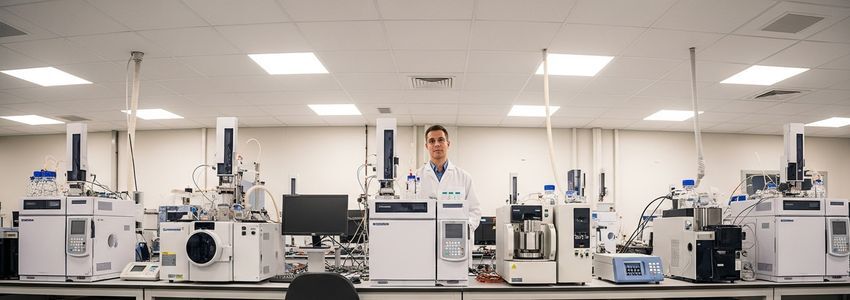
Building an internal testing lab is one of the most strategic investments a growing business can make. Whether you're a manufacturer seeking tighter quality control, a biotech firm accelerating R&D, or an electronics company reducing third-party testing costs, having your own lab delivers measurable competitive advantages. The challenge is the significant upfront cost — equipment, facility upgrades, staffing, and certifications can quickly run into six or seven figures. That's where lab equipment financing and dedicated testing lab loans become indispensable tools for forward-thinking business owners.
In This Article
What Is a Testing Lab Loan?
A testing lab loan — also called lab equipment financing or laboratory facility financing — is a business loan specifically used to fund the creation, expansion, or upgrade of an in-house testing or quality assurance laboratory. These loans cover a wide range of costs including scientific equipment, analytical instruments, environmental controls, furniture, software systems, and leasehold improvements needed to build out the physical space.
Unlike general-purpose working capital loans, testing lab financing is often structured around the useful life of the equipment or the specific expansion project. Lenders evaluate the business's revenue, creditworthiness, and the expected ROI of the lab investment when making approval decisions.
The term "internal testing lab" refers to any on-site facility where a business performs quality control, product validation, research and development, regulatory compliance testing, or materials analysis. Industries that commonly invest in internal testing labs include manufacturing, food and beverage production, pharmaceutical and biotech, electronics, environmental services, construction materials, and medical devices.
Industry Insight: According to the U.S. Census Bureau, the testing and measurement equipment market generates over $32 billion annually in the United States. For businesses that rely on product quality, in-house testing is one of the highest-ROI investments they can make.
Key Benefits of Building an Internal Testing Lab
Before diving into financing options, it's worth understanding why so many businesses choose to fund an internal lab rather than rely on third-party testing services. The financial and operational advantages are substantial.
Cost reduction over time. Third-party testing fees add up quickly, particularly for businesses running high-volume production. A manufacturer that spends $80,000 per year on external lab services can often recoup the cost of building an internal lab within two to three years.
Faster time to market. When you own your lab, you control the testing schedule. Instead of waiting days or weeks for results from an outside provider, your team can run tests same-day or overnight — compressing development cycles and accelerating product launches.
Proprietary data security. For companies developing new products or formulas, sending samples to external labs creates intellectual property risk. Internal testing eliminates that exposure entirely.
Regulatory compliance confidence. Many industries — food, pharma, medical devices, aerospace — operate under strict regulatory frameworks. Owning your testing infrastructure means continuous compliance readiness rather than scrambling before audits.
Competitive differentiation. Businesses with certified in-house labs command more credibility with clients, can offer faster turnaround commitments, and often qualify for higher-margin contracts in quality-sensitive industries.
Ready to Fund Your Testing Lab?
Get fast, flexible lab equipment financing from the #1 business lender in the U.S. No obligation - apply in minutes.
Apply Now →How Lab Equipment Financing Works
Understanding how testing lab financing is structured helps you choose the right product and negotiate better terms. The process typically follows these stages:
Step 1 - Needs assessment and cost projection. Before approaching lenders, document exactly what you need. Break down the project into equipment costs, facility improvements, installation, calibration, staffing, and ongoing supplies. Having a detailed budget demonstrates preparedness and speeds up approval.
Step 2 - Lender selection and application. Depending on your credit profile, time in business, and loan amount, you may work with a traditional bank, an SBA lender, or an alternative business lender. Each has different documentation requirements, timelines, and rate structures.
Step 3 - Underwriting and approval. Lenders will review your business financials including revenue history, profitability, existing debt load, and credit scores. Many lab equipment financing deals are structured as secured loans, using the equipment itself as collateral, which can improve terms.
Step 4 - Funding and disbursement. Once approved, funds are either disbursed directly to vendors (common in equipment financing) or deposited into your business account (common for term loans and lines of credit). Equipment financing typically allows you to take ownership immediately while spreading payments over the useful life of the asset.
Step 5 - Ongoing management. Monthly payments reduce the balance over the loan term. For equipment financing, the loan is tied to a specific asset and ends when the equipment is paid off. For business lines of credit, you can draw and repay revolving capital as lab needs evolve.
By the Numbers
Lab Equipment Financing - Key Statistics
$32B+
U.S. testing equipment market annually
2-3 Yrs
Typical payback period vs. outsourced testing
24 Hrs
Potential funding approval from alternative lenders
100%
Financing available on qualifying equipment
Types of Financing Options for Testing Labs
There is no single "lab loan" product. Instead, several financing structures can fund a testing lab project, and the best choice depends on the scope of your buildout, how quickly you need funds, your credit profile, and your preferred repayment structure.
Equipment Financing
Equipment financing is the most common structure for lab projects dominated by instrument purchases. The lender finances up to 100% of the equipment cost, and the equipment itself serves as collateral. Repayment terms typically range from 24 to 84 months, aligning with the useful life of the equipment. Interest rates vary based on credit quality and lender type.
This structure is ideal for businesses purchasing analytical instruments, centrifuges, spectrometers, HVAC systems for controlled environments, or specialized testing machinery. Because the loan is asset-backed, lenders can sometimes approve applicants with lower credit scores than required for unsecured loans. Learn more about equipment financing options at Crestmont Capital.
Equipment Leasing
Rather than purchasing equipment outright, leasing allows you to use instruments in exchange for monthly payments. At the end of the lease term, you typically have the option to purchase the equipment, return it, or upgrade to newer models. Leasing preserves capital, often provides lower monthly payments than purchasing, and can simplify equipment upgrades in rapidly evolving fields like testing technology. Crestmont Capital also offers equipment leasing solutions for businesses that prefer this structure.
SBA Loans
The Small Business Administration offers several loan programs that can fund lab buildouts. The SBA 7(a) loan is the most flexible, with loan amounts up to $5 million and terms up to 25 years for real estate or 10 years for equipment and working capital. SBA 504 loans are specifically designed for major fixed asset investments including facility improvements and large equipment purchases. SBA loans carry lower interest rates than most alternatives, but the approval process is more rigorous and can take 30-90 days. For more information, visit SBA.gov or explore SBA loan programs at Crestmont Capital.
Business Term Loans
A traditional business term loan provides a lump sum that you repay over a fixed period with set monthly payments. Term loans can fund mixed-cost lab projects that include both equipment and facility improvements — expenses that don't fit neatly into equipment financing. Repayment terms typically range from 1 to 5 years for alternative lenders and up to 10 years for bank loans.
Business Line of Credit
A business line of credit is a revolving credit facility that you draw from as needed and repay as funds allow. For lab projects that unfold in phases — starting with core instruments, then adding advanced capabilities over time — a line of credit offers unmatched flexibility. You only pay interest on what you've drawn, making it a cost-efficient choice for staged investments.
Working Capital Loans
Working capital loans are useful when your lab buildout costs overlap with operational cash needs — for example, if you need to hire lab technicians, purchase reagents and supplies, or fund facility rentals while your permanent lab space is being built out. These loans provide quick cash injection with shorter repayment terms.
Pro Tip: Many lab buildouts benefit from combining loan products. A business might use equipment financing for instruments, a line of credit for consumables and staffing during the startup phase, and a term loan for leasehold improvements. Crestmont Capital can help you structure a financing mix that minimizes total cost.
Who Qualifies for Testing Lab Financing?
Eligibility for lab equipment financing varies by lender and loan type, but most business lenders look at the same core factors. Understanding these criteria lets you prepare a stronger application.
Time in business. Most lenders want to see at least 1-2 years of operating history. SBA loans typically require at least 2 years. Alternative lenders may approve businesses with 6 months to 1 year of history for smaller amounts.
Annual revenue. Revenue requirements vary widely. For equipment financing, many lenders want annual revenue of at least $100,000-$250,000. For larger SBA loans, revenues above $500,000 are typically required. Demonstrate consistent or growing revenue to strengthen your application.
Credit score. Business credit scores and personal credit scores both matter. For SBA loans, lenders typically want personal credit scores of 680 or higher. For alternative lenders and equipment financing, scores in the 600-640 range may qualify, though at higher rates. If your score is below the typical threshold, review what credit score you need for a business loan and take steps to improve before applying.
Business financials. Lenders will request bank statements, profit and loss statements, and tax returns. They want to confirm that your business generates sufficient cash flow to service the new debt. A debt service coverage ratio (DSCR) of 1.25 or higher is typically expected by traditional lenders.
Collateral. For equipment financing, the equipment itself is collateral. For larger loans, lenders may require additional business or personal assets as security. Having collateral significantly improves approval odds and reduces interest rates.
Business plan and ROI justification. For larger lab buildouts — particularly for SBA loans — a well-documented business case showing the expected return on investment strengthens your application considerably. Include projected cost savings from reduced outsourced testing, new revenue enabled by faster product development, and regulatory benefits.
Not Sure If You Qualify?
Our team reviews every application individually. Talk to a Crestmont advisor today - there's no obligation and no hard credit pull to get started.
Get a Free Quote →How Crestmont Capital Helps You Fund Your Testing Lab
Crestmont Capital is the #1 business lender in the United States, offering a full suite of financing options purpose-built for growing businesses. Whether you're funding a $50,000 analytical instrument upgrade or a $2 million turnkey lab facility, we have the products and expertise to structure the right solution.
Our equipment financing programs allow you to fund up to 100% of your lab equipment cost with no large down payment required. Terms range from 24 to 84 months, giving you predictable payments that align with your cash flow. We specialize in industries where testing labs are critical — manufacturing, food and beverage, biotech, healthcare, electronics, and environmental services.
For businesses building comprehensive labs that include facility construction or significant leasehold improvements, our commercial financing programs can cover the full scope of the project. We also offer SBA-backed products for businesses that want the longest repayment terms and lowest rates available.
What sets Crestmont Capital apart is speed. While traditional banks can take 30-90 days to approve and fund a lab loan, our streamlined process can deliver term loan funding in as little as 24-72 hours. For businesses on tight project timelines — racing to bring a new product to market, responding to a regulatory deadline, or expanding capacity ahead of a major contract — that speed translates directly into competitive advantage.
Our advisors understand the technical vocabulary of lab buildouts, which means faster conversations and more accurate loan structuring from day one. Apply online at offers.crestmontcapital.com/apply-now or contact our team at crestmontcapital.com/contact-us to discuss your project.
Real-World Scenarios: Testing Lab Financing in Action
Understanding how other businesses have used lab financing helps clarify which approach may work best for your situation.
Scenario 1 - Food Manufacturer Reduces Outsourcing Costs
A mid-sized food manufacturer spending $120,000 per year on third-party microbiological testing financed a $350,000 in-house lab using a combination of equipment financing and an SBA 7(a) loan. The equipment financing covered analytical instruments and lab benches with a 60-month term. The SBA portion funded HVAC upgrades and cleanroom improvements needed for food safety compliance. Within 26 months, the company had fully recouped the investment through eliminated testing fees.
Scenario 2 - Electronics Company Accelerates Product Development
An electronics components manufacturer had been waiting an average of 12 days for failure analysis results from an external lab. After financing a $175,000 internal testing station through equipment financing with a 48-month term, turnaround dropped to same-day. The company launched two new product lines that year — an outcome they attribute directly to the compressed development timeline enabled by in-house testing.
Scenario 3 - Pharmaceutical Startup Meets Regulatory Requirements
A pharmaceutical startup needed a certified quality control lab before it could file for FDA approval of its first product. The $800,000 project included HPLC instruments, environmental monitoring systems, and a dedicated cleanroom. With no assets to collateralize and only 18 months in operation, the founders used a combination of SBA microloan programs and angel investment to fund the build. Two years after FDA approval, annual revenues exceeded $3 million.
Scenario 4 - Construction Materials Firm Wins Government Contracts
A regional construction materials company wanted to bid on government infrastructure contracts that required certified on-site materials testing. A $250,000 lab buildout financed over 72 months through equipment financing gave them the ISO certification needed. Their first government contract, awarded six months after the lab opened, was worth $2.1 million.
Scenario 5 - Environmental Services Company Expands Service Menu
An environmental services company with strong water testing capabilities used a $400,000 line of credit to add soil and air quality testing to their lab. Rather than draw the full amount at once, they staged equipment purchases over 18 months as client demand grew. The revolving credit structure meant they only paid interest on amounts drawn, minimizing carrying cost during the ramp-up period.
Scenario 6 - Medical Device Manufacturer Achieves ISO Certification
A medical device startup needed ISO 13485 certification to enter the European market. The quality management lab required — including instrument calibration systems and document control infrastructure — cost $650,000. They financed the project using equipment financing for instruments and a commercial term loan for software and facility improvements. ISO certification was achieved in 14 months, opening European distribution channels worth $5 million annually.
Comparing Testing Lab Financing Options
| Loan Type | Best For | Typical Amount | Speed |
|---|---|---|---|
| Equipment Financing | Instrument-heavy projects | $25K - $5M+ | 1-5 days |
| SBA 7(a) Loan | Long-term, lower rates | Up to $5M | 30-90 days |
| SBA 504 Loan | Large facility projects | $250K - $10M+ | 45-90 days |
| Business Term Loan | Mixed-cost projects | $50K - $2M | 1-7 days |
| Line of Credit | Phased buildouts | $25K - $500K | 1-5 days |
| Equipment Leasing | Frequent technology upgrades | $10K - $5M+ | 1-5 days |
For most testing lab projects, a combination approach works best. Equipment financing covers instruments, a term loan handles facility improvements, and a line of credit provides flexibility for ongoing supply and operational needs. Crestmont Capital advisors can help you design an optimal financing stack that minimizes your total cost of capital while meeting your project timeline.
Build Your Lab. Grow Your Business.
Crestmont Capital offers equipment financing, term loans, SBA products, and lines of credit designed for businesses making serious investments in growth.
Start Your Application →Frequently Asked Questions
How to Get Started
Document every cost associated with your lab buildout - equipment quotes, facility improvement estimates, software, and staffing projections. A well-prepared budget speeds up approval and improves your terms.
Complete our quick application at offers.crestmontcapital.com/apply-now - the process takes just a few minutes and there's no obligation.
A Crestmont Capital advisor will review your project and match you with the optimal financing structure - whether that's equipment financing, an SBA loan, a term loan, or a combination approach.
Receive your funds - often within 24-72 hours for equipment financing - and begin your lab buildout. Your in-house testing capability is just weeks away.
Conclusion
Building an internal testing lab is a high-ROI investment that pays dividends for years through reduced outsourcing costs, faster product development cycles, improved regulatory compliance, and stronger competitive positioning. Lab equipment financing makes this investment accessible without requiring large upfront capital expenditure, allowing businesses to preserve working capital while acquiring the capabilities they need to grow.
The right financing structure depends on your project scope, timeline, and financial profile. Equipment financing is ideal for instrument-heavy projects with fast turnarounds. SBA loans offer the lowest long-term rates for established businesses with time to go through the approval process. Business lines of credit provide flexibility for phased buildouts. In many cases, a combination approach delivers the best results.
Crestmont Capital has helped thousands of businesses across manufacturing, healthcare, food production, environmental services, and other industries fund mission-critical lab investments. If you're ready to bring testing in-house, our team is ready to help you structure a financing solution that works. Apply today at offers.crestmontcapital.com/apply-now and take the first step toward building the lab your business needs to compete at the highest level.
Disclaimer: The information provided in this article is for general educational purposes only and is not financial, legal, or tax advice. Funding terms, qualifications, and product availability may vary and are subject to change without notice. Crestmont Capital does not guarantee approval, rates, or specific outcomes. For personalized information about your business funding options, contact our team directly.